
Italy’s Plexiglas Revolution in Postwar Car Design
Postwar Europe: a new material promised to turn ordinary cars into visions of the future. Plexiglas – the trade name for polymethyl methacrylate (PMMA) – had been invented in the 1930s by German chemist Otto Röhm. Chemists had first polymerized methyl methacrylate into a tough, transparent sheet, discovering a plastic that was light, virtually unbreakable, and possessed “almost perfect transmission of visible light”. By the late 1930s it was trademarked in Europe (sold as Perspex in Britain and Plexiglas in Germany) and during World War II both Allied and Axis forces used it for aircraft windshields, canopies, and submarine periscopes. In that crucible of innovation, this acrylic “glass” proved itself: it was as clear as the finest silica, yet far lighter (with less than half the density of real glass) and practically shatterproof (indeed, thick acrylic panels are still used in deep-sea submersibles and aquariums for their strength). It also lacked the greenish tint of automotive safety glass and resisted yellowing even under harsh sun. Little wonder that after 1945, Plexiglas was hailed as a wonder-material – a crystal-clear canvas for designers’ wildest dreams.
No one embraced those dreams more fervently than the Italian carrozzieri, the custom coachbuilders of Italy. Always eager for new ideas, Italy’s design houses saw in Plexiglas the very spirit of futurism. Here was a crystal they could bend and mold into wraparound windscreens, bubble tops, and panoramic roof panels – features straight out of a science-fiction comic. More than a flashy gimmick, Plexiglas also met practical needs in a war-scarred era: it was lightweight (helping cars go faster on less power) and easily formable, aligning with the aircraft-inspired construction techniques many Italian designers already employed.
Ugo Zagato, the legendary coachbuilder trained in aviation, had revolutionized car bodies in the 1920s by building them like airplane fuselages – lightweight aluminum skins over tubular frames. After WWII, seeking even more weight reduction and visibility, Zagato and his contemporaries turned to Plexiglas. By replacing heavy safety glass with broad acrylic panels, they could dramatically cut weight and give drivers an unprecedented panoramic view of the road. Zagato later described his postwar designs as “more spacious and more comfortable greenhouses” – made possible by using “a new material, Plexiglas, in place of the traditional heavy glass.” In their hands, clear plastic became a ticket to the future. The resulting cars looked like they had been plucked from the pages of a futurist novel, perfectly embodying Italy’s postwar aesthetic of innovation.
Yet the romance between Italian designers and Plexiglas was not without nuance. This is the story of that mid-century romance – from early experiments in the 1930s, through the exuberant 1950s era of “bubble tops” and Space-Age dream cars, to the practical lessons learned along the way. We’ll see how Italian coachbuilders used Plexiglas to lift cars from earthbound mundanity into the realm of aviation fantasy, and why ultimately even their wildest plastic dreams were tempered by reality. Buckle up (under a transparent dome, of course) and prepare to look at 20th-century concept cars in a new light – quite literally.
Origins and Early Experiments
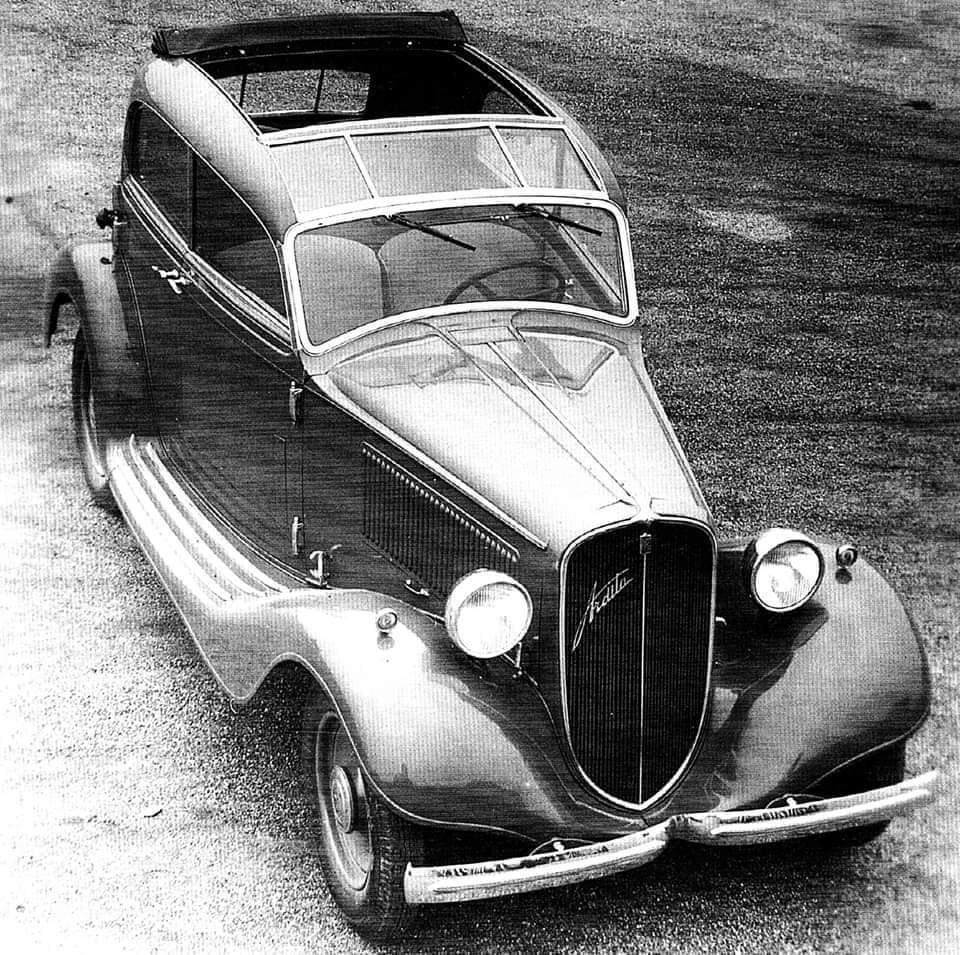
In the early 1930s, Carrozzeria Bertone introduced a concept it called Luminosa (literally “bright” or “illuminated”) on one-off luxury cars. At the 1934 Milan Motor Show, Bertone displayed a Lancia Augusta Berlina described as Superluminosa, designed by Mario Revelli di Beaumont. It featured a patented sunroof system and wraparound “panoramic upper windows” equipped with pull-down anti-glare curtains – an early attempt to create an airy, aircraft-like cockpit for a car A year or two earlier, in 1933, Bertone had tried a similar trick on a Fiat 518 Ardita prototype, essentially extending the windshield into a transparent roof panel. These pre-war experiments were constrained by the materials of the time – safety glass and clever curtain mechanisms – but the intent was clear (no pun intended): dramatically increase outward visibility and sunlight for passengers. As one historian notes, Bertone’s Superluminosa saloon “set a new standard for luxury features” by flooding the cabin with natural light, something unheard of in the closed sedans of that era.
While Bertone was playing with “transparent tops” in the early 1930s, similar ideas were percolating at Stabilimenti Farina and Pinin Farina (later Pininfarina). The term Luminosa appeared in Pinin Farina’s designs as well – for example, a Lancia Artena Luminosa sedan in 1937. All of these fuoriserie (custom coachbuilt) creations hinted at what could be achieved if only glass weren’t so heavy and fragile. Fortunately, material science was advancing in parallel. In 1933, an acrylic formula for Plexiglas was patented in Germany, and by 1935 the first large flat sheets of Plexiglas were being produced. Promotional materials from the mid-1930s already showcased Plexiglas being used for car windshields in a few German prototypes. It’s likely that designers like Revelli and his peers were aware of these developments. By World War II, acrylic glass had proven itself in the harshest conditions – forming the bubble canopies of fighter planes that gave pilots unobstructed 360° views. The stage was set for a postwar leap: what had only been imagined with ordinary glass in the 1930s could, by the late 1940s, be realized with sweeping curves of Plexiglas.
🔗 Read more: Mario Revelli di Beaumont: the first Freelance Car Designer
The concept of the transparent car roof/greenhouse was “in the air” (literally and figuratively) well before any Italian car actually sported a plastic dome. Visionaries like Revelli di Beaumont laid the groundwork with cars like the Lancia Astura Superluminosa – proving there was customer appetite for brighter, airier cabins – and the invention of Plexiglas provided the perfect tool to achieve those aims. As we’ll see next, Italy’s coachbuilders wasted no time in exploiting this new material once the war was over.
Postwar Optimism and Mass-Market Experiments
The immediate postwar period in Italy was a time of optimism, creativity, and hunger for innovation. Coachbuilders big and small were brimming with ideas to make automobiles not just transportation, but symbols of la dolce vita and futuristic style. Plexiglas fit right into this ethos. By the late 1940s, sheets of acrylic were more readily available, and Italian designers began incorporating them into both exclusive show cars and even limited-production specials for the burgeoning auto market.
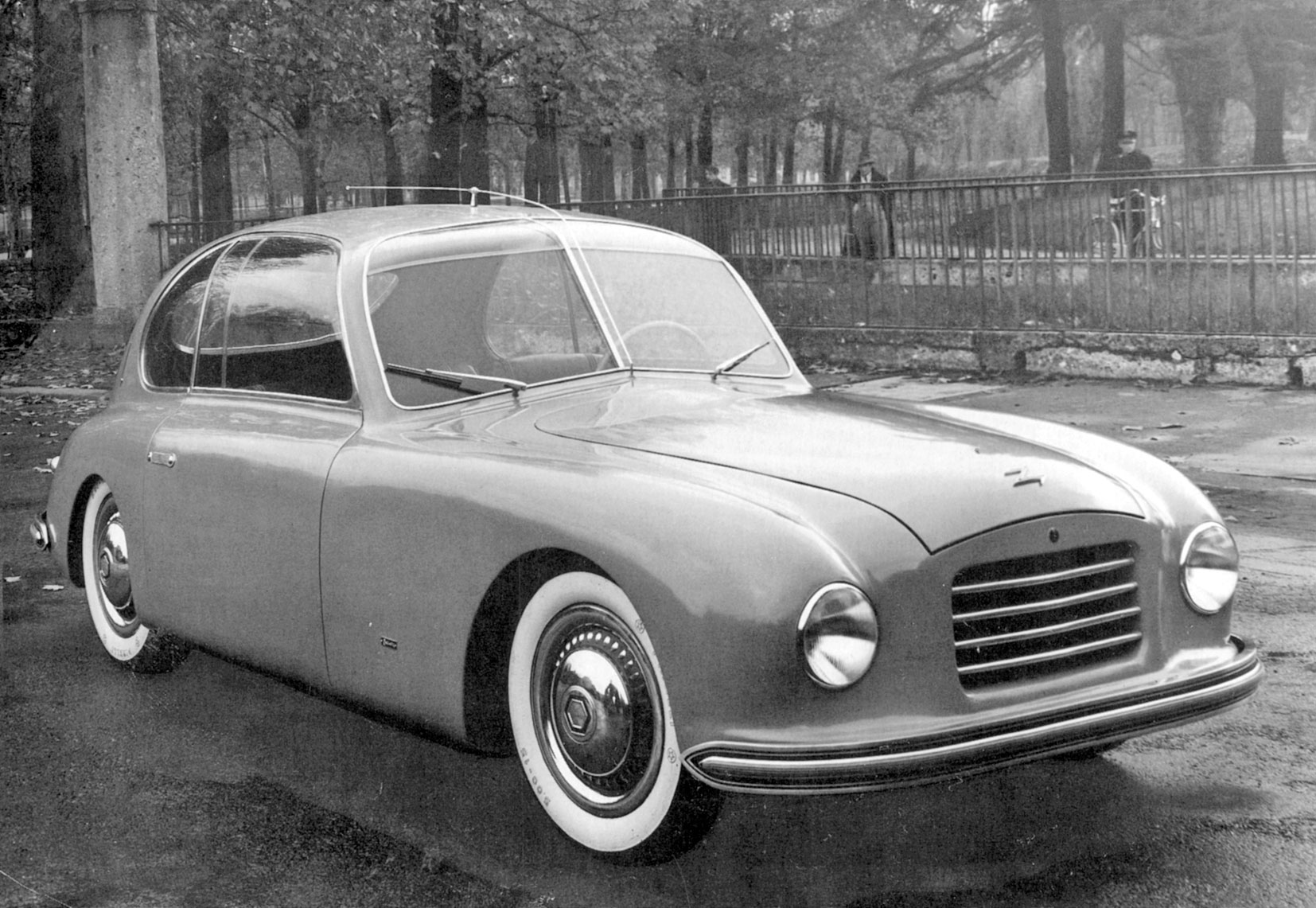
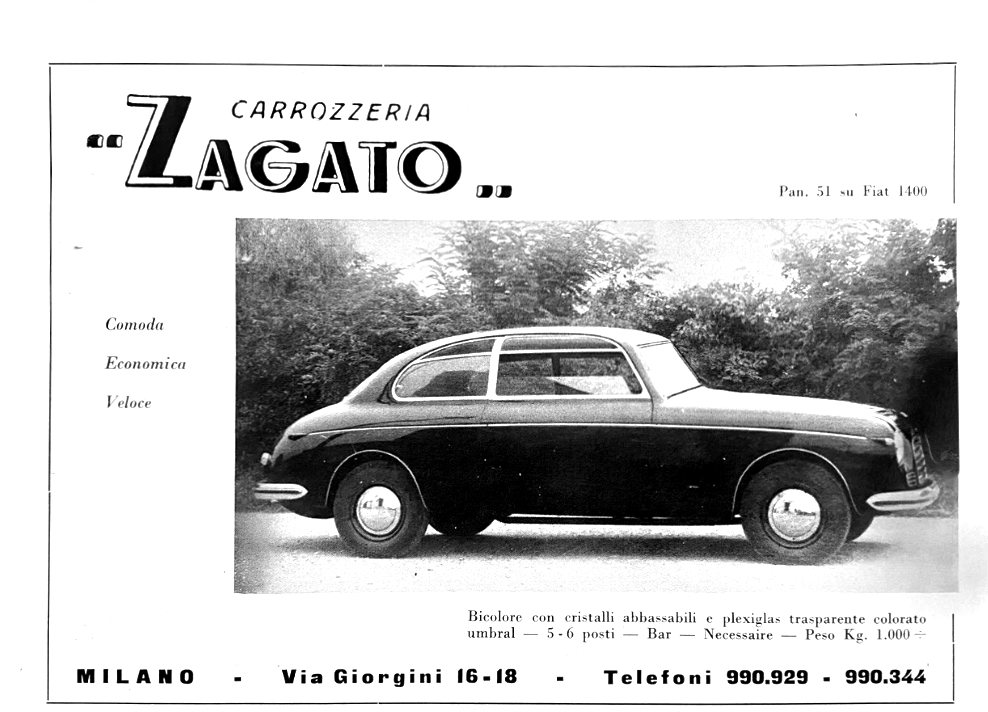
One early adopter was Ugo Zagato, who had survived WWII and reopened his Milan workshop with fresh ideas. In 1946–47 Zagato debuted a series of custom coupés under the name “Panoramica.” These cars – built on humble chassis like the Fiat 500 Topolino and Fiat 1100 – took the earlier Luminosa concept to its next logical step: using Plexiglas to form much of the greenhouse. Zagato’s Fiat 1100 Panoramica (first shown in 1947) featured a roofline raised higher than a standard 1100, with the windshield and side glass flowing in a continuous curve into the roof panel.
Rather than discrete windows, the Panoramica used Plexiglas panels to create a wraparound effect. In fact, the driver and passenger side windows were fixed (non-opening) one-piece acrylic that extended into the roof – giving a seamless, pillarless vista from inside. Ventilation suffered (there was only a small vent or vent wings for air), but Zagato reasoned that the improved visibility was worth it, especially for racing. Period observers described it as akin to “driving in a fast greenhouse” – the car offered an airplane cockpit’s field of view. Zagato applied the Panoramica treatment to a variety of makes: not just Fiats, but also a few Maserati A6 sportscars and even a Ferrari chassis. Ultimately, the approach had aesthetic limitations (the tall domed roof looked a bit ungainly on some cars) and practical ones (lack of opening windows, greenhouse heat), and Zagato phased it out by the early 1950s. But as a proof of concept, it was invaluable – it showed that Plexiglas could fundamentally change a car’s appearance and function, and it established Zagato’s reputation for pushing the envelope. (Interestingly, the lessons from Panoramica directly led Zagato to invent the “double-bubble” roof a few years later – more on that soon.)
🔗 Read more: The Double Bubble Roof by Zagato: A Bump in the Right Direction
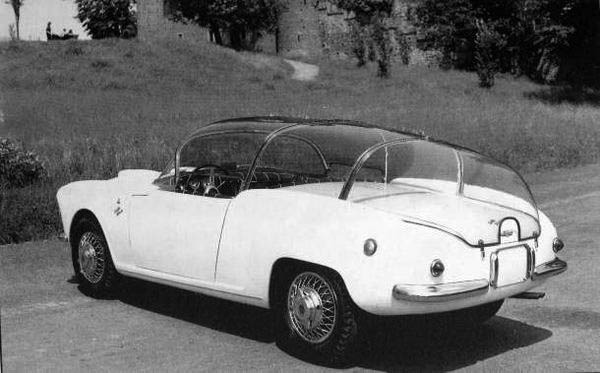
Italian innovators also experimented with Plexiglas in more pedestrian vehicles during the 1950s. A great example is Carrozzeria Francis Lombardi, a coachbuilder in Vercelli, Italy. Lombardi created a special luxury version of the tiny Fiat 600 city car, cheekily named the Lucciola (“firefly”). The most distinctive feature on this micro-saloon was its use of Plexiglas to create an enlarged rear window. This was in 1955 – at a time when even much pricier cars like Cadillacs didn’t have such a feature. While the Lucciola was never high-volume (it cost about 30% more than a standard Fiat 600), it showed how Plexiglas could democratize a bit of the concept-car experience. As one write-up notes, the Lombardi Lucciola “stood out primarily due to its enlarged rear window, replaced with a much larger plexiglass alternative” that gave the tiny car a more refined, airy look. Drivers of even a humble Fiat could literally see more of the world.
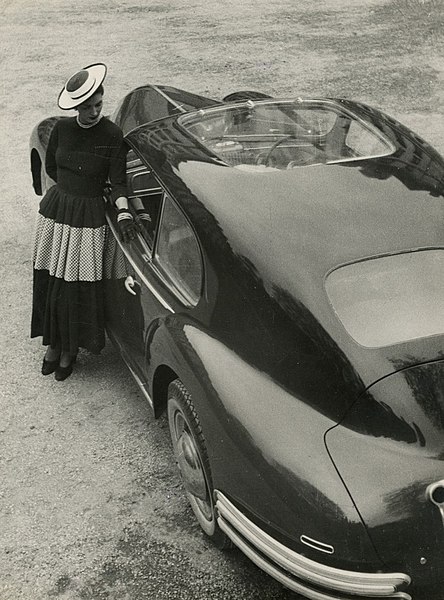
Meanwhile, Carrozzeria Touring of Milan – famed for its Superleggera lightweight bodies – also jumped on the Plexiglas trend. Touring was among the first to employ plexi windows in the late 1940s on its custom coupés. The company even patented an idea called “Aerlux”, which was essentially an integrated Plexiglas sunroof. An Alfa Romeo 6C 2500 Super Sport built by Touring in 1949, for example, featured an original Plexiglas roof insert that earned it the name “Aerlux” (from aria + lux, air and light). Only few of these Aerlux Coupés were made, but they were striking – the clear roof panel let sunlight stream into the cabin, much like modern panoramic sunroofs. Touring applied the Aerlux idea on a handful of chassis (Alfa 6C 2500s, a few Lancias, etc.), making them some of the first production cars in the world to offer a transparent roof from the factory. This was aviation thinking applied to grand touring cars: the Aerlux gave you a bit of a airplane canopy feeling in a gentleman’s coupe. One restored example even noted that a replacement had to be made for its plexiglass roof panel during restoration – a reminder of how novel that was in the 1940s.
🔗 Read more: Aerlux: Carrozzeria Touring’s Window to the Sky
Across Italy, other boutique car builders experimented with Plexiglas in creative ways. In 1948, Giovanni Michelotti and Carrozzeria Balbo crafted the Fiat 1500 “Vittoria” sedan with an enormous wrap-around rear window in plexiglass – a very advanced styling cue for 1948. Small sports-car makers like Stanguellini and Nardi used plexiglass headlight covers on their barchettas. And we can’t forget the wonderful world of one-off show cars that were just around the corner in the 1950s, where Plexiglas would often steal the show. But before we get to the dream cars, let’s look at how plexi made its way into the brutally practical realm of racing and performance specials – where every gram saved and every bit of visibility counted.
Plexiglas in Sportscars and Racing Specials
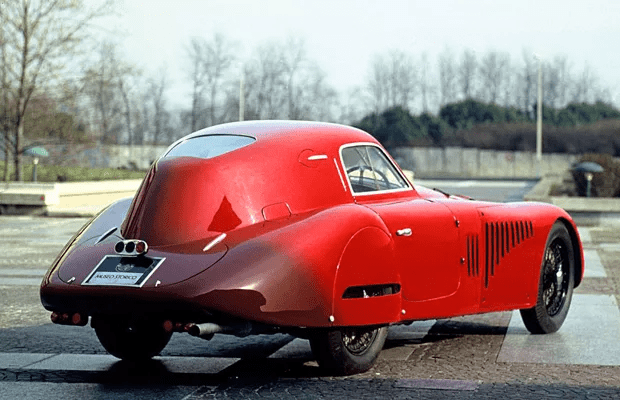
By the early 1950s, using Plexiglas for performance gains was a well-established tactic. Just as aircraft designers loved acrylic for being lighter and tougher than glass, race car builders saw an advantage. In Italy, where many road cars doubled as competition machines for privateers, plexiglass windows became a common trick to shed weight. Perhaps the earliest notable example is the Alfa Romeo 8C 2900B Le Mans Speciale of 1938. This fabulous Alfa coupe, bodied by Touring for the 24 Hours of Le Mans, was one of the first closed-cockpit racers of its era – and Touring’s engineers pulled out all the stops to save weight. The body was hand-formed aluminum over a light tubular frame (the famous Superleggera method), yielding a shell of only 180 kg. To push things further, all the side and rear windows were made of Plexiglas instead of glass. As one source notes, “the body was aluminium and all glassware except the windshield was plexiglass, in true Superleggera spirit.” This reduced weight up high on the car and eliminated the risk of shattered glass on track. The 8C 2900B went on to lead Le Mans for many hours before mechanical failure stopped it – but it proved the efficacy of those choices. (It’s sobering to realize this was 1938, and that same car’s acrylic windows survived into its restoration – a testament to the durability of quality Plexiglas.).
By the 1950s, Alfa Romeo was doing something similar on a smaller scale. Their first postwar sports car for the masses, the Giulietta Sprint Veloce, had a special racing version called the Alleggerita (Italian for “lightened”) in 1956–57. Bertone, who built the Giulietta bodies, put these coupes on a diet for private racing customers. They used thinner-gauge steel for the body panels, alloy in place of iron for parts like the bumpers and trim, and crucially replaced the side and rear glass with Plexiglas panes. The Giulietta Alleggerita’s side windows weren’t just plexi; they also slid open horizontally (with simple straps or latches) instead of winding down with a crank mechanism. This eliminated the heavy steel window frames and winding apparatus altogether. The result was a 150 lb weight reduction in the little Giulietta, a difference drivers could definitely feel. With their plastic windows, these Alleggeritas went on to great success in European touring-car races. In the same spirit, Alfa also built a handful of Giulietta Sprint Speciale prototypes with extreme lightweight features – one, built by Michelotti and nicknamed the Giulietta Goccia (“drop”), had sliding plexiglass windows and no rear seat, more racecar than road car. Italy’s tuners and gentlemen racers quickly embraced plexiglass: if you couldn’t afford a special factory build, you might retrofit your own car with plastic side windows or headlamp covers for competition. Even the humble Fiat 600 and 1100 sedans, when prepped for the Mille Miglia or other races, often had their heavy safety glass swapped for plexi panes taped in place.
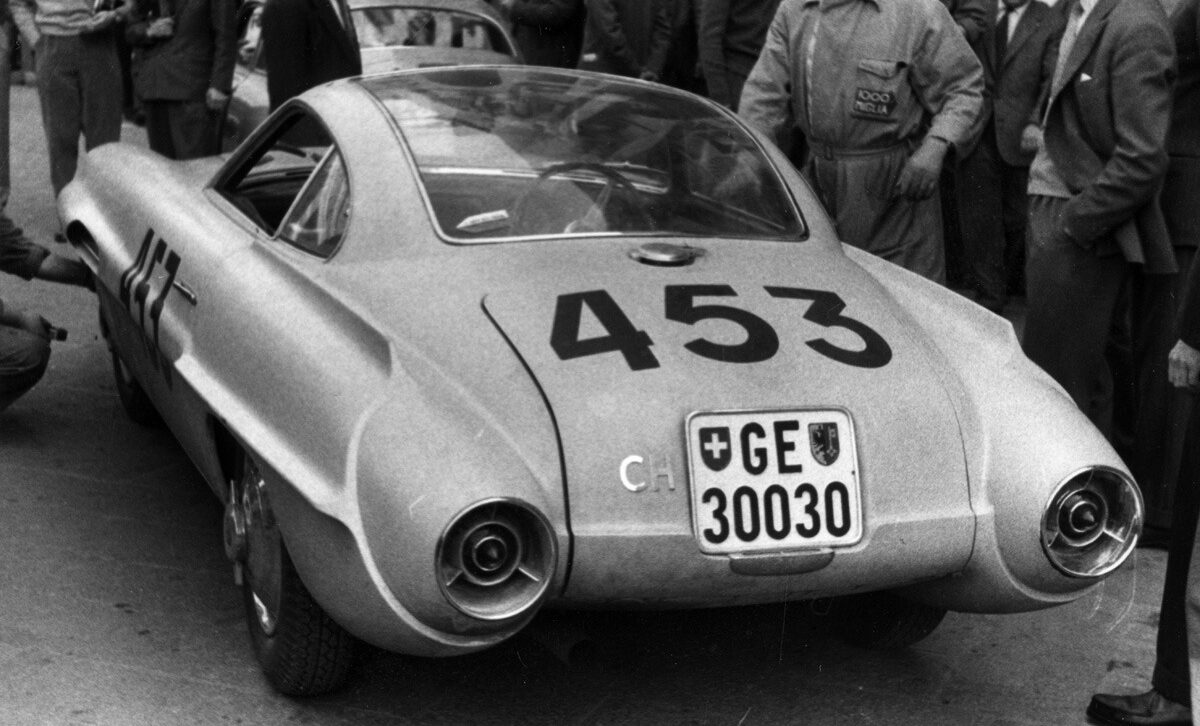
One Italian sports car where plexiglass played a starring role (literally) is the 1955 Panhard Dyna 750 Coupé by Allemano. This was a Franco-Italian hybrid: a lightweight aluminum-bodied coupe on a French Panhard chassis, bodied by Allemano in Turin for racing in the sub-750cc class. We mention it here because Allemano went to extremes to save weight – not only an all-alloy body, but also plexiglass side windows to shave those last few kilos. The result was a feathery 550 kg ca that punched well above its weight, even earning respectable finishes in the Mille Miglia against far larger cars. In an era when many small racers simply ran with no side windows (or tiny aeroscreens), the Panhard Allemano’s use of Plexiglas meant the driver could have a fully enclosed cabin with minimal weight penalty. As the Vehicle Overview dryly noted, this was “a solution that saved further weight” – purely functional, yet it incidentally gave the car a very modern, “jet canopy” appearance with its curved one-piece side glass.
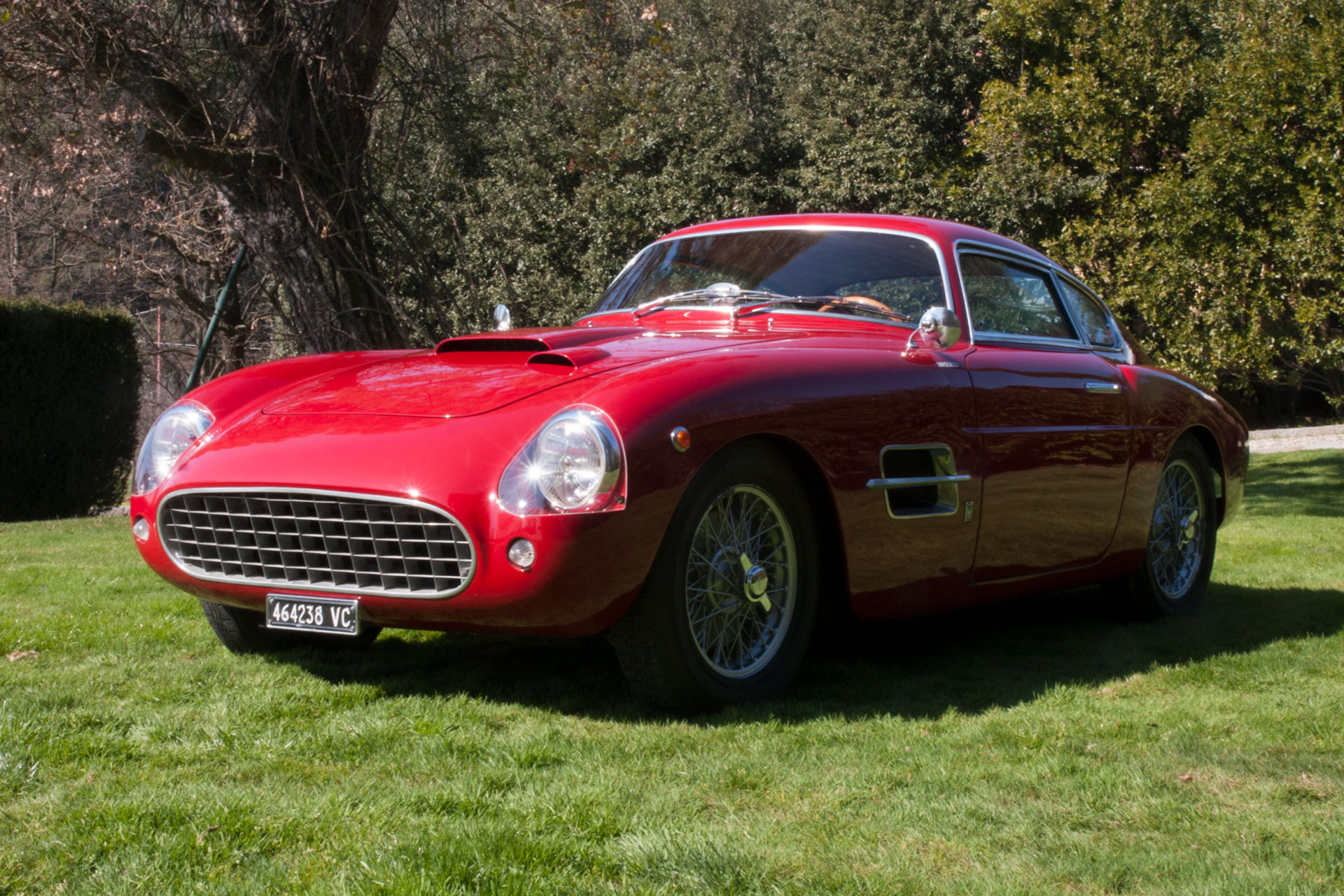
Of course, plexiglass wasn’t only used for windows. Italian designers also found uses in other areas of competition cars. One famous modification was on a Fiat 8V (Otto Vu) private race car in the mid-1950s: the owner (the grandson of Fiat’s founder) had the car’s front headlights redesigned with streamlined, aerodynamically hinged plexiglass covers that could flip up when needed. This kind of idea – enclosing headlights behind clear covers – became very popular by the late ’50s on sports cars and GTs for both aesthetics and aero reasons. In fact, the practice continues to this day (though modern headlamp covers are polycarbonate, a close cousin of PMMA). Many a 1950s Ferrari, Maserati, or Alfa had plexiglass faired-in headlamp covers, either from the factory or added by owners, to give that Le Mans racer look. Michelotti even designed a few one-offs (like a Ferrari 212 Export coupe) with uniquely shaped plexi covers over rocket-inspired triple headlamp arrangements. And speaking of rockets – we should mention one more delightful footnote in racing: transparent engine covers. The 1954 Alfa Romeo 2000 Sportiva (a Bertone-bodied prototype) and some mid-engine racers in the ’60s experimented with small plexiglass windows in the engine cover so spectators could view the carburetors or cam covers at work. This was a harbinger of things to come decades later (think Ferrari F40’s clear engine lid panel in 1987), but Italians were playing with the idea much earlier.
🔗 Read more: Carrozzeria Allemano: The Coachbuilder That Redefined Elegance
All these racing and sports specials proved that Plexiglas was more than a styling fad – it was a technical solution too. If you needed to make a car faster, lighter, more agile, acrylic windows made sense. And if you needed to give a driver an edge – a better view of an apex or the competitors around them – a wraparound plexi windshield could be the answer. From the Mille Miglia to Le Mans, the 1950s saw plenty of plastic on the track. But it was at the auto shows and design studios back in Italy that Plexiglas truly blossomed into an art form. The material’s ability to be shaped like taffy into wild curves was about to meet the unbridled creativity of the Space Age. The result? Some of the most fantastical dream cars ever built.
Plexiglas as Showpiece in Dream Cars & Concepts
If Plexiglas gave race cars a competitive edge, it gave concept cars pure star power. The 1950s and early ’60s were the golden age of wild, one-off “dream cars” – and Italian coachbuilders were at the forefront, often working with American automakers as well as domestic ones. In these flights of fancy, Plexiglas was used to create the jaw-dropping design flourishes that had crowds five-deep around the show stand. Italy’s carrozzieri blended Space-Age optimism with Mediterranean flair, and Plexiglas was their material of choice to suggest rocket ships, jet fighters, and spacecraft in automotive form. Let’s tour a few of the highlights.
On both sides of the Atlantic, the early ’50s saw designers toying with transparent canopies on cars, directly mimicking fighter-plane cockpits. In Italy, the most famous example is the Ghia “Supersonic” series. This design, penned by Giovanni Savonuzzi at Carrozzeria Ghia, first appeared on an Alfa Romeo 1900-based special in 1953 – the one that ran (briefly) in that year’s Mille Miglia. Savonuzzi gave the car a truly aviation-inspired roof: a very low, compact cockpit with a wraparound windshield and a large curved rear window in Perspex that extended nearly to the roof’s apex. It looked for all the world like a fighter jet canopy grafted onto a sports car. Journalists in Turin were stunned; the Supersonic coupe, as it was dubbed, appeared ready to take off for the moon. One report marveled at the “ultra-long wraparound rear window of the Alfa prototype (the Perspex dome reaching the windshield)” which made the interior light and airy. Unfortunately, that particular Alfa Supersonic coupe was wrecked during the race (proving perhaps too futuristic for the real world). But the design itself rose like a phoenix: Ghia quickly adapted the Supersonic styling for a limited run of Fiat 8V Supersonic road cars in 1954–55. On those, the Perspex “bubble” rear window was slightly toned down for production – but still impressive. As Classic Driver magazine describes, “the rear window/roof was covered by a large, curved Perspex panel to create a light interior” on the Fiat 8V Supersonic. It was not a removable bubble like an American hot rod, but a fixed part of the body – essentially the first panoramic rear windshield of its kind. The Fiat 8V Supersonics (about 14 made) helped spread the gospel of Plexiglas: car collectors around the world saw and desired those plexi domes.
🔗 Read more: Ghia Supersonic: The Space-Age Icon on Wheels
Ghia wasn’t done. They had caught “bubble fever,” and even in collaboration with American companies they kept pushing the idea. One legendary show car built by Ghia for Ford was the 1955 Lincoln Futura, a concept that later found fame as TV’s Batmobile. Built in Italy by Ghia’s craftsmen, the Futura was “arguably the most famous show car ever built” and it absolutely glowed – literally – thanks to its wild canopy. The Futura sported not one but two clear domes over each seat, forming a double-bubble roof that was electrically retractable. The 1955 Lincoln Futura concept (built by Ghia in Turin) featured twin Plexiglas canopies. Originally pearl-white, its space-age “double bubble” roof foreshadowed the Jetsons era and later became iconic as the Batmobile. This extravagant feature was pure Jet Age theater: when the Futura was unveiled (painted pearlescent white, with a glowing-blue interior), crowds in Chicago and Detroit could scarcely believe it. The clear canopies allowed an unobstructed view of the futuristically styled interior, and when retracted, gave the impression of a convertible spaceship. It was a pure fantasy – yet it worked reliably enough for Ford to tour the car extensively. The Futura’s domes were plexiglass, of course, since no technology existed then to do such forms in safety glass. In fact, Ford’s own advanced 1953 concept, the XL-500, had a big bubble canopy that the press release claimed was glass; one designer quipped “I don’t think the technology existed in 1953 to create this top out of glass… I’m guessing it was plastic, probably Plexiglas”. He was right. Plexiglas was tops – automotive style.
Turin, 1954. The Auto Salon floor hums with chatter when Carrozzeria Monviso unveils a Fiat 1100 like no other. Giovanni Michelotti has transformed the modest sedan into a shooting star — literally, the Stella Filante. Its party trick was the roof: not painted steel but a removable Plexiglas canopy, latched in place with aeronautical hooks. With the dome on, the cabin glowed with daylight; with it off, the car became a breezy open-top years before “targa tops” were invented. The idea was radical, and the crowd loved it. Production never followed, but the Stella Filante proved Plexiglas could be more than a gimmick. In Michelotti’s hands, it turned a humble Fiat into a vision of the future.
A year later, in 1955, Enrico Nardi and Michelotti doubled down on space-age drama. Their Raggio Azzurro I, built by Vignale, looked half car, half jet. A wide grille with three headlights suggested a turbine intake, while twin fins swept back like wings. Most striking was the blue Perspex canopy, a double-bubble roof with sliding tinted panels and an air scoop feeding the cockpit. Inside, the light was otherworldly, as if you’d stepped into a spaceship. Under the skin, it was serious business: a tubular racing chassis, Lancia Aurelia V6, and advanced suspension. But what people remembered was the glow of that plexi dome. Shown in Turin, then Paris and New York, the Raggio Azzurro became a rolling emblem of Jet Age imagination — a dream in blue plastic and aluminum.
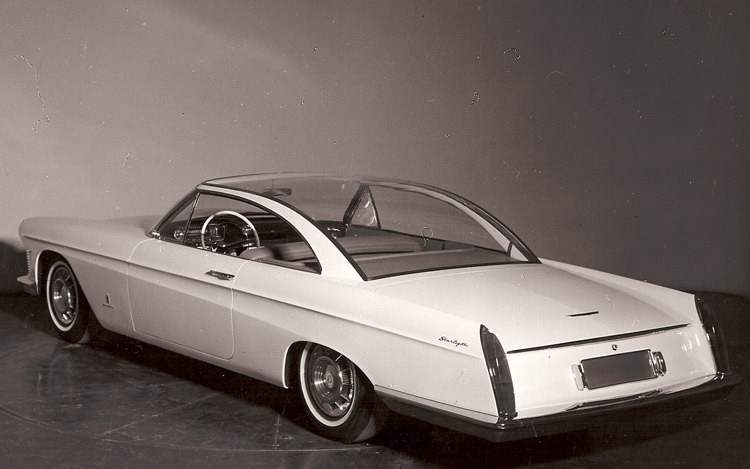
In the late 1950s, Italian designers explored dramatic uses of glass in car design. In 1959, Pinin Farina (Pininfarina) collaborated with Cadillac on a series of ultra-luxury concepts. The most striking was the Cadillac Starlight, unveiled at the Paris Salon in October 1959. It featured an expansive transparent roof that gave the cabin a futuristic, glass-domed character, highlighting Cadillac’s ambition to pair Italian elegance with American scale and presence.
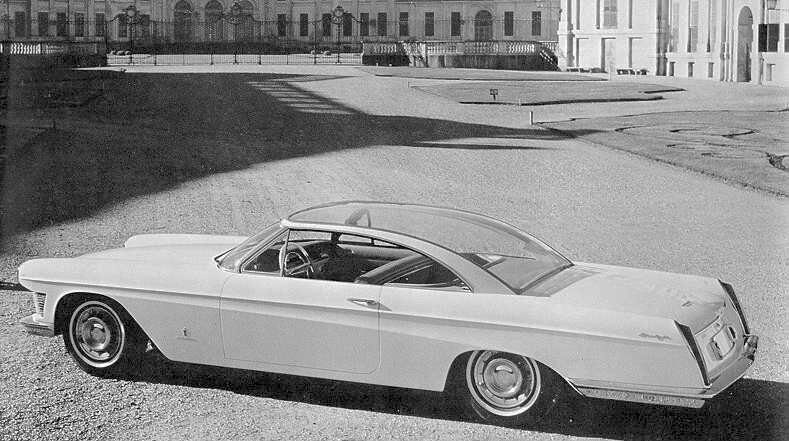
The Starlight was a two-door hardtop that took the idea of a see-through roof to its zenith: it had a single-piece curved roof made entirely of Plexiglas. Where a normal car would have a metal roof panel, the Starlight had a huge clear bubble canopy from windshield header to rear turret. When sunlight poured through, the cabin was flooded with daylight; at night, you could gaze up at the stars – hence the name. Reviewers called it “beautiful” and ingenious. To solve the heat and glare problem, Pininfarina equipped the Starlight with a set of four articulated metal sunshade panels inside, which could slide out to cover the plexi roof when desired. It was an elegant solution: you could have a fully open-glass experience, or a fully covered roof, or anything in between. Contemporary press noted that this “ingenious headliner” of folding metal plates stowed away neatly when not needed. The Starlight was truly the pinnacle of the Plexiglas-roof era – and perhaps its swan song, as by the early ’60s, safety and practicality concerns meant such features remained concept-only. (GM itself experimented with a few “bubble top” Motorama cars in the ’50s, and Ford produced a limited run of 1954–56 Mercury and Ford models with half plexiglass roofs – but customer reception was mixed, as many found the cabins too hot, even with tinting. Only 1,791 Mercurys with plexi roofs sold in 1955, and the option was dropped thereafter.).
Beyond full canopy roofs, Italian designers found other creative ways to incorporate Plexiglas into concept cars. In the mid-1950s, Pininfarina undertook a series of radical show cars on the sporty Alfa Romeo 6C 3000 CM chassis. These were the Super Flow I, II, III, and IV concepts (1956–1960) – each evolving the last, and each experimenting with transparent elements. The first iteration, Super Flow I (1956), was perhaps the most extreme. It featured a low, aerodynamic berlinetta body with a sloping plexiglass roof and, astonishingly, transparent plexiglass front fender covers over the wheels. The front wheel arches were enclosed in clear bubbles, allowing onlookers to see the suspension and wheels in motion. It was a bold stylistic choice, meant to showcase technology (disc brakes, etc.) and also test aerodynamics. Ultimately, those plexi wheel covers proved impractical – they tended to fog or get dirty, and Super Flow II reverted to metal fenders – but the idea left a lasting visual impression.
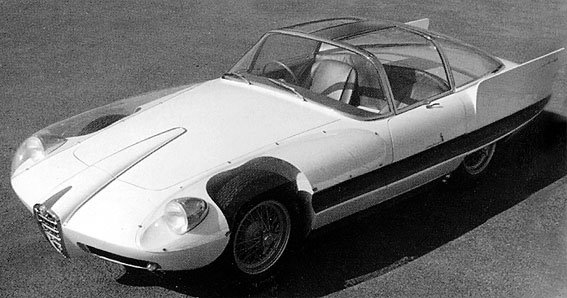
By the time of Super Flow III and IV, Pininfarina had shifted the plexiglass to other roles: the later versions sported tall vertical tailfins whose upper sections were made of clear plexiglass (illuminated at night for a dramatic effect), and one version had a plexiglass roof panel with gullwing-style hinged sections. Pininfarina was clearly infatuated with transparency as a design language – using clear panels to reduce visual mass or add futuristic flair. The Super Flow series culminated in the 1960 Alfa Spider Superflow IV, which had a mostly open-top with a wraparound windscreen and removable plexiglass panels – essentially an early targa top concept. Summing up these experiments, one author noted that “Pinin Farina’s fascination with transparency continued in another form… taller tail fins incorporating plexiglass upper elements” in those later Super Flows. The legacy here was not about production feasibility, but about establishing a visual language of the future: one in which glass (or its plastic surrogate) could seamlessly integrate into bodywork.
Emerging from the same experimental spirit that produced the Superflow series, Pininfarina’s collaboration with Abarth resulted in two compact, forward-looking concept sports cars based on the Fiat 850. The 1000 Spider and Coupé Speciale (1964), headlamps encased within a seamless transparent cover—an embodiment of form over function, made all the more dramatic through Carello’s lighting integration.
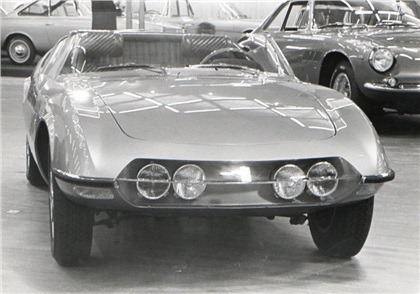
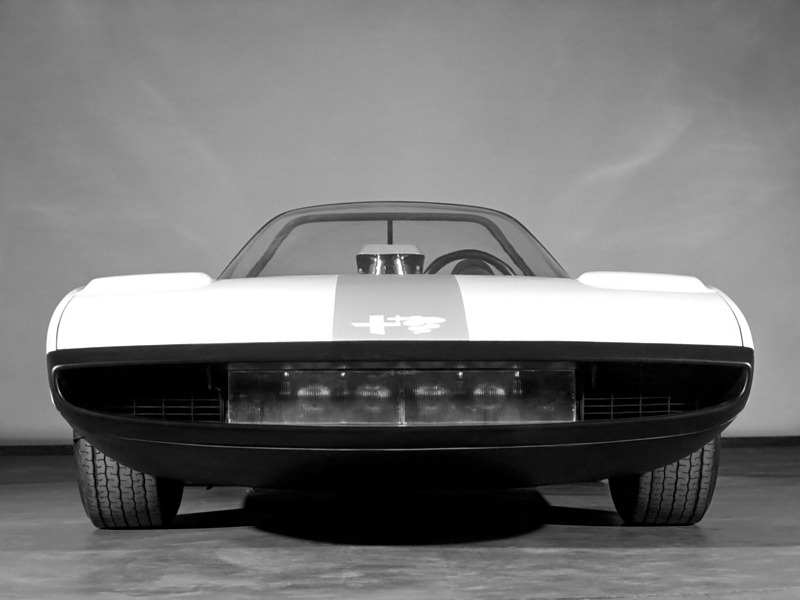
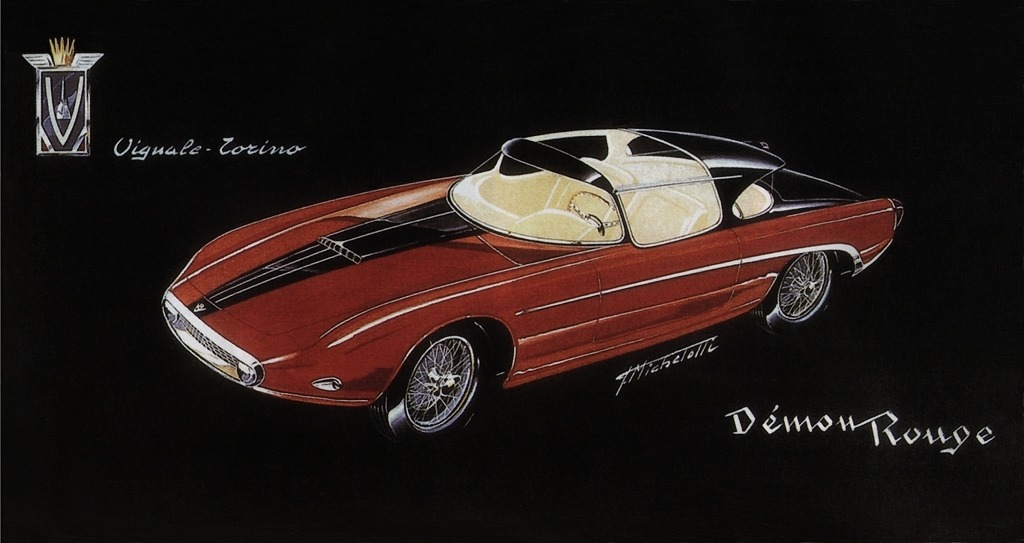
Other Italian studios played with similar themes. Carrozzeria Vignale, under the eye of designer Giovanni Michelotti, often put on dramatic displays at the Turin and Geneva shows. In 1953, Vignale showed a Fiat 8V nicknamed Demon Rouge that featured a panoramic plexiglass roof insert and an expansive curved windshield – giving it a flying-bubble look. By the late ’60s and early ’70s, plexiglass would resurface in concept cars as hidden details: for instance, Pininfarina’s 1971 Alfa P33 Cuneo (a wedgy barchetta) hid its headlamps behind a full-width Plexiglas panel on the nose, giving a perfectly smooth front when the lights were off. That idea – flush plexiglass nose panels – became common in show cars (and eventually some production cars with pop-up lights). In short, designers learned they could use acrylic not only for big obvious canopies, but also for trim and accents: translucent fin caps, light covers, illuminated logos, interior partitions, etc. Plexiglas added an element of surprise and delight.
🔗 Read more: The Fiat 8V Demon Rouge: Michelotti’s Red Devil
One particularly charming use of plexi was on the Nash “Palm Beach” concept (1956, by Pininfarina for Nash of the U.S.). While the car was a conservative two-seat roadster in many respects, it had an unusual set of thick Plexiglas bumperettes at front and rear, inset with the car’s lamp assemblies. These clear acrylic blocks gave the illusion of chrome bumpers (from a distance) but lit up with parking lights and turn signals from within – a very imaginative styling trick that echoed Virgil Exner’s “push-button” transparent taillights on the Chrysler Norseman concept the same year. Such whimsical details showed how plexi could be structural (able to act as a bumper) and decorative simultaneously.
Interiors and the Plexiglas Touch
Italian coachbuilders were among the first to bring Plexiglas inside the car, where transparency became a sign of modern elegance. Carrozzeria Castagna led the way with its Vistotal models, derived from Labourdette’s 1935 Vutotal patent. Known for their frameless, full-vision windshields, these cars carried the theme into the cabin: the 1950 Fiat 1100 E Vistotal, now preserved at Museo Nicolis, sported a Plexiglas steering-wheel rim together with crystal-clear knobs and handles. Contemporary reports singled out these details: “volante con corona in plexiglas trasparente, lo stesso materiale con cui sono realizzati i pomelli e le maniglie interne.” The result was a harmonious design—clarity outside, clarity inside.
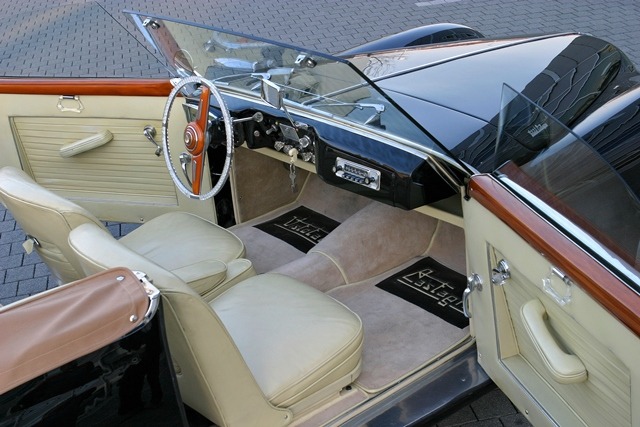
A year later, Ghia explored similar ideas on the 1951 Fiat 1100 E “Supergioiello” Coupé, styled by Giovanni Michelotti. Though outwardly a refined GT, its interior sparkled with whimsical Plexiglas details: a transparent wheel rim, jewel-like knobs, even an acrylic ignition key handle. These touches echoed Virgil Exner’s taste for translucent plastics in concept cars, a trend Ghia had already embraced in its Chrysler show cars like the 1954 Dodge Firearrow. In the Supergioiello, the effect was jewel-box modernity—an elegant balance of tradition and futurism.
The same fascination appeared in other postwar one-offs. A notable example is the Lancia Astura Cabriolet by Stabilimenti Farina, a one-off built on chassis 3271 in 1946–47. Re-bodied on a long-wheelbase third-series Astura chassis from the 1930s, this car blended prewar underpinnings with postwar styling and transparent interior flourishes. Recently shown at the 2025 Pebble Beach Concours d’Elegance, it stands as a reminder that even immediately after the war, Italian designers were already experimenting with Plexiglas to inject lightness and modernity into both form and touch.
Together, Castagna, Ghia, and Stabilimenti Farina reveal how Italian carrozzieri treated Plexiglas not just as a structural or styling material, but as a way to make the driver’s very interaction with the car—through wheel, knobs, and handles—feel futuristic.
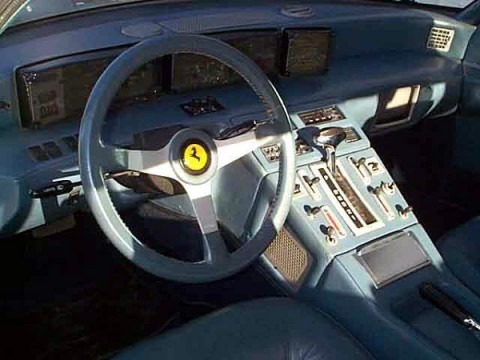
Fast forward to the 1980s, and plexiglass popped up again in a very different interior: the dashboard of the one-off 1983 Ferrari Meera S. This car, a heavily customized Ferrari 400i designed by Michelotti for a Middle Eastern prince, featured a radical digital instrument panel housed in three separate transparent Plexiglas pods on the dash. Each of these clear boxes contained electronic gauges and circuitry, visible in plain view – the idea being to emphasize the high-tech nature of the car by literally showing off its electronics under plexiglass. Contemporary photos show a truly sci-fi cockpit: three arcing clear modules with LED readouts and circuit boards inside, looking like something from Tron. While the Meera S remained unique (and in fact, during a later restoration, that digital dash was removed in favor of a stock Ferrari dash), it’s a great example of plexiglass used in interior design to convey modernity. It anticipated the later trend of clear engine covers and even today’s glass floor panels in hypercars (e.g. the Ford GT’s see-through engine start button or Pagani’s glass gear linkages). In the Meera S, it was perhaps a bit ahead of its time – the world wasn’t quite ready for transparent dashboards – but it certainly made a statement about the marriage of design and technology.
Even practical competition-focused interiors saw benefits. Many racing cars in the ’50s and ’60s had Plexiglas wind deflectors and visors inside, or clear rally map lights. The 1957 Cadillac Eldorado Brougham “Starlight” concept we discussed not only wowed with its roof, but inside had four folding metal sunshades precisely because of that plexi roof, showing how even interior mechanisms had to adapt to the new material.
Why Plexiglas Mattered
Looking back, it becomes clear that Plexiglas was never just a novelty, but a true enabler of mid-century innovation, sitting at the crossroads of engineering and imagination. Its first gift was lightness. In a time when every kilogram mattered—whether on the delicate balance of a postwar city car or in the pursuit of speed on the Mille Miglia—Plexiglas gave coachbuilders an easy advantage. Half the weight of glass, it could trim dozens of kilos from the uppermost parts of a car, lowering the center of gravity and sharpening performance. One only needs to think of the Giulietta Alleggerita, its side and rear panes swapped for plastic, shedding nearly seventy kilos in the process; or of Touring’s Alfa 8C 2900, its sweeping plexi windows making the difference between merely light and almost ethereal.
But weight was only the beginning. Plexiglas could be shaped in ways glass simply could not. While mid-century safety glass could manage only gentle bends, acrylic could be coaxed into bubbles, domes, and flowing canopies. A single sheet could be heated and blown into a fantastical roof, or draped to form a wraparound windshield that seemed lifted from a jet fighter. As Giugiaro later remarked about the bubble-tops of the 1950s, the technology did not exist to achieve such curves in real glass—only plastic could oblige. In the hands of Italian stylists steeped in Space Age optimism, this freedom translated into cockpits that felt airborne, cars that looked poised for orbit.
Clarity was another of its charms. High-quality cast acrylic transmitted more light than glass and lacked the greenish hue of the era’s laminates. A Plexiglas canopy offered a crystalline, almost invisible barrier between driver and sky, turning a coupe into a sun-flooded observatory. Better yet, it resisted yellowing under the Mediterranean sun, promising that its brilliance would endure.
Strength, too, played its part. While it scratched more easily than glass, Plexiglas did not shatter into shards. Wartime pilots had trusted it in their canopies because it absorbed impact without exploding into their faces, and designers borrowed that confidence. A bubble roof might flex, but it would not crumble. Even its pliancy proved useful: the twin domes of the Lincoln Futura sealed neatly against one another precisely because the material could give and bend, something glass would never tolerate.
For the artisans of Milan and Turin, there was also a practical allure. Producing a complex curved windshield in glass required expensive molds and industrial ovens—out of reach for a small atelier building a handful of cars. Plexiglas, by contrast, could be shaped with ingenuity and a good wood form. It gave coachbuilders the freedom to prototype their wildest ideas without waiting for the glass industry to catch up. This democratization of experimentation explains why so many of the most daring transparent roofs and windows appeared on one-offs and show cars rather than production sedans.
🔗 Read more: The Panoramica by Zagato
And beyond all this, Plexiglas carried with it the sheen of modernity. Born of wartime chemistry, employed in aircraft and rockets, it became shorthand for the future itself. To crown a car with a clear dome was to declare it advanced, an object not of today but of tomorrow. Just as chrome signaled atomic optimism, Plexiglas embodied the dream of the Space Age. In the words of one historian, Italian coachbuilders of the 1940s and ’50s “defined automotive elegance” through a marriage of technical ingenuity and artistic flair—and their embrace of Plexiglas, shaping it into forms the world had never seen, was among their boldest expressions of that philosophy.
Limitations and Decline
For all its virtues, Plexiglas was not a miracle solution for everyday cars. As the 1960s dawned, many of the wild plexi innovations of the ’50s were dialed back or disappeared, even from show circuits. Why? In part because limitations became apparent, and in part because automotive technology (and regulations) caught up in other ways.
One major issue was scratch resistance and longevity. While top-grade PMMA doesn’t yellow, its surface is softer than glass and can get hazy or scratched from dust, wipers, or cleaning if not careful. On a show car that’s handled with white gloves, that’s fine. But on a daily driver, a plexiglass windshield might need regular polishing or replacement to maintain clarity. We can imagine, for example, if Mercury had continued its plexiglass-roof “Sun Valley” line into the late ’50s, warranty claims would mount as those roofs got scuffed or owners complained of upkeep. Traditional safety glass, by contrast, is very hard and stays clear (unless it breaks). By the early ’60s, some makers did introduce curved glass panels (e.g. the 1960–61 Thunderbird had a large curved backlight, made in real glass thanks to better manufacturing) that gave a similar panoramic effect with less maintenance. In short, the rise of complex curved safety glass gradually eroded Plexiglas’s styling advantage.
Heat and comfort were another issue. Those futurists quickly learned that a transparent roof is glorious in fair weather and greenhouse-like in hot sun. The experimental Ford and Mercury models with partial plexi roofs (the 1954 Mercury Sun Valley and Ford Skyliner) taught a lesson: despite a light green tint, they made the interior uncomfortably hot on sunny days, and many buyers were not fans of wearing sunglasses and hats in their cars. Ford sold about 13,000 Skyliner plexi-roof models in 1954, but for 1955 Mercury cut back to under 2,000 units, and by 1956 the option vanished (only 603 made for Ford that final year). It was a fad whose practicality didn’t pan out for mass use. In Italy, such cars were mostly one-offs or very limited, so consumer feedback was less of an issue. But even so, coachbuilders recognized the comfort trade-offs. Pininfarina’s Cadillac Starlight addressed it with sunshade panels – clever, but also an admission that a plexi roof alone isn’t viable in all climates. Zagato’s Panoramicas suffered from stale air and heat buildup due to fixed windows. The flashier American bubble-tops like GM’s Motorama cars had air conditioning units (novel at the time) to counteract the sun – an expensive solution. In everyday European use, something like the Francis Lombardi Lucciola’s plexi roof was likely sweltering in summer (imagine a tiny Fiat 600 with no AC and a plexi rear window – basically a terrarium!). Thus, practicality reared its head.
There were also safety regulations looming. In the 1960s, standardized rules for safety glass (laminated windshields, tempered side glass, etc.) became more stringent in Europe and the U.S. Plexiglas, being a rigid plastic, doesn’t meet those regulations – it doesn’t shatter into harmless pieces like tempered glass, and it can deform in ways that might be dangerous to occupants (sharp edges, or popping out of seals in a crash). Today we have advanced polycarbonates with coatings that are DOT-approved for limited use, but back then, it was easier for automakers to avoid plastic for any critical windows once regs came in. Even headlight covers: by the mid-1960s, U.S. law required sealed-beam headlights with no covers, which killed off the plexi-covered headlamp trend on American models (European cars still used them into the ’80s, however, until plastic lens technology improved). So, legal standards contributed to Plexiglas’s decline in production cars.
Another limitation was that Plexiglas could be expensive and tricky to work with in production. Small studios managed fine, but scaling up to hundreds or thousands of units, maintaining consistent optical quality, dealing with thermal expansion (acrylic expands more than glass with heat), and providing easy repair – these were challenges. A glass window that gets a deep scratch can be left as-is; a plexi one might prompt an unhappy customer or a warranty replacement. Carmakers tend to avoid materials that require kid-glove treatment by owners. So as the styling trends moved on (by the 1960s, the space-age bubble aesthetic was giving way to the sharper “wedge” designs and a focus on speed rather than flamboyance), the incentive to use plexi waned.
🔗 Read more: The Timeless Hexagonal Vision of the Lamborghini Marzal
By around 1965, most of the clear-domed show car ideas had been shelved. You’d still see Plexiglas in concept cars (e.g. the 1967 Bertone Marzal had a mostly glass roof/gullwing doors, but they actually used glazed panels – I believe those were safety glass, possibly plastic laminate). Interestingly, as the wedge era arrived, designers used plexi in different ways: covering entire front ends (Alfa Cuneo’s nose, Lamborghini Athon’s cowl), or for engine covers and headlamp “glasses”. But the age of the panoramic plexi canopy was essentially over by the mid-’60s. Cars like the 1970 Lancia Stratos Zero concept or 1972 Ferrari Modulo had extreme windshields, but those were actually glass (by then, you could make a very steep, large curved glass windshield, as technology had improved).
Finally, we should mention durability in the real world. Acrylic windows can creak or leak over time as seals degrade – something a lot of concept cars never had to worry about beyond a few years. Also, while Plexiglas itself is UV resistant, the interior of a bubble-topped car could get heavily UV-baked (fading upholstery, etc.). These secondary issues made car manufacturers stick to proven solutions (metal roofs, smaller glass areas) until such time as they could solve them. In essence, the Plexiglas revolution remained largely confined to prototypes, racing cars, and ultra-low-volume specials.
That said, the ideas were not forgotten – they simply went into hibernation until materials science caught up. By the 1980s-90s, we start to see a resurgence in panoramic roofs (using laminated tinted glass and later polycarbonate panels). And of course, headlights and taillights by the ’80s universally switched to polycarbonate lenses, a direct descendant of those early plexi-covered headlights. The concept of a transparent engine cover returned gloriously on supercars like the Ferrari F40 (1987, with a big Lexan panel vented by NACA ducts – very reminiscent of the 1950s experiments) and then practically every modern mid-engine supercar since the 2000s has one, showcasing the engine under a clear cover.
Legacy
Seen today, those Plexiglas experiments still look like dreams on wheels. A bubble roof or wraparound canopy has an otherworldly purity, as if the car were lifted from a retro-futurist film. That is the true legacy of Italy’s mid-century coachbuilders: machines that dazzle decades later because they embodied a rare mix of optimism and daring, hinting that the automobile might soon fly.
Many of their ideas seeped quietly into the mainstream. Zagato’s quest for panoramic vision foreshadowed today’s vast windscreens and slender pillars. The wraparound glazing of the Panoramica lives on in the panoramic roofs of Teslas and luxury SUVs. Flush plexi headlamp covers evolved into the aerodynamic lighting of the 1980s, and the “double-bubble” roof—born from the need to tuck helmets under a Plexiglas dome—remains a Zagato signature, now a stylish flourish rather than a technical fix.
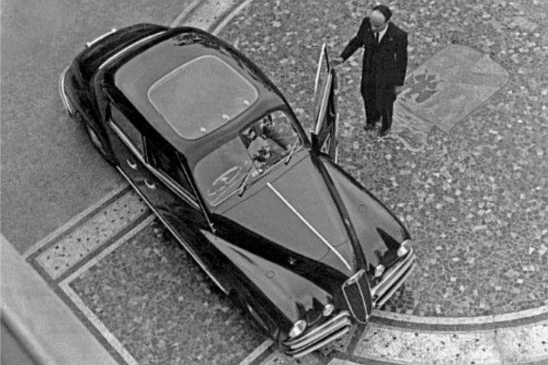
More than the details, it was the attitude that endured. Plexiglas symbolized a belief that wartime technology could be repurposed for beauty, that new materials could lift cars into a brighter, lighter future. As Karl Ludvigsen observed, the carrozzieri defined elegance by fusing ingenuity with artistry, and Plexiglas was their perfect medium.
That is why a Ghia Supersonic, a Lincoln Futura, or a Zagato Panoramica still looks startlingly modern under museum lights. Their clear domes and seamless glass-to-body lines have aged far better than the fins and chrome of the same decade. They captured a fleeting glimpse of tomorrow, and even if mass production never embraced the fantasy, the vision continues to stir the imagination.
In the end, Plexiglas was more than a material. It was an attitude—experimental, playful, unafraid to cut a roof in half and make it clear if that meant a new experience. The romance was brief, but its spirit lingers in every glass-canopied hypercar and every supercar engine displayed under a transparent cover. Those mid-century creations remind us that the future of the car has always been, at least in part, crystal clear

ABOUT THE AUTHOR
Andreas Scheidl
Italian classic car enthusiast with German roots. Renowned as a respected figure in the classic car community, he serves as a jury member at various international concours d'elegance, including the Classic Gala Schwetzingen and Mantova. As a content creator, Andreas passionately shares his profound knowledge and appreciation for vintage automobiles. His heart beats for cars designed by Giovanni Michelotti, showcasing his discerning taste and dedication to preserving the timeless elegance of automotive history.
More stories by Andreas Scheidl ↗CONTINUE READING
Posts You Might Like
Fiat Panda Cabrio: The Italian Coachbuilders Who Opened Giugiaro’s Box
From Moretti’s Panda Rock to Italdesign’s experimental Strip, Maggiora’s four-wheel-drive convertible and Stola’s remarkable Destriero, the history of the open-top Panda reveals an unexpected chapter in Italian coachbuilding. When Giorgetto Giugiaro designed…
Read story
Gabriele d’Annunzio and the Cult of the Automobile
There was a time when the automobile had not yet become part of the landscape. It announced itself from afar through the beating of an engine, the smell of petrol and hot…
Read story
Fiat 1400: The Last Great Playground of the Carrozzieri
From Touring and Abarth to Farina, Ghia, Vignale, Boneschi, Bertone, Viotti and the smaller carrozzerie, the new Fiat quickly became one of the richest bases for Italian special bodies in the early…
Read story
How a Swiss Dealer Challenged Ferrari: The Story of Monteverdi
How Peter Monteverdi went from Swiss Ferrari dealer to creator of rare Frua and Fissore-bodied GTs, the Hai supercar and luxury off-roaders.
Read story
THE CONVERSATION
Comments 0
Share a memory, a period photograph or a documented detail about this story.