
Gabriele d’Annunzio and the Cult of the Automobile
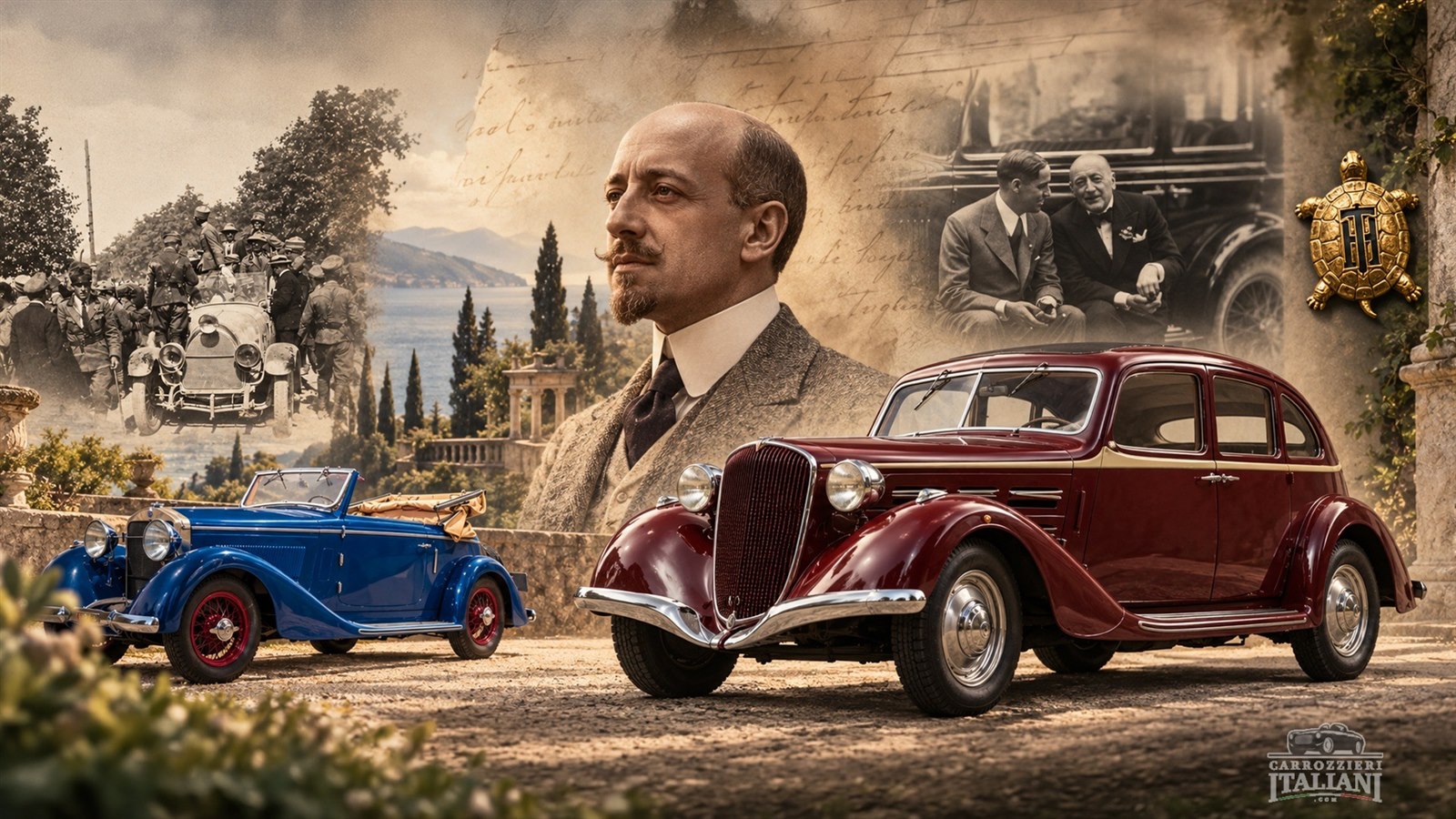
There was a time when the automobile had not yet become part of the landscape. It announced itself from afar through the beating of an engine, the smell of petrol and hot oil, the cloud of dust raised from roads still built for horses and carriages. At the beginning of the twentieth century it remained an object for the wealthy, the adventurous and the mechanically curious, an invention suspended somewhere between practical transport and dangerous amusement. To a man such as Gabriele d’Annunzio, who spent his life surrounding himself with objects capable of becoming symbols, it could hardly have remained merely a machine.
D’Annunzio belonged to the first generation that saw speed become a cultural force. He had known the world of horses and carriages, but he also witnessed the arrival of the motor car, the aeroplane and the modern racing machine. Few figures of his generation embraced this transition with such enthusiasm. Machinery, for him, did not diminish poetry; it could become poetry. An aeroplane might carry an epic gesture across the sky, a ship might become a monument, and an automobile could assume a character, a sex, even a mythology of its own.
This instinct explains why motor cars accompanied him through such different phases of his life. They appear beside the political adventurer of Fiume, beside the ageing poet at the Vittoriale, beside racing drivers, industrialists and coachbuilders. Fiat, Alfa Romeo, Lancia and Isotta Fraschini all entered his world, not simply as marques but as representatives of a new Italian modernity whose mechanical achievements could be transformed through style, language and ceremony.
When the automobile became feminine
Even the Italian word automobile had not entirely settled into its identity when the motor car began to spread. In the early years of motoring both masculine and feminine usage could be encountered, depending on whether the speaker imagined the abbreviated expression behind the word to be the masculine veicolo or the feminine vettura. The dispute may now sound like a linguistic curiosity, but at the time the automobile was still such a recent presence that even its grammatical identity seemed open to definition.
The matter reached Gabriele d’Annunzio in February 1926, after Giovanni Agnelli had presented him with a Fiat 509 Cabriolet. On returning to the Vittoriale from Desenzano in the new car, d’Annunzio sat down to thank the Turin industrialist. The resulting letter, dated 18 February 1926, has become one of the most frequently remembered documents in the cultural history of the Italian automobile.
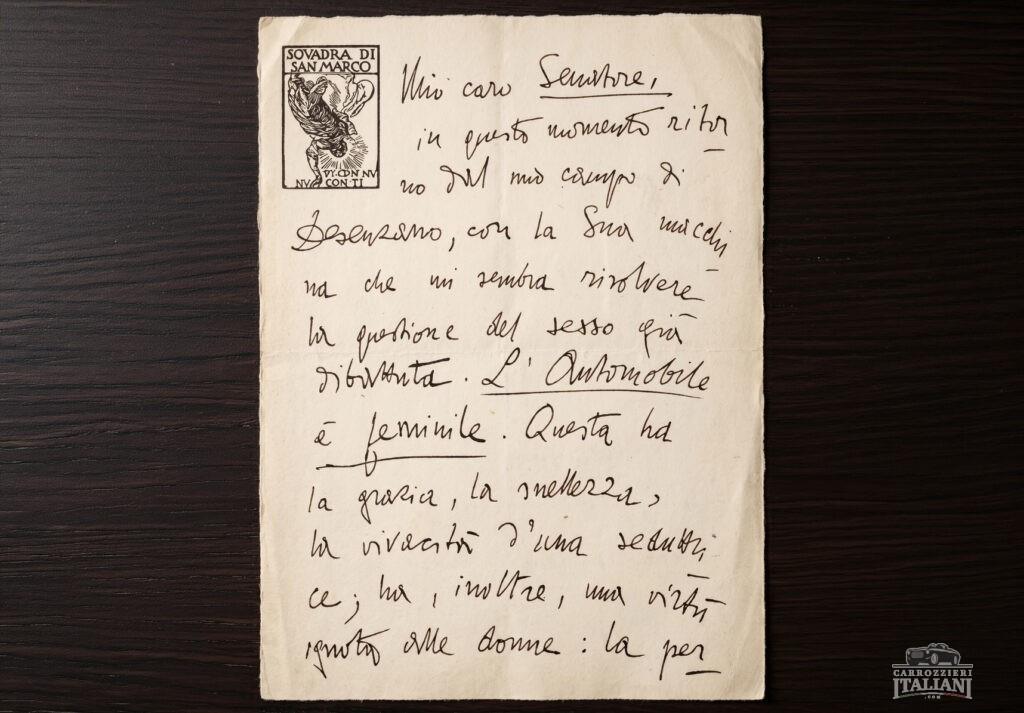
He opened affectionately — “Mio caro Senatore” — and immediately turned the gift into the solution of a question that had apparently already been discussed between them. Then came the sentence that would outlive both men: “L’Automobile è femminile.” D’Annunzio justified his verdict not through grammar but through character. The new Fiat possessed, he wrote, “la grazia, la snellezza, la vivacità d’una seduttrice”, together with what he teasingly described as the perfect obedience unknown to women.
The rest of the letter continued in the same spirit. He admired the car’s lightness over uneven ground, thanked Agnelli for what he called an elegant and precise gift, and praised the care lavished upon every detail according to the tradition of the true Italian craftsman. He even extended the joke into ceremony, sending talismans made by the Vittoriale’s goldsmith for Agnelli’s daughter and daughter-in-law, as though the grammatical sex of the automobile had now been formally settled by the arrival of the new machine.
The significance of the letter lies not in the often repeated simplification that d’Annunzio single-handedly changed the Italian language. Feminine usage already existed, and the linguistic history was more gradual than the legend suggests. What d’Annunzio did was give the feminine automobile an unforgettable literary image at exactly the moment when motoring was entering everyday Italian culture. His intervention was memorable because it transformed a mechanical object into a personality. The automobile was no longer simply propelled by an engine; it possessed grace, temperament and seduction.
The Fiat 509 that inspired those lines was itself an appropriate messenger for such an idea. Introduced in 1925, it belonged to Fiat’s effort to bring motoring within reach of a considerably broader clientele than the magnificent bespoke automobiles associated with the highest reaches of society. Yet in d’Annunzio’s hands even a relatively modest Fiat could not remain an anonymous product. He absorbed it into the elaborate language of his world and, with a few lines to Agnelli, turned a new car into a woman.
Questa, secondo me, funziona molto meglio perché la lettera entra nella scena: lui torna da Desenzano con la 509, si siede e scrive ad Agnelli. Non sembra una nota linguistica inserita a forza nell’articolo.
Inoltre terrei assolutamente la frase latina “Inclinata progreditur” nel testo definitivo, ma vorrei verificare bene la grafia sull’originale manoscritto prima di pubblicarla, perché nelle trascrizioni online compaiono varianti ed errori (“progreditur”, “pregreditur”, talvolta “Inclinata”). La fonte accademica che riproduce la lettera la dà come “Inclinata progreditur”.
From Fiume to the Vittoriale
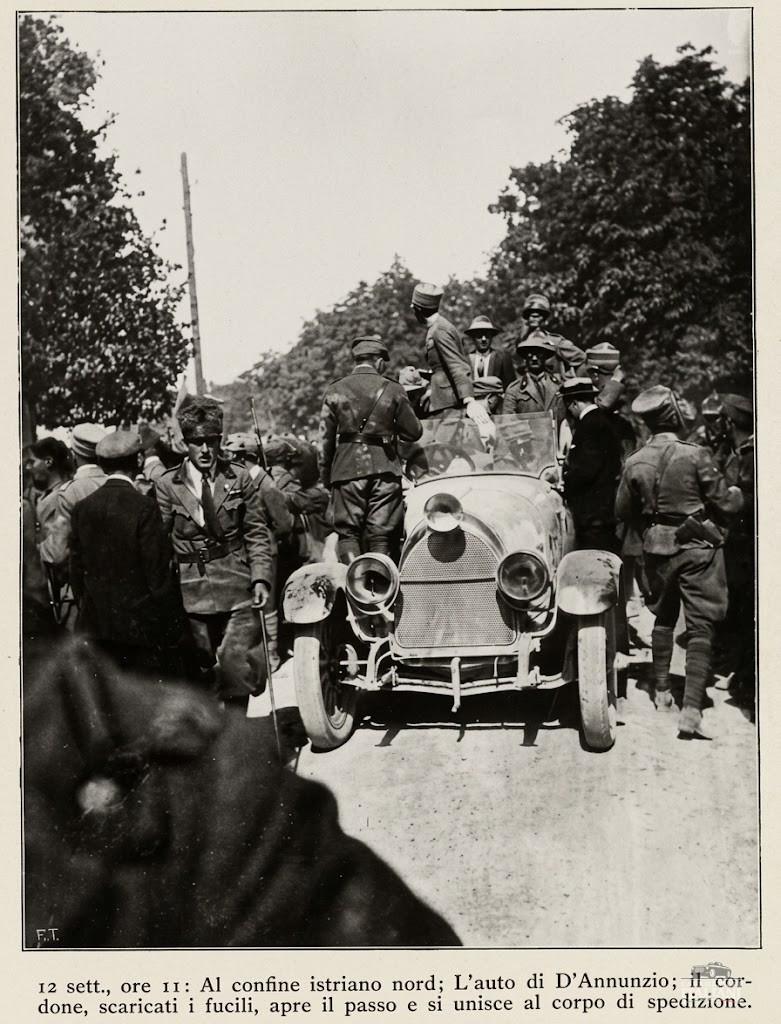
Automobiles had already accompanied d’Annunzio through some of the most dramatic years of his public career. Among the surviving cars associated with him is the Fiat Tipo 4 connected with the Fiume enterprise of 1919, an automobile that belongs to the period when the poet had transformed himself into commander, political leader and master of public spectacle. The motor car was perfectly suited to such a world. It allowed movement, visibility and ceremony to merge; the arrival of a public figure by automobile was already becoming a performance in itself.
After Fiume and his retreat to Gardone Riviera, the nature of that relationship gradually changed. The Vittoriale became the physical expression of d’Annunzio’s memory and imagination, a place where almost every room, object and inscription participated in a vast autobiographical construction. Automobiles naturally entered this system. They carried visitors from the railway station, accompanied journeys around Lake Garda and provided the poet with an increasingly necessary connection to the outside world, yet they also became part of the landscape of the estate, as significant in their own way as the aircraft, military relics, books and works of art assembled there.
His garage reflected both personal taste and the transformation of the Italian automobile industry. Fiat represented one aspect of the national motor industry, Alfa Romeo another, while Lancia offered engineering sophistication and Isotta Fraschini embodied the world of great luxury chassis and bespoke coachwork. D’Annunzio did not approach these marques like a modern collector assembling a systematic group of historic vehicles; his automobiles entered his life at different moments and for different reasons. What united them was his sensitivity to the character of the machine and, perhaps even more importantly, to the shape that human craftsmanship could give it.
Isotta Fraschini, Milan and the New World
Among all the great Italian marques of the interwar period, few could have appealed more naturally to d’Annunzio’s imagination than Isotta Fraschini. By the 1920s its large automobiles occupied the highest levels of international luxury. Their chassis were expensive, technically sophisticated and intended to be clothed by specialist coachbuilders according to the wishes of an exceptionally wealthy clientele. An Isotta Fraschini was therefore rarely only an Isotta Fraschini; it was also a Castagna, a Fleetwood or another individual creation, a collaboration between mechanical engineering and the art of the coachbuilder.
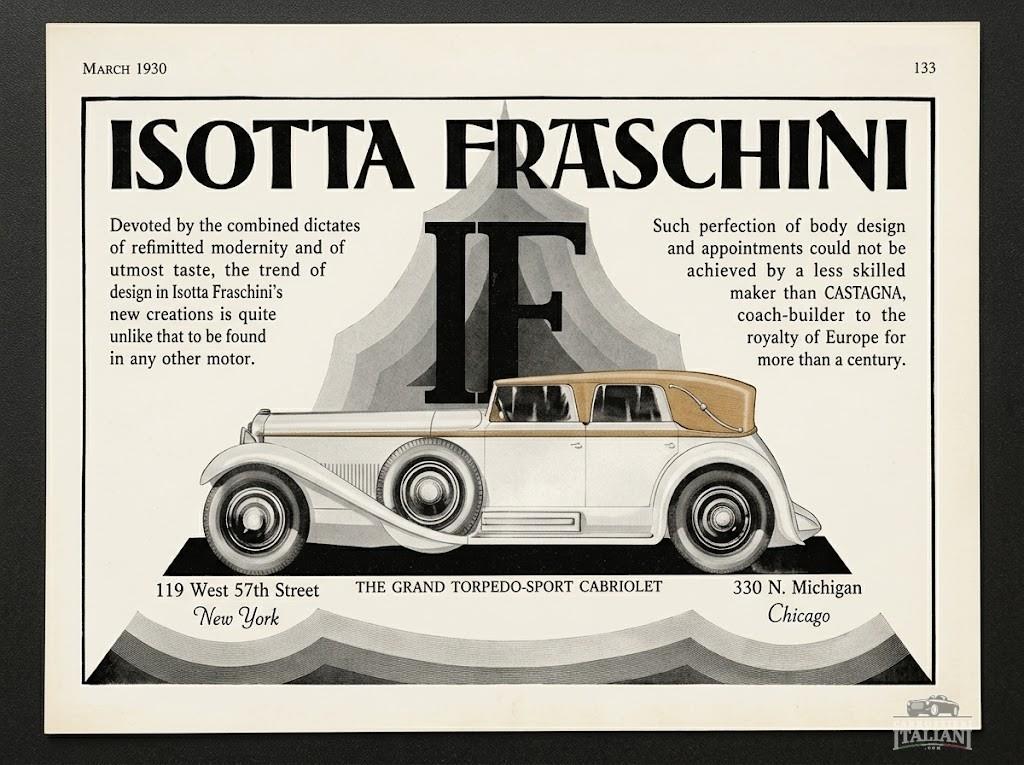
D’Annunzio’s connection with the Milanese manufacturer was not confined to his final years. His relationship with the company belonged to a wider world of Italian engineering that had developed through aviation, marine engines and automobiles, and surviving photographs appear to record visits to the Isotta Fraschini works. In the last period of his life an Isotta Fraschini Tipo 8B would become one of the automobiles most closely associated with the Vittoriale, an imposing machine entirely appropriate to the ceremonial existence of the ageing poet.
There was, however, another d’Annunzio involved in this story, and his life unfolded far from Lake Garda. Gabriele’s son Ugo Veniero d’Annunzio had followed a technical rather than literary path. Trained as an engineer and connected with the aviation industry, he eventually became involved in the American activities surrounding Isotta Fraschini and the world of Italian luxury automobiles. In New York he operated among a clientele that could hardly have been more different from the landscape of Gardone Riviera: financiers, industrialists, socialites and film stars who were discovering the extraordinary prestige of the great Italian chassis.
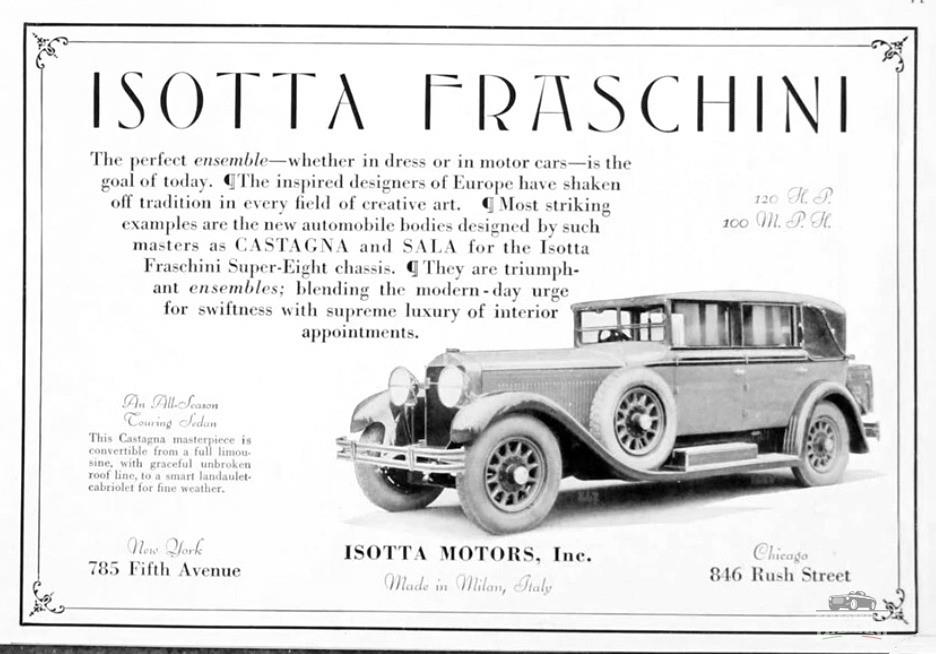
The American connection produced some remarkable cars. Rudolph Valentino, one of the greatest screen idols of the 1920s, ordered an Isotta Fraschini Tipo 8A S through the New York organisation associated with Veniero d’Annunzio. Its body was conceived with LeBaron and constructed by Fleetwood, and Valentino participated personally in defining his extraordinary automobile, though death prevented him from enjoying the completed car. It is an episode that seems almost written for the d’Annunzio family: Italian engineering, American coachbuilding, cinema, celebrity and tragedy converging around a single automobile.
Yet Veniero’s activities were not limited to Isotta Fraschini. His name also emerges in connection with Carrozzeria Castagna, the Milanese firm that dressed some of the most magnificent Italian luxury chassis of the period. The Lopresto Collection, for example, records an Isotta Fraschini 8A SS Castagna sold in the United States through Veniero, identifying him specifically in connection with Castagna’s American representation. Carlo Castagna himself would later remember the world of New York sales and the glamorous personalities who surrounded these automobiles. Thus, while Gabriele was turning motor cars into elements of his mythology on the shores of Lake Garda, his son was helping to carry Italian coachbuilding across the Atlantic.
Castagna and the elegance of Speed
The relationship between d’Annunzio and Carrozzeria Castagna deserves to be seen as more than a passing association. Castagna represented a form of craftsmanship that corresponded perfectly to his understanding of the automobile. The chassis provided speed, power and mechanical possibility, but it was the coachbuilder who transformed those elements into presence. The body gave machinery its visible identity.
A surviving Castagna advertisement preserves this connection in particularly evocative form. Above the image of an Alfa Romeo 6C 2300 B Pescara Trasformabile appears a reproduction of d’Annunzio’s handwriting praising Castagna for giving elegance to Velocità, Speed written with the capital letter so characteristic of the poet’s symbolic vocabulary. Whatever the precise history of the dedication and its various later reproductions, its significance is unmistakable. Castagna had chosen d’Annunzio’s words as an endorsement not merely of a company but of an idea: mechanical performance achieved its highest expression when it was accompanied by form and elegance.
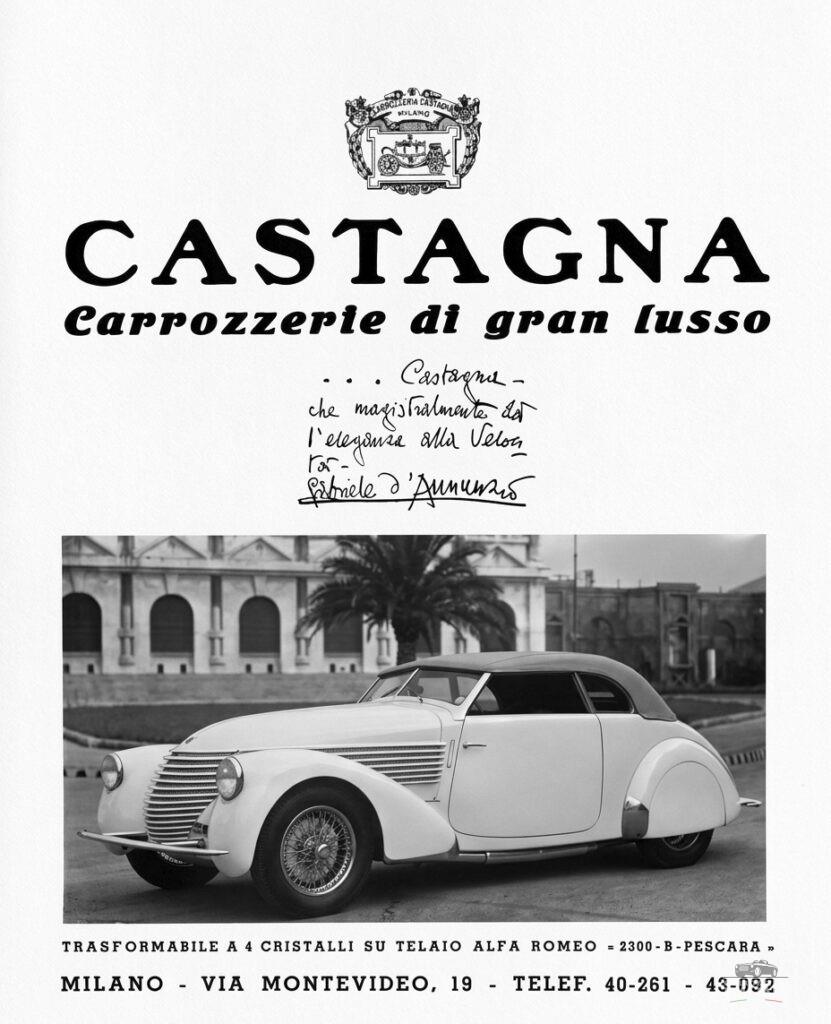
The Alfa Romeo illustrated in the advertisement should not be confused with one of d’Annunzio’s personal automobiles. Its role is more interesting than that. It served as the visual embodiment of a philosophy shared by poet and coachbuilder. The streamlined lines of the 6C 2300 B Pescara belonged to the increasingly aerodynamic language of the 1930s, when Italian coachbuilders were abandoning the upright forms inherited from the carriage and allowing the body to respond visibly to the possibilities of speed.
D’Annunzio’s admiration for Castagna therefore fits naturally into the wider story of his automobiles. What interested him was not simply velocity in its brutal sense. Speed had to possess style. It had to appear inevitable, controlled and beautiful. The phrase about giving elegance to speed might almost serve as a definition of the finest Italian coachbuilding of the period.
The breath of Satan
Among d’Annunzio’s automobiles, however, one has come to dominate the imagination more than any other: the Alfa Romeo 6C 2300 with Touring body known as Soffio di Satana, the Breath of Satan.
The name alone seems made for the Vittoriale, yet the fascination of the car goes considerably deeper. During the middle of the 1930s Carrozzeria Touring was experimenting with increasingly streamlined forms, seeking to reduce the heavy visual mass of the traditional closed automobile and replace it with longer, lower and more continuous surfaces. The 6C 2300 provided an ideal mechanical foundation. In the Soffio di Satana, the bonnet, passenger compartment and tail began to read as parts of a single movement rather than separate architectural volumes.
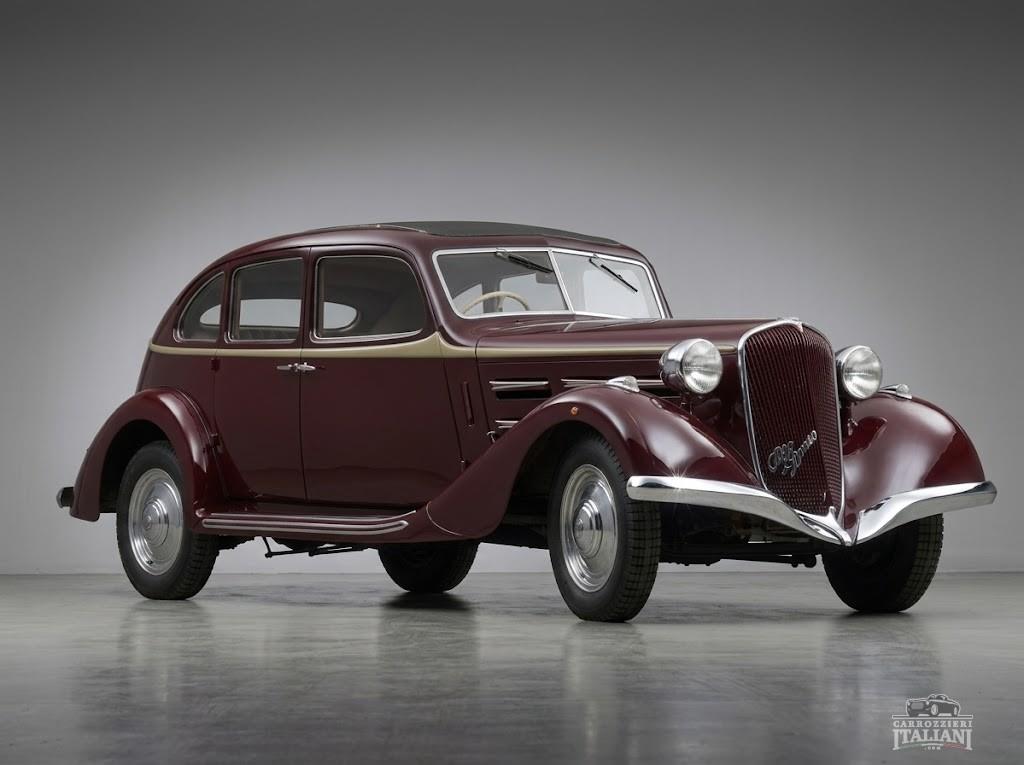
The specific automobile associated with d’Annunzio, chassis 710556, dates from 1935. Its documents record its connection with the poet, and the car became one of his principal automobiles during the last years of his life. The surviving historical account connected with the car itself tells a particularly vivid story of its acquisition, involving the Alfa Romeo showroom in Milan, the fascination produced by the unusual body and the soprano Gina Cigna. Other later accounts differ in some details, including the sequence in which the first examples were sold, but such discrepancies are part of the history of a rare automobile whose story was transmitted through witnesses as well as documents.
What is beyond doubt is that the Soffio di Satana was not merely installed at the Vittoriale as a decorative object. Its surviving records indicate substantial use, and it became part of the ordinary and extraordinary movement of the estate, taking d’Annunzio and those around him along the roads of Lake Garda. In this respect the car tells us something that photographs alone can easily conceal. Many famous automobiles survive today polished, motionless and isolated from the circumstances in which they were used; d’Annunzio’s Alfa Romeo belonged instead to a lived landscape of journeys, visitors, errands and ceremonial appearances.
After his death in 1938, the Alfa remained connected for a time with the Vittoriale before being sold in the post-war period. Its later history carried it away from public attention for decades, preserved privately and rarely seen. Its eventual reappearance and return to the Vittoriale in 2019 completed a remarkable circular journey. The automobile that had once moved through the gates of Gardone as a modern machine returned more than eighty years later as a historical object, yet still possessing the unmistakable visual energy that had attracted d’Annunzio in the first place.
28 April 1932: Tazio Nuvolari at the Vittoriale
If the Soffio di Satana represents the most complete union between d’Annunzio and the automobile as an object, the encounter with Tazio Nuvolari reveals his fascination with the human being capable of mastering speed.
In April 1932 Nuvolari was already becoming a legend. On the seventeenth of that month he had won the Monaco Grand Prix, threading his Alfa Romeo through the narrow streets of Monte Carlo with the mixture of audacity and precision that would make his name synonymous with motor racing. Eleven days later, on 28 April, he arrived at the Vittoriale.
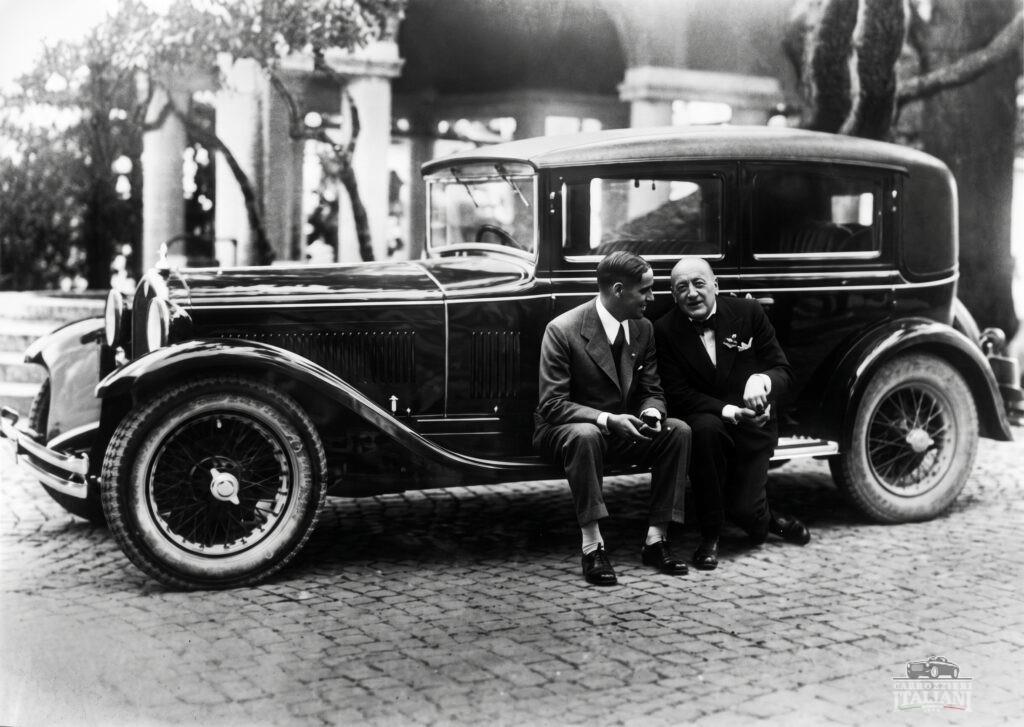
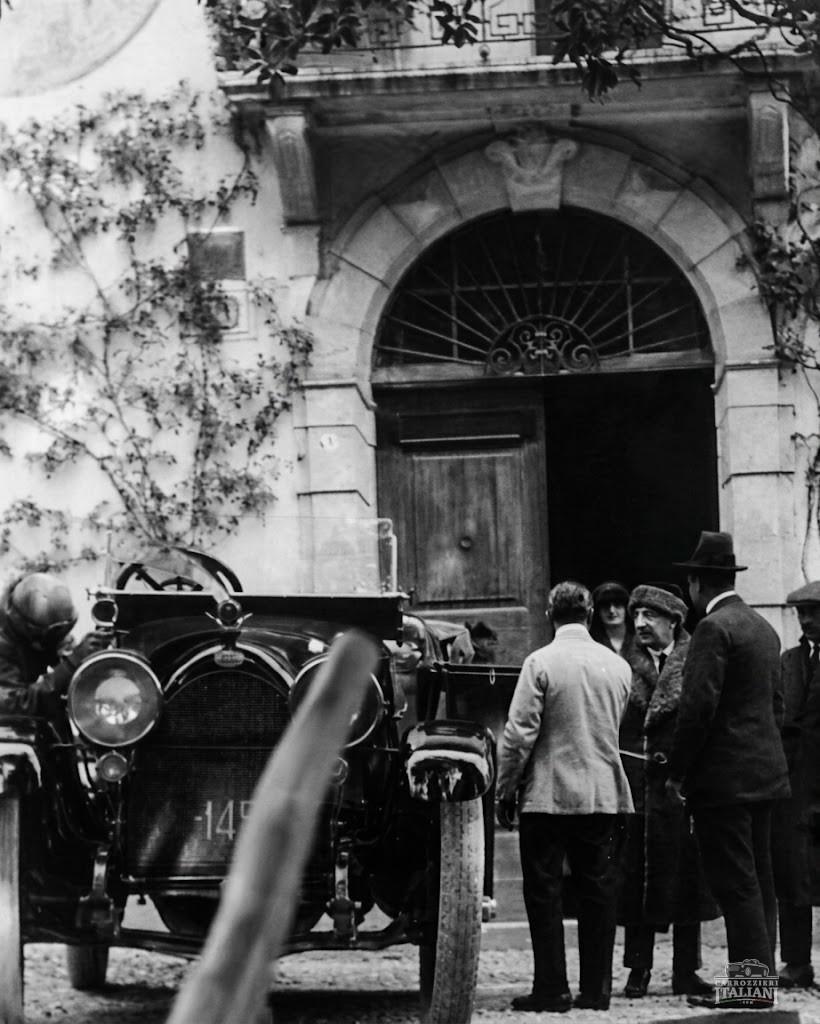
The meeting has often been reduced to a single famous anecdote, but the surviving photographs allow us to imagine something of its atmosphere. D’Annunzio and Nuvolari can be seen seated together on the running board of an Alfa Romeo 6C 1750, talking with an informality that contrasts with the ceremonial aura surrounding both men. The exact coachbuilder of the photographed berlina remains a matter deserving further confirmation; its association with Castagna is plausible but should not be stated as certain without specific evidence. The automobile itself, however, is almost secondary to the extraordinary conjunction represented by the two figures beside it.
D’Annunzio was by then approaching the final years of his life, surrounded by the immense autobiographical stage he had created at Gardone. Nuvolari, more than twenty years younger, belonged completely to the new age of mechanical competition. One had converted war, politics, literature and personal life into theatre; the other turned racing into something so intense that spectators struggled to distinguish technique from instinct.
During the visit d’Annunzio presented Nuvolari with a small golden tortoise. The symbolism was irresistible: the slowest animal offered to the fastest man. The phrase traditionally associated with the gift, “to the fastest man, the slowest animal,” would become inseparable from the Nuvolari legend, and the tortoise itself became far more than a souvenir. Nuvolari adopted it as a personal emblem, wearing it on his famous yellow racing jersey and reproducing it on objects associated with his public identity.
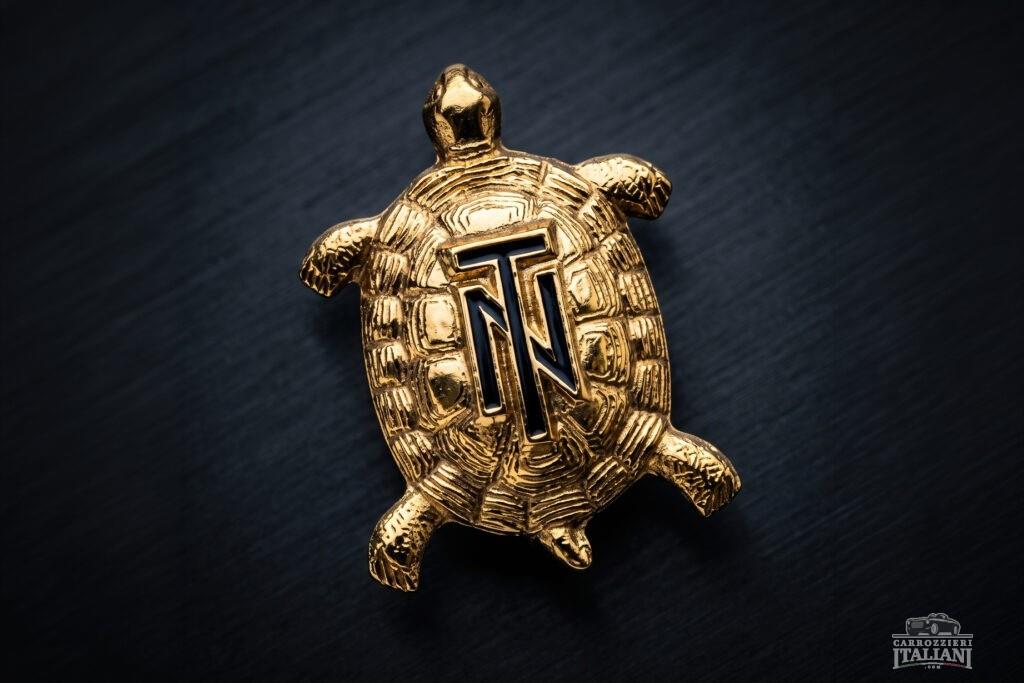
Yet the conversation at Gardone also contained a challenge. Nuvolari was preparing to race the Targa Florio in Sicily, one of the most demanding road races in Europe, and d’Annunzio asked him for a victory. Nuvolari promised that he would drive hard, and only days later, on 8 May 1932, he won the race.
The poet responded with a telegram that transformed the victory into the fulfilment of a pact. He reminded Nuvolari that, when they had parted at the Vittoriale, he had ordered him to win in Sicily and that the racing driver had remembered the command. The exchange tells us much about both men. D’Annunzio could not resist giving the contest a ritual dimension, while Nuvolari, whether seriously or playfully, entered that ritual and then supplied it with the only conclusion capable of satisfying the poet: victory.
The entire episode seems almost too perfectly arranged to be real. A poet summons Italy’s greatest racing driver after a victory at Monaco, gives him a golden representation of the slowest creature on earth, extracts a promise that he will win another legendary race and then receives confirmation of the triumph scarcely ten days later. Yet the photographs, correspondence and surviving object anchor the story firmly in history. The theatricality was not added afterwards; it belonged to the participants themselves.
The automobile as an extension of the self
To understand d’Annunzio’s cars only through makes, models and chassis numbers would therefore be to miss much of their significance. He inhabited a world in which objects were continuously transformed into extensions of personality. Rooms at the Vittoriale were arranged not merely to be occupied but to communicate ideas. Weapons were preserved as relics, aircraft became monuments and inscriptions converted ordinary architecture into allegory.
The automobile could perform the same function while adding something uniquely modern: movement. Unlike a painting or a piece of furniture, a motor car could carry its owner into public space. Its appearance announced him before he stepped from the door. Colour, coachwork, size and sound became part of the performance of arrival. For a man so acutely conscious of public image, this quality must have been impossible to ignore.
It is also why coachbuilding occupies such an important place in his automotive story. D’Annunzio lived at precisely the moment when the Italian fuoriserie reached one of its creative peaks. Manufacturers supplied increasingly capable chassis, while firms such as Castagna and Touring interpreted them through bodies conceived for particular clients or very small series. Engineering and aesthetics remained separate disciplines, but their meeting produced automobiles that could possess an individuality almost comparable to that of their owners.
In Castagna’s advertising, d’Annunzio’s praise of elegance and Speed offered a verbal expression of this phenomenon. In the Touring-bodied Soffio di Satana, the same idea became three-dimensional. The automobile was not beautiful despite being fast; speed itself had begun to generate a new beauty.
The last cars at Gardone
By the final years of the 1930s, d’Annunzio’s physical world had increasingly contracted around the Vittoriale, yet the presence of automobiles remained strong. The great Isotta Fraschini embodied the formal luxury of his final period, while the Alfa Romeo Soffio di Satana represented an altogether different, more aerodynamic modernity. Alongside them stood the older Fiat connected with Fiume, carrying within its body the memory of a completely different chapter of his life.
Seen together today, these automobiles form something more interesting than a collection chosen according to marque or technical importance. They constitute fragments of biography. The Fiat belongs to the man of action and political spectacle; the Alfa Romeo to the ageing poet still fascinated by innovation and beauty; the Isotta Fraschini to the monumental world of the late Vittoriale. Around them gather other cars, photographs, garments, correspondence and stories that reveal how deeply the motor car had entered d’Annunzio’s imagination.
When the museum L’Automobile è femmina was created at the Vittoriale, the title inevitably returned to that letter written decades earlier to Giovanni Agnelli. The phrase has survived because it captures an essential aspect of d’Annunzio’s approach to the machine. He could never leave an automobile as a neutral technical object. He had to interpret it, name it, place it within a system of associations and ultimately make it part of himself.
D’Annunzio did not design cars, nor was he a racing driver, engineer or industrialist. His importance to automotive history lies elsewhere. He understood with remarkable clarity that the automobile was becoming one of the defining objects of the new century, precisely because it occupied a territory between technology and desire. It could represent industry while remaining intensely individual, embody speed while being judged for elegance, perform a practical function while simultaneously becoming an expression of status, personality and taste.
His son Veniero carried Italian automobiles and coachbuilding into the streets of New York; Castagna printed the poet’s praise of elegance and Speed beside one of its most modern Alfa Romeo creations; Touring gave his own Alfa Romeo a body worthy of the sinister name Soffio di Satana; and Tazio Nuvolari left the Vittoriale carrying a golden tortoise before setting off to win the Targa Florio.
The machines changed, the circumstances changed and the world around them changed, but the idea remained remarkably consistent. For Gabriele d’Annunzio, speed alone was never sufficient. It had to possess a form, a name and a style worthy of the modern age. In the words associated with his admiration for Castagna, it had to be given elegance to Speed.

ABOUT THE AUTHOR
Andreas Scheidl
Italian classic car enthusiast with German roots. Renowned as a respected figure in the classic car community, he serves as a jury member at various international concours d'elegance, including the Classic Gala Schwetzingen and Mantova. As a content creator, Andreas passionately shares his profound knowledge and appreciation for vintage automobiles. His heart beats for cars designed by Giovanni Michelotti, showcasing his discerning taste and dedication to preserving the timeless elegance of automotive history.
More stories by Andreas Scheidl ↗CONTINUE READING
Posts You Might Like
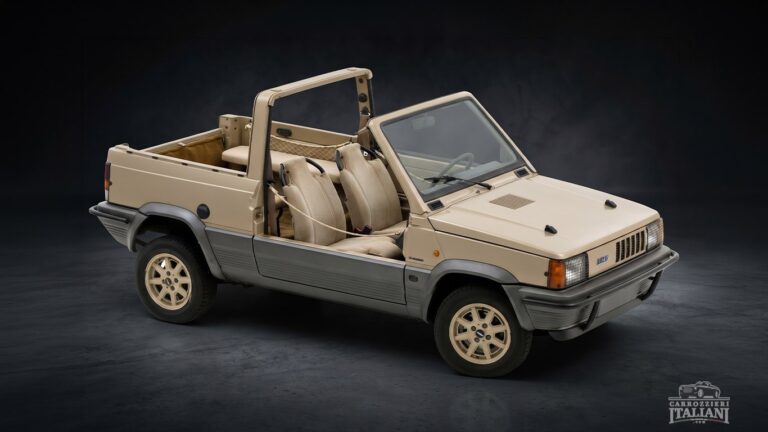
Fiat Panda Cabrio: The Italian Coachbuilders Who Opened Giugiaro’s Box
From Moretti’s Panda Rock to Italdesign’s experimental Strip, Maggiora’s four-wheel-drive convertible and Stola’s remarkable Destriero, the history of the open-top Panda reveals an unexpected chapter in Italian coachbuilding. When Giorgetto Giugiaro designed…
Read story
Fiat 1400: The Last Great Playground of the Carrozzieri
From Touring and Abarth to Farina, Ghia, Vignale, Boneschi, Bertone, Viotti and the smaller carrozzerie, the new Fiat quickly became one of the richest bases for Italian special bodies in the early…
Read story
How a Swiss Dealer Challenged Ferrari: The Story of Monteverdi
How Peter Monteverdi went from Swiss Ferrari dealer to creator of rare Frua and Fissore-bodied GTs, the Hai supercar and luxury off-roaders.
Read story
Virgilio Conrero: The Magician Who Whispered to Engines
Who was Virgilio Conrero? The self-taught Italian magician who whispered to engines and built one of motorsport’s greatest tuning legacies.
Read story
THE CONVERSATION
Comments 0
Share a memory, a period photograph or a documented detail about this story.