
Exner’s Revival Cars: The Wild ’60s Attempt to Bring Dead Brands Back to Life
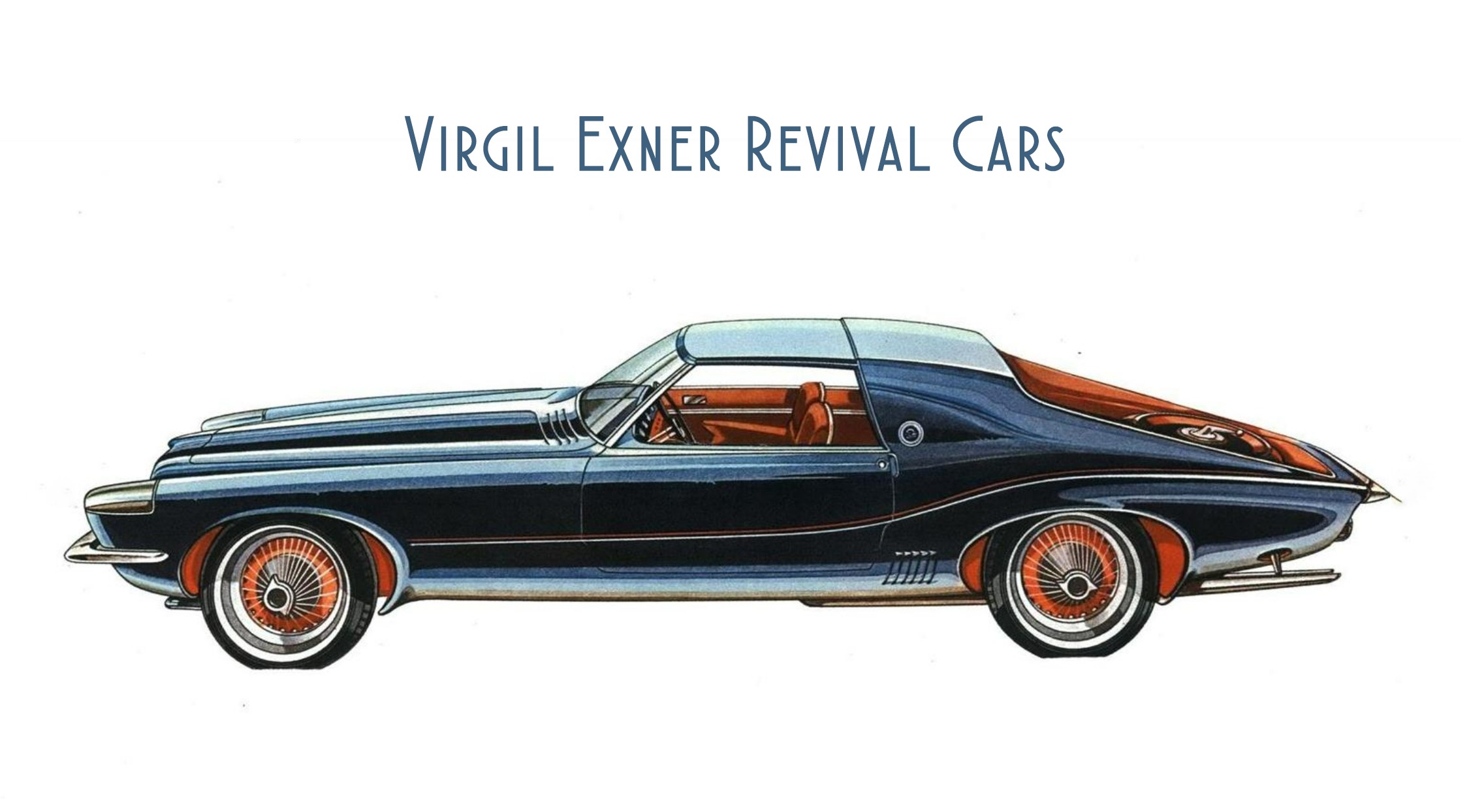
If you’ve never heard of Virgil Exner’s Revival Cars, don’t worry—most people haven’t. They were born from one of those wonderfully reckless ideas that could only come from the early ’60s: Esquire magazine asked a recently ousted Chrysler design boss to imagine what America’s prewar automotive royalty would look like if they were still around today.
That designer was Virgil Exner, and instead of treating it like a fun little illustration gig, he treated it like a personal mission. With his son, Virgil Jr., he reimagined four fallen giants—Stutz, Duesenberg, Packard, and Mercer—as modern machines. Not retro. Not replicas. Actual 1960s cars with the DNA of their 1920s ancestors woven through them.
Esquire published the results in December 1963 under the poetic banner “Flights of Fancy,” and the drawings stopped readers in their tracks. Each new design sat beside a sketch of its original Classic Era counterpart, making the message obvious: Exner wasn’t parodying the past—he was trying to evolve it. Long hoods, pontoon fenders, imposing grilles… these were love letters written in sheetmetal.
And the timing could not have been better. American car design had just traded the wild optimism of the ’50s for restrained, committee-approved sameness. Enthusiasts were starting to miss the grandeur of the prewar classics, and designers like Brooks Stevens were already poking at the idea of neo-classics.
🔗 Read more: Virgil Exner was the designer who taught Detroit to dream again
So Exner did what Exner always did: he went all-in. No fins, no chrome explosions—just bold, modern interpretations of marques that were already history. The feature caused a small uproar in the press and struck a nerve with readers. Suddenly, people were wondering… what if these brands actually came back?
For a moment, the Revival Cars weren’t just illustrations. They were a challenge.
A designer standing at the edge of the 1960s, looking backward and forward at the same time, asking the car industry: “Why did we stop making cars with soul?”
From Magazine to Model: The “Revivals by Renwal”
The splash made by Esquire’s illustrations did not end on the printed page. A New York-based model kit manufacturer, Renwal, saw an opportunity in Exner’s flights of fancy. By 1964, Renwal had licensed the designs and launched a series of 1:25 scale plastic model kits under the banner “Revival Classics.” The first release (1964) packaged the four Esquire stars as the “1966 Stutz, Duesenberg, Packard, and Mercer” – each a detailed kit imagining those cars as if actually produced in the mid-’60s. In 1966, Renwal followed up with three additional models – Bugatti, Jordan Playboy, and Pierce-Arrow – drawn from further Exner renderings that hadn’t appeared in the original article. Notably, Exner’s Pierce-Arrow and Jordan designs were new “Revival” ideas he cooked up after the initial four, showing how the concept had taken on a life of its own.
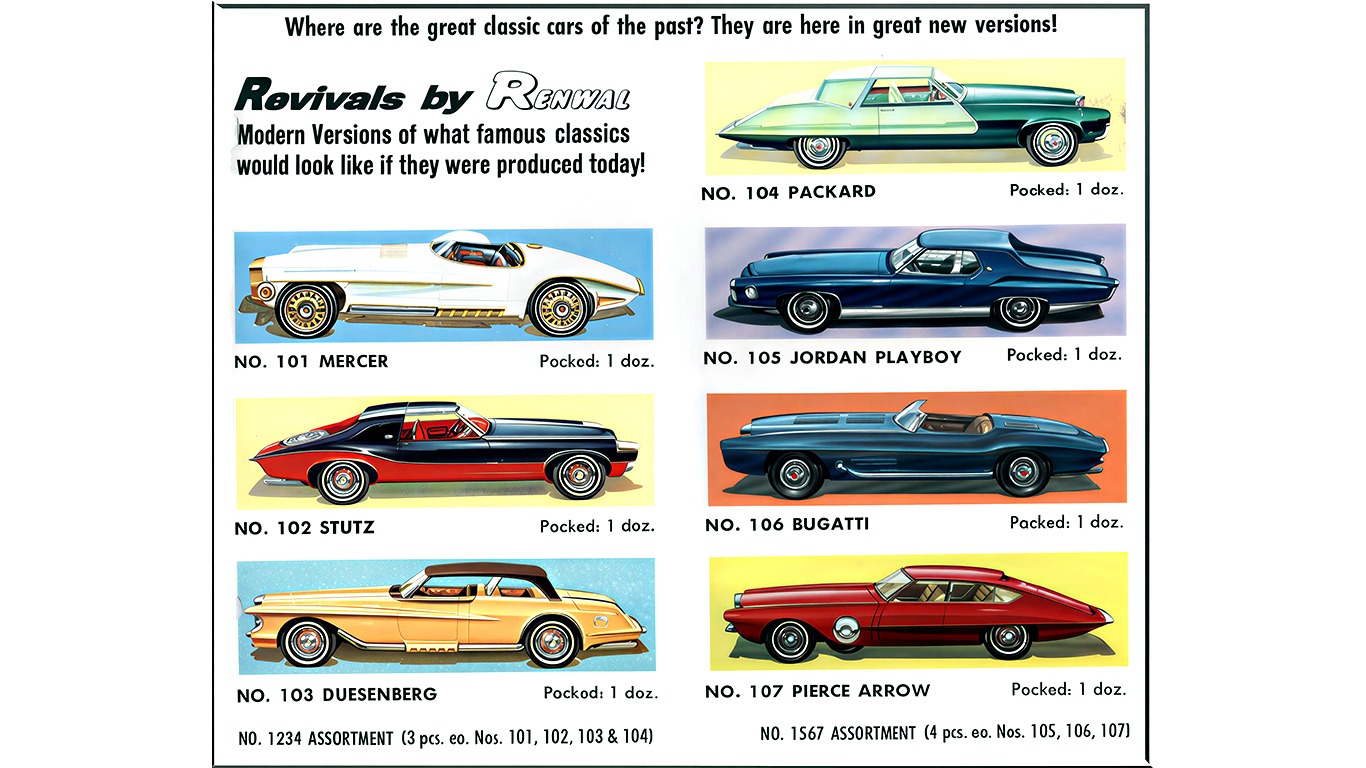
Bringing these extravagant neo-classics to the toy market was a bold move. Renwal’s ads presented the models as “Yesterday’s classics envisioned as today’s dream cars” – a tantalizing proposition to hobbyists. However, the reception in the mid-’60s was mixed. Younger model-builders, focused on hot rods and muscle cars, didn’t quite know what to make of a pseudo-1930s Packard or Stutz; one hobby shop worker recalled kids walking past the Renwal kits, not recognizing the old marque names at all. Adult enthusiasts showed some interest (the Mercer and Bugatti kits were the favorites, given those cars’ sports car appeal), but overall the Revival Series sold in modest numbers by 1960s standards. Even Renwal’s attempt to market the Stutz and Mercer as working slot cars did little to spur a craze.
Yet over time, those quirky kits attained a cult following. They became prized collectibles, especially as the real Exner revival cars gained mythic status among neo-classic aficionados. Today the once-neglected Renwal models can fetch small fortunes at auction – a mint Bugatti 101-C roadster kit or a Jordan Playboy has sold for well over $300–400. In retrospect, Renwal’s venture succeeded in keeping Exner’s dream alive in plastic form, inspiring many a young builder to appreciate the romance of classic luxury cars. The kits also preserved design details that never made it to full-size production, effectively archiving Exner’s vision. As we’ll see, some of these “paper tigers” remained only as drawings and models, while others evolved into real cars in the ensuing years.
The Jordan Playboy Revival – A “Playboy” for the Space Age
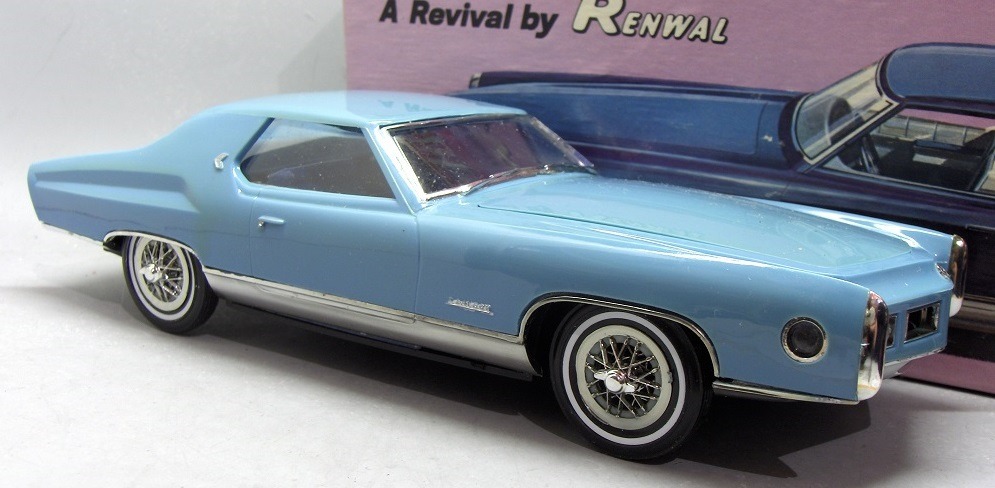
One of the more curious names in Exner’s revival roster was Jordan – a defunct 1920s marque best known for its marketing slogan “Somewhere West of Laramie” rather than any engineering greatness. The original Jordan Playboy was a jaunty two-seat roadster epitomizing Jazz Age style. Exner’s 1966 take on the Jordan Playboy brought that concept into the Jet Age. He envisioned the new Playboy as a personal luxury coupé, low-slung and unapologetically fashionable. The revival Jordan’s design was rife with dramatic 1960s touches: a long, sculpted hood line; a wide, aggressive grille (flanked by hidden or flush headlamps); and a flowing roof that tapered into a short rear deck. On the Renwal box art and build-ups, the Jordan appears as a sleek 2+2 GT – painted in candy apple red or metallic hues – looking ready to cruise down Palm Springs boulevards.
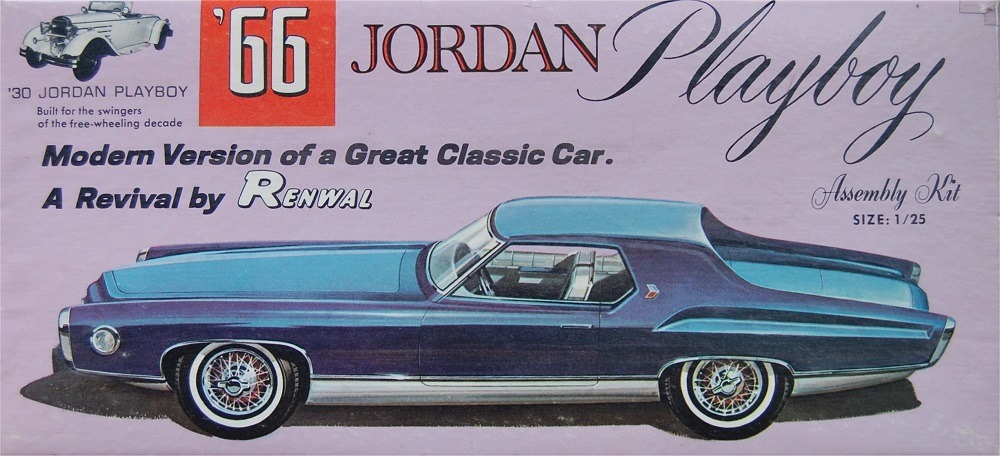
Despite the name, little of the 1920s Playboy roadster’s appearance carried over – instead of a rakish open tourer, Exner’s version was more like a Corvette crossed with a Buick Riviera. Contemporary modelers have noted that the Jordan Revival’s styling uncannily foreshadowed late-’60s Detroit trends. Indeed, from certain angles it could be mistaken for a 1967–70 Cadillac Eldorado or Olds Toronado, with its hidden headlights, prominent fender forms, and ornate roofline. (Whether this was coincidence or Exner’s influence coming full-circle is a matter of debate among car historians – as one commentator quipped, “Who inspired who? The design was definitely ahead of its 1966 time”.)
🔗 Read more: How the Space Age Shaped 50s-60s Italian Car Design
Exner’s revived Jordan Playboy remained a what-if dream on paper and plastic. No prototype was ever built, and the Jordan name itself had long faded from public consciousness. Yet the design is fascinating for its bold mix of classic and contemporary: the grille faintly recalls a 1930s Jordan radiator shape, and the overall “playboy” spirit – a sporty, indulgent ride for the well-heeled and young-at-heart – lives on in Exner’s interpretation. Surviving records of the Jordan revival exist mainly in the Renwal kits and a few published images.
In hindsight, this concept was one of Exner’s more prescient Revivals: it anticipated the personal luxury boom of the late ’60s, when long-hood/short-deck coupés became the craze. The Jordan Playboy Revival asks us to imagine an alternate 1960s where a boutique carmaker in Cleveland (Jordan’s home) might have produced a car to rival the Riviera, Thunderbird and Toronado – a flashy personal luxury car with a famous name from the Roaring Twenties. It never happened, but thanks to Exner’s illustration it remains a delightful piece of automotive fantasy.
The Packard Revival – Return of the “Twin Six”
Of all the Revival Cars, Exner’s Packard concept may have been the most grandiose – fittingly so, as Packard had been synonymous with American luxury. In Exner’s eyes, any modern Packard needed the gravitas of the classic coachbuilt Packards of the ’30s. His design was labeled the Packard Twin Six, reviving the name of Packard’s legendary V12 engines. The rendered car is an imposing two-door Convertible Victoria, combining formal elegance with high performance intent. It sports a long bonnet with hints of pontoon fenders, an upright ox-yoke grille flanked by what appear to be retractable headlights, and a low-cut convertible roof with landau irons – as if Dietrich or LeBaron (renowned Packard coachbuilders) had been transported to 1963. In the Esquire illustration, the Packard was notably drawn only in monochrome (unlike the other three designs which were in color), giving it a sober, no-nonsense demeanor. Perhaps this was intentional: Packard’s image had always been elegance in understatement, and Exner followed suit by envisioning a dignified but modern Packard.
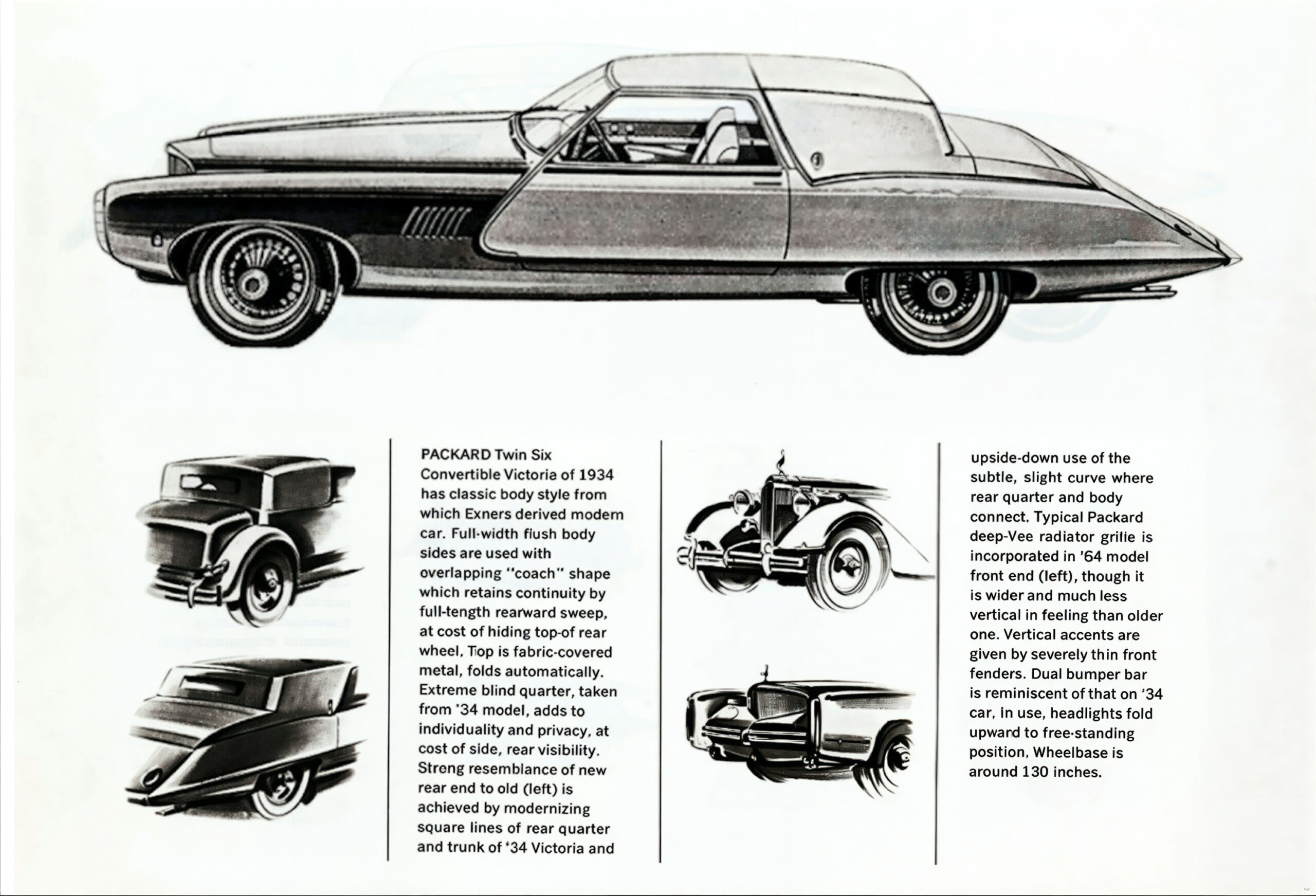
The “Twin Six” moniker was more than just nostalgia – it implied Exner’s revived Packard would have a twelve-cylinder heart, just like the magnificent Twin Six models of 1916–23 and 1932–39. This was an audacious idea in an era when multi-carb V8s ruled; a V12 Packard in the 1960s would have been a direct challenger to Rolls-Royce. Exner’s concept incorporates subtle tributes to Packard’s past: the hood sports a graceful chrome strip that could hark back to the old Packard bonnet mascots, and the rear features a slight continental spare bulge (a nod to the aft-mounted spares on many classic Packards). The proportions suggest a large, powerful machine – Esquire described it as the car a modern Packard might build for a head of state or a captain of industry, had the company survived.
In reality, Packard had ceased production by 1958, and no serious revival was attempted in the ’60s. Exner’s design tantalized enthusiasts with what might have been. Some AMCs and Cadillacs a decade later would coincidentally echo elements of Exner’s Packard – for instance, the opera-window roofline and formal grille can be seen in the ’70s personal luxury coupés that followed. It’s even been speculated that if American Motors (which inherited some Packard dealers after the Packard-Stude merger) had seen Exner’s drawings, they might have considered resurrecting Packard as their luxury brand. That never came to pass, of course, and Exner’s Packard Twin Six remained a paper dream. No prototype was built, and aside from the Esquire feature and Renwal kit, this Packard exists only in archives. Still, its impact on the imagination was significant – it reminded the world that “ask the man who owns one” used to mean something, and in Exner’s view, could mean something again. His Packard Revival is a melancholy tribute to a great name, rendered with the respectful eye of a designer who clearly adored the classics.
The Pierce-Arrow Revival – The Silver Arrow Flies Again
Exner did not forget Pierce-Arrow, that patrician marque from Buffalo known for its quiet, refined automobiles (and those signature fender-headlights). For Pierce-Arrow’s revival, Exner drew inspiration from one of the company’s most famous creations – the 1933 Pierce Silver Arrow show car. In fact, his concept is often referred to as a “Pierce-Arrow Silver Arrow” Revival. The original Pierce Silver Arrow was a sensational, stream-styled fastback sedan announced with the tagline “Suddenly it’s 1940!” It featured a swooping roofline, a periscope-style rear window, and a powerful V12 under the hood. Exner essentially asked: What if Pierce-Arrow had built a second Silver Arrow in the 1960s? His answer: a spectacular luxury super-coupé blending 1930s Art Deco futurism with 1960s Jet Age details.
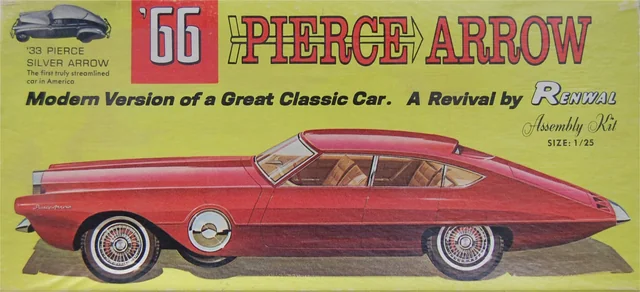
On paper, the Pierce-Arrow Revival is a large, dramatic two-door with a sharply sloping rear end (echoing the 1933 car’s fastback “streamlined” profile). It has a broad, confident stance. At the front, Exner imagined a modern interpretation of Pierce’s classic radiator – a tall grill split by a central rib, flanked by headlamps integrated into the fender line. (One could easily imagine Pierce’s trademark fender-mounted headlights reborn here as pop-up lamps or stylized pods.) A “periscope” rear window is incorporated – essentially a tunneled backlight, enhancing rear visibility in that fastback body. Under the hood, naturally, would sit a mighty V12 engine – as Exner noted, Pierce’s 1930s V12 could hurl the original Silver Arrow over 110 mph, and his 1960s Pierce would be no less potent. The interior, had it been built, likely would have been sumptuous and gadget-laden, befitting Pierce-Arrow’s reputation for peerless quality (Exner’s interior sketches showed a sophisticated, aircraft-like instrument panel and a snug, tailored cabin for four).
Unlike some of the other Revival Cars, the Pierce-Arrow concept never progressed beyond Exner’s drawings and the Renwal scale model. By the mid-1960s, Pierce-Arrow had been gone for almost three decades, and no investors stepped up to pursue the revival. Still, Exner’s Pierce-Arrow Revival serves as a stunning “what if.” It’s arguably one of the most cohesive designs of the series – less fanciful than the Jordan, more true to its 1930s roots than the Packard. One can see in it the influence of the Silver Arrow lineage, yet Exner wasn’t shy about adding mid-century flair: the body sides have subtle curves and strakes that would have been at home on a 1966 Chrysler, and the tail likely sported slim, vertical taillights à la contemporary Cadillacs. The car manages to look both forward-looking and backward-facing – a tribute to Pierce-Arrow’s legacy of innovation. Enthusiasts who have built the Renwal model often paint it in two-tone silver and burgundy to accentuate its period-inspired lines, imagining perhaps that if it had debuted in 1965, the Pierce Silver Arrow II might have stolen the show at the New York World’s Fair. Alas, it remained a beautiful figment of Virgil Exner’s imagination, preserved only in model form – a silver arrow that never quite left the bow.
The Duesenberg Model D prototype by Ghia
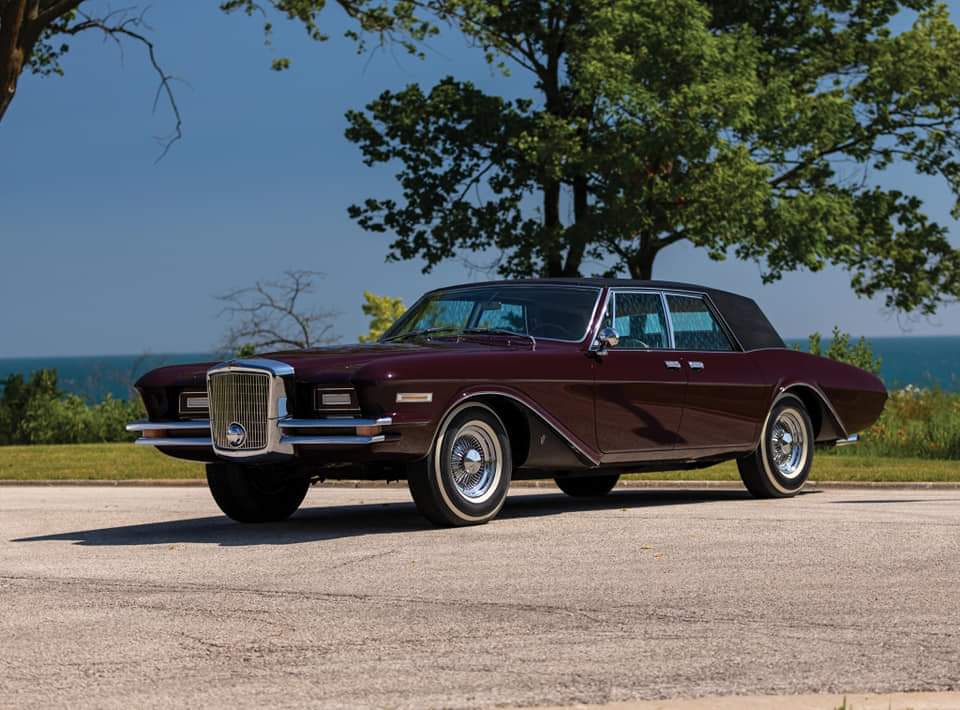
If there was ever a moment when Virgil Exner’s Revival Cars threatened to break free from paper and become an actual, functioning “new classic,” it was with the Duesenberg Model D. This wasn’t just a sketch or a model kit. This was a real car — a full-sized, coachbuilt prototype built by Ghia in 1966, wearing the Duesenberg name with the confidence of a marque that hadn’t produced anything in three decades.
And for a brief, intoxicating minute, it looked like the comeback might actually happen.
The project started when a group of investors secured rights to the Duesenberg name and hired Exner to design a modern flagship: something that could sit in the same room as a Rolls-Royce and not blush. Exner responded with what he always did—a long hood, impossible proportions, and enough presence to make traffic part like the Red Sea. Ghia translated his drawings into steel so faithfully that the finished car looked less like a prototype and more like a production model whose price tag started with “if you have to ask…”
Inside, it was an unapologetic lounge of chrome, leather, and switches, the kind of instrument panel that makes you wonder if you’re driving a car or launching an Apollo mission. Underneath, it used Chrysler Imperial underpinnings, but the way Exner and Ghia wrapped it, you’d never know.
🔗 Read more: The story of Carrozzeria Ghia – part 1
And people wanted it. Supposedly, fifty buyers put their names down. Elvis was one. Jerry Lewis another. The kind of clientele who didn’t care what something cost as long as it was outrageous, fast, or both. But then reality stepped in. Investors imploded. Funding evaporated. By the time the dust cleared, the Model D stood alone — a stunning, meticulously crafted orphan. A car that looked ready for production but never got beyond its single prototype. Oddly enough, that made it even more fascinating. Because the Model D wasn’t a fantasy like the Esquire sketches. It was a fully built alternate timeline — a Duesenberg that almost existed in the real world, wearing the Jet Age with the confidence of a brand that refused to stay dead.
Today, the solitary Model D survives as the most convincing proof that Exner’s Revival Cars could have worked. Not just pencil-on-paper possible. Actually possible.
Bugatti and Stutz – From Revival Concepts to Reality (Almost)
While most of Exner’s Revival Cars lived only on paper or in plastic, two notable cases bridged the gap to full-size automobiles – at least to some extent. The Bugatti and Stutz revival concepts enjoyed second lives beyond the drawing board, and their stories serve as a bridge between Exner’s fanciful sketches and the real-world neo-classic boom that followed.
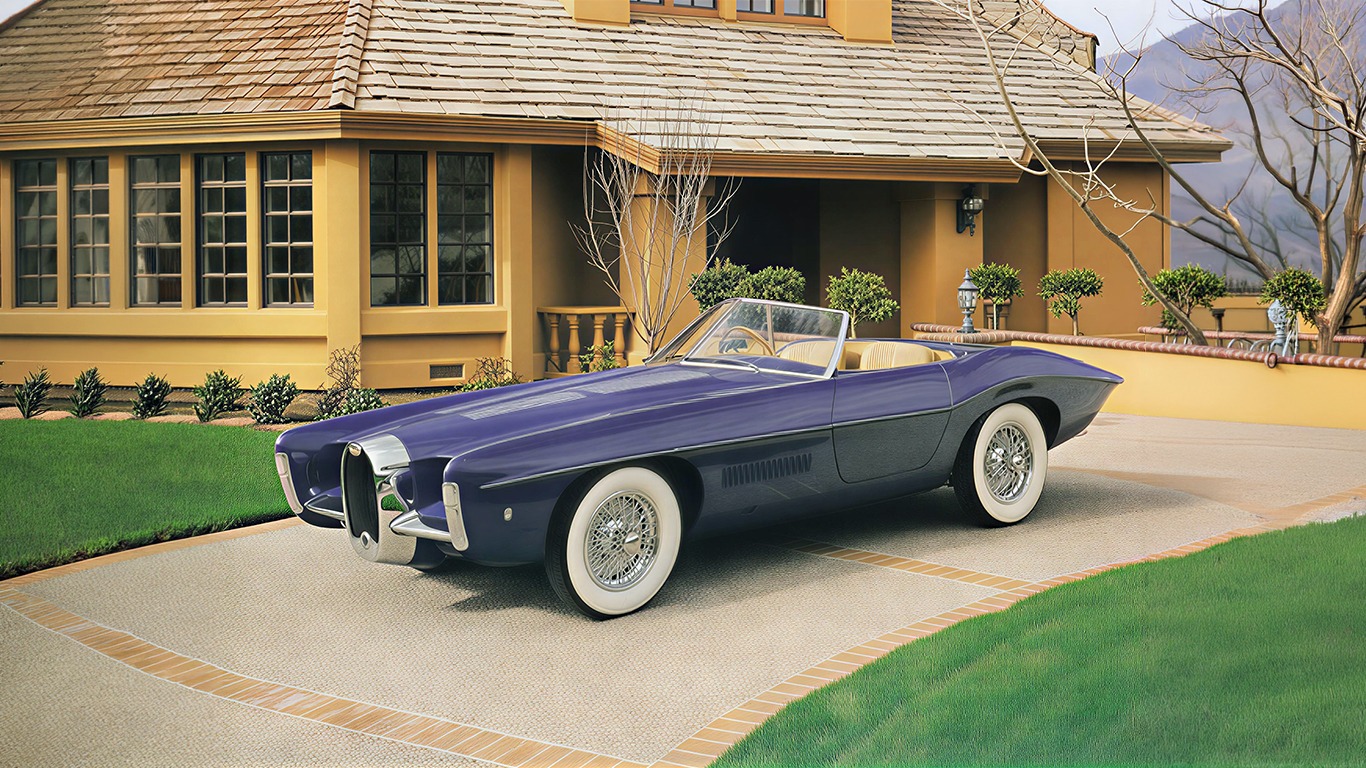
Exner’s sketch of a modern Bugatti roadster particularly captured imaginations. It wasn’t part of the original four Esquire cars, but shortly thereafter Exner designed an updated Bugatti Type 101 roadster (sometimes called 101C) – essentially, “what if Bugatti had built a new sports car in 1965?”. Amazingly, this Revival Car was built. In 1965, famed coachbuilder Ghia constructed a one-off Bugatti roadster on the last existing Bugatti Type 101 chassis, with Virgil Exner Sr. penning the exterior and Exner Jr. contributing to the interior. The finished car – often dubbed the Bugatti 101C Roadster by Ghia – debuted at the 1965 Turin Motor Show. It combined classic Bugatti cues (a proud horseshoe grille, engine-turned dash, etc.) with a sleek Exner body that featured a dramatically long hood and flowing fenders. Underneath, it truly was part vintage Bugatti: the chassis and straight-eight engine dated back to Bugatti’s postwar Type 101 series (a direct evolution of the prewar Type 57). Exner shortened the chassis to a sporty 112-inch wheelbase and Ghia clothed it in steel after six months of hand-crafted work. The result was a “modern classic” two-seater that Motor Trend described in November 1965 as “the latest thing off Exner’s drawing board…his version of the modern Bugatti”, noting its blend of genuine Bugatti mechanicals and contemporary design.
🔗 Read more: The Bugatti That Came Back From the Dead… Then Died Again: Exner’s Type 101C
Despite the wow factor, the Bugatti revival one-off did not manage to revive the marque. By 1965, Bugatti (the company) was moribund, and the Exner/Ghia roadster failed to attract new investors to restart production. It remained a unique specimen – effectively the last “new” Bugatti until the brand’s 1990s resurrection under different ownership. Today that car still exists, cherished in private collections as a fascinating footnote in Bugatti history. It’s a testament to Exner’s vision that he not only sketched a neo-Bugatti but helped will it into reality. In doing so, he ensured that at least one of his Revival Cars earned a physical place in automotive history – an exquisite swan song for the original Bugatti lineage.
Perhaps the most influential of Exner’s Revival Cars was the Stutz. In Esquire, Exner had presented a modern Stutz Bearcat – a low, aggressive roadster referencing the famous Bearcats of the 1910s. That concept, with its side-mounted exhaust pipes and external spare tire, so intrigued financiers that it directly led to the only successful marque revival of the bunch. By 1968, former Duesenberg investor James O’Donnell (often misremembered as “McDonnell”) acquired rights to the defunct Stutz name and hired Exner to turn the Stutz revival concept into a production car. Exner combined elements of his Esquire Stutz Bearcat drawing with cues from his Duesenberg four-door proposal (which had gotten as far as a Ghia-built prototype in 1966).
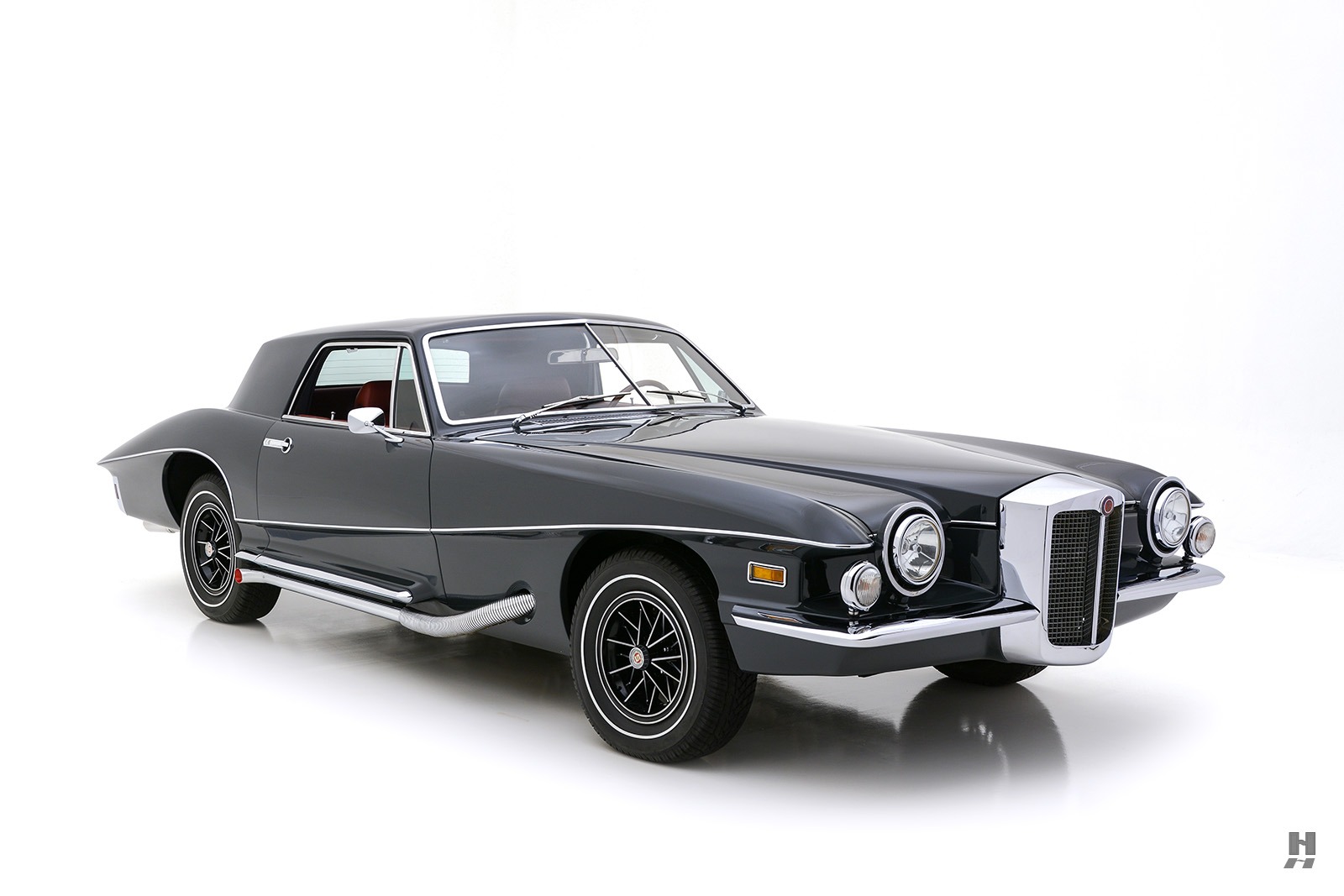
The resulting design became the 1970 Stutz Blackhawk, a flamboyant ultra-luxury coupé coachbuilt in Italy on a Pontiac Grand Prix chassis. The Blackhawk retained the Exner hallmarks – freestanding headlamps, a massive grille, side exhaust pipes, and a sweeping profile – essentially a neoclassical interpretation of a modern Grand Tourer. When the first Blackhawk debuted in January 1970 at New York’s Waldorf-Astoria, it inaugurated the 1970s wave of neo-classics. The car’s exorbitant price and outrageous styling attracted celebrity clients: Elvis Presley famously bought the first one off the line, and performers like Dean Martin and Sammy Davis Jr. soon followed suit. It was the 1970s equivalent of a supercar – not in speed, but in exclusivity and shock value.
🔗 Read more: The Second Life of Stutz: How an American Classic Was Reborn with Italian Flair
Though only a few dozen Stutz Blackhawks were produced, the car proved that Exner’s Revival concept had real commercial legs (if only briefly). It also validated Exner’s belief that American auto design could benefit from looking over its shoulder at the past. The Blackhawk’s success spurred other neo-classic attempts in the ’70s (Zimmer, Clénet, etc.), and in a broader sense, Exner’s early-’60s “retro” ideas helped pave the way for the brougham and neo-classical styling trend that swept Detroit in the late ’60s and ’70s. Cars like the Lincoln Continental Mark III, Cadillac Eldorado and others would adopt long hoods, upright grilles, and vintage cues – just as Exner had prophesied with his Revival drawings.
The Mercer-Cobra – The Revival Car That Actually Bit Back
If the Revival Cars were Exner’s dreams, the Mercer-Cobra was the one dream he actually bolted together and fired up. Before the Bugatti. Before the Duesenberg Model D. In 1964, Exner teamed up with legendary engineer Carroll Shelby (yes, that Shelby) and decided the world needed a modern take on the 1910s Mercer Raceabout — one of America’s original performance cars.
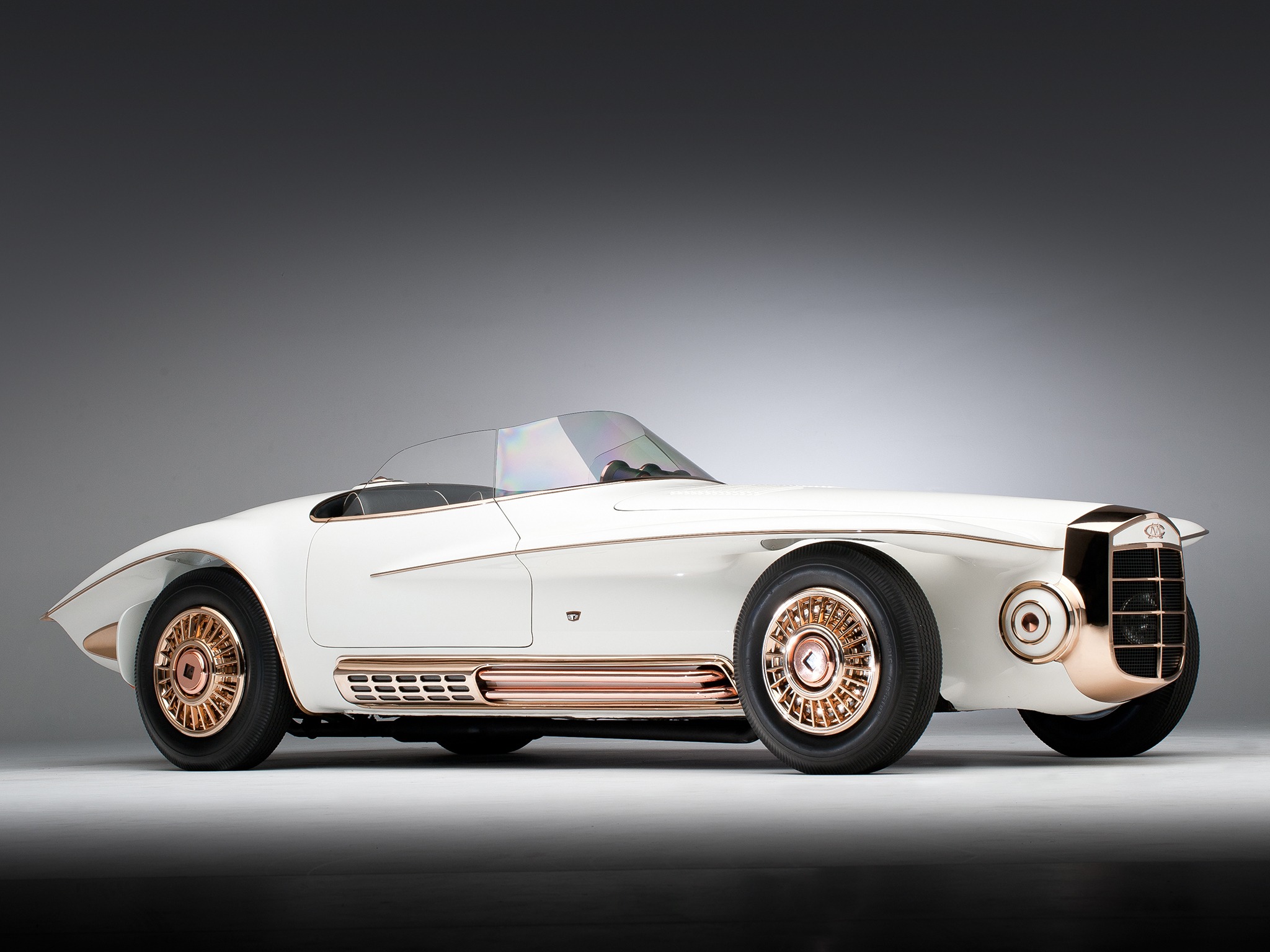
And because subtlety wasn’t part of the menu, they started with a 289-powered Shelby Cobra chassis. Yes: Exner’s Mercer revival wasn’t just a design exercise — it was sitting on one of the hottest sports car platforms in the world.
Ghia didn’t build this one; it was crafted by Sibona-Basano in Turin, the same shop behind some of the prettiest coachbuilt Italian exotics of the ’60s. They wrapped the Cobra frame in a low, copper-colored, coachbuilt body that looked like the 1910s and 1960s had been thrown into a blender at high speed: monocle-style windscreen, exposed side pipes, cycle fenders, riveted metalwork. It was half retro roadster, half Jet Age showpiece, and fully outrageous.
The Mercer-Cobra wasn’t subtle. It wasn’t rational. It wasn’t even meant for production.
It was a statement, the kind of car that makes people at concours events stop mid-sentence and forget what they were talking about.
Under the hood? Still a fire-breathing Cobra V8.
Performance? Let’s just say no other Revival Car was doing 0–60 in “are you even holding on?” times. It drove like a lunatic — because it was built on a lunatic’s sports car.
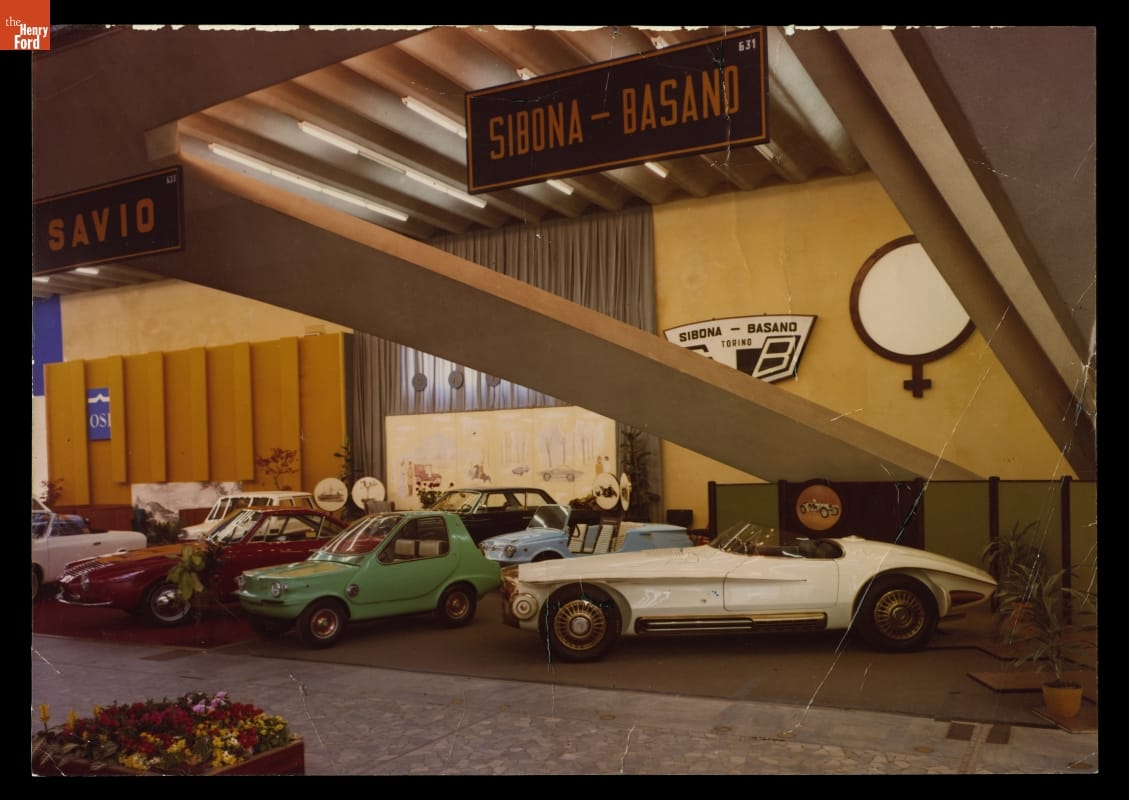
Today, the Mercer-Cobra exists as one of the strangest, most spectacular automotive mashups ever attempted. It proved that Exner’s Revival Cars weren’t just drawings of imaginary pasts. They could be real, loud, fast, and dangerously tempting.
And if we’re being honest, it’s probably the most fun of the entire Revival lineup — because it’s the only one that can leave two black stripes behind it.
When a Designer Decides “Screw It, I’ll Just Build My Own Past”
In the end, Virgil Exner’s Revival Cars weren’t corporate strategies or marketing studies. They were the automotive equivalent of a mic drop — a designer looking at the sanitized ’60s car market and saying, “Fine. If no one else will bring back the good stuff, I will.”Though only a few dozen Stutz Blackhawks were produced, the car proved that Exner’s Revival concept had real commercial legs (if only briefly). It also validated Exner’s belief that American auto design could benefit from looking over its shoulder at the past. The Blackhawk’s success spurred other neo-classic attempts in the ’70s (Zimmer, Clénet, etc.), and in a broader sense, Exner’s early-’60s “retro” ideas helped pave the way for the brougham and neo-classical styling trend that swept Detroit in the late ’60s and ’70s. Cars like the Lincoln Continental Mark III, Cadillac Eldorado and others would adopt long hoods, upright grilles, and vintage cues – just as Exner had prophesied with his Revival drawings.
Half dream, half provocation, they jumped from magazine pages to model kits to full-size coachbuilt metal, dragging long-dead marques into the Jet Age just to prove he could. And even when the projects went nowhere, they still managed to embarrass an entire industry by showing how much personality had leaked out of car design.
Most of the Revivals stayed fantasy. A few escaped into the real world. But all of them revealed the same truth: Exner didn’t just love the classics — he wanted to pick a fight with time itself. And for a brief, glorious moment, it looked like he might win.

ABOUT THE AUTHOR
Andreas Scheidl
Italian classic car enthusiast with German roots. Renowned as a respected figure in the classic car community, he serves as a jury member at various international concours d'elegance, including the Classic Gala Schwetzingen and Mantova. As a content creator, Andreas passionately shares his profound knowledge and appreciation for vintage automobiles. His heart beats for cars designed by Giovanni Michelotti, showcasing his discerning taste and dedication to preserving the timeless elegance of automotive history.
More stories by Andreas Scheidl ↗CONTINUE READING
Posts You Might Like
Reinterpreting the Past: When Coachbuilders revisited it’s Icons
When iconic coachbuilt cars are rebade through time, intent matters more than nostalgia. From experimental originals to modern reinterpretations, this article examines how legends are reimagined—and why some ideas refuse to stay…
Read story
Neither Coupé nor Spider: Italy and the Targa Roof
A deep dive into Italy’s decades-long exploration of the targa roof—from early post-war experiments to Ferrari and Lamborghini icons—revealing how Italian designers created a third way between coupé and spider.
Read story
Italian Vision of the MPV: The Monovolume Concept
Long before MPVs filled suburban driveways, Italian designers were shaping the monovolume with prototypes that ranged from pragmatic to outright outrageous. Their work rewrote how space, style, and function could fit under…
Read story
Italian Coachbuilt City Car Concepts: From Microcars to Urban EVs
How did Italy’s famed coachbuilders go from designing Ferraris to dreaming up tiny electric runabouts? From the quirky Tsé-Tsé to Pininfarina’s visionary Nido, discover how city cars became a proving ground for…
Read story
THE CONVERSATION
Comments 0
Share a memory, a period photograph or a documented detail about this story.