
The Bugatti That Came Back From the Dead… Then Died Again: Exner’s Type 101C
By the middle of the 20th century, the name Bugatti felt like a ghost story whispered among old mechanics. Ettore was gone, Jean had been lost years earlier, and the workshops at Molsheim—once alive with the clatter of prewar glory—had fallen quiet enough for dust to become a permanent resident.
Bugatti tried once more to stir, offering the world the Type 101 in 1951: a last-ditch, postwar salute built from the remaining bones of the legendary Type 57. It carried the familiar 3.3-liter twin-cam straight-eight—supercharged, it could still belt out close to 200 horsepower, enough to embarrass many European engines of the day. But brilliance alone couldn’t turn back the clock. Only a tiny handful of Type 101s ever materialized, each one wearing a custom coachbuilt suit as if attending its own farewell gala.
By 1952, even that flicker faded. A few unfinished chassis sat abandoned in Molsheim, silent witnesses to a dynasty that seemed destined to end not with a bang, but with a sigh.
And then—years later, thousands of miles away—an American designer with a taste for the dramatic glanced at this forgotten chapter and thought: Bugatti isn’t done yet.
What followed was one of the strangest, boldest, and most romantic resurrection attempts the marque would ever see.
Virgil Exner and the Revival Dream
The man who dared to resurrect Bugatti wasn’t French, wasn’t a racing baron, and certainly wasn’t shy. Virgil M. Exner was Detroit royalty—the stylist who had given Chrysler its “Forward Look” and half a decade’s worth of concept cars that looked like they’d been pulled from science-fiction storyboards. But by 1962, Exner found himself on the outside of the company he’d helped reshape, still buzzing with restless creative energy and a lifelong affection for the great marques of the prewar age.
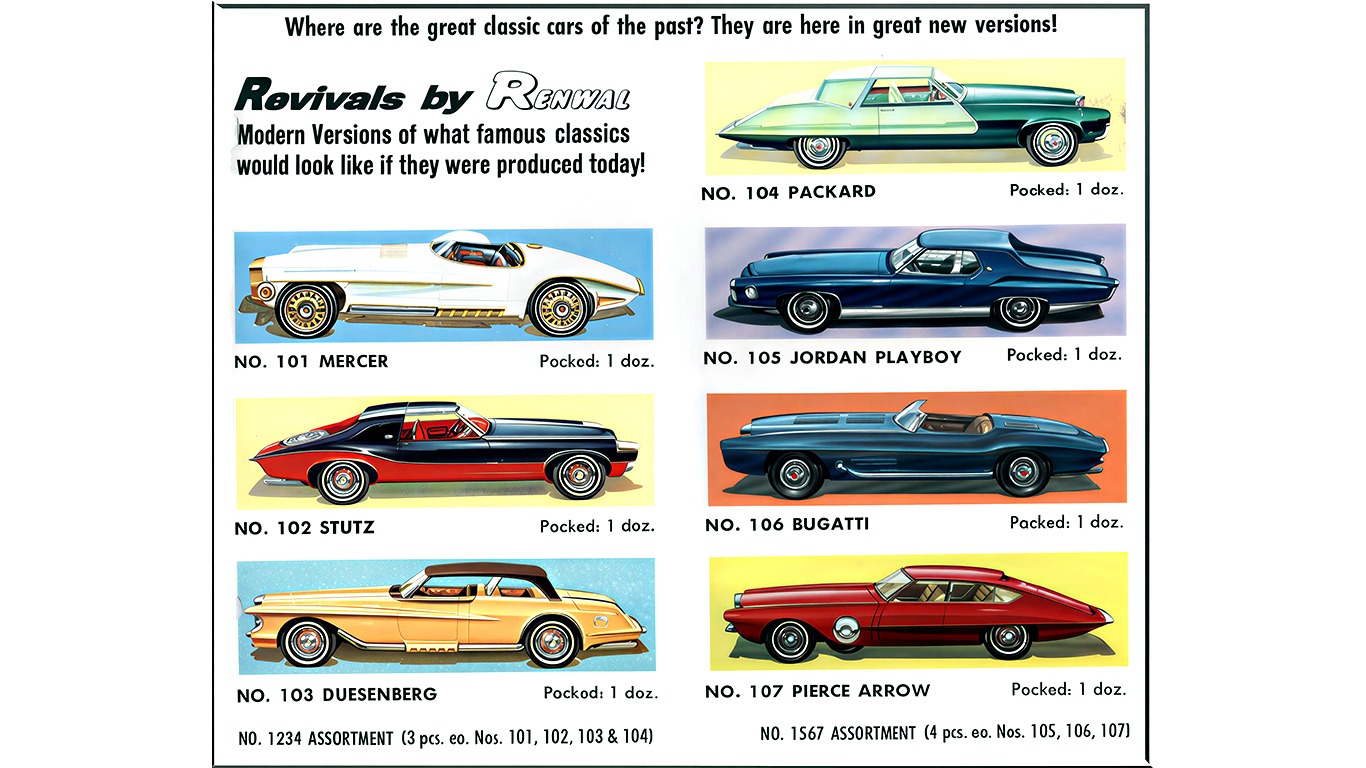
While others sketched doodles during lunch breaks, Exner sketched resurrections. In a 1963 issue of Esquire, he unveiled design studies for modern Duesenbergs, Stutzes, Packards, and Mercers—cars whose names already sounded like artifacts from a lost civilization. Bugatti, of course, soon entered his imagination too. These weren’t indulgences or idle fantasies; to Exner, reviving a dead marque was both a design challenge and a romantic quest.
And the 1960s were the perfect moment. The world was trading tailfins for minimalism, chrome for clean lines. Design was evolving by the month. Yet Exner believed there was still a place for cars that blended modern performance with the glamour of the 1930s—the era when Ettore Bugatti ruled the concours lawns and the Grand Prix grids alike.
🔗 Read more: Virgil Exner’s “Revival Cars” Design Concept: A Tribute to Automotive Legends
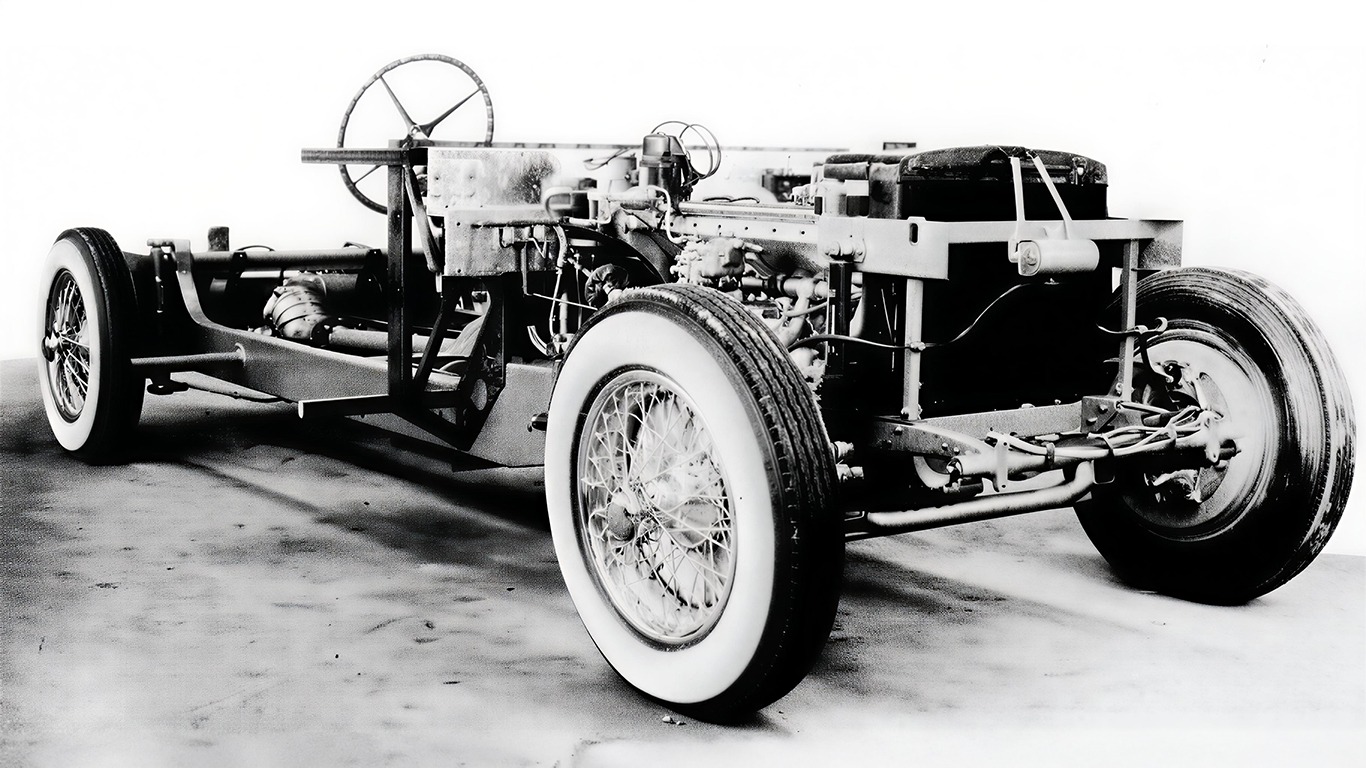
Bugatti, with its unmatched prewar pedigree, was the ultimate prize. And as fate would have it, one last opportunity remained: a lone, unbodied Type 101 chassis, number 101506, a relic of Bugatti’s failed attempt at a postwar comeback. Built in 1951, fitted with a supercharged Type 57 straight-eight, and intended as a show chassis, it had somehow never received a body. For years it existed in a sort of mechanical limbo—tended by Pierre Marco at Molsheim, briefly considered by a French enthusiast who asked Giovanni Michelotti to sketch a coupe for Vignale, and eventually crossing the Atlantic into the hands of American Bugatti collector E. Allen Henderson.
This was no ordinary chassis. It was Bugatti’s final heartbeat—waiting, quite literally, for someone to bring it to life.
That someone arrived in 1964, thanks to L. Scott Bailey of Automobile Quarterly, who quietly told Exner that Henderson might be willing to part with the orphaned relic. Exner didn’t hesitate. He and his son soon found themselves deep in rural New Jersey, standing before what looked like a treasure trove from a fever dream: fourteen unrestored Bugattis, packed wing-to-wing inside a barn. And at the center of it all, chassis 101506—bare, running, surreal.
To Exner, it wasn’t just a chassis. It was destiny.
What followed was one of the strangest, boldest, and most romantic resurrection attempts the marque would ever see.
For $2,500—an absurdly small sum even then—the deal was struck. In the dead of winter, Exner Jr. and a friend loaded the naked frame onto a trailer, pointed a station wagon toward Michigan, and drove straight into snowstorms and subzero winds with their priceless cargo rattling behind them.
When they finally rolled it into the Birmingham studio, father and son looked at the chassis and saw not what it was, but what it could be: the modern Bugatti the world had forgotten it needed.
The revival was officially underway.
Designing a Modern Bugatti
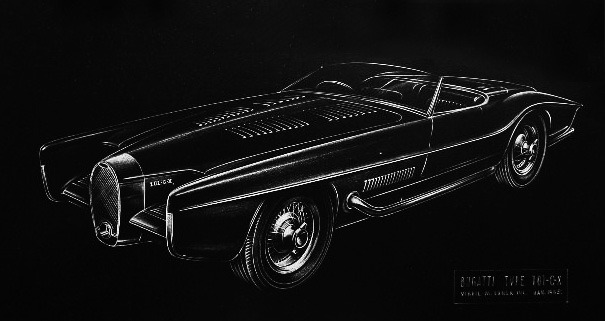
Back in Michigan, Exner Sr. and Jr. rolled up their sleeves to design a body that would honor Bugatti’s legacy while bringing it into the 1960s. The task was daunting: how to clothe an antiquated grand-tourer chassis in contemporary sports car style without losing the marque’s identity. Exner’s guiding light was the iconic Bugatti horseshoe grille. Many designers had struggled with integrating that distinctive oval grille shape on modern cars, but the Exners were determined to make it the centerpiece of their design. They envisioned a low-slung, athletic roadster – something that could compete for attention with a Ferrari or Jaguar of the era, yet immediately be recognized as a Bugatti.
First, some engineering adjustments were necessary. The Type 101 chassis, derived from the prewar Type 57, was quite large and built for a more upright touring body. To achieve the sleek proportions Exner wanted, the team shortened the wheelbase by 18 inches, from about 130 inches down to roughly 112 inches. Exner Jr., along with engineer friends Paul Farago and Dale Cosper, cut and re-welded the chassis frame to remove the excess length. They also lowered the cowl and dropped the seating position deep between the frame rails, dramatically reducing the car’s profile. These modifications were crucial to give the new roadster a low, aggressive stance – the original chassis sat high with a straight-rail frame and solid axles, great for 1930s coachbuilt cars but not for a 1960s sports car. By the time they were done, the chassis sat much lower to the ground, ready to receive a sporty body.
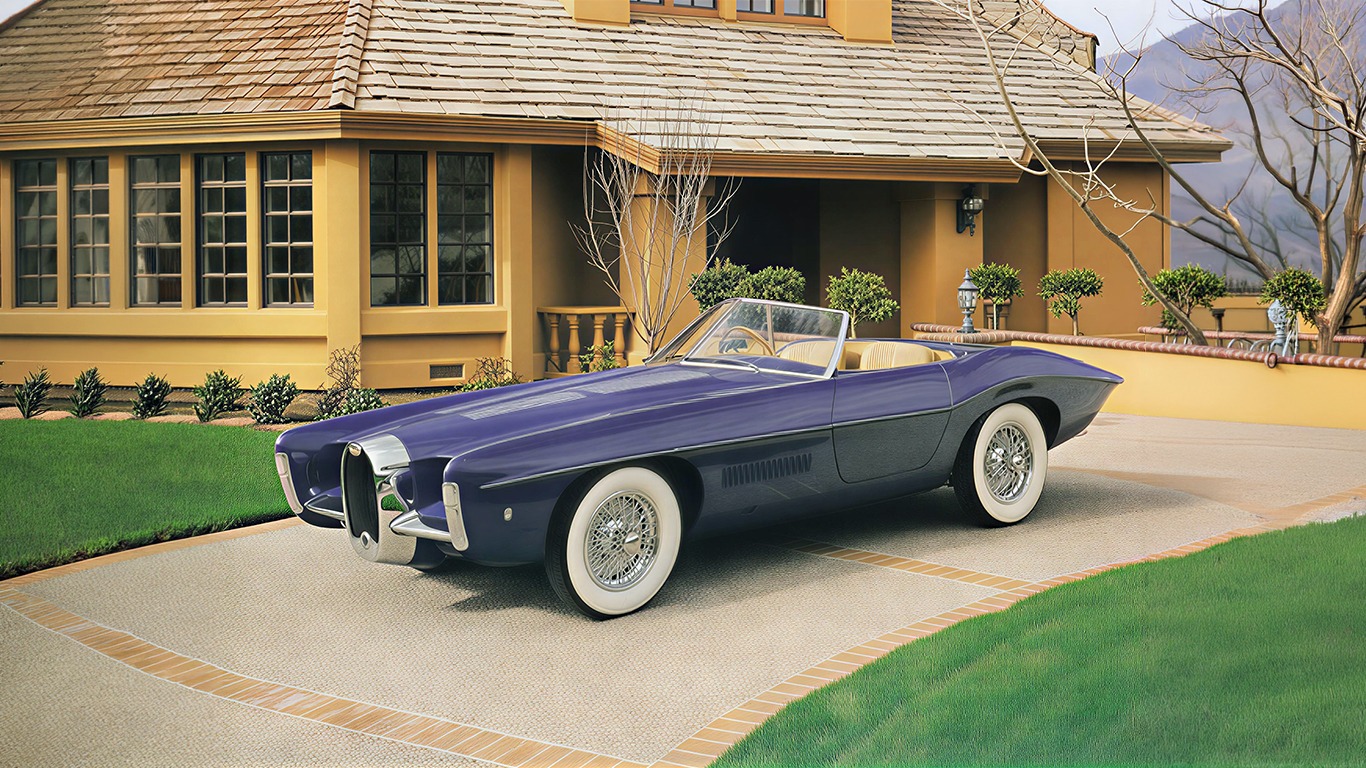
Virgil Exner Sr. then translated his vision into shape. Working with his son and team, he created sketches and even a scale model to refine the design. The aesthetic they settled on was a fascinating blend of old and new. Classic Bugatti elements were carefully woven into a modern form: The horsehoe grille was placed proudly at the nose, flanked by twin hood intakes. Exner gave the car a long, pontoon-fendered front end with flowing fenders that evoked the prewar Type 57SC Atlantics and Corsicas, yet the overall lines were crisp and contemporary. The fenders swept back into a tapered tail, described as almost Corvette-like in its curved rear deck. A slight “swage” character line ran the length of the car, kicking up over the rear wheels – a flourish that added visual motion to the profile. In side view the car had a dramatic stance: low hood, a sharply raked split windshield (a “motorboat-style” vee windscreen), and a boat-tail hint in the tapered rear.
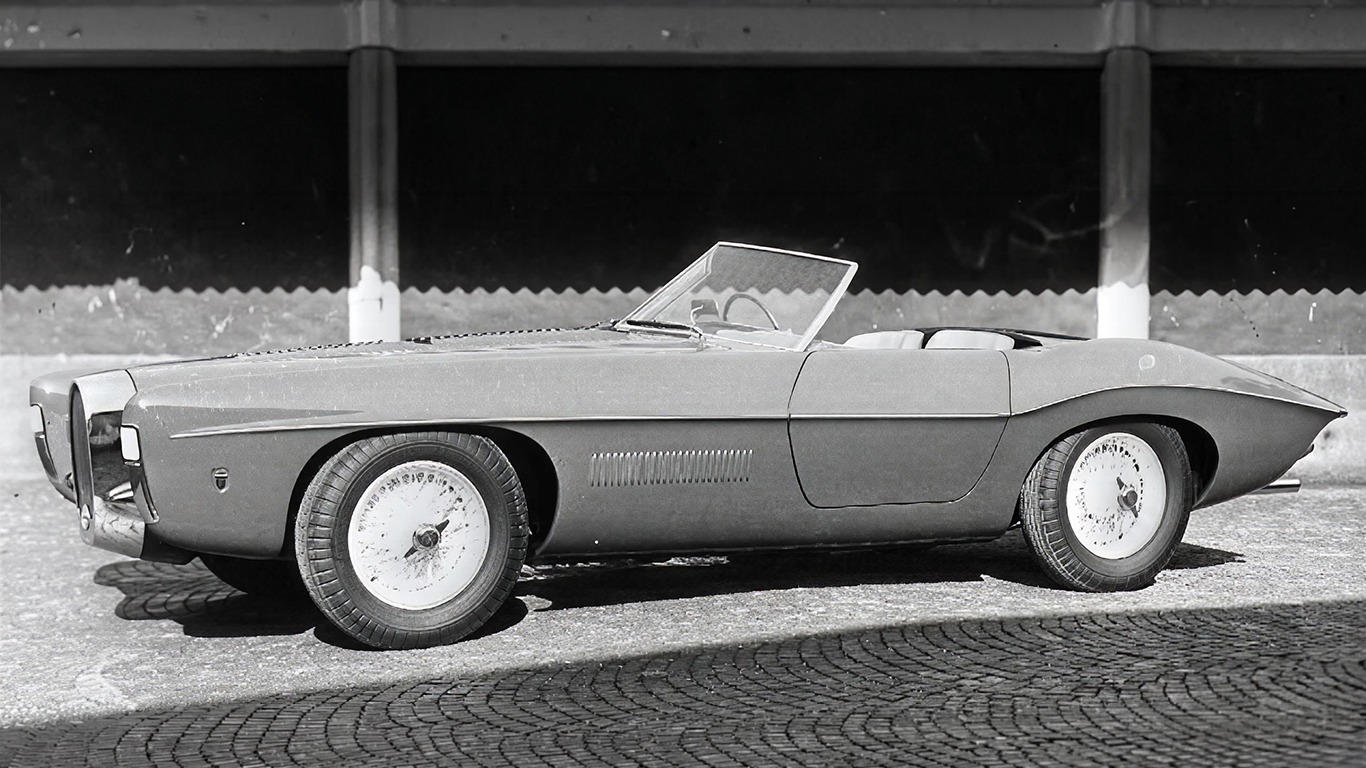
The Exners paid homage to Bugatti’s racing heritage with functional details. The long hood and flanks were peppered with louvers, recalling the famous Bugatti Grand Prix machines. Out back, they chose oval taillamps as a subtle nod to the oval Bugatti logo badge. Initially, Exner even contemplated routing the exhaust as an external side pipe along the left side – much like a classic Grand Prix Bugatti – although this feature was ultimately dropped in the final build. Importantly, the signature grille itself was kept very true to tradition: an upright ovoid radiator shell that immediately said “Bugatti”, yet tidily integrated into the curvaceous front end. This touch won praise from marque experts; historian Barrie Price later commended Exner’s grille as “the most traditional interpretation of the Bugatti horseshoe seen on any Type 101” – high praise, considering several original Type 101s in the 1950s had rather awkward frontal styling. In Exner’s hands, the timeless Bugatti face was reborn gracefully.
🔗 Read more: Virgil Exner was the designer who taught Detroit to dream again
Inside, Virgil Exner Jr. took charge of the interior design, determined to make the cockpit as bespoke and luxurious as Bugatti owners of old would expect. The resulting cabin did not disappoint. It was upholstered in rich materials and featured elegant touches like roll-top wood compartments in the doors (for storage) and a full complement of analog gauges with jewel-like bezels. Despite being a two-seat sports car, it aimed to exude the feel of a grand tourer in the Bugatti tradition – blending sport and luxury. Exner Jr.’s work gave the car a personality and panache that set it apart from the minimalist roadsters of the day. Crucially, the design also accounted for practicalities: unlike many show cars, this one was built with a folding soft top (all-weather equipment) and proper road equipment, since the intent was to have a fully usable automobile.
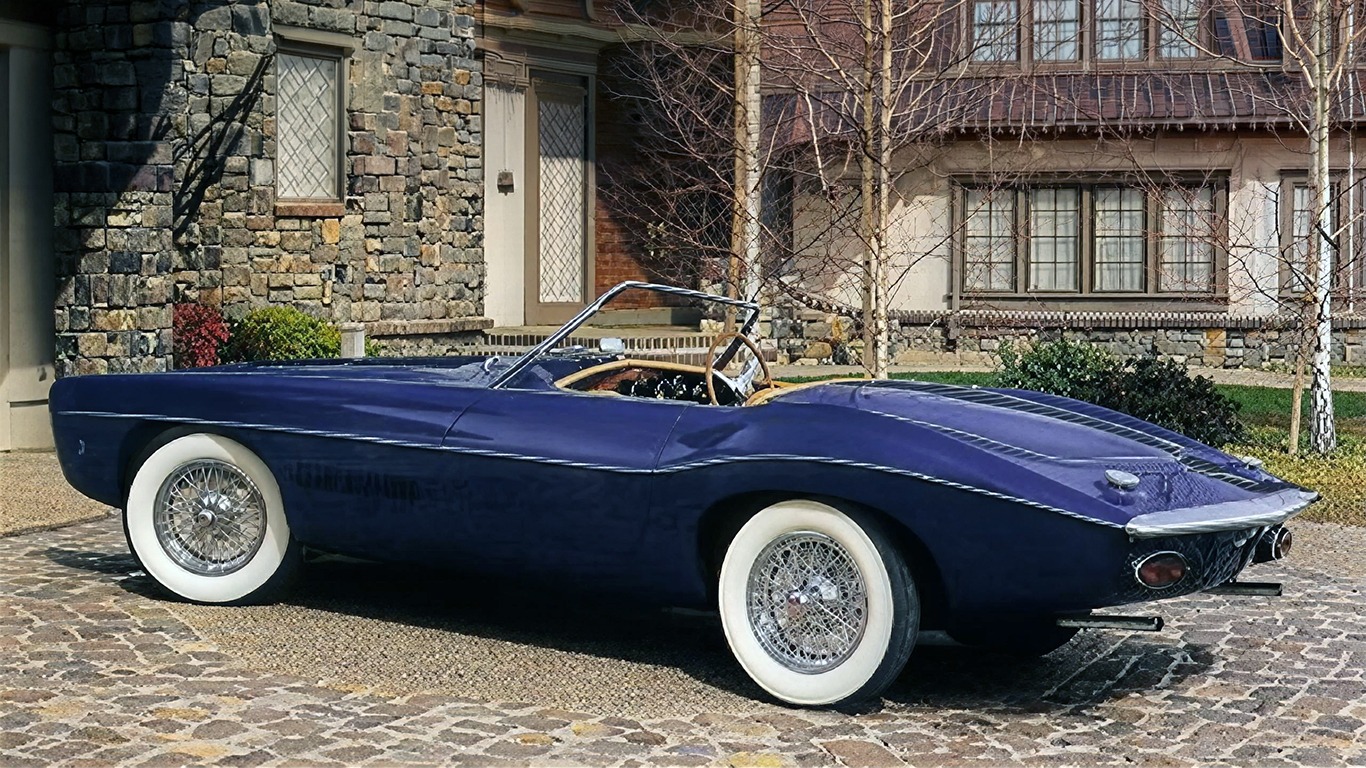
Mechanically, the car remained pure Bugatti – at least under the hood. Exner had acquired the chassis complete with its original 3.3-liter straight-eight, engine no. 101506. This dual overhead cam engine with a Roots supercharger produced on the order of 190 horsepower in its final tune. By 1960s standards, 190 hp was not extraordinary, but it was on par with contemporary Jaguar XK or Aston Martin units and certainly enough to give a lightweight roadster brisk performance. In fact, when the Type 57-derived engine first appeared in the early ’50s, Bugatti proudly noted it made the highest horsepower of any European road car of its time, rivaling even American V8s. The transmission in the chassis was a 4-speed manual (the original plan to use a French Cotal electric pre-selector gearbox was likely scrapped or never implemented on this last chassis). The chassis retained its sturdy prewar-style suspension: a solid front axle located by radius rods and semi-elliptic springs, and Bugatti’s hallmark quarter-elliptic springs in the rear. Exner’s challenge was to hide these old bones under a modern skin, and by all accounts he succeeded – the styling cleverly masks the high frame rails and traditional suspension by using the flowing fender line and lowered stance to make the car look far more modern than its underpinnings.
Italian Craftsmanship by Carrozzeria Ghia
With designs and scale models in hand, the Exners turned to an old friend for the actual coachbuilding: Carrozzeria Ghia of Turin, Italy. Ghia had built many of Virgil Exner’s concept cars during his Chrysler days in the 1950s, and their craftsmen were experts at turning drawings into metal. In mid-1965, the shortened Bugatti chassis was shipped off to Ghia. There, a team of artisans hand-formed an all-steel body over the custom frame, adhering faithfully to Exner’s design details. In fact, Ghia built the car strictly to the Exners’ quarter-scale model and blueprints – and they did so with such precision that only a couple of minor changes were made during construction. One alteration was to split the one-piece curved windshield in two (perhaps for structural rigidity or sourcing reasons), yielding a twin-pane vee windscreen that actually enhanced the “classic roadster” feel. The other was the aforementioned rerouting of the exhaust to a conventional under-car location, instead of the initially envisioned external side pipe. Almost every other element came out exactly as planned: the long bonnet with its vents, the tapered tail, the low-cut doors, even details like the slight fins over the rear fenders and the placement of chrome bumpers and trim. Ghia proudly affixed its coachbuilder’s badge in a rather unconventional spot – low on the front fender, just ahead of the wheel well – as if signing a piece of art.
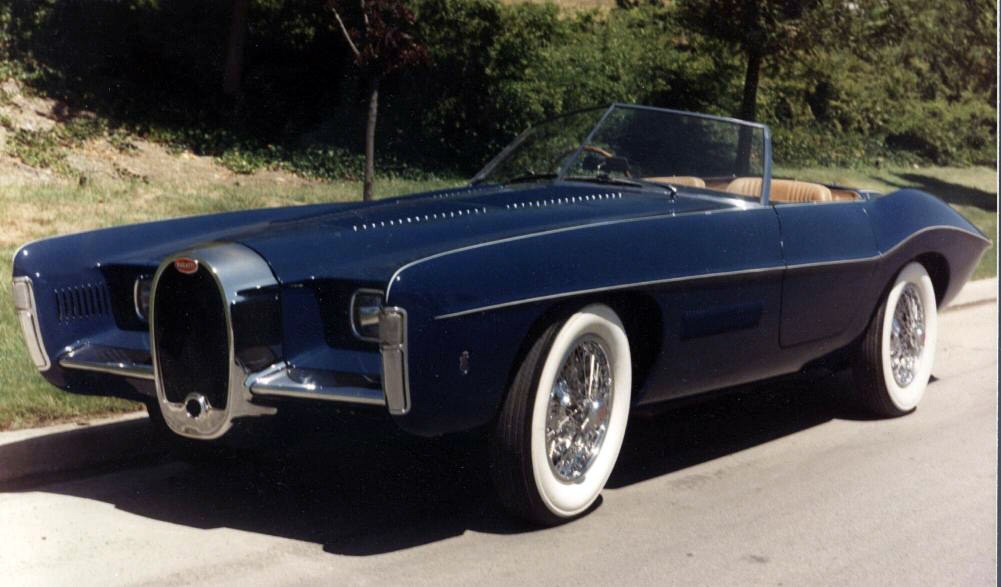
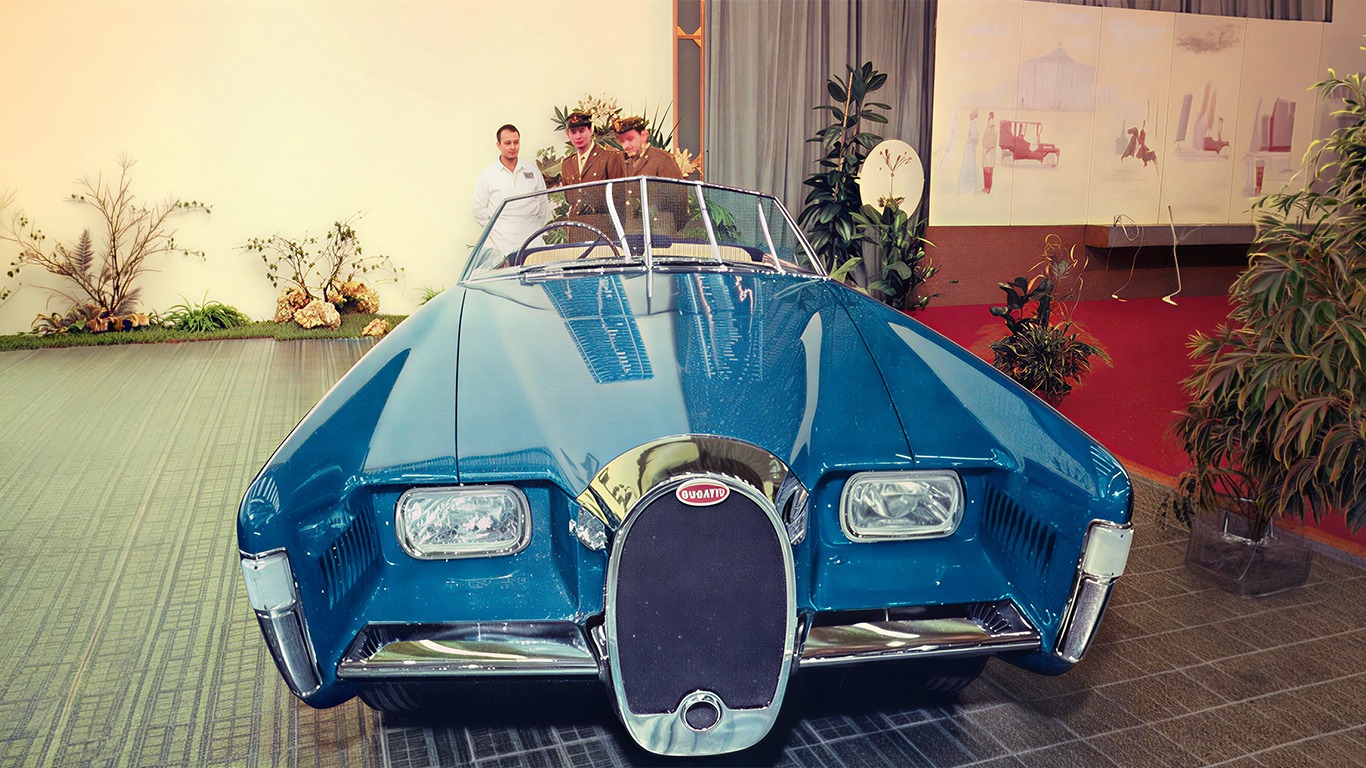
One fortunate aspect of this project was that Exner did not have to pay Ghia out-of-pocket for the build. The Italian coachbuilder absorbed the construction costs as a form of barter settlement for fees it actually owed Exner from previous consulting work. According to accounts, Ghia had accumulated about $27,000 in unpaid design consultancy fees with Exner’s firm, and the decision was made to square up the debt by effectively delivering the completed Bugatti body at no charge. This mutually beneficial arrangement meant Exner got his dream car built without scrounging for a separate bankroll – and Ghia got to showcase its talents on a high-profile project. It took Ghia roughly six months to transform the bare chassis into a finished automobile. The result was stunning to behold: the car was painted a deep midnight blue, accented by elegant ivory-white wire wheels (a nod to Grand Prix Bugattis that often wore bright wheel paint). Every line and curve exuded tailored craftsmanship. Standing next to the low roadster, one could admire touches like the polished aluminum fuel filler caps (there were two, for symmetry, though only one fuel tank) and the neatly integrated driver’s wind deflectors. The suicide-style doors (hinged at the rear) opened to reveal the sumptuous interior, complete with engine-turned metal dash inserts and bespoke switchgear – a blend of modern 1960s style and classic Bugatti artistry.
🔗 Read more: The Partnership between Ghia & Chrysler
By late 1965, the one-off Bugatti was ready for its public debut. It was more than just a design study now; it was a fully functional automobile, arguably the first “new” Bugatti car to hit the road since the early 1950s. All it needed was an audience – and hopefully, an investor or two willing to finance a production run. Exner and Ghia chose the perfect stage for the grand unveiling: the 1965 Turin Motor Show.
Turin 1965: Unveiling a New Bugatti
In November 1965, the Turin Salon opened its doors to the automotive world, and among the many exciting concept cars and production debuts, an arresting blue roadster took center stage at Ghia’s stand. The signage identified it as a Bugatti 101C – immediately piquing curiosity, as Bugatti was a dormant marque. Showgoers and journalists gathered around to inspect this transatlantic creation. They found an exquisite two-seater roadster that looked at once modern and nostalgic. The long hood, chrome accents, and that signature grille gave it an unmistakable identity. It was as if Bugatti had been awakened from a two-decade sleep, dressed in contemporary fashion yet still recognizably aristocratic.
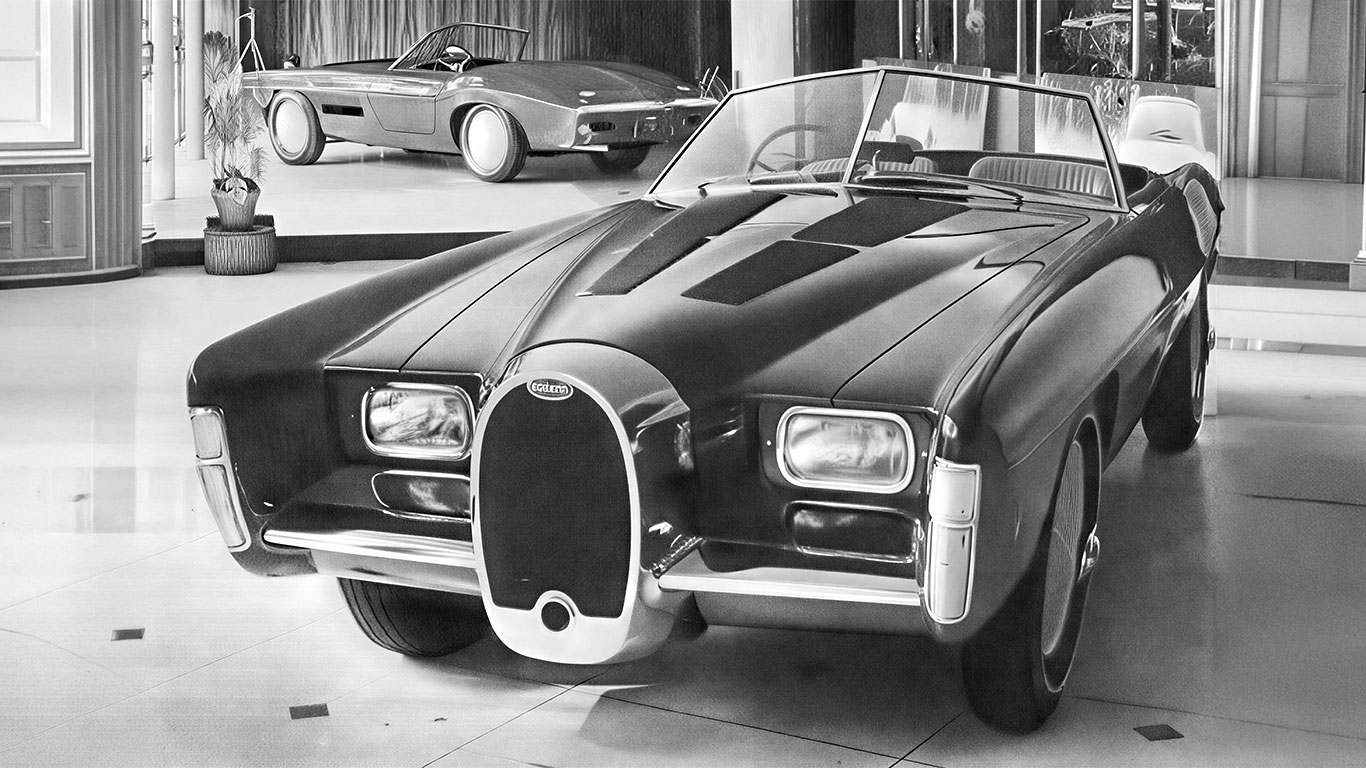
The reaction in the press was enthusiastic. Motor Trend magazine, for instance, ran a piece on the Exner-designed Bugatti, calling it “a modern classic 2-passenger roadster” – the very latest from Virgil Exner’s drawing board, and “his version of the modern Bugatti.” The article duly noted that the chassis was shortened to 112 inches from the original 130 and that power came from “the last DOHC Type 57 straight-8 Bugatti built in 1951 by Pierri Marco, Ettore’s right-hand man.” Only a half-dozen of those chassis were made, Motor Trend reminded readers, and this was the lone one left to be bodied. Indeed, the car on display at Turin was carrying not just its own sleek bodywork, but also the weight of Bugatti’s heritage on its shoulders.
Critics and enthusiasts praised how well the design blended old Bugatti cues with new ideas. The low-slung stance and dramatic fender sweep were seen as a triumph of engineering and styling, given that the underlying chassis had not been intended for such a sporty silhouette. To achieve its low height and balanced proportions, Exner’s team had performed what one expert called a “tour de force” – lowering the car’s profile by cutting down the cowl and sinking the seats within the frame. The result was that the roadster sat impressively low and sleek, belying its prewar bones. From the front, the car presented an aggressive face: the oval Bugatti grille leaned forward between two faired-in intakes that housed rectangular headlamps – a modern twist, since classic Bugattis had separate round headlamps. The way Exner executed this feature drew particular notice. As author Karl Ludvigsen later noted, Exner had the courage to avoid simply copying Jean Bugatti’s 1930s designs (like the Type 57SC) and instead crafted something new. Yet he did so with enough respect for tradition that the result felt authentic. Barrie Price’s comment that it was “entirely in the tradition of many previous Bugattis” despite being “somewhat amazing” in style, perfectly encapsulated the balance Exner struck.
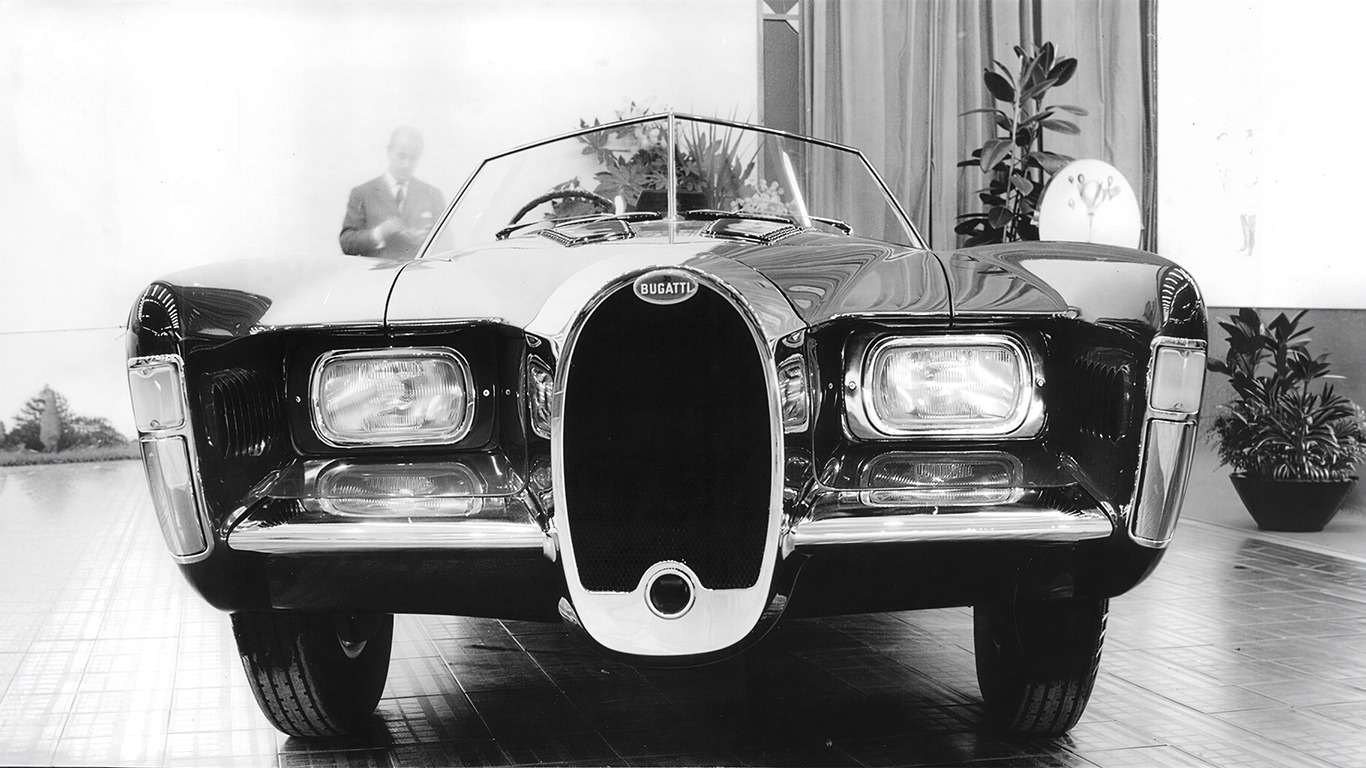
The car’s rich midnight blue lacquer finish gleamed under the show lights, and its interior – visible with the top stowed – impressed onlookers with its detailed luxury. Clearly this was not a stripped-down racer but a proper Bugatti grand routier in the making, with supple leather seats, a turned-metal dash, and finely appointed trim. It even had a set of fitted luggage (as some reports later indicated) and a folding roof concealed behind the cockpit. Such touches reinforced that this car was production-intent, not just a styling exercise.
However, the Turin Motor Show unveiling was a bittersweet moment. Exner and the small cadre of Bugatti faithful hoped that the 101C Roadster would attract a wealthy sponsor or a consortium willing to finance Bugatti’s return. The idea was that this prototype could lead to a limited production run – likely using modern components (perhaps a contemporary chassis and drivetrain) wrapped in Exner’s design. Virgil Exner openly expressed his hope that showing the car in Turin would spark interest in a production series with an updated chassis and more powerful engine. After all, by 1965 Bugatti’s old straight-eight, while charming, was technically antiquated; any serious revival would need a modern powerplant. But the concept on display was meant to signal what a “modern Bugatti” could look like, and to test the public’s reaction.
Unfortunately, no financier stepped forward. Despite the car’s beauty and the nostalgia it evoked, the mid-1960s automotive industry was not kind to such revival ventures. The Bugatti name, revered as it was, belonged to a bygone era in the eyes of major manufacturers. Further, the resources required to restart a car marque – even on a boutique scale – were enormous. Exner’s one-off garnered admiration but not the investment needed to put it into production. As one historian put it, “financing could not be arranged and production plans were scrapped.” The 1965 Ghia-built roadster thus remained a one-of-one dream car, rather than the first of a new lineage. In hindsight, it was the last new car ever to wear the Bugatti badge until the marque’s official revival decades later.
Aftermath: The One-Off’s Odyssey
With the Turin show behind it and no revival forthcoming, the Exner-designed Bugatti became a unique curiosity in automotive history – a footnote to what might have been. Yet the car itself very much came to life beyond the show circuit. Virgil Exner retained the 101C Roadster as his personal vehicle for a few years after 1965. This was no trailer queen: Exner reportedly put around 1,000 miles on the Bugatti, driving and enjoying the machine he and his son had created. One can imagine the sight of this elegant blue roadster wafting through the streets of Birmingham, Michigan – a small taste of Bugatti’s renaissance, however fleeting.
By 1969, Exner decided to part with the car. He sold it to Thomas W. Barrett III, a well-known collector of classic supercharged cars and European exotics. (Barrett, incidentally, would later co-found the Barrett-Jackson auction, underscoring his stature in the collector world.) Barrett III was exactly the sort of enthusiast who appreciated the Bugatti’s significance; he added it to his stable of rarities and kept it for a time. The next owner was Irving “Bud” Tushinsky, another American car connoisseur who had a penchant for unusual classics. Under Tushinsky’s care, the Exner Bugatti continued to make appearances at shows and gatherings, often billed as “The Last Bugatti.”
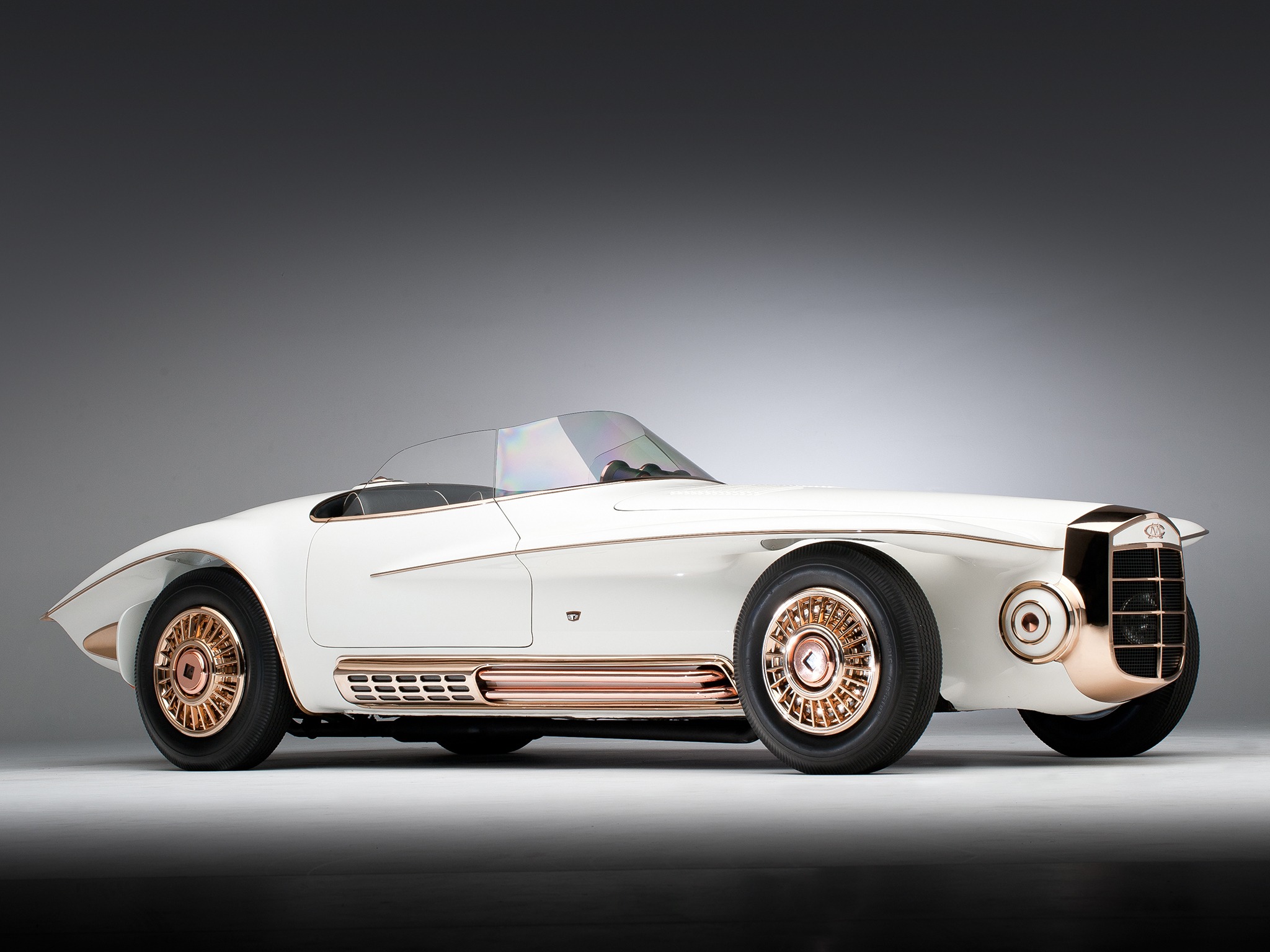
In the early 1980s, the car came into the sights of the famous Blackhawk Collection in California – a group known for dealing in and exhibiting some of the world’s most exceptional automobiles. The Blackhawk Collection acquired the Bugatti around 1984 from a private seller. They eventually sold it to General William Lyon, a prominent American collector based on the West Coast. General Lyon (a retired Air Force General turned businessman) had a world-class collection, and the Exner Bugatti took its place among other crown jewels of motoring. In Lyon’s stable, interestingly, it was reunited in spirit with a sibling of sorts: Lyon also owned the 1964 Mercer-Cobra Roadster, a one-off concept sports car that Virgil Exner Sr. had designed just a year before the Bugatti. That Mercer was another “revival” dream – an homage to the Mercer Raceabout built on a Shelby Cobra chassis, clad in gleaming copper-toned bodywork. Seeing Lyon’s collection, one could find both the Bugatti 101C Roadster and the Mercer-Cobra parked together – tangible proof of Exner’s relentless imagination in resurrecting the past. What a legacy! as one writer exclaimed, that these exotic embodiments of Exner’s vision survived and were treasured decades later.
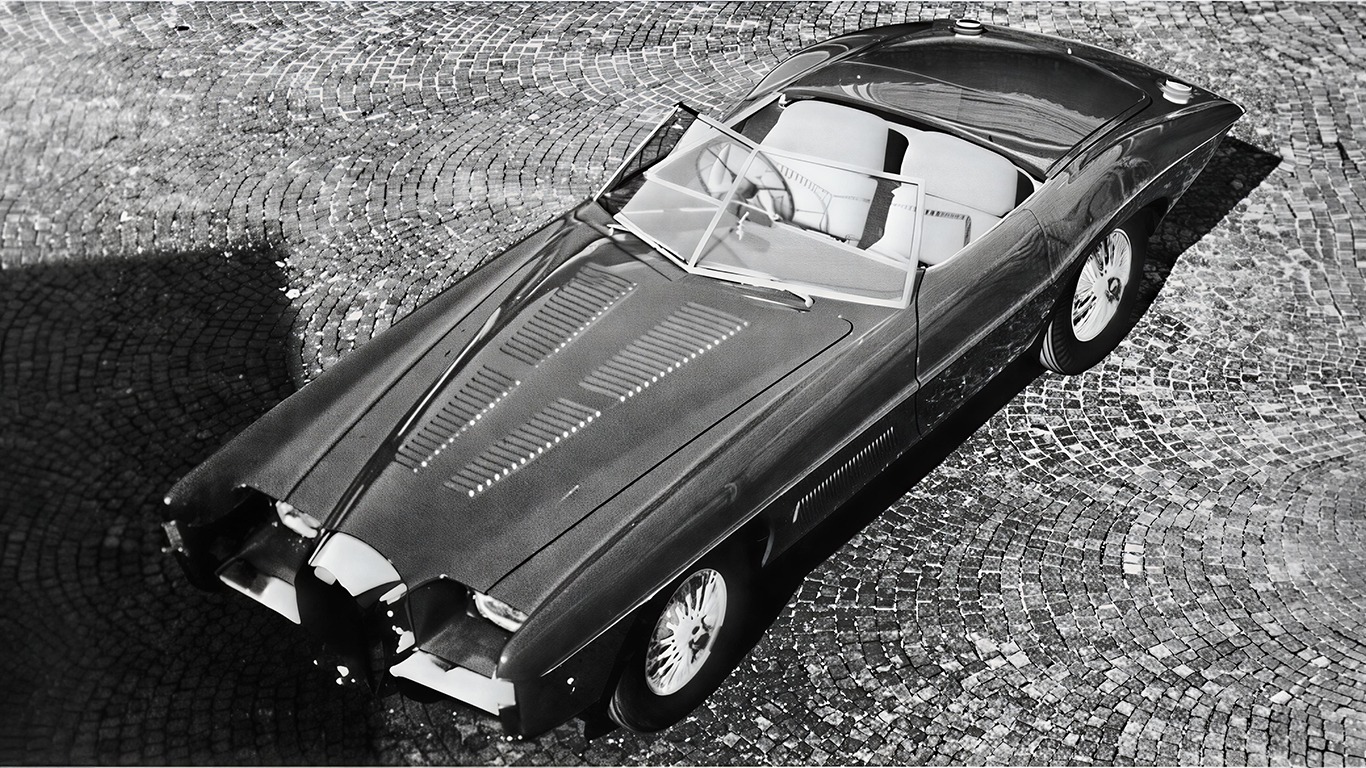
Over time, the Exner/Ghia Bugatti became a celebrated guest at major car events. It has been displayed at the Pebble Beach Concours d’Elegance, drawing fascinated crowds who may not even have known Bugatti built a car in the 1960s. In 2022, it joined all the other surviving Type 101 chassis for a special exhibition at the Cité de l’Automobile (Schlumpf Museum) in Mulhouse, France. There, under museum lights, the Exner roadster stood alongside its 1950s siblings – an extraordinary reunion of “Les sept Bugatti Type 101.” Notably, chassis 101506 still belonged to the Lyon family as of that exhibition, indicating that General Lyon’s estate had retained it even after his passing. It sat as the final car in the lineup, visually emphasizing that it was the last Bugatti of the original era.
Wherever it appears, the 1965 Bugatti Type 101C Roadster by Ghia never fails to intrigue. It provokes onlookers to ask “What is this Bugatti?” – since it defies the usual timeline of Bugatti models. In many ways, it is a bridge between eras: the swan song of Ettore Bugatti’s engineering, married to the forward-looking style of a 1960s dream car. It carries the DNA of the prewar classics but also the fingerprints of Virgil Exner, an American stylist who dared to believe that past glory could be reborn.
Exner’s Revival Cars: A Broader Legacy
The Exner Bugatti was part of a larger saga in which Virgil Exner sought to revive golden-age marques. While the Bugatti project reached the metal-and-rubber stage, other Exner revival concepts had varying fates. In 1965, around the same time the Bugatti was taking shape, Exner unveiled the Mercer-Cobra roadster – a tribute to the 1910s Mercer Raceabout, built on a Shelby Cobra chassis with coachwork by Carrozzeria Sibona-Basano. That stunning copper-colored machine was presented in 1965 as a one-off show car, again blending old design cues (like a monocle windscreen and external exhaust pipes) with modern underpinnings. Another ambitious effort was Exner’s plan to revive Duesenberg. He penned a new Duesenberg Model D luxury sedan concept in 1966, and even got a company formed with backing from Fritz Duesenberg (son of the original founder) to build it on contemporary Chrysler Imperial chassis. A prototype Model D was built by Ghia – a stately opulent car – and remarkably around 50 customers reportedly signed up, including celebrities like Elvis Presley and Jerry Lewis. For a moment, it seemed Duesenberg might indeed ride again. But financial troubles derailed the project before production, and the sole Model D prototype was seized by creditors, ending that dream. Exner also sketched revival concepts for Packard, Pierce-Arrow, and Jordan, among others, though those never went beyond drawings or scale models. One notable success derived from Exner’s revival ideas was the resurrection of Stutz: Exner’s design for a modern Stutz coupe eventually materialized (after Exner’s lifetime) as the 1970 Stutz Blackhawk production car, keeping some of his design cues.
In this context, the 1965 Bugatti 101C Roadster stands out as the only instance where an original chassis from the classic era was used to create a revival car. It wasn’t a retro-styled new build or a replica; it was a real Bugatti chassis reborn with new coachwork. This gives it a unique authenticity among Exner’s projects – it is at once the last original Bugatti and a concept for a new Bugatti. While Exner’s broader revival endeavors helped spark an industry trend toward “neo-classic” cars in the 1970s and beyond, the Bugatti remained an exquisite one-off.
A Fascinating Epilogue
The story of the 1965 Exner-Ghia Bugatti Type 101C Roadster is one of automotive history’s great “what-ifs.” What if someone had funded it? What if Bugatti had returned in the 1960s with this blue roadster as its rebirth? Instead, Bugatti would stay dormant until the EB110 era, making Exner’s creation feel like a brief, brilliant spark—a final heartbeat of the original marque.
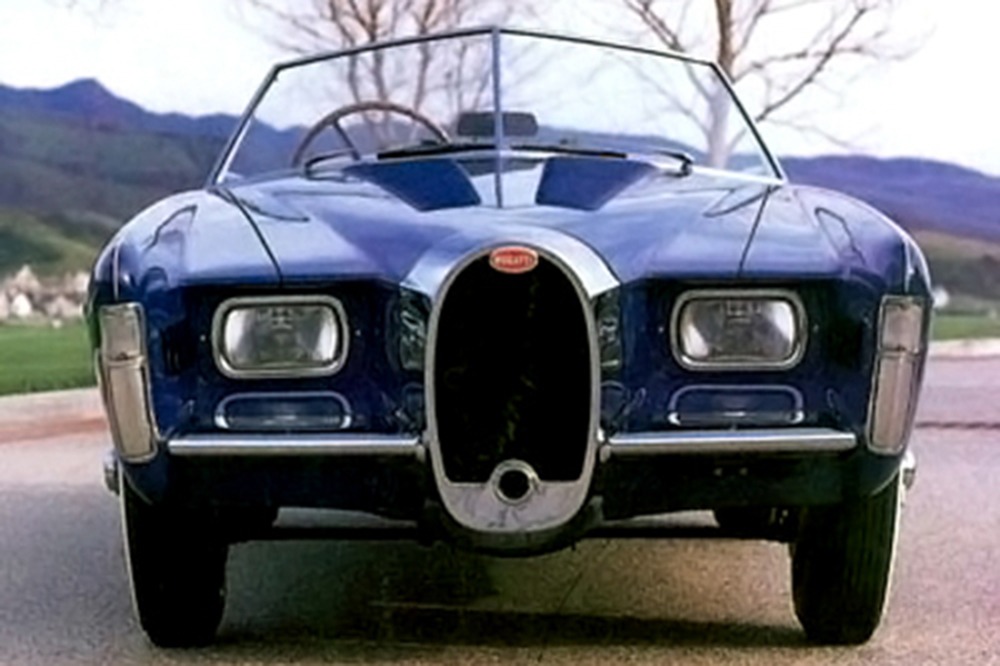
To enthusiasts, the car remains a testament to Exner’s audacity. He took a dusty chassis from a New Jersey barn and imagined it rivaling Ferraris—a belief rooted in the sketches he made as a boy watching Bugattis at Indianapolis. Decades later, he finally designed one.
In the end, the Type 101C Roadster became not the start of a revival but a beautiful farewell: Bugatti’s last original car, shaped by an American dreamer and an Italian coachbuilder. And that lone, improbable collaboration continues to captivate anyone lucky enough to stand beside it.

ABOUT THE AUTHOR
Andreas Scheidl
Italian classic car enthusiast with German roots. Renowned as a respected figure in the classic car community, he serves as a jury member at various international concours d'elegance, including the Classic Gala Schwetzingen and Mantova. As a content creator, Andreas passionately shares his profound knowledge and appreciation for vintage automobiles. His heart beats for cars designed by Giovanni Michelotti, showcasing his discerning taste and dedication to preserving the timeless elegance of automotive history.
More stories by Andreas Scheidl ↗CONTINUE READING
Posts You Might Like
A Central Driving Position, a Rear-Mounted V8. Was This Really a Lancia?
In 1948, visitors to the Turin Motor Show could see an unusual Lancia on the stand of Carrozzeria Ghia. It was a large two-door coupé with a two-litre V8 mounted behind the…
Read story
Fioravanti F100: The Ferrari He Was Allowed to Imagine
Enzo Ferrari’s centenary, Leonardo Fioravanti’s independent studio and a supercar that explored air brakes, steel wheels and a new way of driving—without ever wearing the Cavallino.
Read story
Michelotti Shellette: When the Fiat 850 Became a Yacht
The yacht designer, the Turin stylist and the tiny coachbuilt car that crossed between the quay, the royal holiday house and the auction room. Some automobiles were conceived for the open road,…
Read story
Maserati A6 1500: A New Road for the Trident
When the doors of the Geneva Motor Show opened in March 1947, Maserati was a name that required little introduction to anyone who followed motor racing. What it did not yet possess…
Read story
THE CONVERSATION
Comments 0
Share a memory, a period photograph or a documented detail about this story.