
Fioravanti F100: The Ferrari He Was Allowed to Imagine
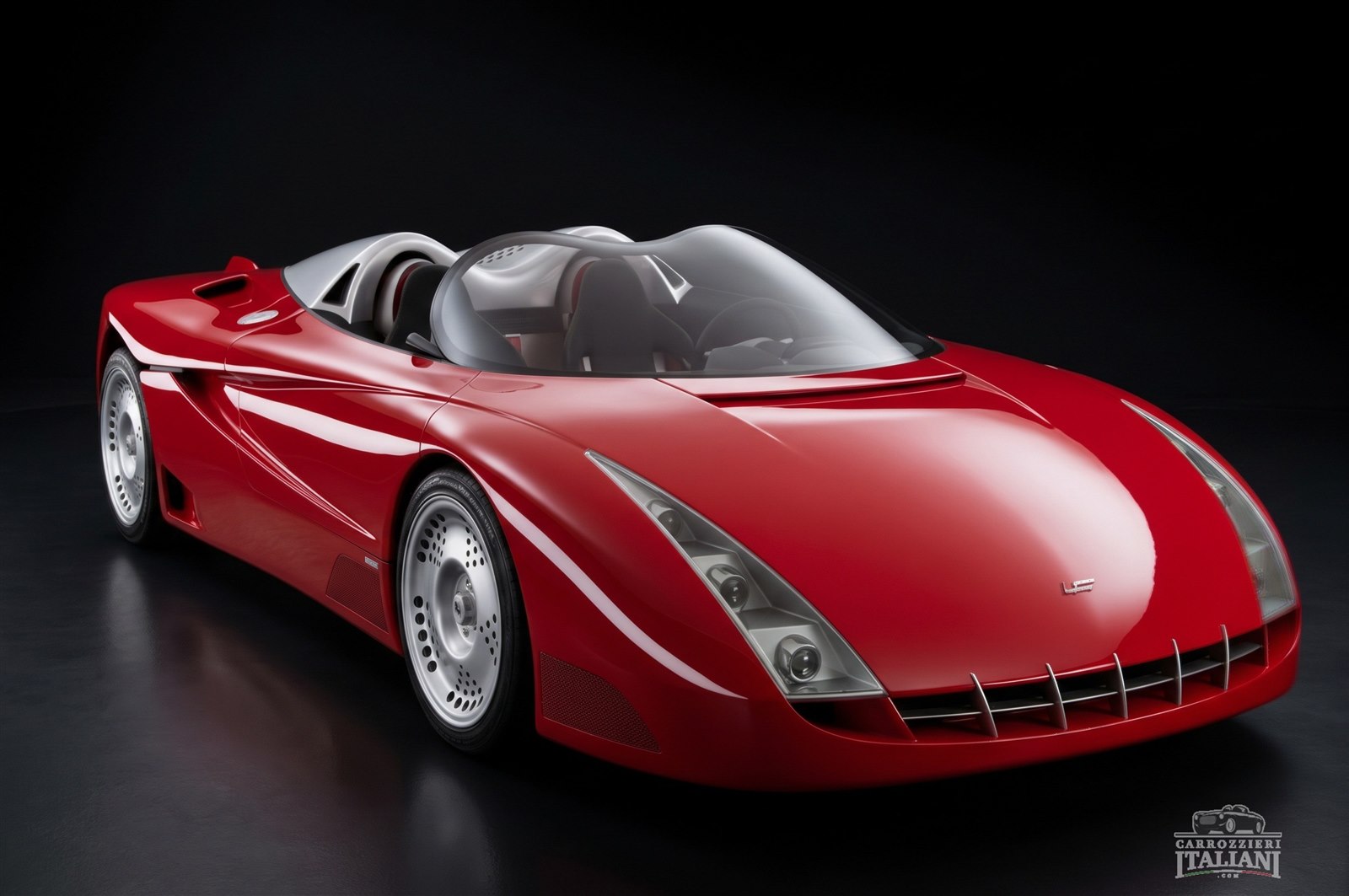
Enzo Ferrari’s centenary, Leonardo Fioravanti’s independent studio and a supercar that explored air brakes, steel wheels and a new way of driving—without ever wearing the Cavallino.
The car Ferrari approved—but would not badge
In 1998, the centenary of Enzo Ferrari’s birth produced no shortage of tributes. The most intriguing came from a man who knew the Commendatore not as a name on a museum wall, but as a demanding presence across a quarter-century of design work. Leonardo Fioravanti had left Pininfarina and was running his own studio outside Turin. For the anniversary he created a red, mid-engined supercar that looked as if it might belong to Maranello’s next generation. He called it F100. There was no prancing horse on its nose.
That absence was deliberate, and the reason survives in Fioravanti’s own account. Speaking at the Museo Casa Enzo Ferrari in Modena in March 2013, in testimony preserved by the AISA historical association, he said that Ferrari had approved the tribute but had not permitted the use of its trademark. The distinction is precise. The F100 was not an unacknowledged Ferrari factory prototype, nor a production programme that failed at the last hurdle. It was an independent Fioravanti design study, welcomed in principle by the manufacturer to which it paid homage but not adopted as a Ferrari-badged vehicle.
This gives the car a more interesting identity than the shorthand “Ferrari F100” suggests. It is a Ferrari imagined by a designer who had shaped many real Ferraris, at the very moment when he could finally propose one outside the structures of Pininfarina and Maranello. The difference between permission to celebrate a brand and permission to use its badge is part of the story, not a legal footnote.
Twenty-five years in the same conversation
The young Fioravanti joined Pininfarina in the 1960s with a degree in mechanical engineering and a conviction that a beautiful car could not be designed independently of its aerodynamics, packaging and production logic. He became closely associated with the company’s Ferrari work. The 250 P5 of 1968 demonstrated how far the partnership could push an experimental mid-engined form; the Daytona translated a much more traditional front-engined brief into one of the definitive long-bonnet GTs of its era. These were different problems, solved within the same industrial relationship.
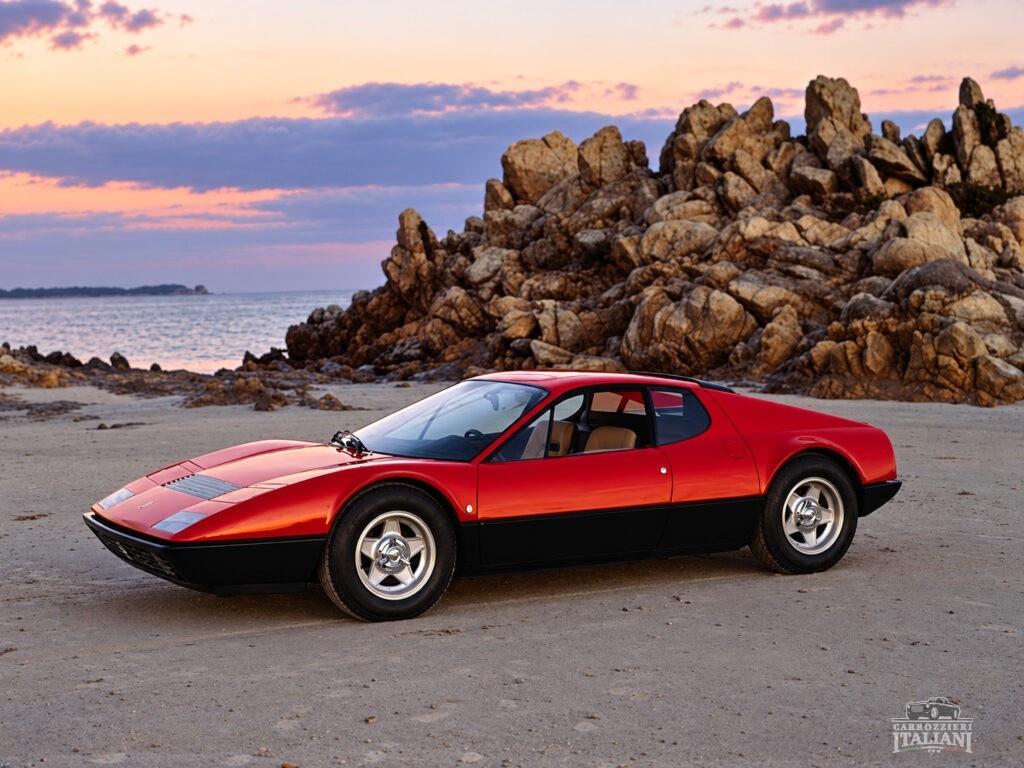
In the 1970s Fioravanti worked on the Berlinetta Boxer family and the 308 GTB, where the questions of body weight, cooling, roof packaging and aerodynamic stability were inseparable from the shape. Later came the 288 GTO and the F40, a car whose programme depended on far more than its instantly recognisable silhouette. His AISA recollections of the period move naturally between engineering constraints and design decisions. A body could be beautiful, but it also had to make sense at speed and in the workshop.
By the end of the 1980s Fioravanti had held senior positions in the Pininfarina organisation and then worked within the Fiat group, including Ferrari. He subsequently developed Fioravanti S.r.l. as an independent design and engineering business. In a contemporary 1998 interview with Auto & Design, he explained that he had deliberately waited for the Ferrari range to complete a cycle of renewal before presenting a new Ferrari-themed proposal. The timing happened to coincide with Enzo’s hundredth birthday. It was an act of personal remembrance, but it was also a declaration of what the studio could do.
A workshop, not a signature on paper
The late-1990s Fioravanti operation was not simply a stylist’s atelier producing attractive renderings. Its programmes were concerned with vehicle architecture, patented components, aerodynamics, prototyping and the reduction of manufacturing complexity. AISA Monograph 114, based on Fioravanti’s 2016 presentation at the company’s Moncalieri showroom, is particularly revealing about that philosophy. He described engineering rigour as the habit of judging each component in relation to the complete vehicle, rather than polishing one element at the expense of the whole.
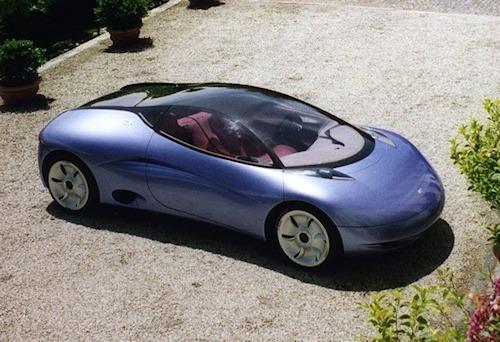
The Sensiva of 1994 explored hybrid propulsion, intelligent tyres, active chassis ideas and new control systems. The 1996 Fiat Bravo Flair pursued aerodynamic efficiency and air-braking solutions, while the Nyce tested how a small leisure vehicle might be simplified for use and manufacture. None of those projects was a disguised F100 prototype. They established a way of thinking: start with a technical or ergonomic proposition and allow the body to make that proposition visible.
F100 was the emotional exception that confirmed the rule. Its occasion was sentimental, yet its content was deliberately practical. The shape was a tribute to Ferrari; the questions inside it were the questions of an engineer. How light could a high-performance GT become? Could the driver’s workload be reduced without reducing involvement? Could aerodynamic drag be used positively in braking? Could even a steel wheel become a piece of advanced component design?
The centenary show car
Period accounts place the F100 on the international show circuit in 1998. Car Design News and specialist registers identify Geneva as an early presentation; Auto & Design’s June 1998 report specifically describes its appearance at Turin, where the car attracted the attention of both visitors and Ferrari representatives. Those statements establish the two events, although surviving summaries do not all use “debut” in the same way. The historical record is better served by naming the documented appearances than by forcing an exclusive world-premiere claim from conflicting later captions.
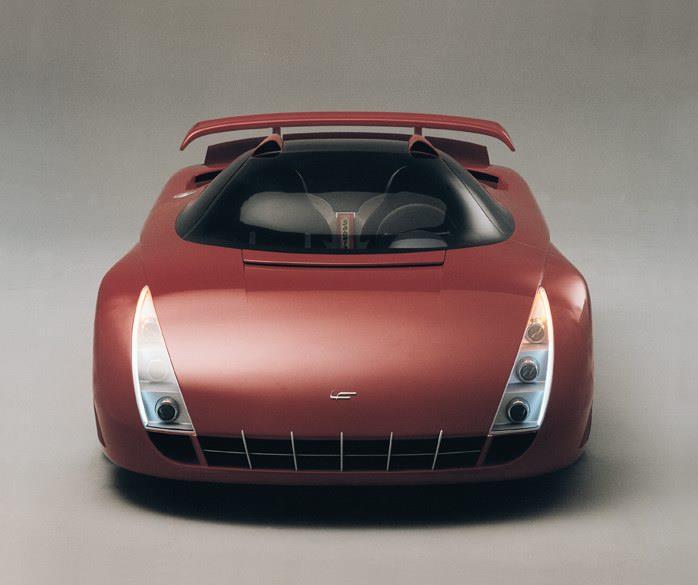
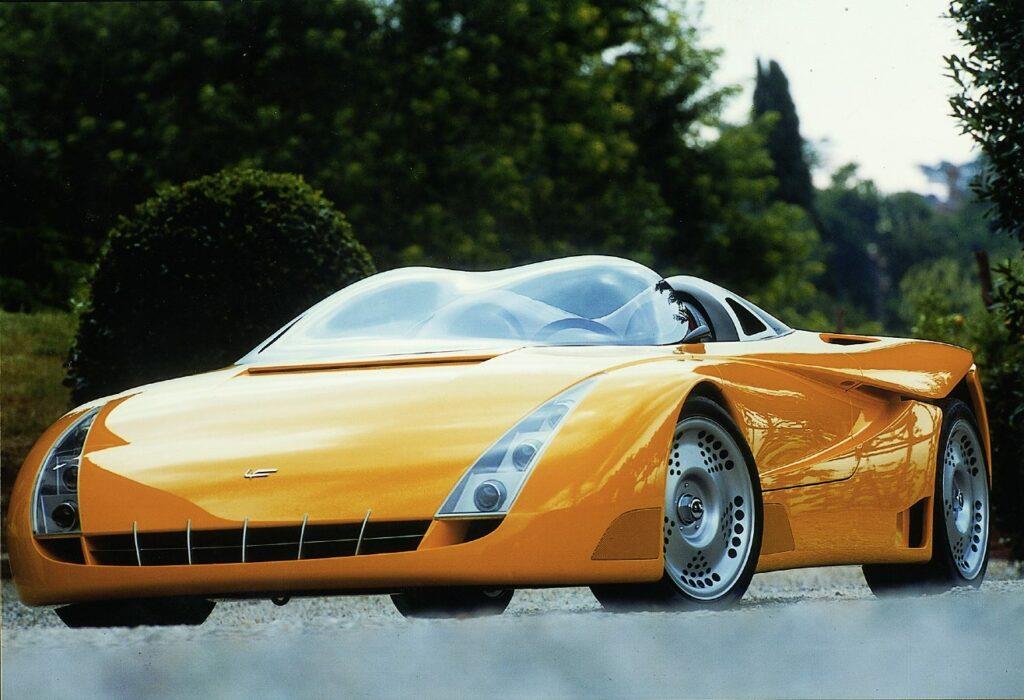
The F100 was compact by supercar standards: approximately 4,390 mm long, 1,910 mm wide and 1,140 mm high, with a 2,550 mm wheelbase. Auto & Design rounded those figures to 4.4, 1.9 and 1.14 metres. The dimensions are not incidental. The contemporary Ferrari F50 was a much larger object. Fioravanti wanted a machine whose scale would be manageable on the road, without surrendering the visual concentration expected of a high-performance Italian two-seater.
The proportions were unmistakably mid-engined. A short nose gave way to a broad windscreen and a tight two-seat cabin, then to a rear deck organised around air intakes, a glazed engine cover and a substantial aerodynamic wing. Its surfaces were cleaner than the F40’s but not timid. The bright red body invited comparison with Maranello, while the compact cabin and low stance made the car seem built around two people rather than around the need to make an enormous power figure visible.
The wave along the flank
Fioravanti’s own period description identified a recurring Ferrari theme in the body: the “onda”, or wave, running along the flank. On the F100 it begins at the nose and gathers force around the side of the car, like a mark cut into the surface rather than a line applied for decoration. The front lamp treatment stretches the graphic forward, while the side volume rises and falls around the cabin and rear wheel. The result is more muscular than the restrained 308, yet it retains the idea that one continuous movement should hold the body together.
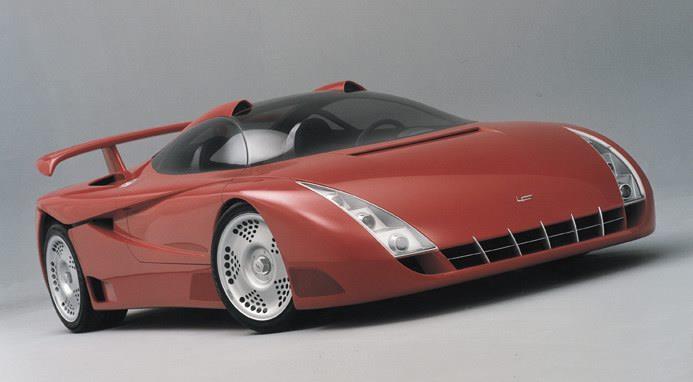
The grille is a deliberate glance backwards. Ferrari’s older road cars used recognisable front openings and round rear lamps long before the brand settled into the later vocabulary of mid-engined supercars. F100 borrowed those memories without copying a specific historical model. The two circular rear lights are especially effective: from behind, the car speaks an older Ferrari language even though the surrounding surface is unmistakably late-1990s.
A conventional concept could have stopped there, content to remind the audience of Daytona and Berlinetta Boxer. Fioravanti instead pushed the shape toward new hardware. The roof-edge intakes were placed high, away from the conventional side scoop position, and were described in the original project material as contributing to the roof’s boxed structure as well as feeding the proposed mid-mounted engine. The engineering and styling stories were being written together.
Braking with the air
The F100’s most consequential technical idea was not the V10 that newspapers liked to imagine behind its occupants. It was the deliberate use of aerodynamic resistance as a braking force. In his 2013 AISA testimony, Fioravanti explained that the car carried air brakes both above and below the rear body so their aerodynamic effects could be balanced. At very high speed, he argued, the resistance of the air was too substantial to be ignored as a means of deceleration.
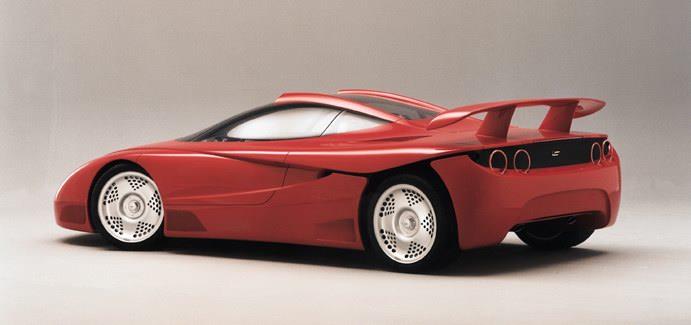
The distinction between drag and downforce is essential here. A fixed rear wing can produce a stabilising load but also creates resistance; a deployable aerodynamic brake deliberately increases resistance when slowing is required. If such a device is placed badly, it may also upset pitch balance or reduce stability. Fioravanti’s answer was to use complementary upper and lower elements, conceived as a coordinated system rather than a single theatrical flap. The F100 was a research model, not a homologated car whose stopping distances had been independently measured. Its air brakes are best understood as a design and engineering proposition, not a verified production performance advantage.
The concept continued work explored in the Flair, where air braking was also treated as part of the complete vehicle rather than an accessory. Auto & Design’s 1998 report explicitly highlighted the pursuit of aerodynamic vertical-load control. Fioravanti was concerned not only with reducing drag for a headline speed but with how the body behaved while accelerating, turning and braking. That is a more demanding brief than simply drawing a slippery silhouette.
The steel wheel that challenged fashion
The wheels tell a quieter but equally distinctive story. The F100’s press material named Fergat, an established Italian wheel specialist, as a development partner. Instead of fitting expensive-looking cast alloys and leaving the subject there, Fioravanti and Fergat investigated whether modern high-strength steels and advanced forming methods could produce an attractive wheel with reduced weight and aerodynamic benefits. The source describes simulation-led design, new assembly techniques and steels with strength limits above 600 MPa.
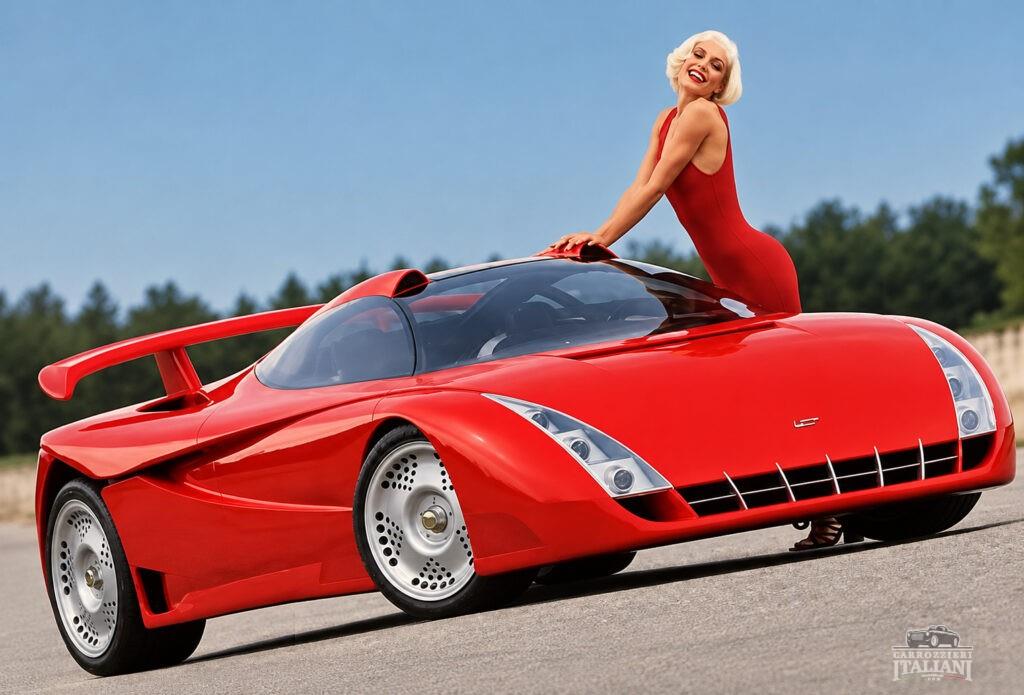
It was an unfashionable idea for an exotic Ferrari tribute. Steel wheels belonged, in the popular imagination, to inexpensive production cars; aluminium alloys belonged to the high-performance world. Fioravanti’s point was that the material alone did not determine engineering merit. Geometry, manufacturing process, strength and the total mass of the finished component all mattered. A carefully designed steel wheel could challenge assumptions made on appearance alone.
The Fergat work was part of a broader attempt to reduce mass without reducing the car to a fragile racing shell. The front and rear neon lighting units were conceived as lightweight assemblies with familiar Ferrari graphic references. Neither the wheel research nor the lamp concept should be confused with proof of mass-production tooling. What survives is a clearly described development partnership and a component-level design intention, not a catalogue of production parts installed on customer cars.
The V10 that was not there
The F100 is frequently described as a Ferrari-powered V10 supercar. That is the most persistent error in its modern biography. Fioravanti proposed a compact, high-performance mid-mounted engine of the sort used in contemporary Formula One, together with a semi-automatic transmission and steering-wheel paddles. The surviving F100 display car, however, is described by specialist documentation as having a mock-up engine. No verified production Ferrari V10, no road-tested horsepower figure and no Ferrari donor chassis number have been established for it.
This is not a semantic distinction. A design proposal can accommodate an engine without possessing that engine. A full-size model can be an extraordinarily sophisticated piece of coachbuilding without being a registered, roadworthy prototype. The F100 was created to demonstrate a vehicle concept and a set of components; it was not a Ferrari F1 powertrain conversion available for a test drive.
The V10 idea nevertheless belonged to its time. Ferrari’s Formula One programme had made the configuration familiar to enthusiasts, and paddle-operated gear changes were moving from the paddock into the road-car conversation. Fioravanti used those technologies as a way to imagine a smaller and more relaxed supercar. The language of a competition gearbox served an unexpectedly civilised aim: fewer tasks for the driver, more attention available for the road.
A cockpit for two feet and two hands
Inside the F100, the usual hierarchy of dashboard, centre console, lever and pedals was reconsidered. The transmission was to be operated by paddles behind the steering wheel. Other functions migrated toward the wheel or a compact control interface. Instruments combined digital and analogue information, arranged to be understood quickly at speed. The driver was not being asked to admire technology for its own sake; the intention was to reduce the time spent searching for information and controls.
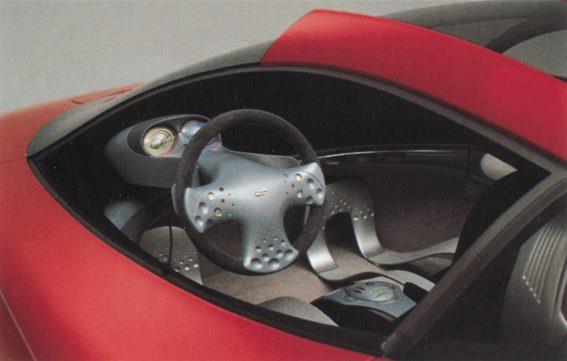
The seats were just as unusual. Extended supports held the occupants’ legs in a relaxed position, while the driver’s supports helped guide the feet toward accelerator and brake. Fioravanti later recalled left-foot braking as part of the intended experience. It was a cockpit designed around the body’s behaviour during sustained high-speed travel, not around the familiar posture of a grand tourer with a gear lever between the seats.
There is a characteristic tension here. The F100 looked aggressive and low, yet its designer repeatedly used the language of relaxation. He wanted a car that could travel very quickly without turning every action into a physical demand. That is why the seat supports, paddles, simplified console and instruments belong in the same story as the air brakes. They were all attempts to reduce wasted effort—by the vehicle or by its occupants.
A roof becomes a windscreen
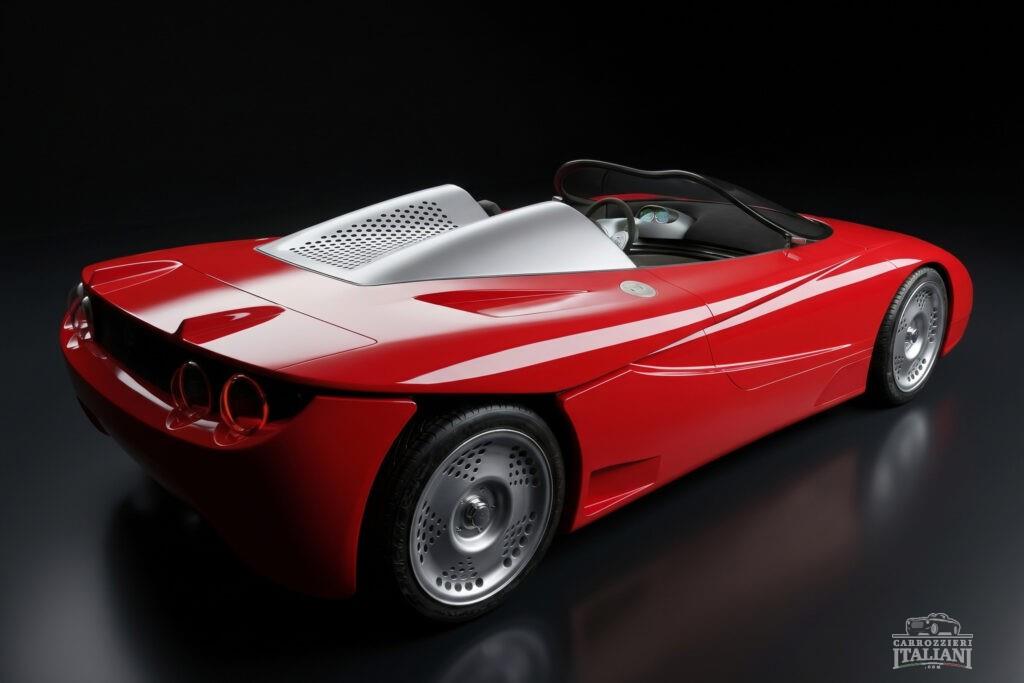
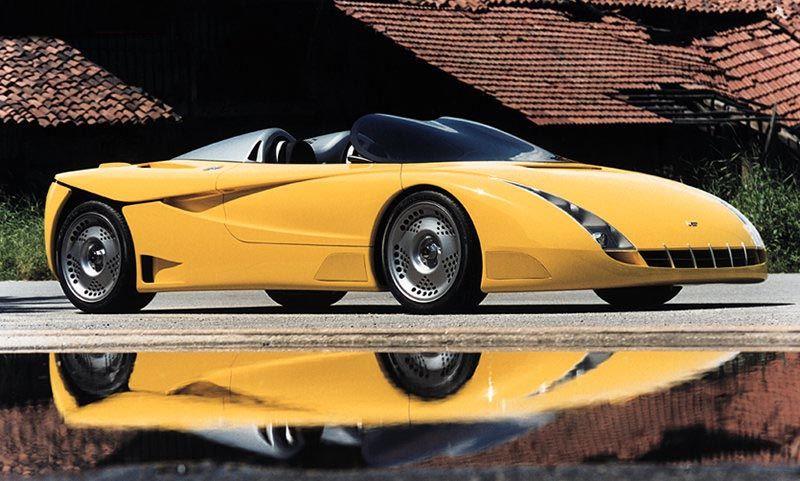
In 2000 Fioravanti returned to the idea with the open F100r. The second study was not simply the coupé with its roof removed. It required a new solution to the problem that open supercars always expose: the air that rushes over the windscreen and collapses into the cockpit. The roadster’s distinctive multispherical screen was shaped to divide the flow and guide it around the occupants. The sculpted forms behind the seats extended that treatment toward the rear.
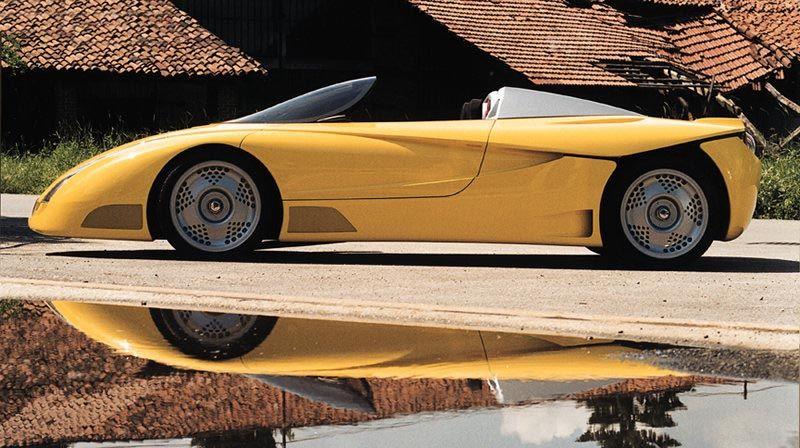
Fioravanti described the air stream as being divided into a central flow passing between the occupants’ heads and lateral streams carried around the body. He was candid that the central passage produced some noise, though not, in his judgement, an intolerable amount. The 2013 testimony is unusually valuable because it gives a designer’s explanation of the geometry, rather than a later caption that merely calls the windscreen futuristic.
The F100r appeared at Turin in 2000. Period and specialist descriptions record camera-based rear visibility in place of conventional mirrors and continued attention to adjustable aerodynamic surfaces. The open car should be treated as a separate physical show study, with its own 2000 date and body architecture. CI’s current F100r listing still contains a generic V12 engine label; the stronger sources establish a concept programme, not a verified installed V12. No serial number is sufficiently documented to promote to an exact chassis identity.
Approval without a badge
The question of Ferrari’s role deserves to be revisited after the mechanical discussion, because the word “approved” can easily be mistaken for “commissioned”. Fioravanti’s first-person AISA recollection is specific: Ferrari approved the centenary object but did not authorise the use of the Cavallino mark. Auto & Design’s contemporary report describes favourable reactions from Ferrari management. Neither statement establishes a factory-funded development programme, a Ferrari VIN, Ferrari assembly or Ferrari homologation.
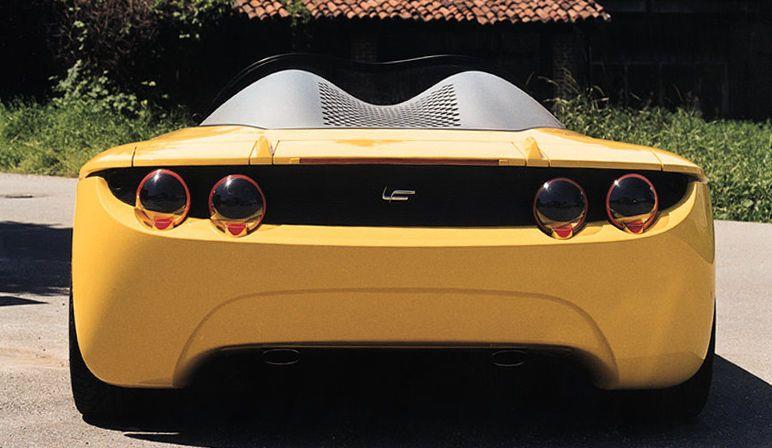
The project’s name was carefully chosen. In the 1998 Auto & Design interview, the F was explained as Fioravanti; the 100 referred to Enzo Ferrari’s hundredth birthday, not the hundredth anniversary of the Ferrari company. Ferrari as a marque had been established much later. A modern headline that calls the F100 “Ferrari’s centenary car” therefore changes the meaning of the tribute. The point was the man and Fioravanti’s relationship with him.
There is no need to diminish the car by calling it unofficial in a dismissive tone. The independence is precisely what made it possible. A designer with decades of Ferrari experience could explore ideas outside a production brief, yet remain in conversation with the brand. The result belongs to the history of Italian coachbuilding and independent automotive research, not to the numbered lineage of Ferrari factory road cars.
A later Ferrari takes the hint
A decade after the F100, the same designer was involved in a very different Ferrari. The F430 SP1 was commissioned for Japanese collector Junichiro Hiramatsu and built as a one-off within Ferrari’s emerging personalisation and special-project environment. Unlike the F100, the SP1 was a genuine Ferrari-based automobile with a production-derived mechanical platform and a named client. Its surfaces echoed parts of Fioravanti’s earlier study, especially the flowing side treatment and the headlamp graphic.
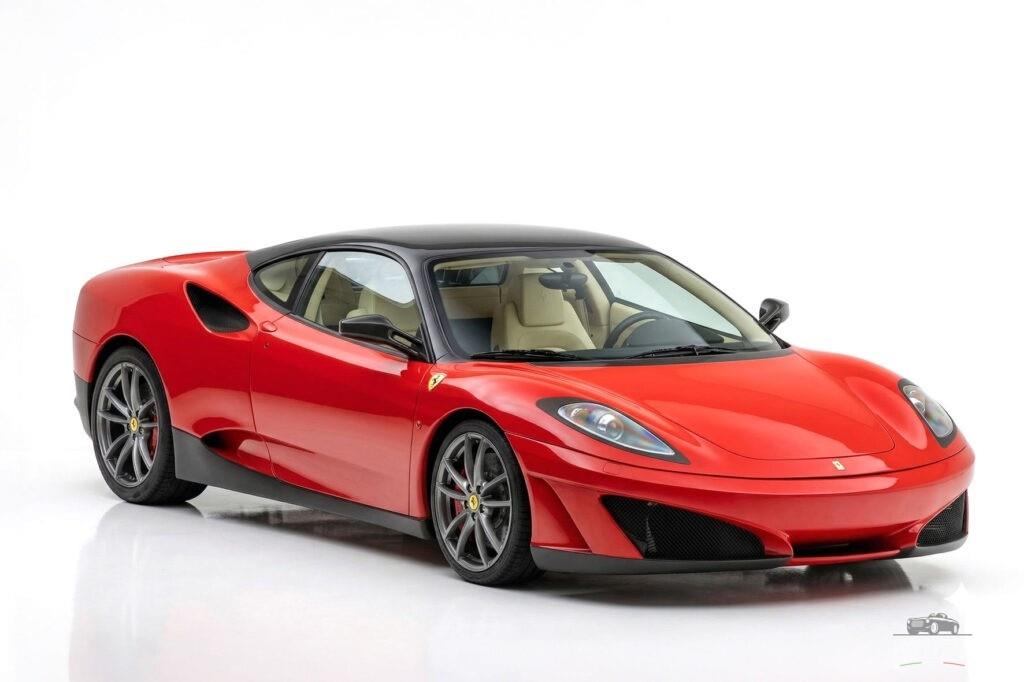
The link is not merely visual. In his AISA account, Fioravanti described the SP1 as a design that deliberately privileged beauty, while the F100 had combined emotion with a catalogue of technical investigations. The 2008 commission demonstrated that the ideas of a privately initiated 1998 show car could remain useful when a client later asked for a truly buildable Ferrari. It does not mean the F100 had been a prototype for the SP1; their purposes, hardware and ownership histories are distinct.
The broader studio continued along several paths. The Alfa Romeo Vola explored an innovative rotating roof, later connected with the production Ferrari Superamerica mechanism. The Tris pushed common-component manufacturing to an unusual extreme, while the LF1 returned to the question of racing aerodynamics. Seen among those programmes, F100 is less an eccentric isolated Ferrari fantasy than a particularly emotional chapter in a consistent engineering philosophy.
Two models, no invented chassis
The physical record remains much thinner than the design record. The 1998 coupé and 2000 roadster are documented as distinct show vehicles, but the consulted first-hand sources do not supply reliable chassis numbers, factory build sheets or a continuous ownership chain for either. A 2018 public sighting of the F100r on a trailer is evidence that a vehicle identified as the roadster was photographed at that time; it is not, by itself, a proven ownership transfer, restoration history or current collection address.
It is tempting to fill these gaps with the language of rarity—“only two ever built”, “Ferrari V10 chassis”, “lost prototype”—but those phrases combine different claims. One known coupé study and one known roadster study are supported by the model histories. An exact total of finished, functioning automobiles is a different question. No auction result for a documented F100 chassis was established in the sources consulted, and no auction value should be inferred from unrelated Ferrari concept-car sales.
For CI 2.0 the proper structure is therefore a small Fioravanti F100 programme with two dated child projects, F100 and F100r. The proposed V10 belongs in the design-intent field, not the installed-engine field. Ferrari’s favourable response belongs in a relationship note, not a manufacturer-of-record field. Fergat belongs in the component-development credit. That separation preserves the people and the hardware without manufacturing a history the evidence does not contain.
The Ferrari he could draw for himself
The F100 is an unusually personal object in a profession that often obscures individual authorship behind a famous badge. Fioravanti had spent years negotiating with Ferrari’s engineers, managers, manufacturing realities and customers. In 1998 he was able to decide what the next Ferrari-shaped object should be, even while knowing it would not wear the company emblem. He made it compact rather than monumental, technologically curious rather than mechanically extravagant, and concerned with driver effort as much as raw speed.
Its most revealing details are not the red paint or the suggestion of Formula One power. They are the air brakes that try to make drag useful, the steel wheels that challenge a material prejudice, the seat extensions that treat the driver as part of the machine, and the roof intakes that perform structural as well as visual work. The open F100r carried the same argument into the movement of air around two human heads.
For the hundredth birthday of Enzo Ferrari, Fioravanti did not simply draw another car that resembled a Ferrari. He returned to the way he had learned to design Ferraris: begin with the whole vehicle, let the engineering question shape the body, and refuse to separate beauty from the work a car is supposed to do. The F100 was never a Maranello production car. It was a Ferrari tribute made by a man who no longer needed Maranello to ask the question.

ABOUT THE AUTHOR
Andreas Scheidl
Italian classic car enthusiast with German roots. Renowned as a respected figure in the classic car community, he serves as a jury member at various international concours d'elegance, including the Classic Gala Schwetzingen and Mantova. As a content creator, Andreas passionately shares his profound knowledge and appreciation for vintage automobiles. His heart beats for cars designed by Giovanni Michelotti, showcasing his discerning taste and dedication to preserving the timeless elegance of automotive history.
More stories by Andreas Scheidl ↗CONTINUE READING
Posts You Might Like

A Central Driving Position, a Rear-Mounted V8. Was This Really a Lancia?
In 1948, visitors to the Turin Motor Show could see an unusual Lancia on the stand of Carrozzeria Ghia. It was a large two-door coupé with a two-litre V8 mounted behind the…
Read story
Michelotti Shellette: When the Fiat 850 Became a Yacht
The yacht designer, the Turin stylist and the tiny coachbuilt car that crossed between the quay, the royal holiday house and the auction room. Some automobiles were conceived for the open road,…
Read story
Maserati A6 1500: A New Road for the Trident
When the doors of the Geneva Motor Show opened in March 1947, Maserati was a name that required little introduction to anyone who followed motor racing. What it did not yet possess…
Read story
Ferrari FX: Beyond the Limits of Maranello
Six documented chassis, the disputed seventh car, Williams transmission development and the anatomy of one of the least understood Ferraris of the 1990s
Read story
THE CONVERSATION
Comments 0
Share a memory, a period photograph or a documented detail about this story.