
THE VEHICLE AT A GLANCE
Model dossier
- Production period
- 1932
- Engine
- V8
- Type
- One-off
- Displacement
- 3,960 cc
- Power
- 100 CV
THE PEOPLE BEHIND THE CAR
Coachbuilding, design & conversions

PRICE & SALES RECORD
Vehicle value
- Original price
- Not documented
- Latest recorded sale
- Not documented
01 / THE STORY
History & context
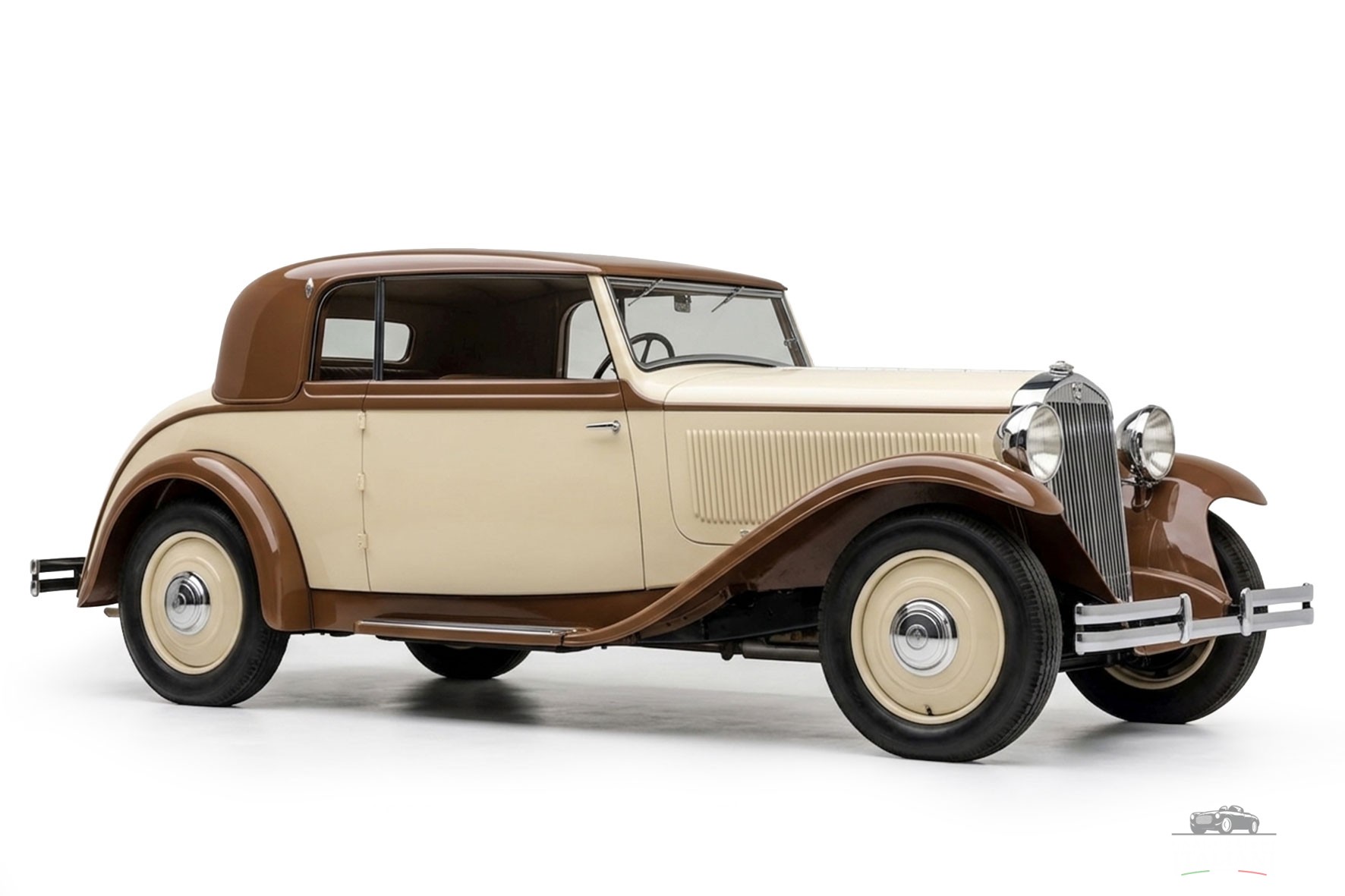
The Lancia Dilambda Tipo Zagato was a coachbuilt luxury car based on the Lancia Dilambda chassis and bodied by Carrozzeria Zagato in the early 1930s. It was an unusual project in Zagato’s production, since the Milanese firm was better known for lightweight sports and competition bodies than for large formal automobiles. The Dilambda was one of Lancia’s most prestigious models of the period. Introduced at the end of the 1920s, it used a narrow-angle V8 engine and was aimed at wealthy clients who wanted a refined, powerful and technically advanced car. Its chassis was suitable for a wide range of bespoke bodies, from formal limousines to cabriolets and sporting coupés. Zagato’s interpretation gave the Dilambda a more individual profile than many conventional luxury bodies of the same period. The long bonnet, upright cabin and separate wings kept the formal character expected from a high-class car, but the side treatment was cleaner and more flowing. The front wings extended in a sweeping line along the lower body, visually linking the nose to the rear section. The rear fenders were rounded and carefully integrated, while the roofline was compact and softly curved. The body shown here uses a two-door closed layout, with a long side window, external hinges and a strong separation between the passenger compartment and the rear body volume. The bonnet sides feature vertical ventilation slots, while the running board and lower trim emphasize the car’s length. The two-tone finish gives the body a more refined appearance and highlights the contrast between the central cabin and the lower coachwork. Compared with Zagato’s racing bodies, the Dilambda Tipo Zagato was not about minimum weight or pure competition use. It was a luxury coachbuilt car, shaped for road presence, comfort and exclusivity. Its importance lies in showing another side of Zagato’s activity: not only aerodynamic sports cars and lightweight spiders, but also bespoke bodies for large prestige chassis.
IN THE ARCHIVE
Coachbuilders & design studios
02 / TECHNICAL IDENTITY
Specifications & construction
Production & construction
- Production type
- One-off
- Production notes
- Legacy One off classification is not promoted. CI Production Types audit has no canonical production-type proposal for this listing; do not infer one-off status from a legacy Units=1 value alone.
Engine & performance
- Engine configuration
- V8
- Displacement
- 3,960 cc
- Power (CV)
- 100 CV
- Engine speed
- 4,000 rpm
- Transmission
- Manual 4-speed
- Drive
- Rear-wheel drive
- Specification notes
- Source-backed donor/model-level baseline for Lancia Dilambda: V8, 3960 cc, 100 CV at 4000 rpm, 4-speed manual, rear-wheel drive. Wheelbase, body dimensions, weight and maximum speed vary by series/body and are intentionally not inherited.
Design & manufacture
- Manufacturer · Documented
- Lancia
- Coachbuilder / Body Builder · Documented
- Zagato
06 / EVENTS & AWARDS
Events & awards
No events or documented awards are currently recorded for this vehicle.
07 / THE VEHICLE IN DETAIL
Photo gallery
No publishable photographs are currently catalogued for this vehicle.
08 / FROM THE ARCHIVE
Archive
References held in the vehicle dossier. Their inclusion does not establish that every historical claim has been independently verified.
| Reference | Source type |
|---|---|
| Museo Nicolis / Epocauto — Lancia Dilambda technical history www.museonicolis.com | Museum technical article |
THE CONVERSATION
Comments 0
Share a memory, a period photograph or a documented detail about this car.