
When a Mistake Made History: Giovanni Michelotti and the Birth of the “Baffo”
How a young designer’s miscalculation at Stabilimenti Farina became an enduring Italian design signature
A Young Designer in a Golden Age
It was the late 1930s, in the quiet yet electric years before the world would plunge into war. Turin’s coachbuilding ateliers were in full bloom, producing one-off machines for Europe’s aristocrats, industrial magnates, and racing heroes. Among the bright young talents at Stabilimenti Farina was a barely twenty-year-old Giovanni Michelotti, still finding his voice as a designer but already showing a restless curiosity and an instinct for innovation.
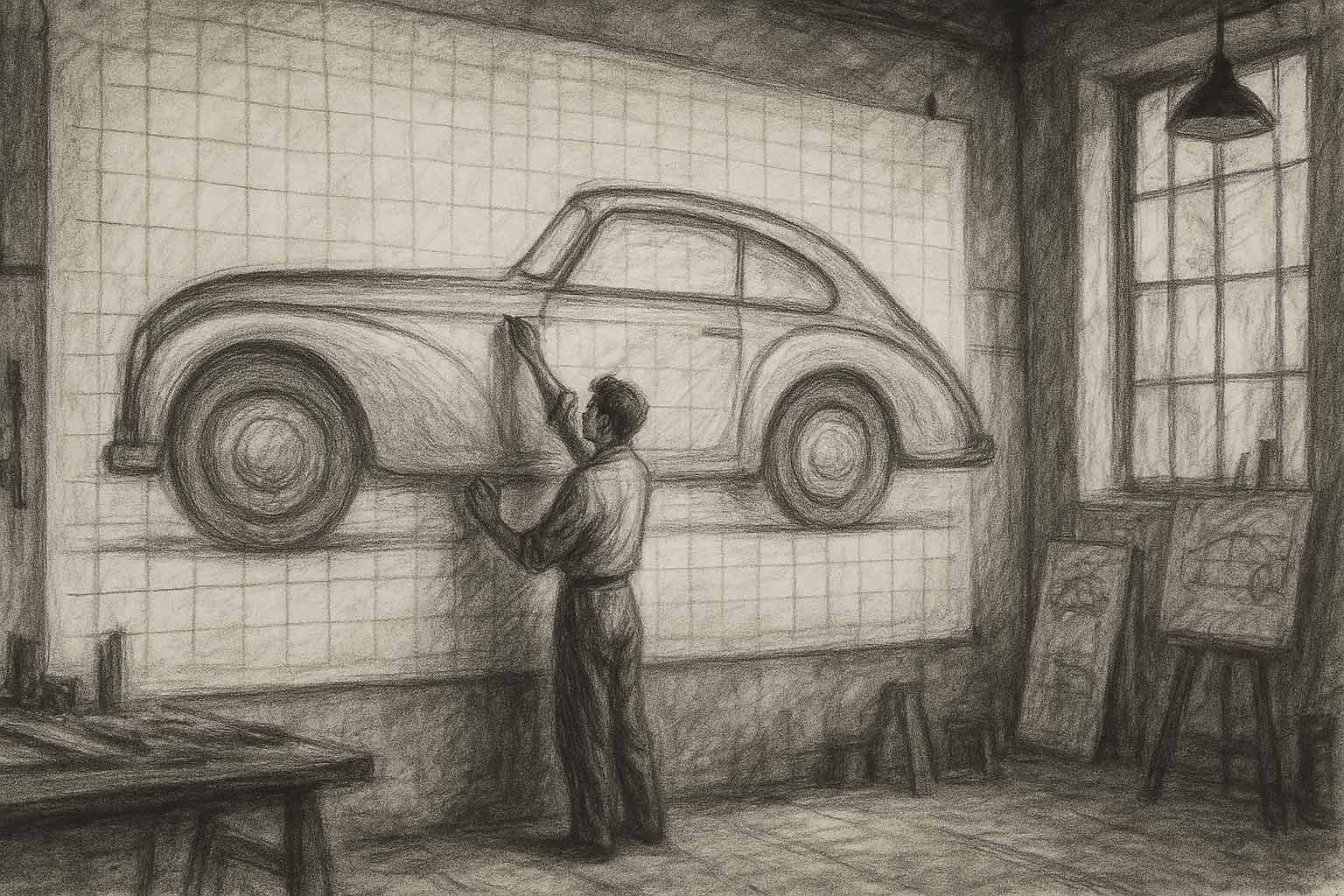
In those days, the process was almost artisanal theatre. The shape of a new car would be plotted on an enormous sheet of heavy paper, stretched across a long drafting table, its surface ruled with fine grid lines. The squares were more than mere decoration — they were the precise coordinates by which a dream would be hammered into steel and aluminium.
🔗 Read more: Giovanni Michelotti: Automotive Maestro
Wheel arches then were flush with the body, a simple, clean form that had remained unchanged for years. No one had reason to question it. Michelotti was about to do so, but not by choice — at least not at first.
The Miscalculation
One winter afternoon, under the diffused light from the high workshop windows, Michelotti’s latest drawing was complete. The chassis measurements had been taken, the proportions carefully laid down on the grid. The master carpenter in the corner began shaping the wooden buck, following the lines with practiced ease. In the metal shop, hammers rang against forming stakes, the air rich with the smell of oak shavings and hot steel.
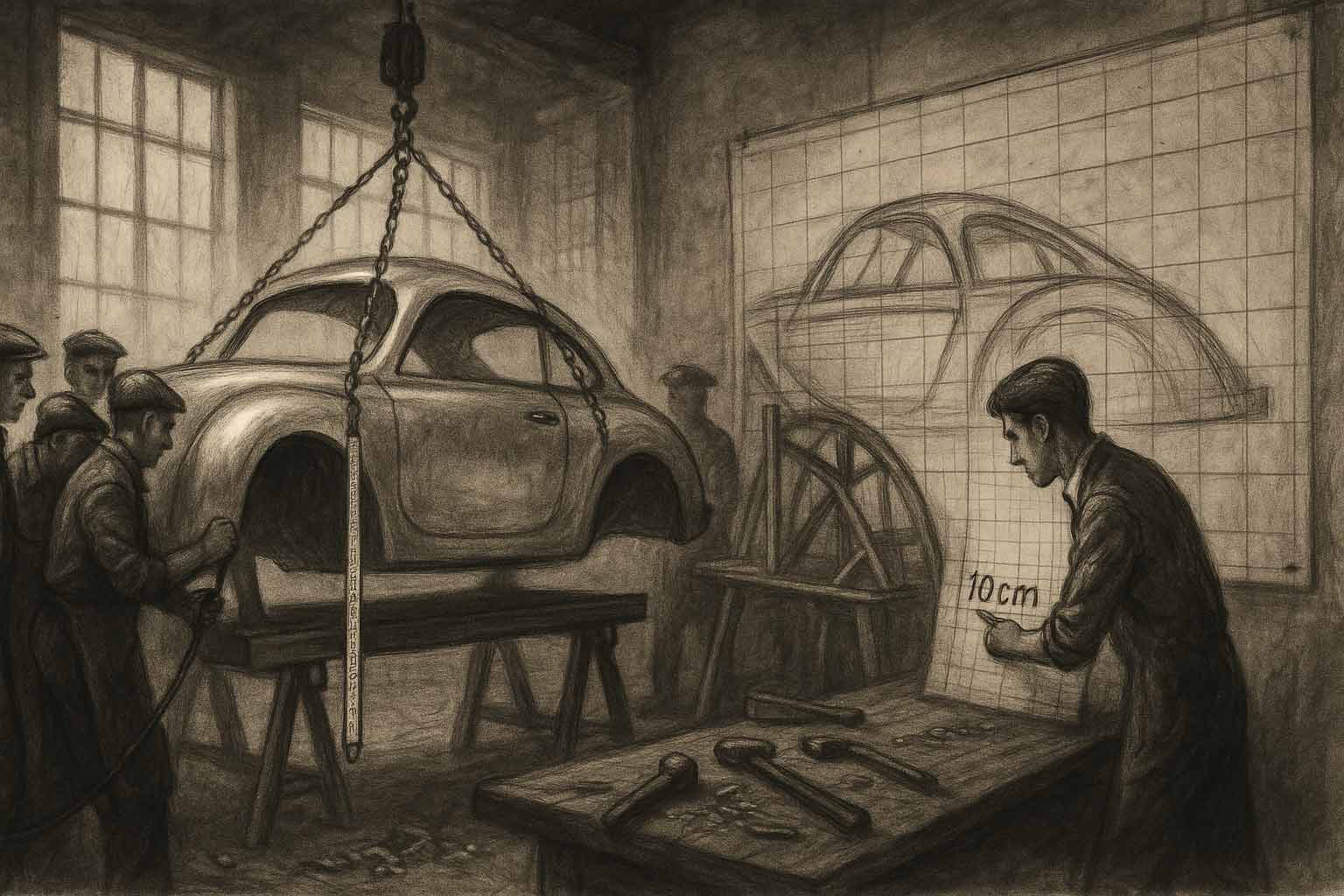
Weeks later, the bare aluminium shell gleamed on trestles. It was time for the ritual moment: lowering the body onto the waiting chassis. The craftsmen gathered, steadying the hoist, eyes narrowing as the shell descended… and then the silence. The shell stopped short. The inner structure refused to seat inside.
Measuring tapes flashed. Voices muttered in Piedmontese dialect. The verdict: the shell was ten centimetres too narrow. Somewhere in the translation from drawing to reality, something had gone wrong. Michelotti, summoned to the floor, stood quietly over the grid-paper original. One finger traced the line of the flank, then stopped. His mouth tightened almost imperceptibly. He had been off by one square. Just one. But in full scale, that meant ten costly centimetres.
The Calm Solution
A lesser designer might have flushed with embarrassment, or demanded the whole body be scrapped. Michelotti simply nodded, as if he had been expecting this all along. “We’ll fix it,” he said. The instruction was simple: split the body shell lengthwise down its centreline, insert the missing width, and weld it back together.
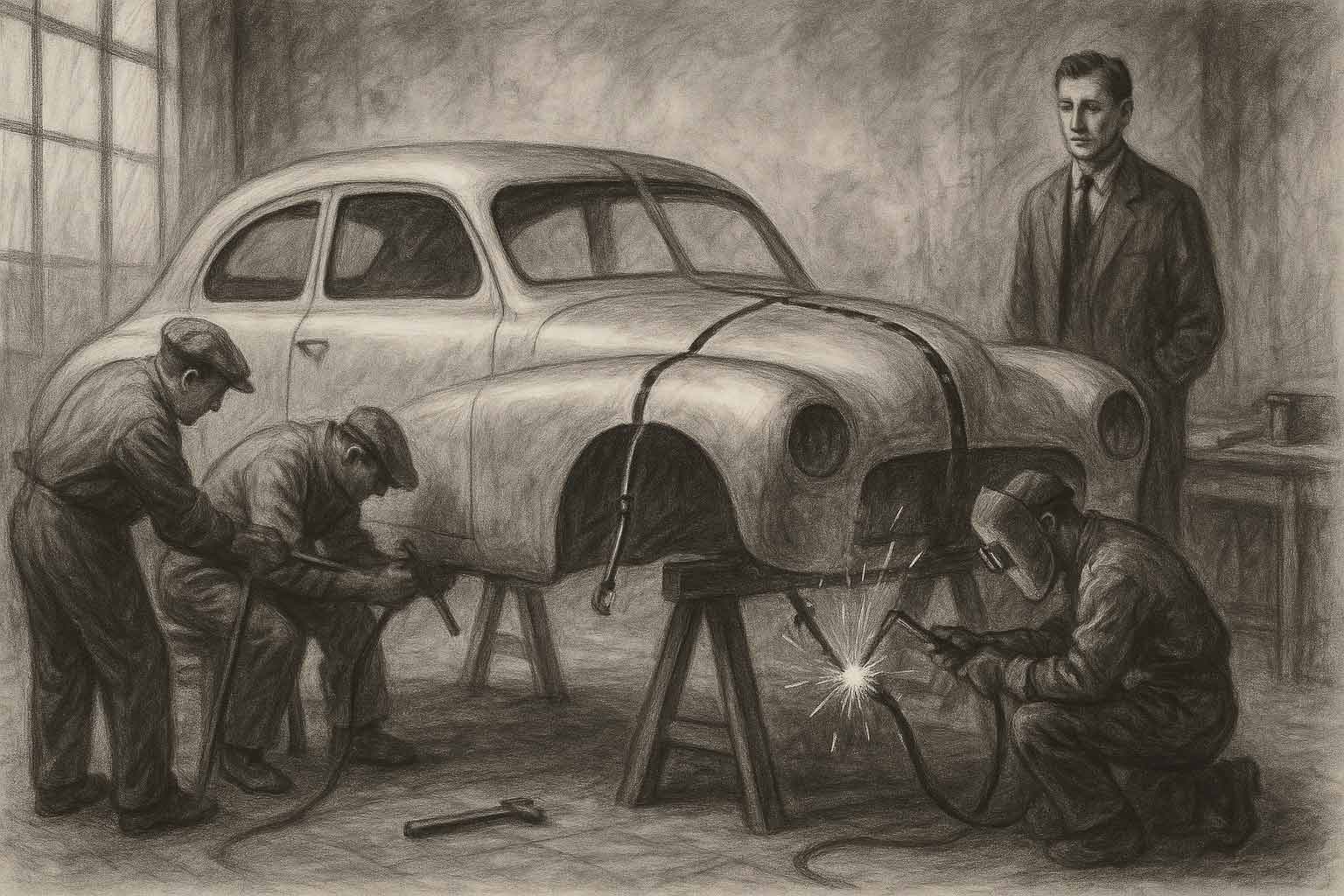
The men worked for days, spreading the aluminium panels like the wings of a bird and grafting in new sections. When the shell was reunited, the fit was almost perfect — almost. The roof’s gentle transverse curve, particularly over the rear haunches, meant they could not recover the full ten centimetres without distorting the shape. The wheels still sat proud by a stubborn two centimetres.
Invention in the Moment
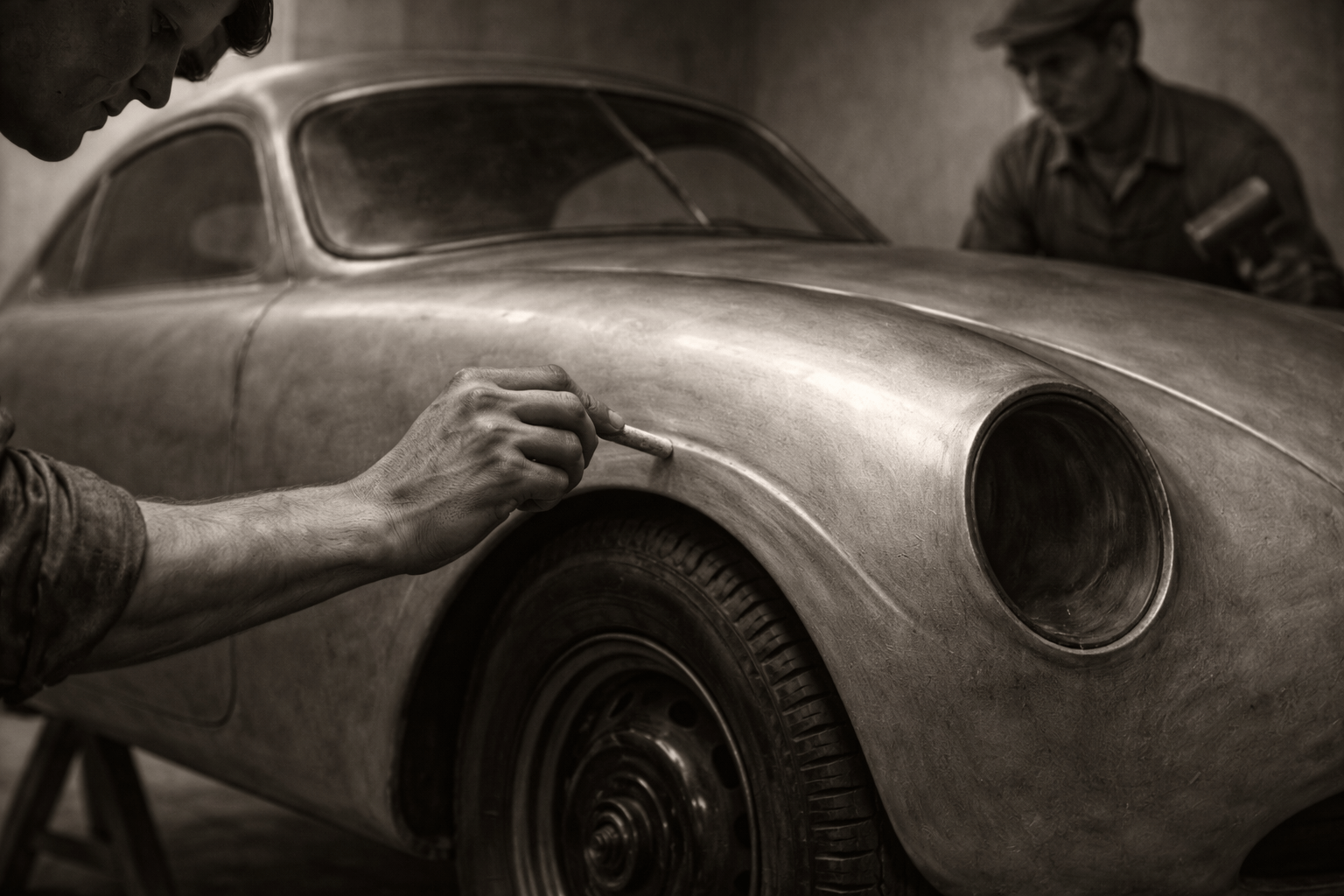
Michelotti stood before the car in the fading afternoon light, the arc of the fender casting a sharp shadow across the floor. Then his pencil was in his hand, sketching directly on the bare metal with a piece of chalk. A subtle outward flare traced itself around the wheel opening, flowing like a sculptor’s gesture back into the body side.
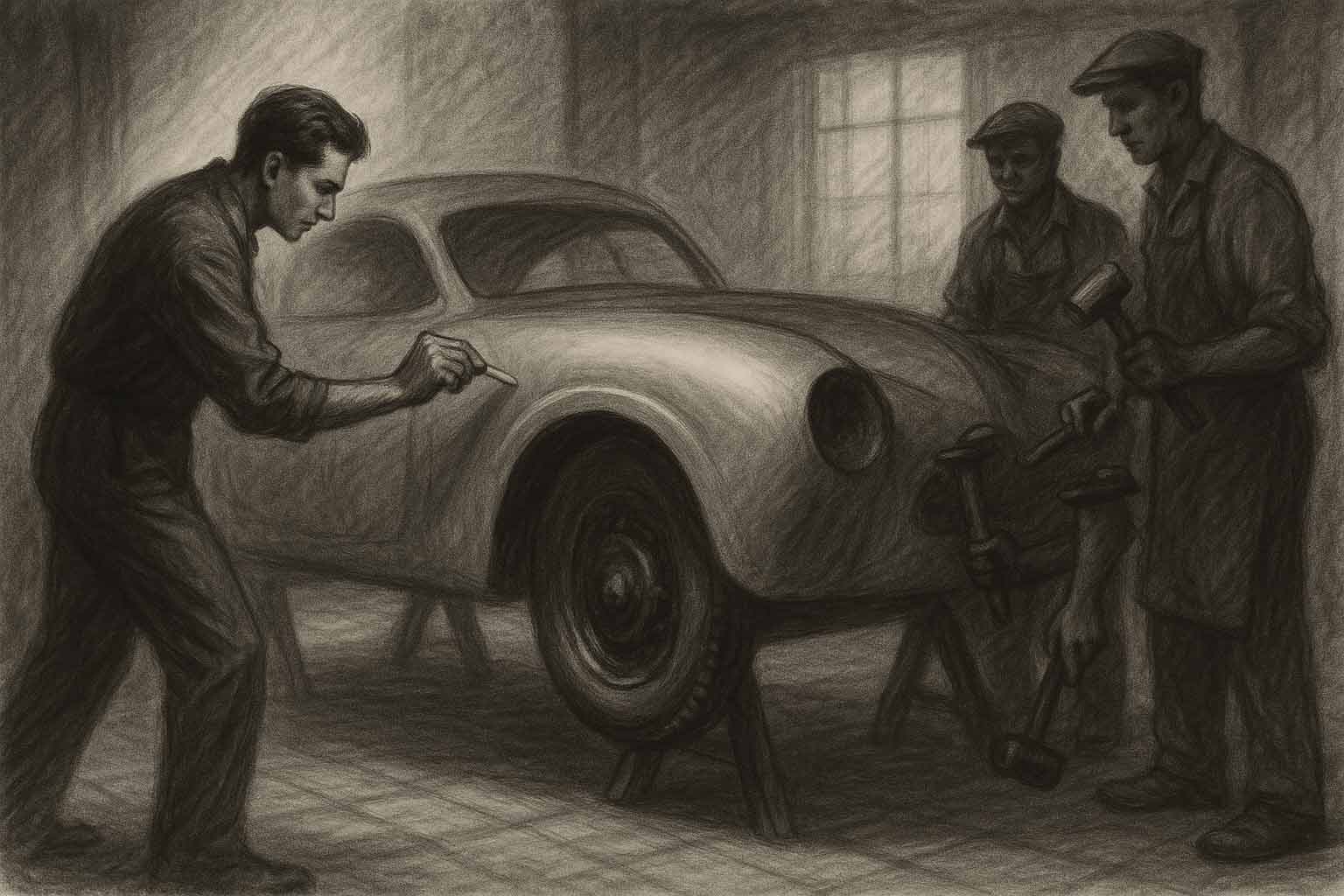
“Make it like this,” he told the panel beaters. The men hesitated — no one had seen such a treatment before. But as the first curve took shape under the hammer, it became clear: this was no compromise. This was an improvement. The flare — a small moustache of metal — reconciled the wheel and body perfectly, while giving the car a more planted, muscular stance.
From Accident to Signature
The client never knew. The car was delivered on time, admired for its stance and poise. The little projection around the wheel arch looked so intentional that it reappeared in Michelotti’s later designs.
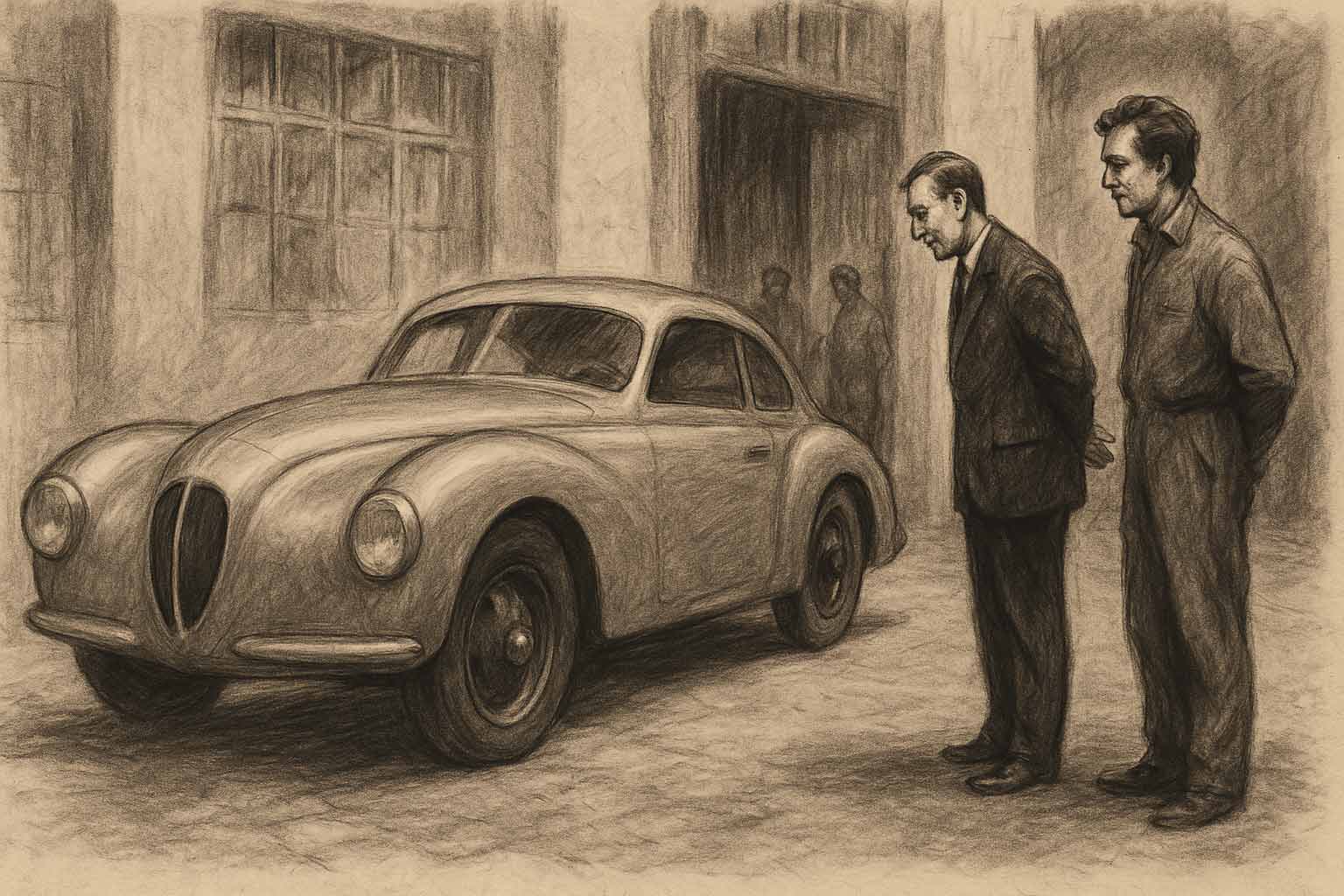
Soon, other coachbuilders imitated it. What began as a solution to a measurement error became known simply as the baffo — the “moustache” — and it would remain a fixture of Italian design for decades. Even on some modern cars, the DNA of Michelotti’s accident can still be traced in the subtle swelling of a fender line.
Always Something New
The baffo was more than a fix — it was a glimpse of Michelotti’s philosophy. Throughout his career, he made it a point to introduce at least one novelty into every design. Beauty alone was not enough; a car had to push an idea forward.
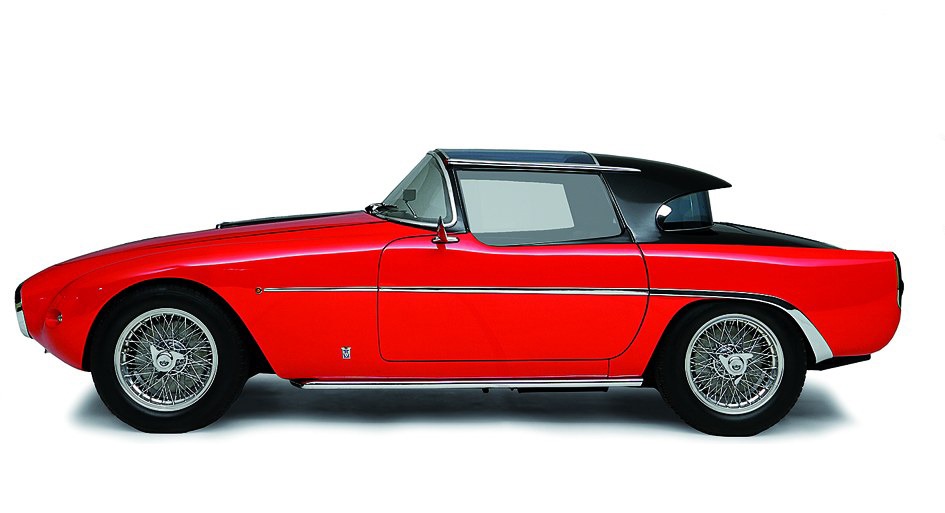
Years later, this same impulse gave birth to another subtle but groundbreaking feature: the hidden door handle of the Fiat 8V Demon Rouge. Determined to keep the flanks of the car perfectly smooth, Michelotti integrated the handle into the rear pillar, concealed beneath a chromed element. To open the door, one pressed the chrome — a gesture that felt both luxurious and futuristic. In the early 1950s, it was a detail unlike anything else on the road.
The young Michelotti could not have known, standing in the Farina workshop that winter’s day, that his quick thinking would give birth to one of the most recognisable design flourishes in Italian automotive history. Yet that is the nature of innovation: sometimes it comes not from deliberate planning, but from the quiet confidence to turn a mistake into something beautiful.
From the pre-war ateliers of Turin to the concept cars and GTs of the 1960s, Michelotti’s baffo has whispered its story — of craftsmanship, ingenuity, and the belief that even a setback can be shaped, under the right hands, into a signature.

ABOUT THE AUTHOR
Andreas Scheidl
Italian classic car enthusiast with German roots. Renowned as a respected figure in the classic car community, he serves as a jury member at various international concours d'elegance, including the Classic Gala Schwetzingen and Mantova. As a content creator, Andreas passionately shares his profound knowledge and appreciation for vintage automobiles. His heart beats for cars designed by Giovanni Michelotti, showcasing his discerning taste and dedication to preserving the timeless elegance of automotive history.
More stories by Andreas Scheidl ↗CONTINUE READING
Posts You Might Like
Fiat Panda Cabrio: The Italian Coachbuilders Who Opened Giugiaro’s Box
From Moretti’s Panda Rock to Italdesign’s experimental Strip, Maggiora’s four-wheel-drive convertible and Stola’s remarkable Destriero, the history of the open-top Panda reveals an unexpected chapter in Italian coachbuilding. When Giorgetto Giugiaro designed…
Read story
Gabriele d’Annunzio and the Cult of the Automobile
There was a time when the automobile had not yet become part of the landscape. It announced itself from afar through the beating of an engine, the smell of petrol and hot…
Read story
Fiat 1400: The Last Great Playground of the Carrozzieri
From Touring and Abarth to Farina, Ghia, Vignale, Boneschi, Bertone, Viotti and the smaller carrozzerie, the new Fiat quickly became one of the richest bases for Italian special bodies in the early…
Read story
How a Swiss Dealer Challenged Ferrari: The Story of Monteverdi
How Peter Monteverdi went from Swiss Ferrari dealer to creator of rare Frua and Fissore-bodied GTs, the Hai supercar and luxury off-roaders.
Read story
THE CONVERSATION
Comments 0
Share a memory, a period photograph or a documented detail about this story.