
The Golden Age of Advertising Vehicles in Italy: 1950s Rolling Billboards
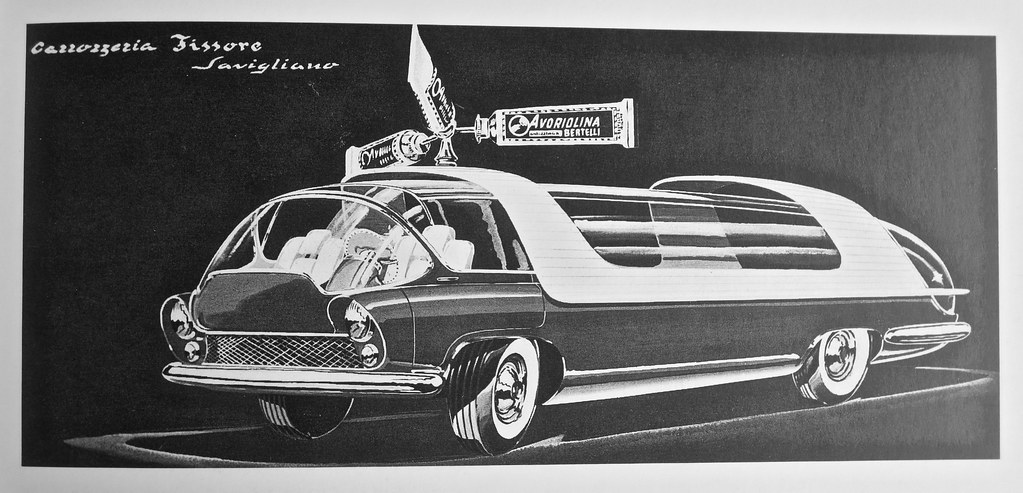
In the late 1940s and 1950s, Italy was a nation on the rebound – emerging from World War II and entering an economic boom (il boom economico) that brought a proliferation of new consumer products. Advertising these products creatively was crucial, especially in a time when mass media was limited. Television had not yet become widespread (Italian TV broadcasting began in 1954), so eye-catching vehicles proved to be an ideal way to bring ads directly to the public. It was in this context that fantastical “mezzi pubblicitari” (advertising vehicles) took to the roads. Companies commissioned custom-built cars and vans decked out with gigantic product replicas or outrageous shapes, turning heads in city streets and along event routes. This trend began in earnest around 1946, notably with the publicity caravan of the Giro d’Italia cycling race, and picked up steam through the 1950s. The concept was essentially an imaginative evolution of earlier practices like billboard streetcars and buses – but now the entire vehicle became a rolling advertisement.
Creativity on Wheels
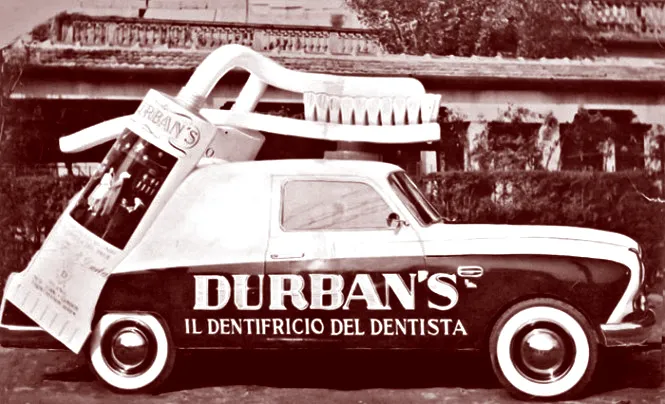
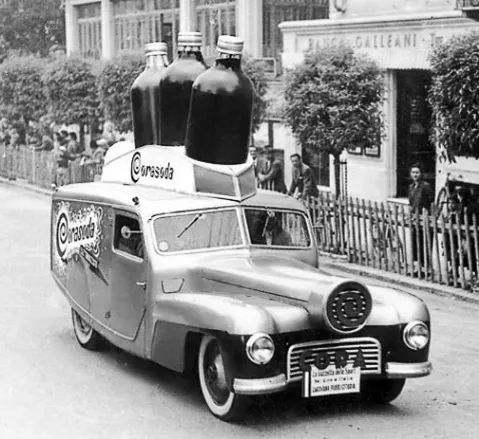
These promotional vehicles were often truly bizarre and whimsical. Some carried enormous cut-out figures of products on their roofs – for example, giant bottles of liquor or outsized cans of food – while others were themselves sculpted into the shapes of the goods being advertised. It was not unusual to see a van topped by a massive vermouth bottle or a car shaped like a tube of toothpaste rumbling down the road. Still others took on forms like oversize shoes, rockets, or even sharks to grab attention. All of this was done in the service of promoting the “prodotti più vari” – the most diverse products of Italy’s burgeoning postwar economy – in a way that was dynamic, memorable, and frankly fun. Crowds were delighted by these moving spectacles, which turned advertising into a form of street theater.
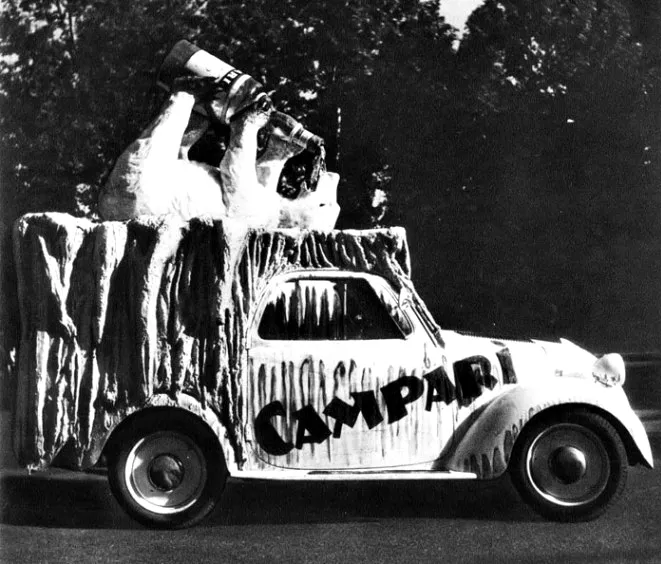
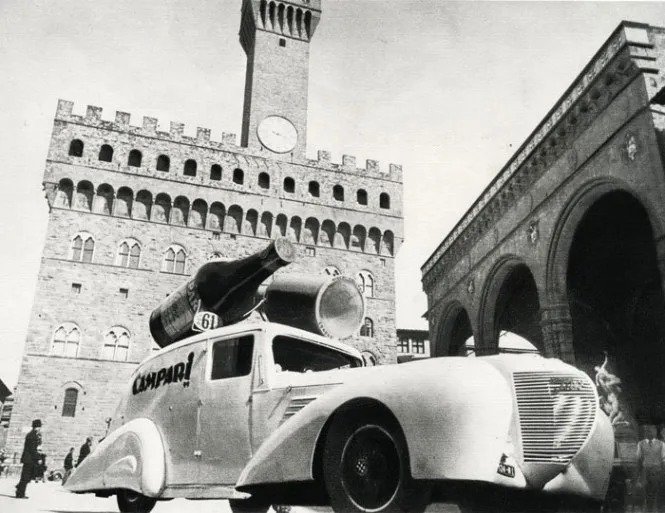
These rolling ads often appeared in parades or special convoys. A famous venue was the Giro d’Italia caravan, where a procession of advertising vehicles would precede the cyclists each day, entertaining spectators and pitching products along the route. The first post-war Giro in 1946 featured some of the earliest examples of these imaginative cars. By the 1950s, the carovana pubblicitaria had become a highly anticipated part of events, with each vehicle more creative than the last. Some vehicles simply mounted billboards or oversized product models, but others were full custom builds with bodies remade into fantastic shapes. For instance, one vehicle carried a polar bear figurine on its roof drinking from a giant bottle of Campari Cordial, recreating an advertisement in 3D and delighting onlookers. Another famous example was the so-called “Scarpa Ebano” – a car transformed into a giant black shoe to promote Ebano shoe polish (as shown above). These attention-grabbing rolling billboards brought advertising directly into city squares and rural towns alike, in an era when such spectacle was a primary means to reach consumers on the ground.
Italian Coachbuilders at Their Peak of Ingenuity
The creation of these extraordinary vehicles was entrusted to Italy’s renowned coachbuilders (carrozzieri). In the 1950s and early ’60s, Italian coachbuilding was at a high point – firms large and small were crafting everything from luxury cars and buses to special one-off designs. Building an advertising vehicle required the same craftsmanship and creativity, and many coachbuilders eagerly ventured into this niche, seeing it as a showcase for their design prowess. Numerous carrozzerie, famous and obscure alike, participated in crafting advertising cars: firms such as Fissore, Boneschi, Mantelli, Borsani, Monviso, Coriasco, Barbi, Zagato, Grazia, Scattolini (Scall) and many others contributed to these projects. In those years, however, two names stood out as the giants of the sector: Carrozzeria Fissore of Savigliano and Carrozzeria Boneschi of Milan. These two coachbuilders produced a large number of advertising vehicles and even developed a friendly rivalry in dreaming up spectacular designs.
🔗 Read more: Italian Coachbuilders Under Fascism and Beyond
To construct an ad vehicle, coachbuilders typically started with a standard production car or light commercial chassis – often models they were already building in their regular coachbuilt lineup – and then modified the body extensively. Many donor cars were common Fiat models (like the 500 “Topolino”, 600 Multipla, 1100 Berlina, or 1400 sedan), since Fiats were ubiquitous and their chassis easy to obtain. The coachbuilders would fabricate custom body sections, roofs, and attachments to accommodate giant fiberglass or wooden figures, display cases, or other props representing the product. Despite the often outlandish appearance, these vehicles still needed to be roadworthy and strong enough to carry the weight of signs and sculptures. The ingenuity of Italian artisans shone through in making the fantastic concepts a reality on four wheels.
Notable Coachbuilders and Their Creations
Below are some of the Italian coachbuilders that ventured into advertising vehicles in the 1950s–60s, along with examples of their most notable promotional creations:
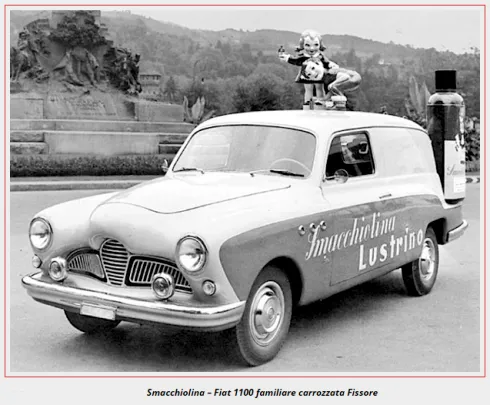
Fissore (Savigliano) – Fissore was one of the leading creators of advertising cars. Notably, Fissore built a Fiat 1100-based station wagon called “Smacchiolina e Lustrino”, featuring two plump cartoon children as three-dimensional figurines on its roof (the mascots for a line of stain remover and shoe polish products). Fissore also devised a dramatic promotional vehicle for Odol toothpaste in 1951, using a Fiat 1400 sedan chassis stretched and fitted with American-style tailfins and a concave side profile – a design said to be inspired by Detroit’s styling trends. Additionally, Fissore created advertising cars for Durban’s toothpaste and for Cavallino shoe polish, among others. The firm’s ability to combine bold graphics, product figurines, and unique bodywork made their vehicles especially memorable.
🔗 Read more: Carrozzeria Fissore: The History
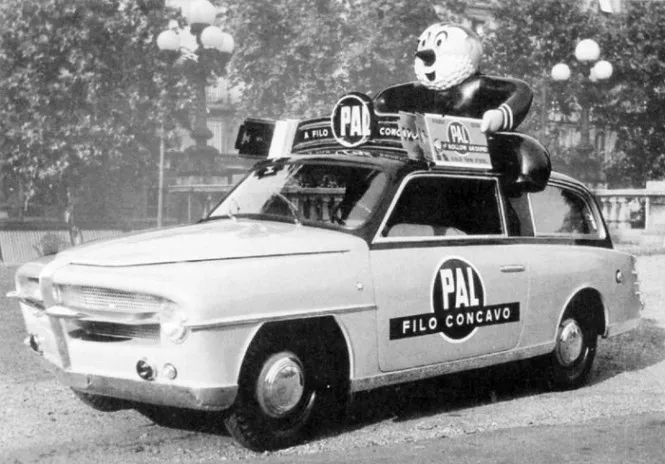
Boneschi (Milano) – Carrozzeria Boneschi was another prolific builder of these “pubblicitari” vehicles and a direct competitor to Fissore in this arena. Boneschi constructed a number of eye-catching cars to promote dental hygiene products – an area where several brands were vying for attention. For example, in 1951 Boneschi built a Fiat 1100 advertising car for Binaca toothpaste, featuring an oversize toothpaste tube and other embellishments. They also crafted a promotional vehicle for Chlorodont toothpaste, likely incorporating a giant replica of a toothpaste tube on the roof. Another Boneschi creation was an elaborately styled van for Colgate-Palmolive’s “Olà” line of oral care products. Beyond dental products, Boneschi made a station wagon for PAL razor blades (“filo concavo PAL”) and even worked on vehicles for food brands. Their designs often had a slightly more refined, automotive look (as Boneschi was known for elegant coachwork), yet were no less imaginative in the advertising elements attached.
Castagna (Milano) – A venerable coachbuilder famous for luxury car bodies in earlier decades, Carrozzeria Castagna also tried its hand at promotional vehicles. One particularly curious example was a car Castagna built that was topped with a giant sewing machine – the vehicle was based on a Simca chassis and the entire body was crafted to resemble an old-fashioned sewing machine, presumably advertising a sewing equipment brand. This unusual creation showed that even Castagna, known for its refined bespoke automobiles, embraced playful creativity when it came to advertising on wheels.
Coriasco (Torino) – Carrozzeria Coriasco was well known for converting small Fiats into vans and estate cars, and some of those found second lives as promotional vehicles. Coriasco built a cute Fiat 500 “Topolino” van that famously featured the “orso goloso” (gluttonous bear) from a Campari Cordial advertisement on its roof – essentially bringing a popular poster illustration to life in 3D. Coriasco also constructed a vehicle for the Presbitero stationery company, complete with oversized fountain pen nibs and colored pencils as decoration. These creations by Coriasco underlined how even compact vehicles could be transformed into attention-grabbing ads with some creative coachwork and props.
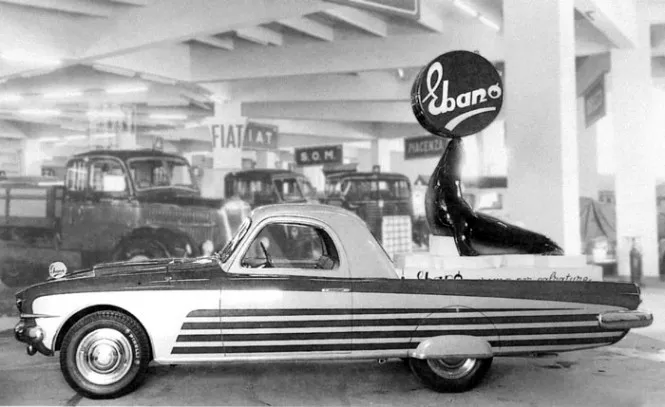
Others – Many other Italian coachbuilders contributed to this trend. Carrozzeria Grazia in Bologna built the aforementioned Ebano shoe-polish car shaped like a giant shoe (see image above) in 1956, arguably one of the most iconic advertising cars. Carrozzeria Barbi, normally a bus and coach manufacturer, constructed at least one promotional truck carrying a huge model of a Simmenthal canned meat tin and a giant cow figure for the Giro d’Italia caravan. Even Zagato, better known for sleek sports car bodies, was involved – Zagato and others reportedly lent their talents to craft flamboyant one-offs for the advertising needs of the time. From north to south, virtually every region of Italy saw local carrozzieri contributing their own flair to promotional vehicles, whether it was a local dairy’s delivery van turned into a roaming milk bottle, or an oil company’s bus outfitted with dramatic signage. This collective effort across big and small firms made the 1950s a true golden age of automotive advertising art.
🔗 Read more: Carrozzeria Boneschi: The History
It’s worth noting that these elaborate vehicles were not mass-produced; each was essentially a one-off creation tailored for a specific campaign or client. The cost and craftsmanship were significant. However, businesses justified the expense as these cars generated enormous publicity – they would be photographed for newspapers, swarmed by curious crowds, and remembered long after a static billboard might be forgotten. They also gave the coachbuilders a chance to showcase their skill in a very public way. In some cases, the base vehicles were part of the coachbuilder’s regular offerings (for example, Fissore and Boneschi both built standard station wagon variants of Fiat cars), so transforming one into an ad vehicle was a matter of adding on custom elements to an existing design. This synergy meant that advertising cars often retained the drivability and reliability of their stock counterparts, even as they sported wild adornments on top.
By the late 1950s and early 1960s, a powerful new medium began to steal the spotlight: television advertising. In 1957, RAI (Italy’s state broadcaster) introduced Carosello, a nightly block of TV commercials that soon became a national phenomenon. Carosello turned advertising into mini theatrical skits on the TV screen, reaching millions of viewers in their living rooms. As the 1960s progressed, more and more Italian households acquired a television set, and companies shifted their marketing budgets accordingly. Why spend a fortune to build and maintain a single advertising vehicle – which could only be in one place at a time – when a TV commercial could broadcast your message to the entire country at once?
Indeed, the very imagery and fantasy that had fueled the success of advertising cars found a new outlet in television ads. The immaginifici Caroselli (imaginative TV ad segments) began to captivate the public nightly, reducing the need for on-the-road spectacles. As a result, by the early 1960s the golden age of the rolling advertisement vehicle started to wane. Fewer companies commissioned custom cars, and many of the existing ones were retired or repurposed after fulfilling their promotional tours. Some made occasional appearances at local fairs or as novelties, but the surge of new creations slowed dramatically.
By the mid-1960s, Italy’s coachbuilders were also undergoing changes – the postwar custom coachbuilding boom was fading as mass-produced cars became more standardized. Many carrozzerie that had flourished in the 1950s either refocused on other work (like buses, trucks, or special conversions) or closed down in the 1960s. The decline of advertising vehicles was both a cause and effect of these economic shifts. In short, television killed the “advertising star car.” Clients found they no longer needed to invest in flamboyant vehicles when they could sponsor a segment on Carosello or buy a print ad in a glossy magazine to reach consumers.
Legacy of the Advertising Vehicles Era
Though their heyday was brief, the Italian advertising vehicles of the 1950s and ’60s left an enduring legacy in both the automotive and marketing worlds. They are remembered as a uniquely creative intersection of art, commerce, and engineering. Surviving photographs – many in black and white, showing smiling crowds gathered around cars with giant shoes or toothpaste tubes – speak to a time when advertising literally stopped traffic. A few originals still exist in museums or private collections: for example, the shoe-shaped Ebano car was rediscovered in a “barn find” and restored in recent years as a piece of design history. Collectors and vintage car enthusiasts now prize these oddball vehicles for their rarity and the stories they tell about Italy’s postwar optimism.
In retrospect, the “mezzi pubblicitari” phenomenon highlights the ingenuity of Italian coachbuilders at a time when they had the freedom to experiment. These craftsmen turned everyday vehicles into moving fantasylands, reflecting the spirit of innovation of the era. While modern advertising has moved to digital realms, the fundamental idea of creating a buzz through unusual, eye-catching displays lives on – whether in today’s quirky promotional vehicles (like food trucks or cars wrapped in logos) or in experiential marketing events. The Italian pioneers of the 1950s proved that with enough imagination (and a skilled coachbuilder), even an automobile can become a work of advertising art.
In conclusion, the story of Italian coachbuilders and advertising vehicles is a fascinating chapter in automotive history. It was born from postwar necessity and creative exuberance, thrived during the economic boom when cars became canvases for corporate imagination, and eventually faded as television took over. Yet, the pictures and restored examples of those fantastic rolling advertisements continue to inspire nostalgia and admiration. They remind us of a time when products were promoted not just with slogans, but with wheels, engines, and a touch of automotive magic – an era when Italian coachbuilders quite literally put advertising on the road and in the spotlight.

ABOUT THE AUTHOR
Andreas Scheidl
Italian classic car enthusiast with German roots. Renowned as a respected figure in the classic car community, he serves as a jury member at various international concours d'elegance, including the Classic Gala Schwetzingen and Mantova. As a content creator, Andreas passionately shares his profound knowledge and appreciation for vintage automobiles. His heart beats for cars designed by Giovanni Michelotti, showcasing his discerning taste and dedication to preserving the timeless elegance of automotive history.
More stories by Andreas Scheidl ↗CONTINUE READING
Posts You Might Like
Reinterpreting the Past: When Coachbuilders revisited it’s Icons
When iconic coachbuilt cars are rebade through time, intent matters more than nostalgia. From experimental originals to modern reinterpretations, this article examines how legends are reimagined—and why some ideas refuse to stay…
Read story
Neither Coupé nor Spider: Italy and the Targa Roof
A deep dive into Italy’s decades-long exploration of the targa roof—from early post-war experiments to Ferrari and Lamborghini icons—revealing how Italian designers created a third way between coupé and spider.
Read story
Italian Vision of the MPV: The Monovolume Concept
Long before MPVs filled suburban driveways, Italian designers were shaping the monovolume with prototypes that ranged from pragmatic to outright outrageous. Their work rewrote how space, style, and function could fit under…
Read story
Italian Coachbuilt City Car Concepts: From Microcars to Urban EVs
How did Italy’s famed coachbuilders go from designing Ferraris to dreaming up tiny electric runabouts? From the quirky Tsé-Tsé to Pininfarina’s visionary Nido, discover how city cars became a proving ground for…
Read story
THE CONVERSATION
Comments 0
Share a memory, a period photograph or a documented detail about this story.