
The Chrysler K-300 Special by Ghia
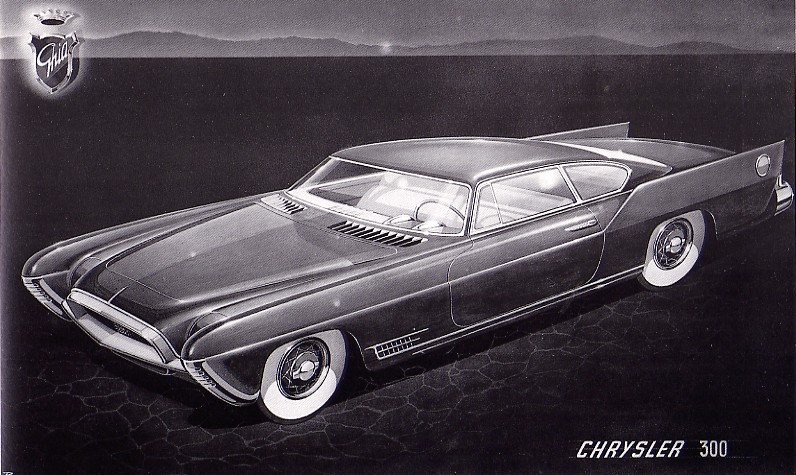
The story of the Chrysler K-300 Special by Ghia unfolds against the rich backdrop of mid-20th century automotive innovation. This unique vehicle was the product of a collaboration between Virgil Exner, Chrysler’s visionary design chief in the 1950s, and Luigi “Gigi” Segre, the director of the Italian coachbuilder Carrozzeria Ghia. Exner’s influence is evident in the car’s dramatic proportions – a long, elegant hood, a low-slung roofline, and bold tailfins that exemplified his “Forward Look” design language. At the same time, Ghia’s European craftsmanship brought refined details and coachbuilt quality. The K-300 Special emerged during an era of increasing transatlantic collaboration in car design, when Chrysler and Ghia frequently partnered to create cutting-edge concept cars and custom automobiles. This fertile partnership set the stage for a vehicle that would encapsulate the spirit of American innovation and Italian artistry in equal measure.
A Royal Commission and Creation
In the mid-1950s, this extraordinary project took on an even more prestigious aura when it was commissioned by Mohammad Reza Pahlavi, the Shah of Iran, as a gift for his second wife, Queen Soraya Esfandiary. The Chrysler K-300 Special was meticulously handcrafted in Ghia’s Turin workshop, where Exner’s futuristic design sketches were translated into metal by Italian artisans. The result was a one-of-a-kind, two-seat luxury coupe that seamlessly blended transatlantic design influences. Before making its way to the royal garage in Tehran, the K-300 Special reportedly made a public debut at the 1955 Paris Motor Show, dazzling audiences with its sleek form and international flair. Built upon a modified Chrysler chassis (akin to the New Yorker of its day), the car was a harmonious fusion of American power and Italian coachbuilding, intended to showcase the best of both worlds. Its very existence as a custom-order for royalty added an extra layer of exclusivity and mystique to the vehicle’s provenance.
Innovative Features and Luxurious Details
Visually and mechanically, the K-300 Special introduced features far ahead of its time. One of its most striking innovations was a fully retractable hardtop roof, operated by a switch on the dashboard – a complex engineering marvel in an era when such mechanisms were virtually unheard of. The body, rendered entirely in steel, was finished in a striking two-tone color scheme (period accounts describe it as silver paired with metallic blue) and adorned with dramatic styling cues. The front grille drew inspiration from a earlier Ghia concept (the Chrysler Ghia GS-1), while the rear fenders swept into prominent tailfins evocative of jet-age aircraft design. Further emphasizing its advanced character, the car featured modern conveniences like power-operated windows and seats, as well as Chrysler’s novel push-button transmission selector, giving the interior a futuristic, push-button control theme for driver functions.
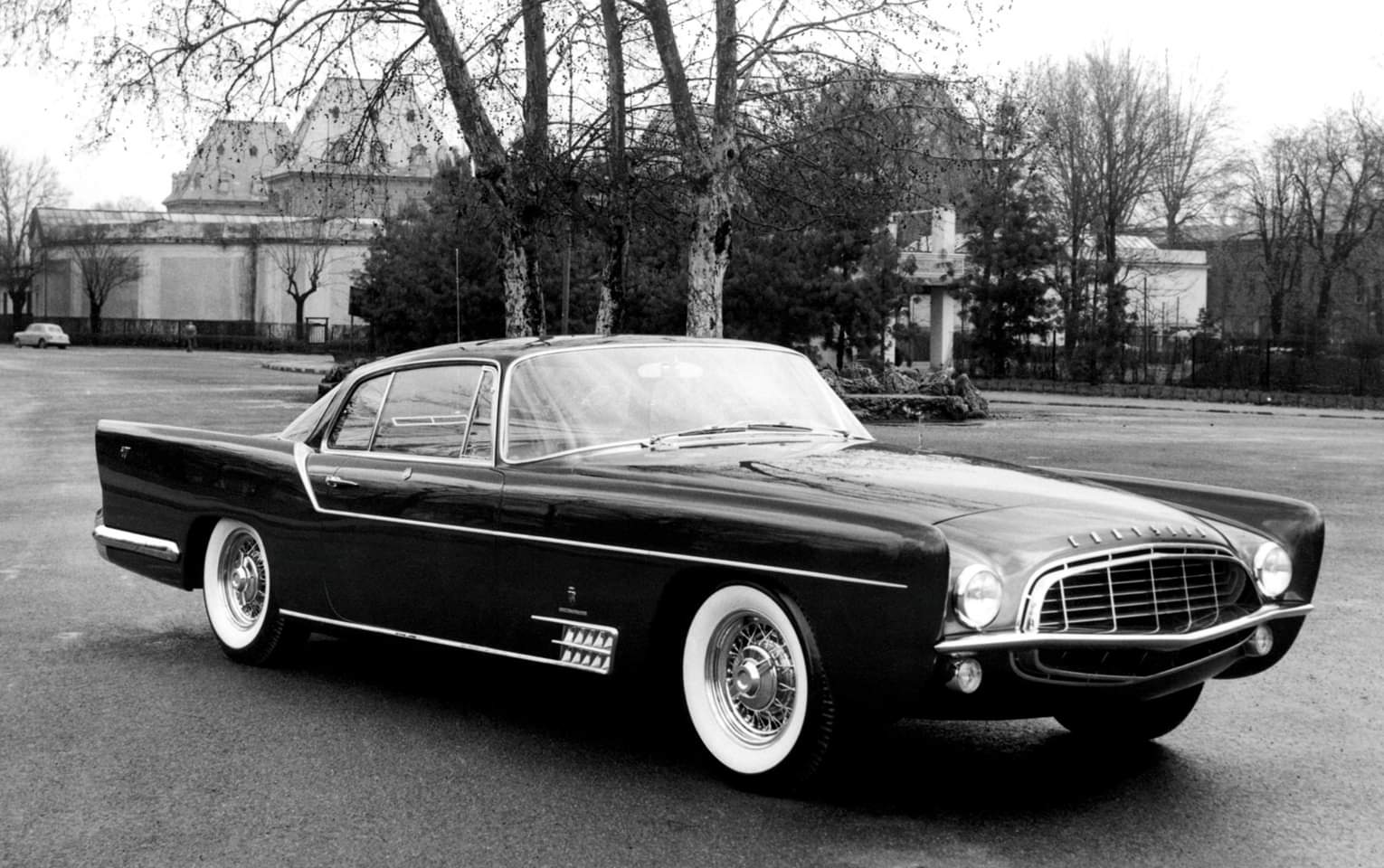
Inside the K-300 Special, no expense was spared to craft an environment fit for a queen. The cabin was trimmed in premium materials – reportedly white leather upholstery with brushed aluminum accents on the dashboard – and packed with amenities that were exceedingly rare in the 1950s. Notable luxury features included:
Glovebox Record Player: A discreet record player was integrated into the glove compartment, allowing passengers to enjoy music on the move. This was based on Chrysler’s short-lived in-car phonograph concept, and exemplified the car’s ahead-of-its-time entertainment options.
🔗 Read more: The story of Ghia – part 1
Refrigerated Mini-Bar: Behind the seats sat a built-in drink refrigerator, providing chilled refreshments – a lavish feature virtually unheard of in cars of that era.
Radio Telephone: A two-way radio telephone system was installed, reflecting cutting-edge technology that enabled communication from the car – a true rarity decades before mobile phones.
Air Conditioning: The K-300 Special was equipped with a full air conditioning system, at a time when air conditioning in automobiles was still a luxury reserved for the most expensive vehicles. This ensured comfort in the hot Iranian climate.
Gold-Plated Instruments: The instrument panel and various interior trim pieces were gold-plated, underscoring the car’s bespoke opulence and the royal attention to detail in its commissioning.
All of these elements were crafted to astonish and delight. Together, they made the K-300 Special’s interior a showcase of mid-century luxury and innovation, tailored to the Shah and Queen’s exacting tastes.
Powertrain and Performance
Beyond its stunning design and lavish appointments, the K-300 Special was engineered for serious performance – at the Shah’s request, no ordinary engine would do. Chrysler equipped the car with a 392 cubic-inch (6.4 L) Hemi V8 engine, the largest and most potent engine in Chrysler’s lineup at the time. Topped with dual four-barrel carburetors (a “double 4-barrel” setup), this powerplant was capable of producing approximately 375 horsepower, an astounding figure in the mid-1950s. In fact, performance estimates for the K-300 Special suggest a top speed on the order of 150 mph, and 0–60 mph acceleration in the 8–9 second range – levels of performance that placed it among the fastest road cars of its era.
However, delivering this engineering marvel to Iran came with logistical challenges. Due to shipping constraints, the high-performance Hemi engine was sent separately and arrived in an unassembled state. Final assembly of the engine and fine-tuning of the car were carried out in Tehran’s Royal Garage, under the supervision of Reza Dardashti, the Shah’s head mechanic. Once completed, the Chrysler K-300 Special possessed the brawn to match its beauty – a robust grand touring machine that could comfortably cruise at high speeds, befitting the Shah’s desire for both luxury and power in his commissioned automobile.
Hiatus: Royal Ownership, Accident, and Storage
Upon its completion, the K-300 Special indeed became Queen Soraya’s personal motorcar, a symbol of her husband’s affection and the pinnacle of 1950s automotive luxury. She used the car for a time as her private transport around Tehran. Unfortunately, this royal romance with the road was cut short by an accident that damaged the car’s front end, rendering the vehicle undrivable until repairs could be made. Not long after this incident, in 1958, Queen Soraya was divorced and left Iran, which meant the special Chrysler lost its primary user and patron. As a result, the one-off car was tucked away and largely forgotten for many years. It spent an extended period dormant in storage, its once-grand presence hidden from sight.
🔗 Read more: The Partnership between Ghia & Chrysler
The next chapter in the K-300’s story was dictated by history: the Iranian Revolution of 1979. In the turmoil that saw the Shah’s regime collapse, all property of the royal family was seized by the new government – including their collection of exotic automobiles. The Chrysler K-300 Special, along with dozens of other royal cars, was confiscated and moved into a storage warehouse. There it sat among dusty rows of classic Rolls-Royces, sports cars, and limousines, awaiting an uncertain fate. For over a decade, the car lingered in limbo, a hidden relic of a bygone era of extravagance.
Restoration and Museum Exhibition
It was not until the early 1990s that the Chrysler K-300 Special re-emerged into the light of day. In 1991, recognizing the historical and cultural value of this singular vehicle, the Iranian authorities sanctioned a meticulous restoration project. The restoration was led by Mansour Kamranfar, a renowned Iranian classic car expert, and his team of specialists. Over the course of the restoration, the K-300 was painstakingly brought back to its former glory – from straightening the hand-formed bodywork and recreating missing parts, to refurbishing the luxurious interior and making the complex retractable roof fully functional again. The team paid special attention to preserving every unique feature that made this car so noteworthy, ensuring that details like the record player, fridge, and gold-plated gauges were all restored or conserved.
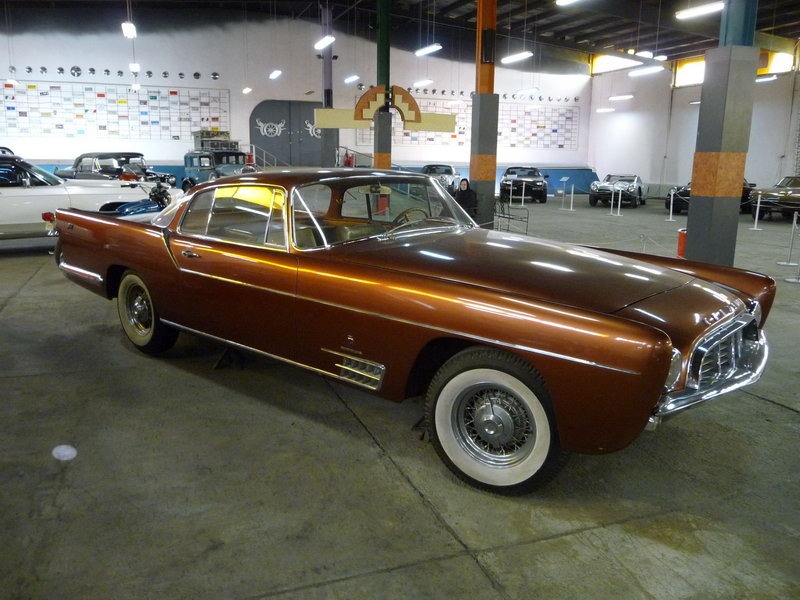
Upon completion of the restoration, the Chrysler K-300 Special took its rightful place on display at the National Car Museum of Iran (located just outside Tehran), which opened to the public in the early 2000s. There, the K-300 Special remains one of the crown jewels of the collection – a freshly gleaming time capsule of 1950s design and royal luxury. Visitors to the museum can admire the car up close, marveling at its jet-age tailfins, sumptuous interior, and the storied history that accompanies it. As an artifact, it offers a tangible connection to the era of the Shah’s reign and the grand visions of automotive design from that period.
Legacy and Significance
The Chrysler K-300 Special by Ghia remains the only example of its kind—a singular expression of mid-century automotive ambition shaped by the intersecting visions of American industry, Italian craftsmanship, and Persian royalty. Conceived on a Chrysler platform and executed in Turin under the direction of Luigi Segre, with design by Virgil Exner, the coupe represented far more than a styling exercise. Commissioned for Queen Soraya by the Shah of Iran, the car emerged as a rolling emblem of opulence, diplomacy, and transnational design cooperation during a time when East and West rarely shared such intimate creative dialogue.
Its lineage bridges cultures and ideologies: an American V8 under the hood, a hand-shaped Italian body, and bespoke luxury features tailored for a royal court. Decades later, after surviving political upheaval and years of abandonment, the K-300 Special re-entered public consciousness through meticulous restoration, reclaiming its role as a historical artifact. Not merely a footnote in Chrysler’s experimental history or Ghia’s design portfolio, the K-300 Special has become a reference point for scholars, curators, and collectors seeking to understand how craftsmanship, power, and aesthetics merged in the geopolitical theater of the 1950s.
Its legacy continues to shape conversations around coachbuilding and international partnerships in automotive design. As a preserved symbol of its time, the K-300 Special captures not only the personality of its creators but also the complexities of the world that made it possible.
CONTINUE READING
Posts You Might Like

A Central Driving Position, a Rear-Mounted V8. Was This Really a Lancia?
In 1948, visitors to the Turin Motor Show could see an unusual Lancia on the stand of Carrozzeria Ghia. It was a large two-door coupé with a two-litre V8 mounted behind the…
Read story
Fioravanti F100: The Ferrari He Was Allowed to Imagine
Enzo Ferrari’s centenary, Leonardo Fioravanti’s independent studio and a supercar that explored air brakes, steel wheels and a new way of driving—without ever wearing the Cavallino.
Read story
Michelotti Shellette: When the Fiat 850 Became a Yacht
The yacht designer, the Turin stylist and the tiny coachbuilt car that crossed between the quay, the royal holiday house and the auction room. Some automobiles were conceived for the open road,…
Read story
Maserati A6 1500: A New Road for the Trident
When the doors of the Geneva Motor Show opened in March 1947, Maserati was a name that required little introduction to anyone who followed motor racing. What it did not yet possess…
Read story
THE CONVERSATION
Comments 0
Share a memory, a period photograph or a documented detail about this story.