
Maserati Boomerang: The Complete History of Giugiaro’s Chassis #081
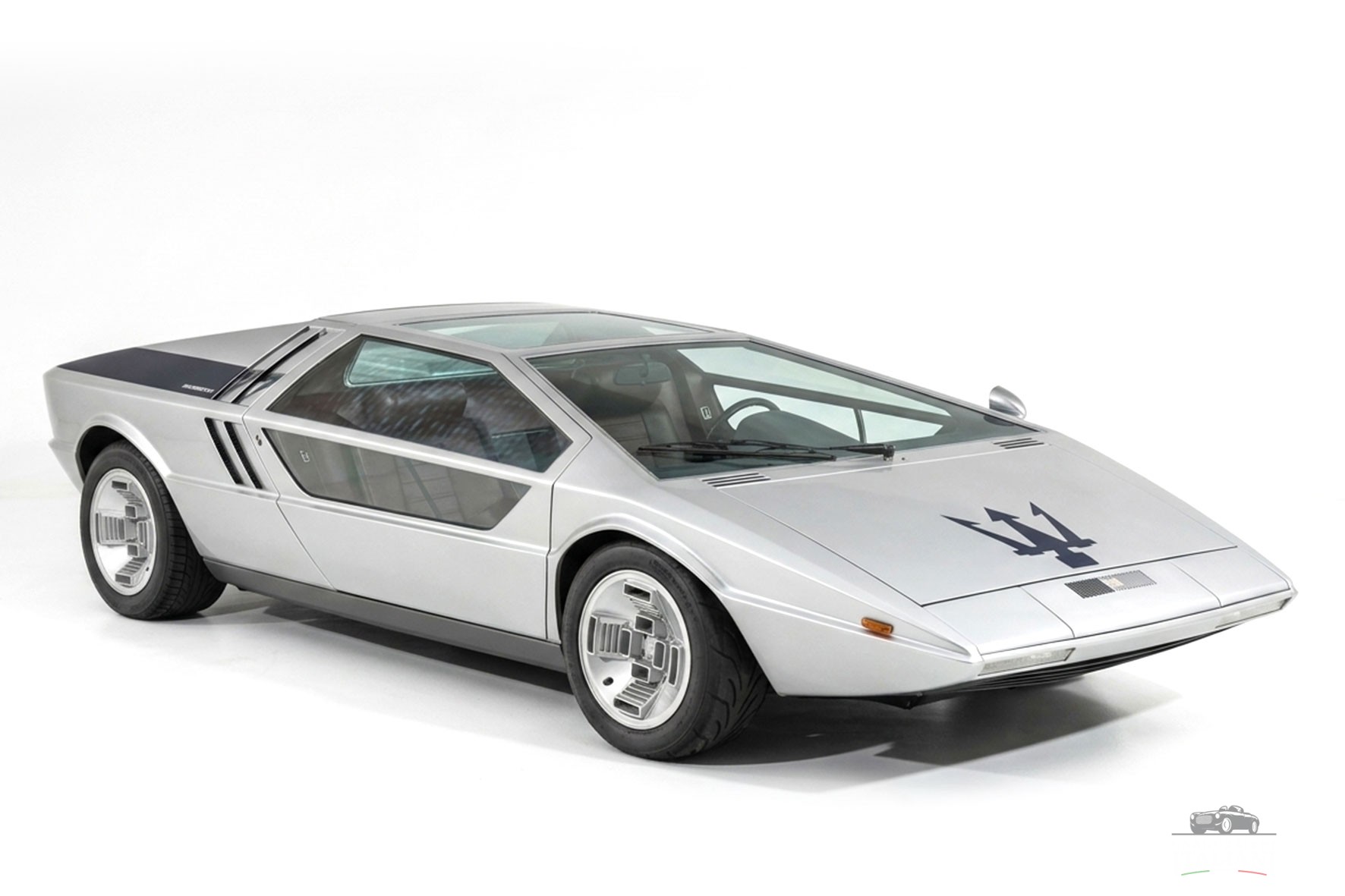
Maserati Boomerang is remembered as one of the most radical shapes of the early 1970s, but the surviving car is more interesting than its reputation as a styling icon suggests. It is not simply an image from the wedge era. It is a single, road-registered chassis with a documented life that moved from the Turin and Geneva show circuit to private ownership in Spain, a long restoration, international concours appearances and a sequence of major auction sales. The history of chassis #081 therefore sits at the intersection of design history, prototype engineering and collecting.
The distinction matters because much of the Boomerang’s story has traditionally been told through its shape alone. Carrozzieri-Italiani already covers the wider wedge-shaped revolution, the evolution of Giorgetto Giugiaro and his recurring use of the glass cockpit canopy. This article follows a different route: the Boomerang as one physical object, from the idea that preceded it to the car that survives today.
Before the Boomerang
When Italdesign was founded in 1968 by Giorgetto Giugiaro and engineer Aldo Mantovani, the new company was conceived as more than a styling studio. It combined design, model-making, prototyping and engineering. Its early show cars became a rapid sequence of experiments in proportion and architecture: the Bizzarrini Manta, the Alfa Romeo Iguana, the Porsche Tapiro and the Caimano all tested increasingly geometric solutions.
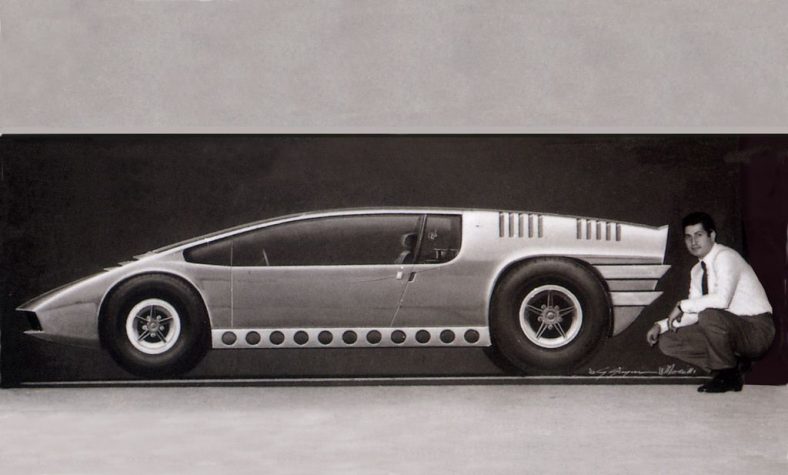
Italdesign’s own archive explicitly identifies elements from the Iguana, Tapiro and Caimano as direct ingredients of the Boomerang. The family resemblance is visible in the recessed bonnet treatment, the definition of the nose and beltline and the increasingly architectural treatment of the glazed cabin. The Boomerang was therefore not an isolated drawing. It was the point at which several lines of Giugiaro’s late-1960s experimentation were pushed almost to abstraction.
The Maserati connection and the Bora chassis
The project became technically credible because Maserati could provide a suitable mid-engined platform. The production Maserati Bora, itself styled by Giugiaro at Italdesign, had given the marque its first series-production mid-engined road car. Its steel structure, rear-mid-mounted V8 and five-speed transaxle offered the Boomerang something many dream cars lacked: the basis for a functioning automobile rather than a static styling object.
Maserati’s own historical material states that the working Boomerang used the Bora chassis and complete mechanical package. The 4,719 cc four-cam V8 was rated at 310 hp and coupled to a five-speed manual transmission. Christie’s later identified the surviving car as chassis 081 with engine 902. In other words, the Boomerang was not a hollow salon shell. It could be registered, driven and mechanically serviced as a real car, however impractical its body might be.
Turin, Geneva and a chronology that needs care
The chronology is one of the places where modern sources no longer agree perfectly. Maserati’s 2022 historical release states that a mock-up made a brief appearance at the 1971 Turin Motor Show and that the fully functioning Boomerang debuted at Geneva on 9 March 1972. The Giugiaro family archive follows the same 1971-to-1972 sequence. Italdesign’s current project page, however, dates the epowood model to Turin 1972 and the one-off to Geneva 1973.
For chassis history the safest treatment is to separate the static model from the surviving working car. The Turin mock-up belongs to the design-development story; chassis #081 is securely documented as the functioning car in the early 1970s, with Maserati identifying the Geneva debut as 9 March 1972. Until period catalogues settle the discrepancy conclusively, reproducing one chronology as unquestionable fact would be less useful than recording the conflict.
Giugiaro reduces the supercar to planes
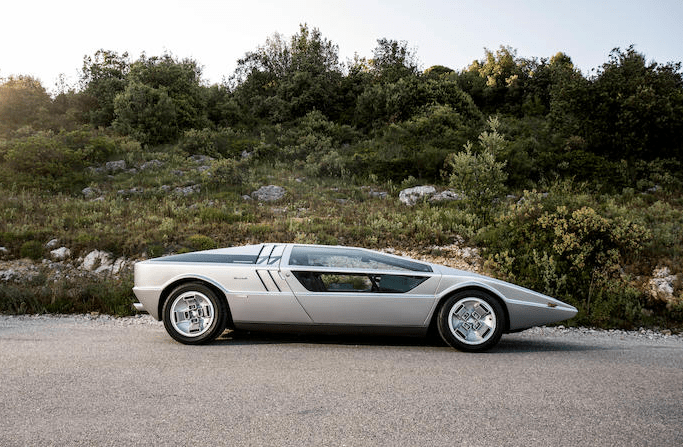
The Boomerang is often described as a wedge, but that word alone misses the severity of the composition. Giugiaro reduced the body to a sequence of almost uninterrupted planes and trapezoids. The waistline reads as a horizontal cut through the car; the nose is extremely low; the cabin appears set beneath a continuous glass structure; the rear mass is defined as much by geometry as by conventional body volume.
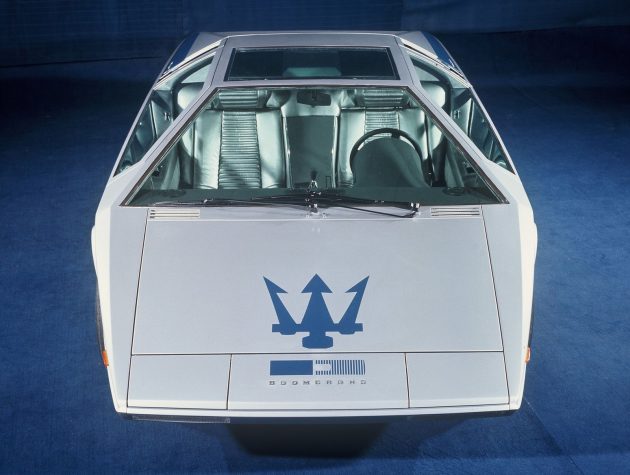
Italdesign records a windshield rake of only 13 degrees from horizontal, even more extreme than the Manta. Glass suppliers considered such an angle problematic because of reflections and visibility. The solution was not simply theatrical. It was part of Giugiaro’s continuing attempt to understand how far the frontal architecture of a road car could be lowered before legislation, visibility and packaging made the idea unusable.
The resulting body measured roughly 4,342 mm long, 1,860 mm wide and only 1,070 mm high. The proportions made the 2,600 mm wheelbase look unusually long in relation to the cabin. The wheel design followed the same logic: broad sculptural discs rather than conventional decorative alloys.
The steering wheel was an engineering experiment
The interior deserves to be treated independently from the body. The familiar photograph of the Boomerang steering wheel can make it look like a piece of visual theatre, yet the fixed central instrument assembly was connected to a genuine safety investigation.
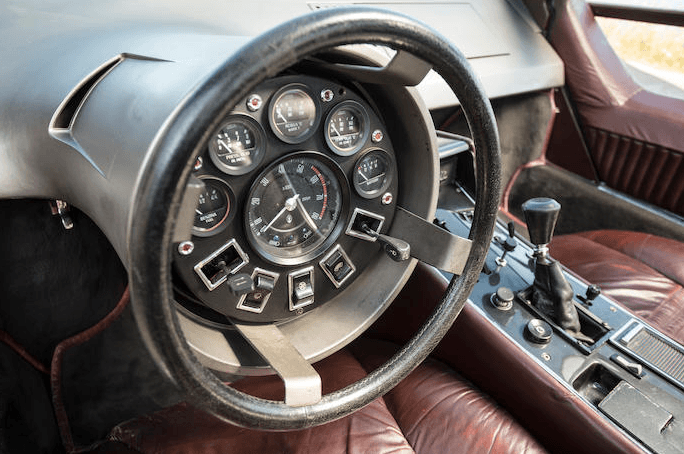
The steering rim rotated around a stationary cylindrical hub containing the speedometer, tachometer, secondary gauges and switchgear. Italdesign explains that the steering column itself was divided and linked by a chain, intended to reduce the risk of the column being driven backwards toward the driver in a frontal impact. The large central disc was also conceived with the possibility of an airbag in mind. It was a highly experimental solution, but it shows that the cabin was not designed only to look futuristic.
This is where the Boomerang also fits naturally into Giugiaro’s broader cockpit-canopy research. His concept cars repeatedly treated the upper body as a transparent technical enclosure rather than a conventional roof sitting above doors and windows. On the Boomerang, that idea became inseparable from the dashboard and driving position.
From Boomerang to Esprit
The design did not enter production as a Maserati, yet several of its ideas moved quickly into less extreme projects. The most obvious comparison is the Lotus Esprit. Giugiaro had already been developing Lotus’s new mid-engined coupé while the Boomerang was circulating on the show circuit. The production Esprit had to accept a far more practical windscreen angle, door structure and cabin, but its low nose, clean planar surfaces and strong wedge profile translated the same design vocabulary into a saleable automobile.
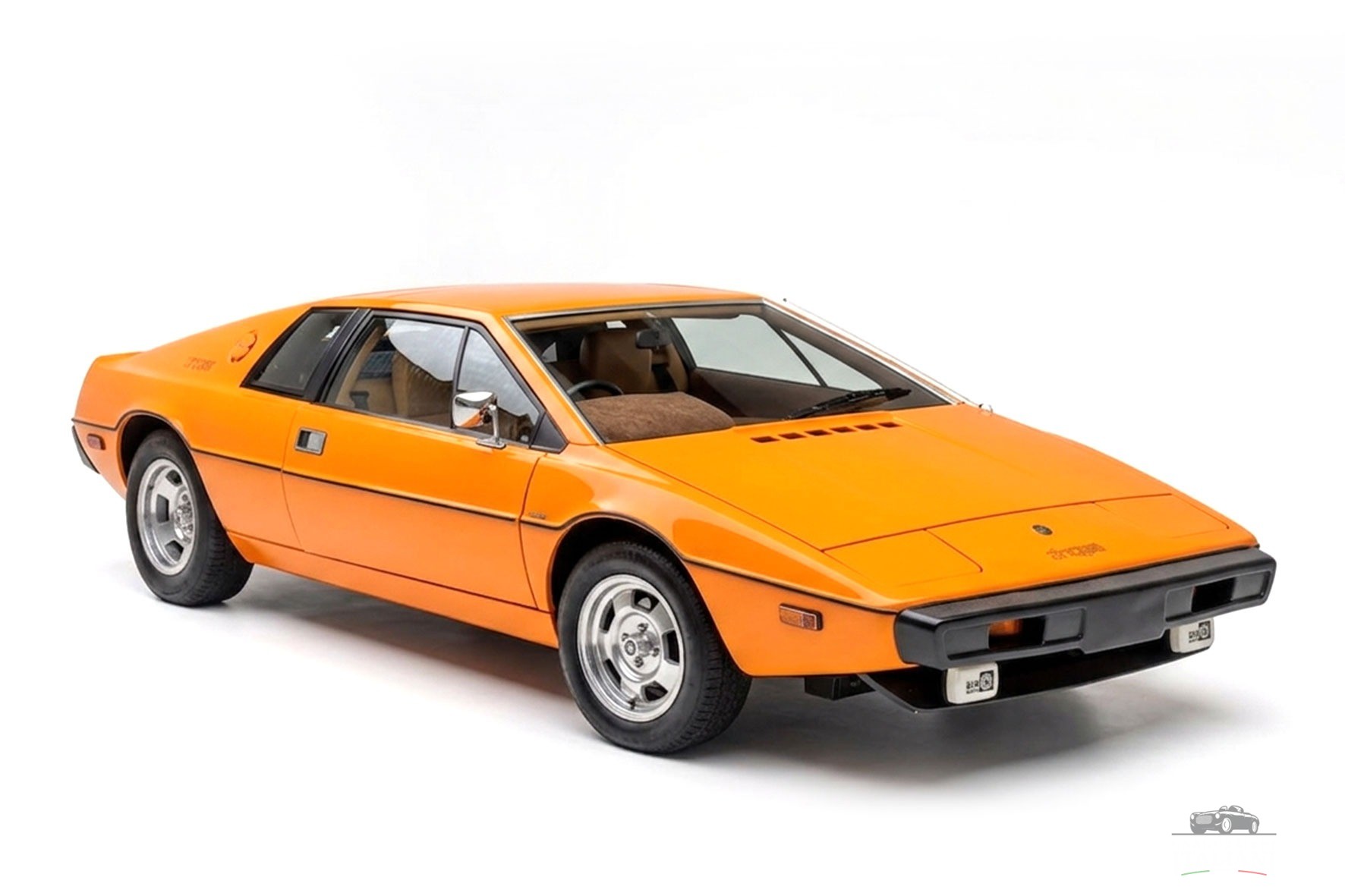
The connection should not be exaggerated into a simple claim that one car ‘became’ the other. The Boomerang was an experimental manifesto; the Esprit was a production programme with different packaging, manufacturing and legislative constraints. What links them is the controlled migration of geometric ideas from show car to road car. The same period also produced other Giugiaro studies and production cars in which crisp planes replaced the rounded massing of the previous decade.
The show circuit and the end of Italdesign ownership
After Geneva the Boomerang continued to appear internationally. Auction histories record appearances in Paris, London and finally Barcelona. By 1974 its role as an active show car was effectively over. At that time it was still common for manufacturers and design houses to dispose of concept cars after their promotional life, rather than preserve them permanently in corporate collections.
Christie’s later recorded that after the Barcelona Motor Show the Boomerang remained in Spain and was sold to a private owner associated with a cabaret in Benidorm. That decision is the reason chassis #081 survived outside an archive. It also opened the least documented period of its history: the years in which one of Italdesign’s best-known prototypes became simply an unusual road car on the Spanish Mediterranean coast.
Benidorm, 1980 and the long restoration
By 1980 the Boomerang had largely disappeared from international view. Christie’s provenance describes a German Maserati enthusiast encountering the car in Spain while on holiday and buying it after having remembered the show car from years earlier. Later secondary accounts have attached names and additional anecdotes to this rediscovery, but the auction-catalogue record is strong enough to establish the essential sequence without relying on every later embellishment.
The new owner undertook a careful restoration during the 1980s. The significance of that work is easy to underestimate. A prototype such as the Boomerang was never designed around long-term parts supply, routine repair procedures or decades of electrical maintenance. Restoring a conventional Bora is one problem; restoring a one-off body, unique glazing, unique interior controls and prototype wiring is another.
Bagatelle 1990: Giugiaro signs the car
The restored Boomerang returned to public view at the Bagatelle Concours d’Elegance in Paris in 1990. Giorgetto Giugiaro was serving on the jury. During the event he signed the rear panel of the car he had designed almost two decades earlier.
The signature became part of chassis #081’s later identity. It marked the moment when the Boomerang ceased to be merely a surviving old concept car and entered the international concours world as an acknowledged design object. During the 1990s it appeared at events including Pebble Beach and Concorso Italiano, accumulating a second history very different from its first life on motor-show stands.
Christie’s 2002 and the return to road use
On 12 February 2002 the Boomerang was offered by Christie’s in Paris. The catalogue identified chassis 081 and engine 902; the car realised €721,750. More important for its physical history is what happened after that transaction.
The new owner considered the earlier restoration largely cosmetic and commissioned British Maserati specialist Paul Grist’s Traction Seabert to return the car to dependable road-usable condition. Christie’s states that the work lasted around eighteen months and cost approximately £20,000. Mechanical and electrical systems were systematically addressed, and the programme was completed in early 2003.
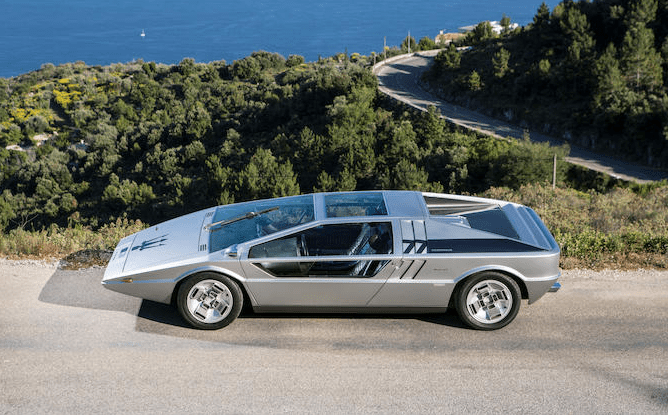
The result was unusual for a surviving concept car: the Boomerang could again be used on public roads. Christie’s noted that German TÜV approval had been obtained, with yellow indicator bulbs among the requirements. The car therefore remained what it had been at Geneva decades earlier – not only a styling exhibit but an operable registered automobile.
Christie’s 2005 and Villa d’Este
The Boomerang returned to Christie’s in Paris in 2005, when it sold for €781,250. The apparent increase over 2002 was modest in euro terms, despite a much larger difference when contemporary results are converted into US dollars.
The next phase showed how usable the recommissioned car had become. In 2006 chassis #081 appeared at the Concorso d’Eleganza Villa d’Este. Period accounts describe it being driven from Monaco to Lake Como – a journey that exposed the contradiction at the heart of the design. Mechanically the car could function much like the Bora beneath it; visibility, ventilation and access remained products of a show-car brief.
From concours object to blue-chip design collectible
By the 2010s the market had begun to value important concept cars differently. Provenance, design authorship, originality and the uniqueness of surviving one-offs were increasingly treated with the same seriousness once reserved for competition Ferraris and pre-war coachbuilt cars.
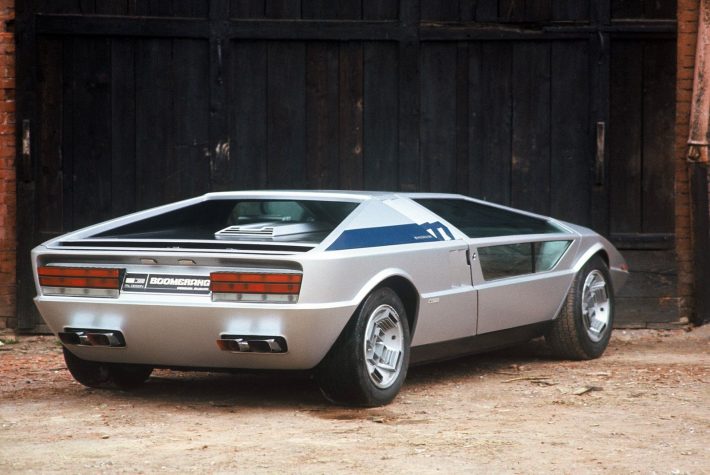
That shift became visible at Chantilly in September 2015. Bonhams offered the Boomerang as lot 11 during the Chantilly Arts & Elegance weekend. It sold for €3,335,000 including premium. Compared with the €721,750 realised in 2002 and €781,250 in 2005, the result represented a major revaluation of the car as a piece of twentieth-century design history.
The Boomerang and the problem of influence
Few concept cars have generated as many claims of influence as the Boomerang. Some are direct and useful; others become too broad. It is reasonable to place the car within the chain that runs from Giugiaro’s late-1960s experiments to the Esprit and other planar 1970s designs. It is less useful to describe every later angular car as a descendant.
Carrozzieri-Italiani’s existing article on the wedge-shaped revolution provides the wider context, including the parallel work of Bertone, Pininfarina, Ghia and Italdesign. The Boomerang’s importance is clearer when placed among those competing experiments rather than treated as the single origin of the wedge.
A design idea returns: Peralta S
More than half a century later, the Boomerang received an unusually explicit echo. The 2025 Peralta S, created by Fabrizio Giugiaro and GFG Style, uses the Boomerang as an acknowledged reference. Its mirror-finished body and dramatic canopy do not reproduce chassis #081, but they revisit the idea of treating an entire car as a single geometric object.
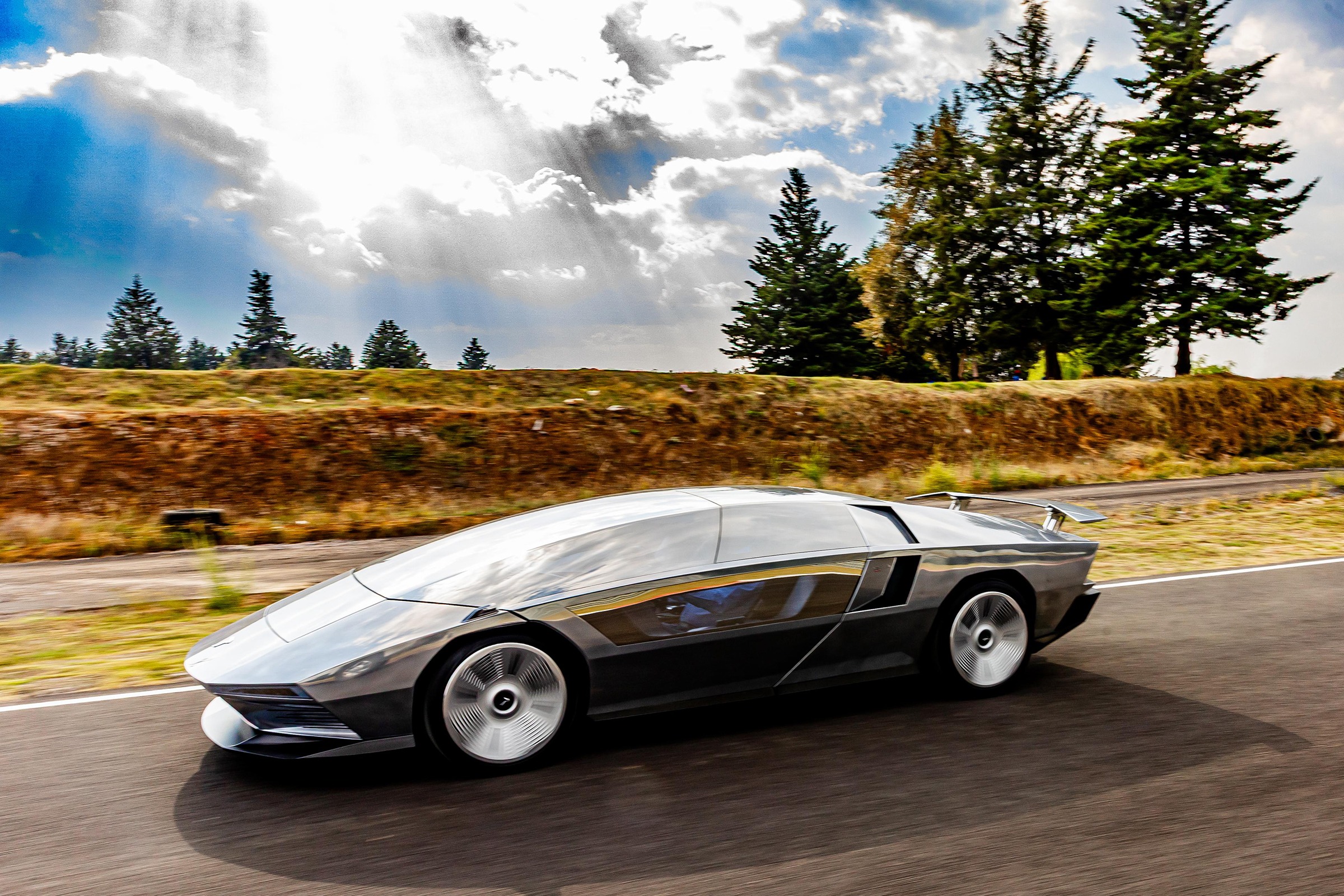
The comparison is useful precisely because the two cars belong to different periods. The Boomerang emerged when Italian design houses used salons to test ideas that production engineering could not yet absorb. The Peralta S belongs to a modern one-off market in which digital design, carbon structures and bespoke manufacturing can turn similarly radical gestures into finished collector cars.
Chassis #081
The Boomerang’s history is therefore not only a design story. Chassis #081 has passed through several distinct identities: experimental Maserati-based prototype, international show car, privately used Spanish automobile, restoration project, concours object and finally multimillion-euro collectible.
That continuity is what separates it from many famous concept cars that survive only as photographs, recreations or museum shells. The same chassis that carried Giugiaro’s most uncompromising early-1970s geometry still retains engine no. 902 in the auction record, still carries his Bagatelle signature and can still be understood mechanically through the Bora beneath it. The object and the idea have survived together.

ABOUT THE AUTHOR
Andreas Scheidl
Italian classic car enthusiast with German roots. Renowned as a respected figure in the classic car community, he serves as a jury member at various international concours d'elegance, including the Classic Gala Schwetzingen and Mantova. As a content creator, Andreas passionately shares his profound knowledge and appreciation for vintage automobiles. His heart beats for cars designed by Giovanni Michelotti, showcasing his discerning taste and dedication to preserving the timeless elegance of automotive history.
More stories by Andreas Scheidl ↗CONTINUE READING
Posts You Might Like

A Central Driving Position, a Rear-Mounted V8. Was This Really a Lancia?
In 1948, visitors to the Turin Motor Show could see an unusual Lancia on the stand of Carrozzeria Ghia. It was a large two-door coupé with a two-litre V8 mounted behind the…
Read story
Fioravanti F100: The Ferrari He Was Allowed to Imagine
Enzo Ferrari’s centenary, Leonardo Fioravanti’s independent studio and a supercar that explored air brakes, steel wheels and a new way of driving—without ever wearing the Cavallino.
Read story
Michelotti Shellette: When the Fiat 850 Became a Yacht
The yacht designer, the Turin stylist and the tiny coachbuilt car that crossed between the quay, the royal holiday house and the auction room. Some automobiles were conceived for the open road,…
Read story
Maserati A6 1500: A New Road for the Trident
When the doors of the Geneva Motor Show opened in March 1947, Maserati was a name that required little introduction to anyone who followed motor racing. What it did not yet possess…
Read story
THE CONVERSATION
Comments 0
Share a memory, a period photograph or a documented detail about this story.