
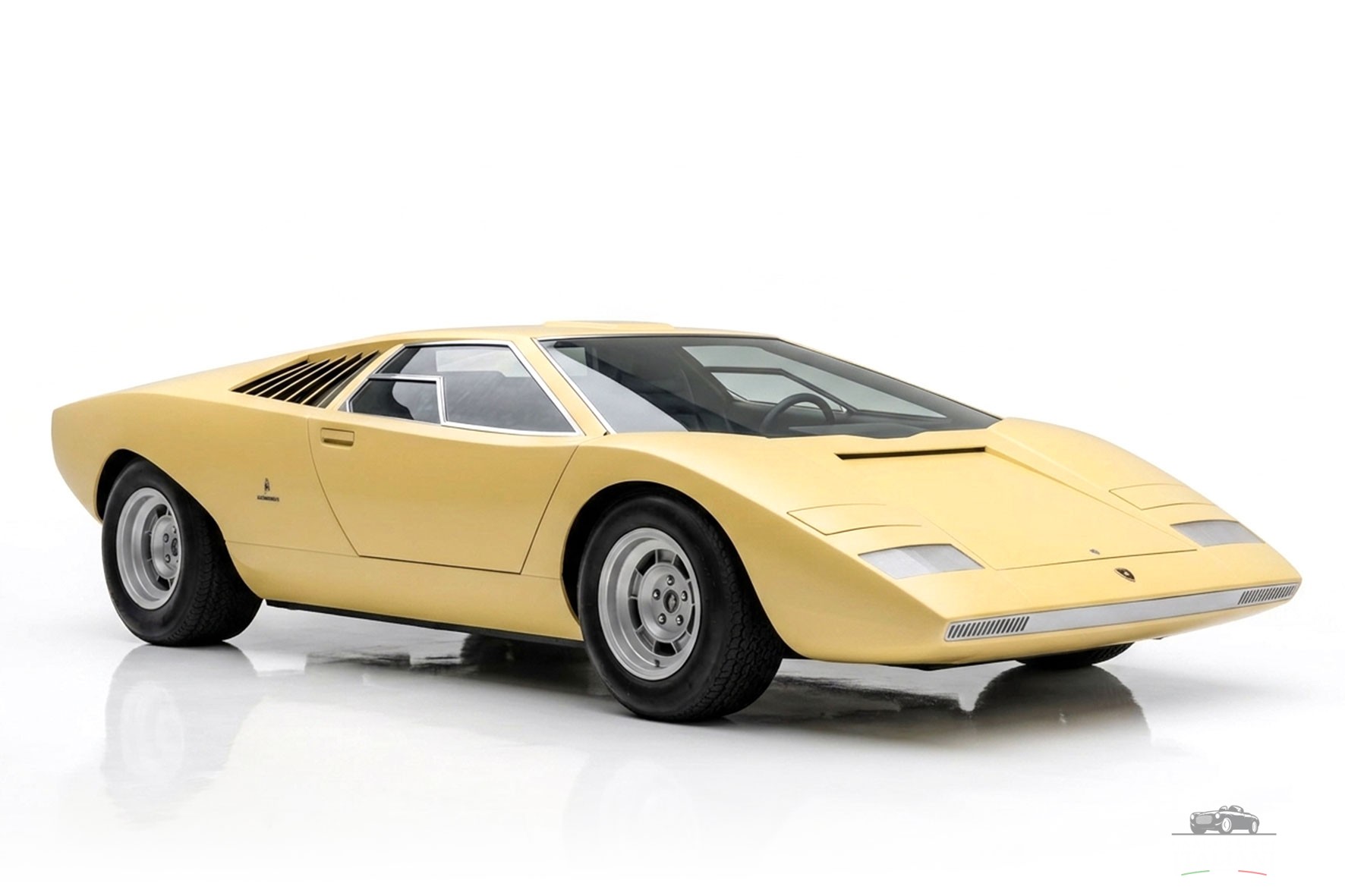
THE VEHICLE AT A GLANCE
Model dossier
- Production period
- 1971
- Body style
- Coupé
- Engine
- V12
- Type
- Limited
THE PEOPLE BEHIND THE CAR
Coachbuilding, design & conversions


PRICE & SALES RECORD
Vehicle value
- Original price
- Not documented
- Latest recorded sale
- Not documented
01 / THE STORY
History & context
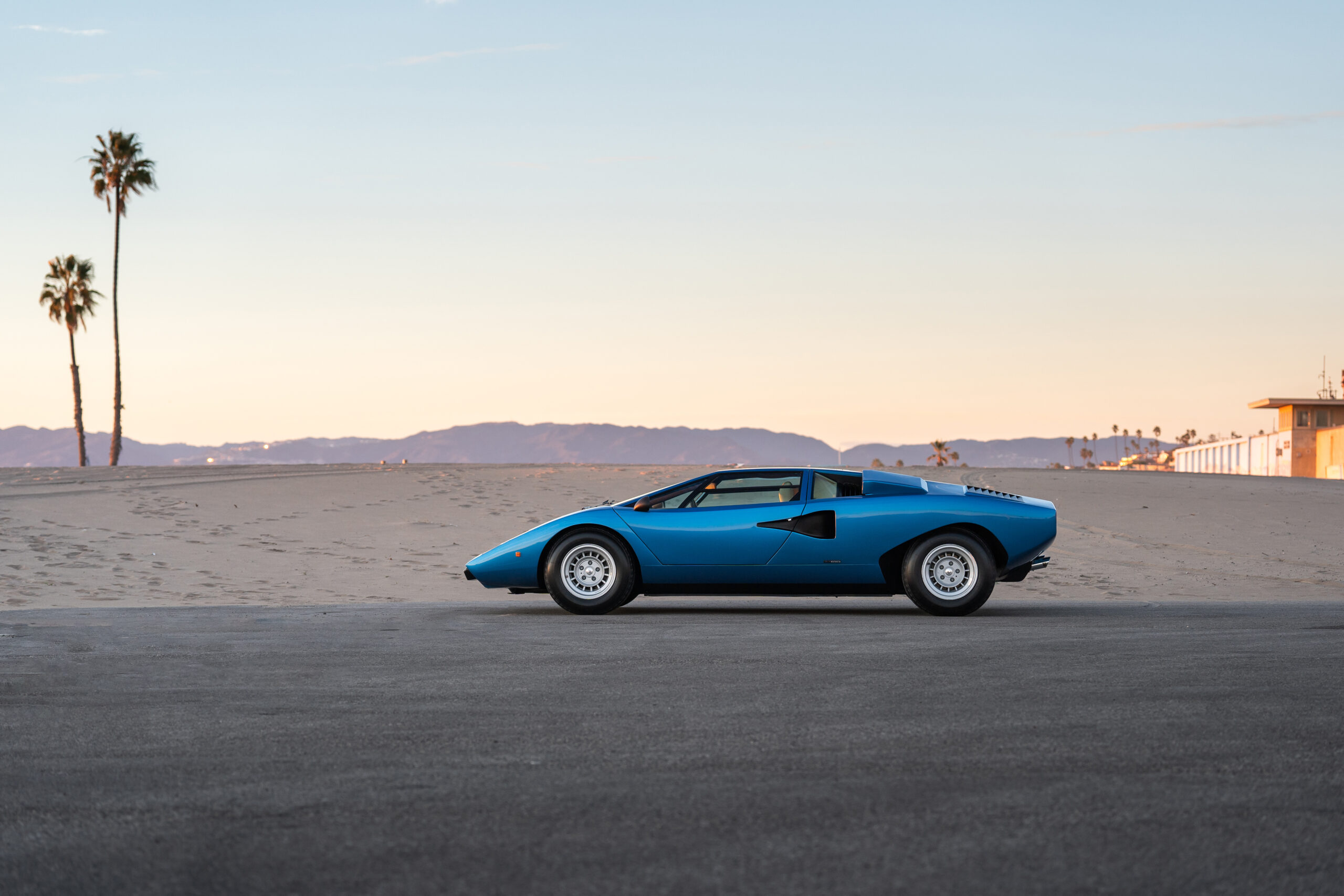
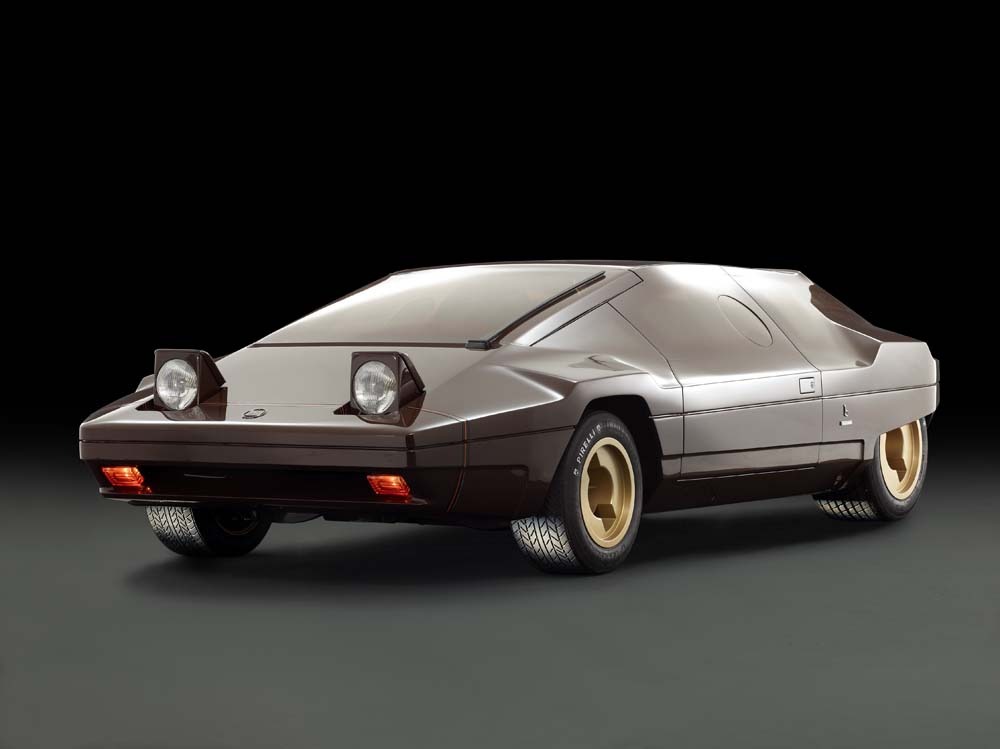
The Lamborghini Countach is a rear mid-engine, rear-wheel-drive sports car produced by the Italian automobile manufacturer Lamborghini from 1974 to 1990. It is one of the many exotic designs developed by Italian design house Bertone, which pioneered and popularized the sharply angled “Italian Wedge” shape. The style was introduced to the public in 1970 as the Lancia Stratos Zero concept car. The Lamborghini Countach prototype was first unveiled by Bertone at the 1971 Geneva Motor Show, as the Lamborghini LP500 concept. Unlike many of the company’s other models, the name Countach is not derived from bullfighting, but from “contacc!”, a Piedmontese expression that, as reported by Gandini himself, was repeatedly used by a profiler working at Bertone along with the team that was designing the car. The word, which can be literally translated as “contagion,” “plague,” is used in the Turin dialect to express astonishment and wonder (corresponding to the Italian accidenti! or perbacco!). It was designed by Marcello Gandini, who had already designed the Miura, and, in 1968, the Alfa Romeo Carabo show car, to which the Countach resembles, above all, in its central part, the passenger compartment. The car was very wide (2 m.) and low (1.06 m.) and was a clever blend of curved longitudinal lines, which immediately gave the impression of aerodynamics, and geometric elements, such as the taillights, and the hexagonal door profile. The most striking feature of the car, which helped to make it a world icon, were the doors, which, hinged at the front, opened by rotating upward, like the elytra of certain insects: after all, this ‘stroke of genius’ had been taken from the very Carabo, the Latin name for the beetle. This mode, called LSD (Lamborghini style doors) was not a pure exercise in style, but was functional to overcome the difficulty of getting into/out of the car in normal use, such as in a parking comb. The body of the Lamborghini Countach was made of trapezoidal aluminum panels, and was attached, by riveting, to a chassis ‘masterpiece’ of round steel tubes. Although this construction was very expensive, it ensured the construction of a chassis that was both light and rigid. The lower parts of the body were made of fiberglass. The front depth-beam headlight assembly was concealed, while the sidelights and flashing lights were visible. The engine mounted on the prototype was the Lamborghini V12, increased to a displacement of 4971 cm³. It was shelved, however, during industrialization because of development problems related to new anti-pollution regulations in the U.S., the main market for Sant’Agata’s cars. The Lamborghini Countach was therefore motorized with the 3929 cm³ V12, already transversely mounted on the Miura, and adapted to the new specifications: longitudinal layout with gearbox in the cockpit, and the drive shaft returning motion to the rear wheels, reaching the differential through a special tunnel carved inside the engine block under the crankshaft. The acronym LP 400, which distinguished the first production model, stands precisely for the engine layout and displacement. This choice in the layout of the powerplant and gearbox helped to concentrate the weights as much as possible toward the center of the car, at the expense, however, of the height of the center of gravity.
IN THE ARCHIVE
Related people
IN THE ARCHIVE
Coachbuilders & design studios
02 / TECHNICAL IDENTITY
Specifications & construction
Production & construction
- Production type
- Limited
Engine & performance
- Engine configuration
- V12
- Specification notes
- SOURCE 2026-09-21 — Lamborghini official history documents the LP500 debut in Bertone's Geneva stand and the LP112 Countach development programme. Displacement remains variant-level across prototype and production family. | FIRST-PERSON 2026-09-25 — Gandini recalls beginning Countach sketches in summer 1970 for a Bertone Geneva prototype; he explicitly traces the scissor-door idea from the 1968 Carabo and recalls a detachable-door mechanism on the second Countach prototype. Countach name origin is stored separately with collaborator-name spelling guarded.
Dimensions & accommodation
- Length
- 4,140 mm
- Width
- 2,000 mm
- Height
- 1,060 mm
Design & manufacture
- Coachbuilder / Body Builder · Documented
- Bertone
- Designer · Documented
- Marcello Gandini
- Manufacturer · Documented
- Lamborghini
- Design features · Legacy attribution
- Wedge
04 / INDIVIDUAL HISTORY
Chassis & provenance
Ownership & provenance
- Ownership & history · Legacy attribution
- Car Collection · Royal Family
06 / EVENTS & AWARDS
Events & awards
Geneva General · legacy_preserved
- Date
- 1971
- Chassis
- General
Preserved CI 1.0 relation. Evidence field: _yoast_wpseo_primary_events. No award inferred.
Kyoto General · legacy_preserved
- Date
- 2019
- Chassis
- General
Preserved CI 1.0 relation. Evidence field: list_of_awards_0_events. No award inferred.
Concorso d'Eleganza Villa d'Este General · legacy_preserved
- Date
- 2024
- Chassis
- General
Preserved CI 1.0 relation. Evidence field: list_of_awards_1_events. No award inferred.
Villa d’Este General · From the historical archive
- Date
- 2024
- Chassis
- General
Stresa Classica General · legacy_preserved
- Date
- 2026
- Chassis
- General
Preserved CI 1.0 relation. Evidence field: list_of_awards_0_events. No award inferred.
07 / THE VEHICLE IN DETAIL
Photo gallery 18 photographs
Show 12 more photographs Show fewer photographs
08 / FROM THE ARCHIVE
Archive
References held in the vehicle dossier. Their inclusion does not establish that every historical claim has been independently verified.
| Reference | Source type |
|---|---|
| Lamborghini — Countach LP500 turns 50 www.lamborghini.com | Manufacturer official history |
THE CONVERSATION
Comments 0
Share a memory, a period photograph or a documented detail about this car.