
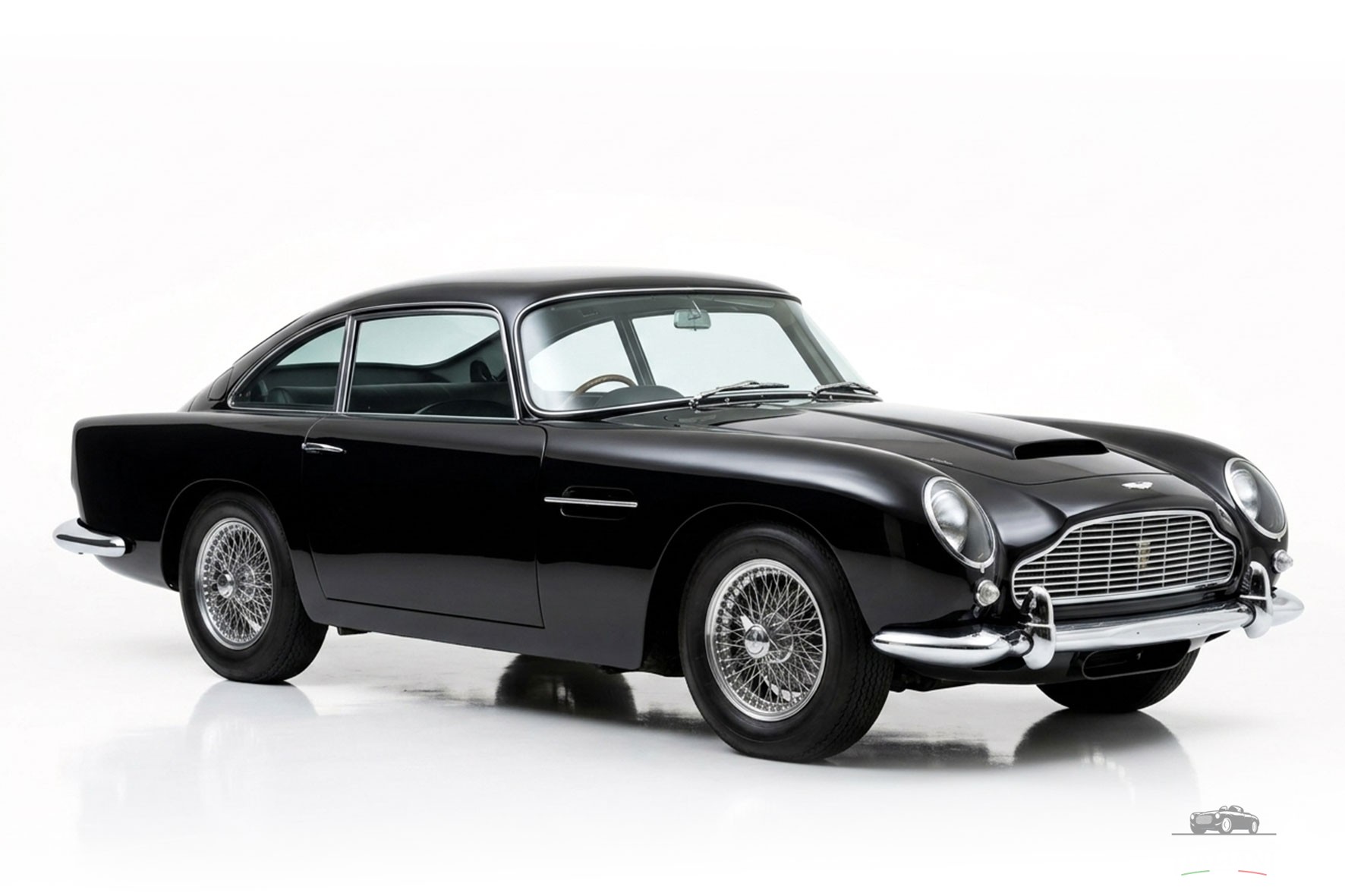
THE VEHICLE AT A GLANCE
Model dossier
- Production period
- 1959
- Body style
- Coupé
- Engine
- Inline-6
- Type
- Limited
- Production
- 75
THE PEOPLE BEHIND THE CAR
Coachbuilding, design & conversions
PRICE & SALES RECORD
Vehicle value
- Original price
- Not documented
- Latest recorded sale
- Not documented
01 / THE STORY
History & context
The Aston Martin DB4 GT Touring was Launched at the London Motor Show in 1958, and emphatically demonstrated that a British manufacturer could better the Italians at their own game when it came to constructing the ultimate Gran Turismo. Its specification included a completely new steel platform chassis with disc brakes all round, and a race-developed twin-cam six-cylinder engine, all clothed in a perfectly proportioned aluminium body designed by Carrozzeria Touring of Milan. Overall, the DB4 was state-of-the-art for its time, a masterpiece of robust British engineering combined with exquisite Italian styling by Touring. Engineered under the watchful eye of Harold Beech, the immensely strong platform-type chassis replaced the DB2/4’s multi-tubular spaceframe, the latter being considered incompatible with Touring’s Superleggera body construction that employed its own lightweight tubular structure to support the hand-formed aluminium-alloy body panels. The trailing-link independent front suspension of the DB2/4 gave way to unequal-length wishbones while at the rear the DB4 sported a live axle located by Watts linkage instead of its predecessor’s Panhard rod. The new car’s competition potential had been recognised from the outset and the factory lost no time in developing a lightweight version suitable for racing, the resulting DB4 GT debuting at the 1959 London Motor Show. The model had already been proven in competition earlier that year when the prototype driven by Stirling Moss (‘DP/199’) won its first race at Silverstone. Extensive modifications to the standard car took 5″ out of the wheelbase and replaced the rear seats with a luggage platform on all but a small number of cars. Together with lighter, 18-gauge bodywork, these changes reduced the car’s weight by around 200lb (91kg). The GT used a tuned engine which, equipped with a twin-plug cylinder head and triple Weber 45DCOE carburettors, produced a claimed 302bhp at 6,000rpm, a useful increase over the standard car’s claimed 240bhp. Maximum speed, of course, depended on overall gearing but 153mph was achieved during testing with a 0-60mph time of 6.1 seconds recorded. The DB4 was also one of the first cars to go from standstill to 100mph and then brake to a dead stop on under 20 seconds, a tribute, in part, to its up-rated Girling brakes as used on Aston Martin’s sports racers of the era.
IN THE ARCHIVE
Coachbuilders & design studios
02 / TECHNICAL IDENTITY
Specifications & construction
Production & construction
- Production
- 75
- Production type
- Limited
- Construction system
- Superleggera
- Construction features · Recorded
- Superleggera
Engine & performance
- Engine configuration
- Inline-6
Design & manufacture
- Coachbuilder / Body Builder · Documented
- Touring
- Designer · Documented
- Federico Formenti
- Manufacturer · Documented
- Aston Martin
06 / EVENTS & AWARDS
Events & awards
No events or documented awards are currently recorded for this vehicle.
07 / THE VEHICLE IN DETAIL
Photo gallery 1 photographs
08 / FROM THE ARCHIVE
Archive
References held in the vehicle dossier. Their inclusion does not establish that every historical claim has been independently verified.
| Reference | Source type |
|---|---|
| Aston Martin — DB4 GT www.astonmartin.com | Manufacturer official history |

THE CONVERSATION
Comments 0
Share a memory, a period photograph or a documented detail about this car.