
The Fishmouth Grille by Bertone
Italy in the immediate post-World War II era was a land of ruins and hopes intermingled. By 1947, with material and moral devastation still casting long shadows, a fervent desire for rebirth gripped the country. The revival of events like the Mille Miglia road race – roaring again through the countryside – symbolized a resilient spirit determined to move forward. In this climate, Italian coachbuilders emerged as artisans of hope, crafting daring new automotive designs that broke from pre-war conventions. Experimental styles flourished: Stabilimenti Farina developed a provocative “Tank” series with low, squat bodies, featuring a pointed prow-like grille and recessed headlamps evoking ancient warrior helmets. Meanwhile, Carrozzeria Zagato pursued a futuristic “Panoramica” concept – enveloping coupés in curving expanses of Plexiglas to give passengers an airy, aircraft-inspired view of the road. These bold expressions were more than styling exercises; they were Italy’s artistic answer to the hardships of war, an exuberant attempt to dream in metal once more.
The Milan Exhibition and Bertone’s Daring Statement
Amid this creative renaissance, a young Nuccio Bertone and his Turin-based atelier introduced their own signature statement – a design language so distinct and full of character that enthusiasts later nicknamed it the “Fishmouth.” This informal moniker described the unique front grille shape Bertone debuted in the late 1940s: an aggressive, gaping oval opening reminiscent of a fish’s open mouth, often incorporating the car’s headlights within its broad grin.
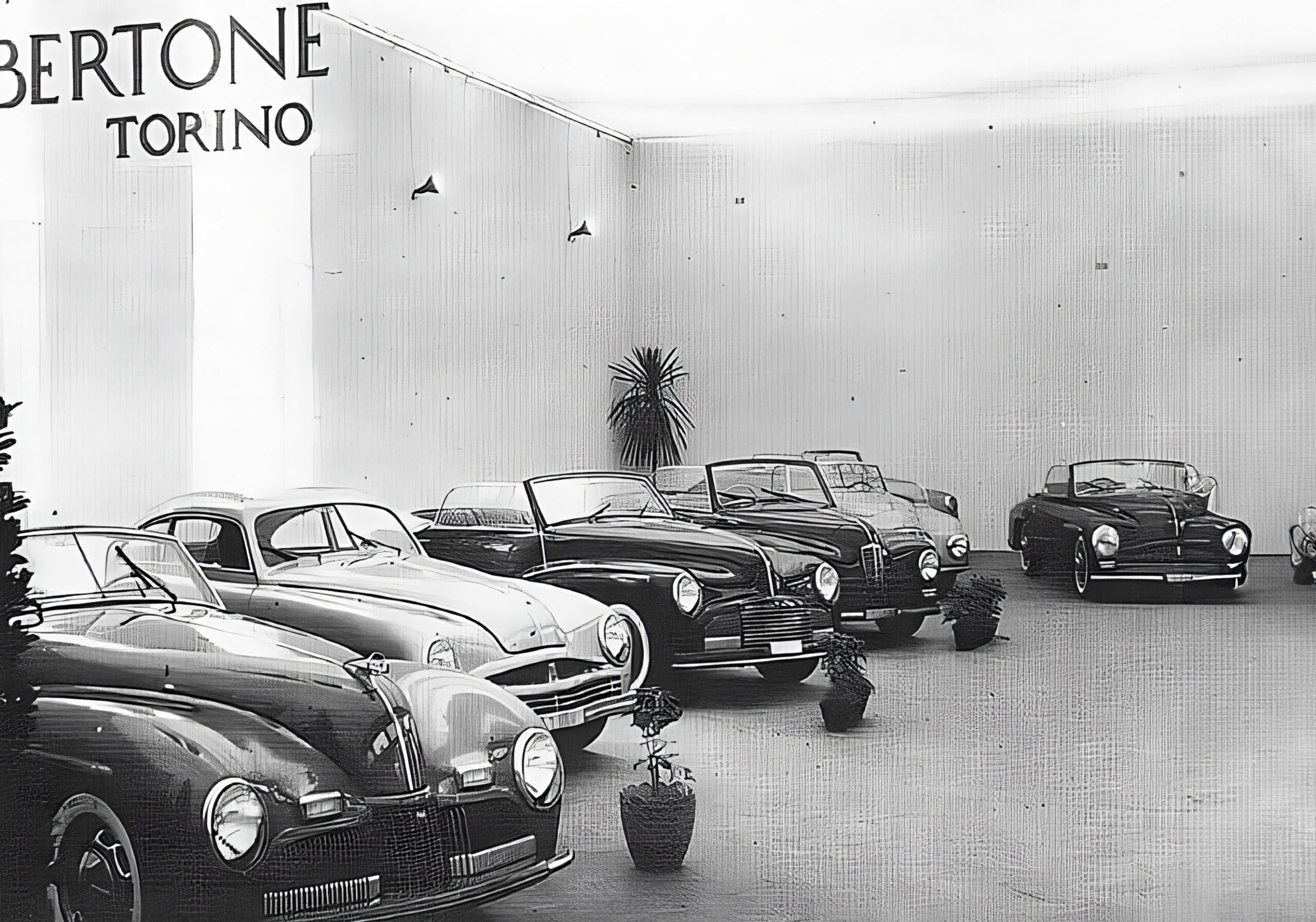
At Milan’s inaugural Mostra della Carrozzeria Italiana exhibition in 1947, Bertone’s stand captivated onlookers with an eye-catching Healey Cabriolet one-off sporting this very feature. Contemporary reports called it an “intriguing fish-mouth front end design” on the elegant British chassis. The look was unlike anything else at the show – at once whimsical and predatory, as if the automobile itself were eager to gulp down the road ahead. For war-weary spectators, this audacious styling embodied the fresh optimism of the age: Italy was smiling broadly again, in chrome and steel.
The Hand of Revelli di Beaumont?
The origins of Bertone’s fishmouth grille can be traced to the fertile mind of Mario Revelli di Beaumont, a visionary designer who consulted with many coachbuilders of the era. Revelli, often hailed as Italy’s first freelance car stylist, excelled at blending artistic flair with engineering function. It was Revelli who conceptualized the wide-mouth grille motif for Bertone, ensuring it was not just visually arresting but also practical. In fact, the “fishmouth” design was said to improve airflow to the engine and even contribute to aerodynamic efficiency on these custom cars.
🔗 Read more: Mario Revelli di Beaumont: the first Freelance Car Designer
This harmonious merge of form and function became a Bertone hallmark. The philosophy behind the fishmouth was bold and forward-looking: a rejection of narrow upright grilles of the past in favor of a low, wide intake that visually widened the car and gave it a confident “face.” It was almost as if the car were breathing in the future. Small wonder the style quickly gained acclaim when first unveiled. Here was a new aesthetic language that symbolized the nation’s irrepressible creativity – an outward expression of Italy’s inner smile, daring the world to share in its post-war joy.
Lancia Aprilia Berlinetta: A Smile on Four Wheels
The Lancia Aprilia Bertone Berlinetta of 1947 was one of the earliest and most emblematic examples of this fishmouth design language. Built on Lancia’s advanced Aprilia chassis, the Berlinetta was a sleek fastback coupé that Bertone clothed in cutting-edge fashion. Its front end immediately commanded attention: a wide oval grille opening with curved edges and a protruding lower lip, flanked by headlights integrated so artfully one could imagine the car as a big fish gliding through water.
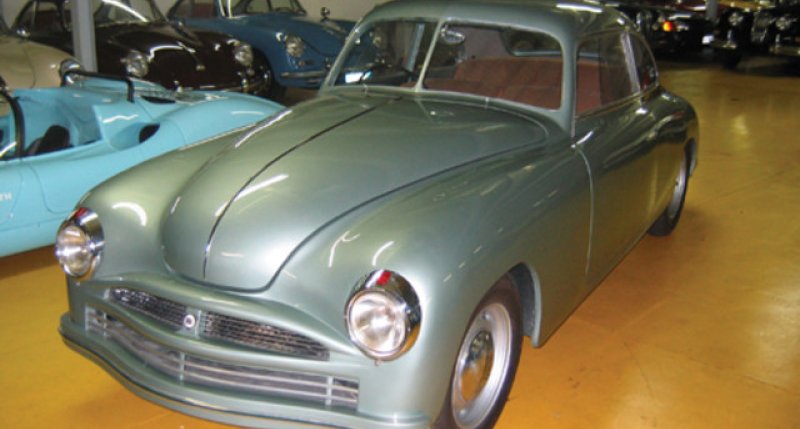
Bertone presented this striking Berlinetta at the 1947 Milan coachbuilding show, where it quickly garnered praise for its distinctive aesthetic. The “fish mouth” grille was the talk of the exhibit – not only did it lend the Lancia an unmistakable face, it also served a purpose, funneling air efficiently to the engine bay. Beneath the dramatic styling, Lancia’s little V4 engine benefited from the cool breath of that gaping nose. Bertone’s craftsmanship on the Aprilia Berlinetta blended visual drama with performance intent in a way that impressed both the public and discerning peers. Only three examples of this special body were ultimately built, each tailored like a bespoke suit, underscoring the coachbuilder’s commitment to exclusivity and artistry. In a period when automobiles were mostly utilitarian, these were decadent objets d’art on wheels.
The Berlinetta’s success cemented Bertone’s status among Italy’s coachbuilding elite, and it showcased the influence of Revelli di Beaumont’s hand – his artistic touch evident in the car’s flowing lines and confident front visage. Indeed, the Lancia Aprilia Berlinetta’s design would prove influential, as the bold fishmouth grille reappeared on a number of subsequent Bertone creations in the coming years.
Stanguellini 1100 Berlinetta: Racing with a Grin
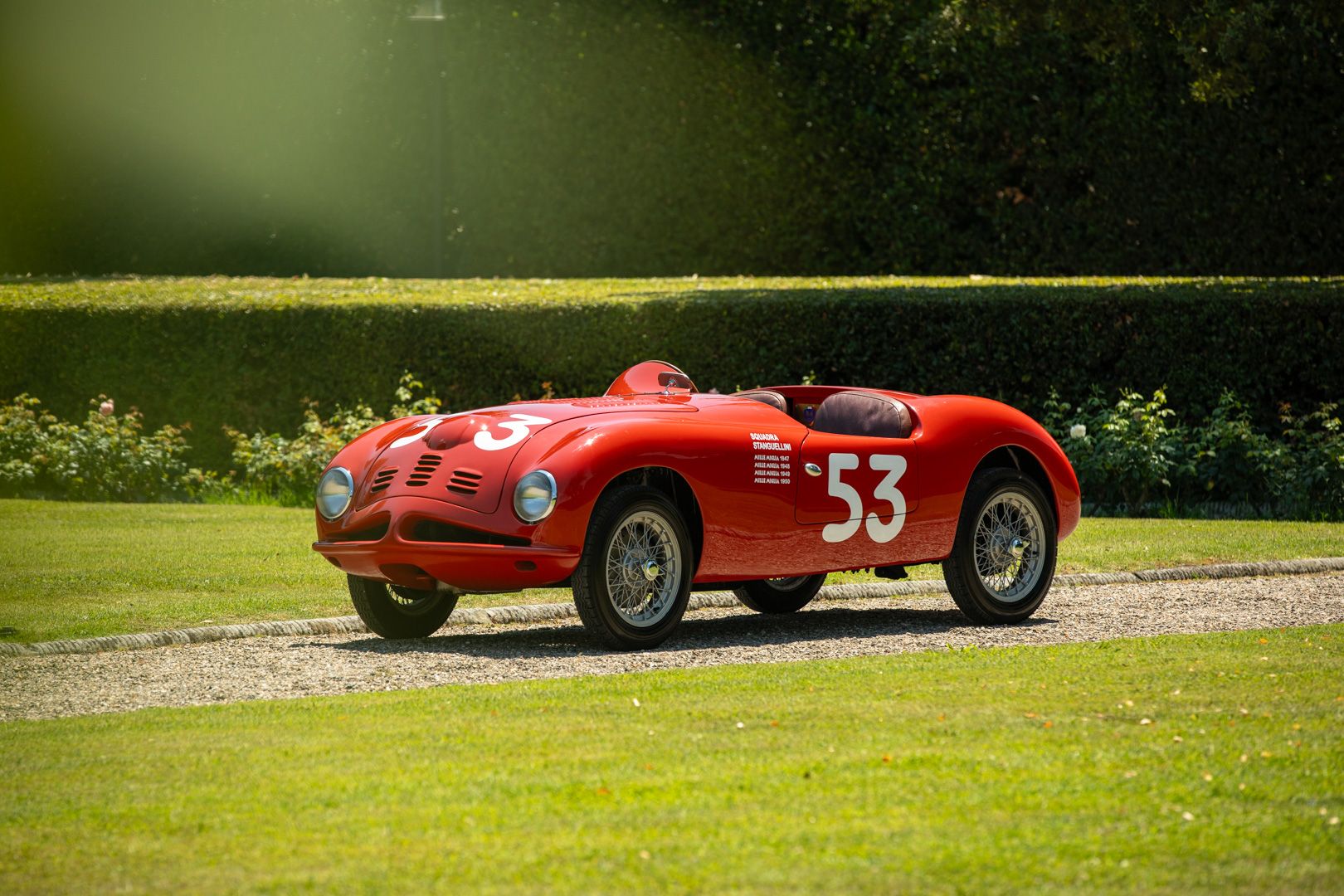
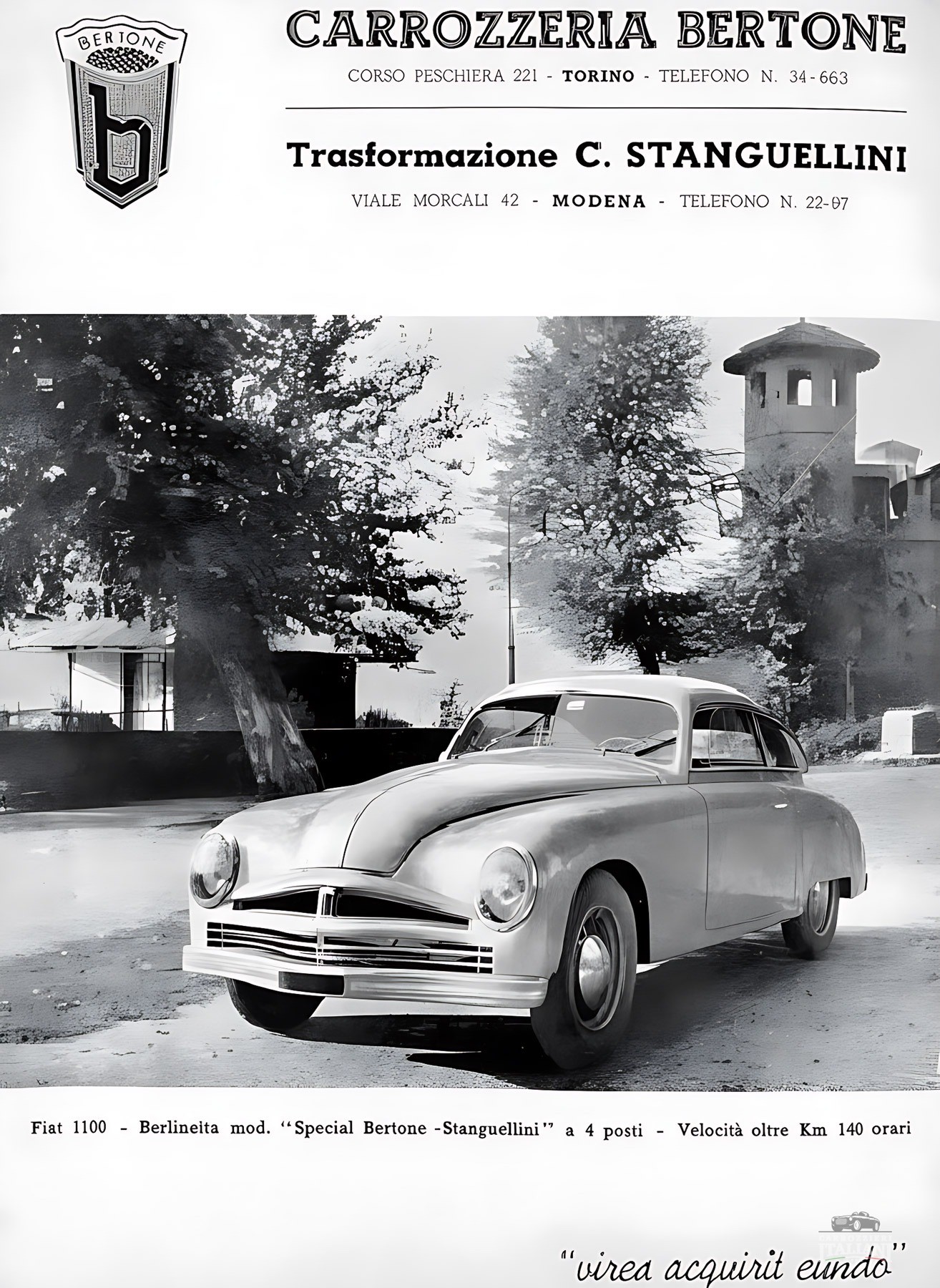
If the Lancia Aprilia exemplified the fishmouth theme in an elegant grand tourer mold, the Stanguellini 1100 Berlinetta Speciale demonstrated how the same design language could be adapted to a competition-oriented sports car. This project sprang from a pivotal meeting in 1947 between Nuccio Bertone and Vittorio Stanguellini, the Modena-based builder of Fiat-powered racing specials. The collaboration yielded a lithe 1100cc Berlinetta on a Fiat chassis, first unveiled at that year’s prestigious Villa d’Este Concours d’Elegance and later displayed in Milan. The Stanguellini Berlinetta introduced avant-garde elements that were ahead of their time – most notably, smooth pontoon fenders that flowed in an unbroken line from nose to tail
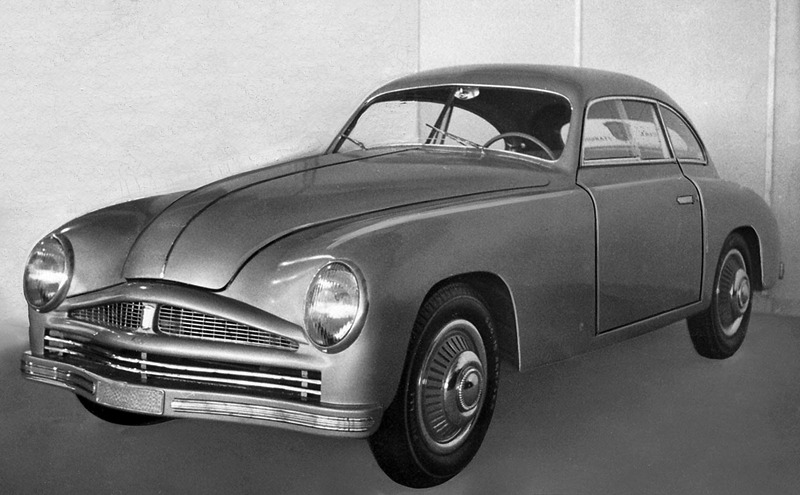
Its aluminum body was tightly wrapped and free of extraneous ornament, a pure teardrop profile built for speed. And at the nose: yes, the unmistakable fishmouth grille made its appearance here as well, giving the car a familial link to the Bertone Lancia. Photographs from 1947 show the Stanguellini’s wide front opening devouring the air, the car crouched low as if eager to leap. This aesthetic continuity was no coincidence. As Bertone’s visionary concept for a new look, the fishmouth motif on the Stanguellini proved that the idea was versatile – equally at home on an elegant road coupe or a petite racing machine. In fact, Bertone’s work on the Stanguellini directly influenced the styling of his subsequent creations, including the Lancia Aprilia and the larger Fiat 1500, as well as the one-off Healey cabriolet.
The Stanguellini 1100 didn’t just look the part; it had the pedigree to back it up. Tipping the scales at only ~725 kg and built with advanced monocoque techniques, the car was a formidable competitor on the circuit. It racked up victories in hill climbs and endurance races, its nimble performance earning acclaim from enthusiasts. One can imagine the spectacle it created: a scarlet red bullet with a gaping mouth grille, streaking past cheering crowds on Italian mountain roads – the very image of post-war fervor. The fishmouth design, far from being just styling whimsy, became the face of a winner.
Fiat 500 Barchetta: A Little Car with a Big Mouth
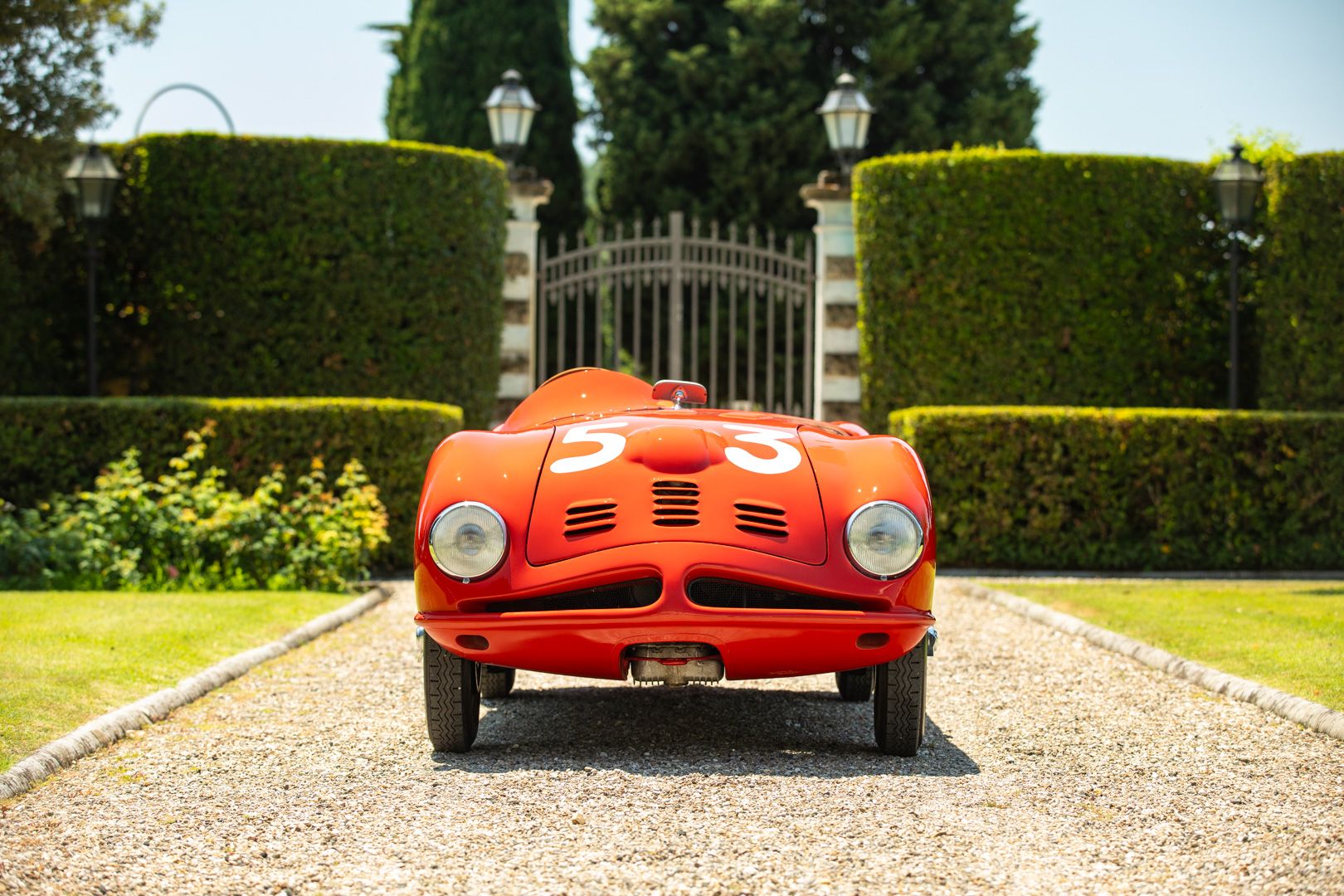
Bertone’s daring new look was not confined to high-profile showcars; it also found expression in one of the humblest Italian platforms – the tiny Fiat 500 “Topolino.” As one of the first projects the young Nuccio Bertone undertook after the war, he transformed Fiat’s 500cc people’s car into a Barchetta (little open sports car) with outsized personality. What this one-off lacked in size, it made up for in charisma. Stylistically, the Barchetta featured the same distinctive fishmouth grille up front, scaled adorably to fit the diminutive face of the Topolino.
The wide oval opening, a trademark Bertone flourish, looked almost cheeky on such a small car – as if a minnow were confidently mimicking a shark. Beneath that grin, the tiny roadster was all business. In 1948 it was sold to an engineer-enthusiast named Carlino Francesconi, who proceeded to enter it in the year’s Mille Miglia. Against all odds, this featherweight 500 Barchetta achieved a remarkable result in the thousand-mile marathon: 46th overall and 2nd in class – punching far above its weight. The sight of the little white spider bounding along Italian roads, its engine humming and its mouth-shaped grille gulping in air, must have been the perfect avatar of Italy’s “can-do” spirit. That such a playful design could prove functional in grueling competition speaks to Bertone’s skill. The fishmouth style was not merely for static showpieces; it lived and breathed on the road and track, from the grandest Lancia to the lowliest Fiat. Each car, regardless of pedigree, was imbued with a dose of postwar audacity – an assertion that Italy’s ingenuity could apply equally to the masses and the motorsport elite.
The International Stage: The Healey Cabriolet
The international appeal of Bertone’s fishmouth design was underscored by the curious tale of a Healey sports car that received an Italian makeover. In the late 1940s, Donald Healey’s British works sent a rolling chassis to Turin, which Bertone promptly transformed into a one-of-a-kind Healey Cabriolet. This elegant open-top tourer married British engineering with Italian artistry, and at its prow sat the now-familiar expansive grille form. Displayed proudly at the Milan Mostra in 1947, the Healey served as a glamorous ambassador of the fishmouth style to an international audience. Its long, flowing hood and sleek fenders were capped by that wide-mouthed face, giving the car a jaunty, almost smiling countenance in true continental fashion.
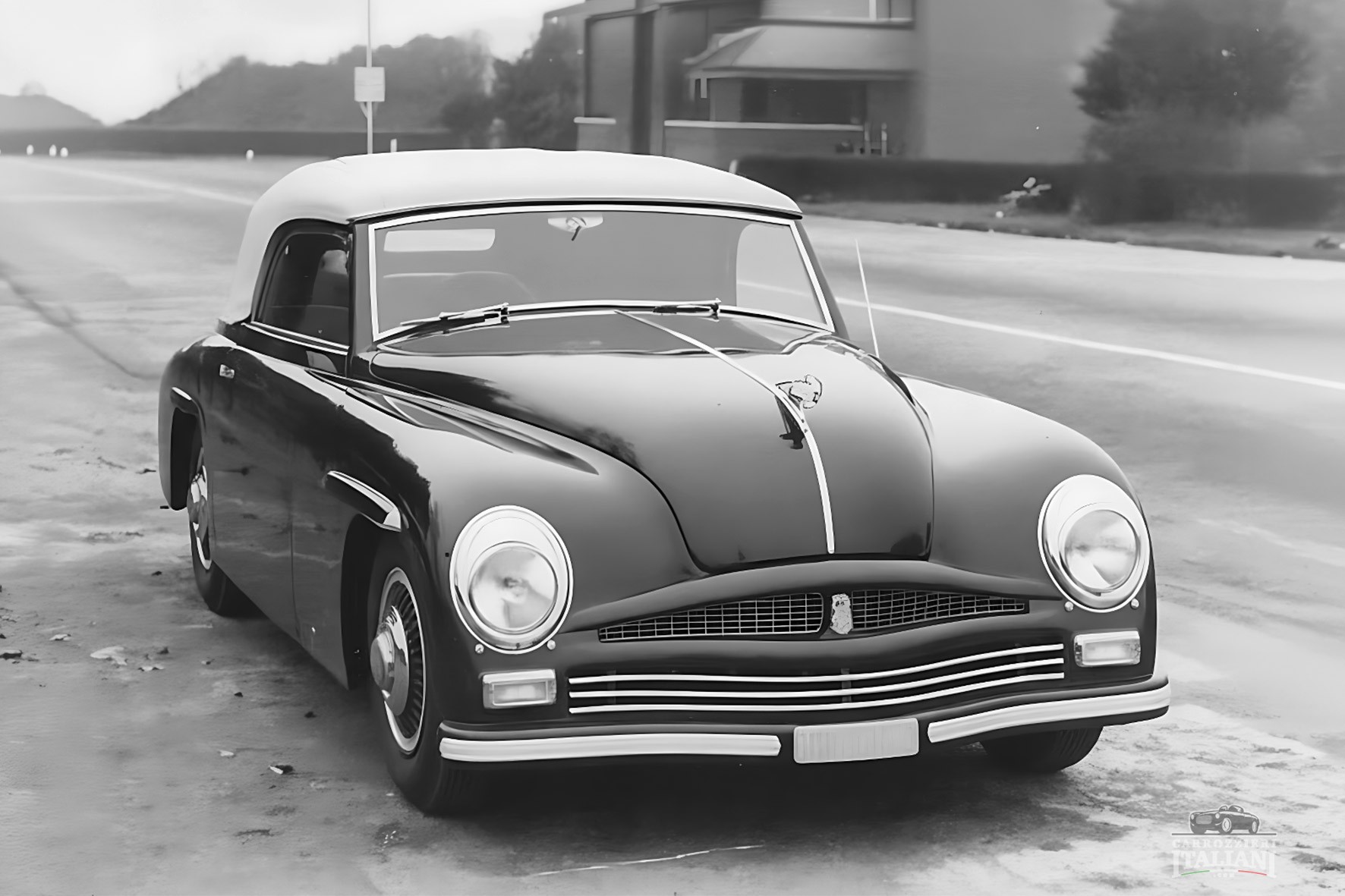
Observers noted how Bertone’s novel front-end treatment would soon reappear on other chassis – indeed, by this point the fishmouth grille had become the coachbuilder’s calling card. For the British marque, which was known for its more conservative roadsters, the Italian-bodied Healey was an eye-opener: a hybrid of Anglo-Saxon brawn and Mediterranean flair. One can imagine the scene at the 1947 show: the Healey Cabriolet gleaming under the exhibition lights, top folded down, drawing crowds who marveled at that gaping chrome smile unlike anything back in Coventry or Birmingham
🔗 Read more: 1947 Mostra della Carrozzeria Italiana
It was a tangible expression of cross-border optimism – proof that Italian design could enchant beyond its borders, helping foreign partners dream a little more boldly too. The Healey one-off remains a fascinating footnote in both British and Italian motoring lore, a testament to how Bertone’s postwar experiments transcended boundaries. With its fishmouth grin leading the way, the car hinted at a future where Italian coachbuilders would heavily influence sports car aesthetics around the world.
Nardi-Danese Cabriolet: Aristocratic Extravagance
Not all of Bertone’s fishmouth creations were focused on speed, however. One of the most opulent interpretations of the theme came in the form of a luxurious custom convertible: the Nardi-Danese “Marco” Cabriolet of 1948. This extraordinary four-seater cabriolet was commissioned by Count Rudy Crespi, an Italo-Brazilian aristocrat with a taste for the finest things.
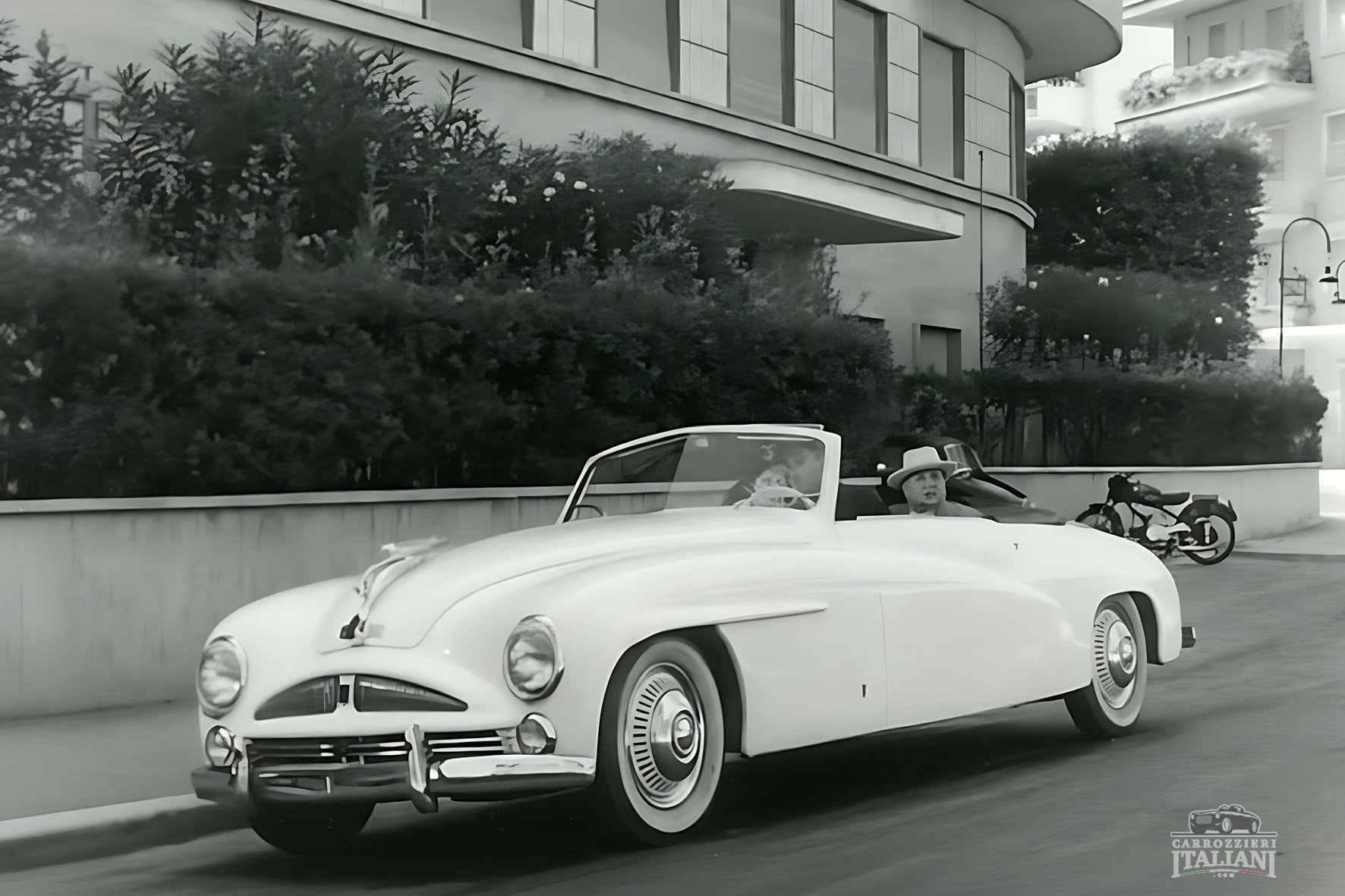
Bertone, tasked with realizing the Count’s dream car, built the Marco Cabriolet on a sophisticated Nardi & Danese chassis powered by a burly 2.0-liter eight-cylinder engine. The result was automotive haute couture – a long and lavish open tourer swathed in rich grey paint (at least originally) and trimmed in exotic materials. Yet, amid all the luxury, it too wore the unmistakable face of Bertone’s new design language. The front grille yawned broadly across the car’s nose, a chrome “fish mouth” motif by Revelli di Beaumont that tied this posh cabriolet to its sporting siblings. In fact, contemporary observers noted the resemblance to the Fiat 1500 E and the Healey Cabriolet – all sharing the same signature grille style that marked them as products of Bertone’s fertile postwar imagination.
What made the Nardi-Danese special was how this daring design was executed with utmost elegance. The long hood and gently curved fenders flowed into the wide grille, giving the car a confident, almost regal expression. It was as much a status symbol as it was a work of art. Inside, every surface was lavish: the interior lined entirely in wild boar leather, complete with fitted suitcases and vanity cases behind the seats for grand touring comfort.
In a final flourish befitting its showpiece nature, the Marco Cabriolet even found cinematic fame – repainted in pearlescent white, it featured prominently in the 1952 Italian film “Cinque poveri in automobile”, dazzling audiences on the silver screen. This one-off creation thus lives on both in real-life concours and in celluloid, its fishmouth grin eternally captured as a symbol of postwar Italian glamour. It underscores that the Bertone fishmouth design was not limited to sporting intents; it could convey pure luxury and theatrical extravagance just as well.
Fiat 1500 E Berlinetta: The Mature Expression
By the end of the 1940s, Bertone’s bold experiment reached a crescendo in the form of the Fiat 1500 E Bertone Berlinetta – arguably the most advanced and mature expression of the fishmouth styling. Built in 1948 on Fiat’s six-cylinder 1500 E chassis, this car was the larger cousin to the earlier 1100cc designs, and it allowed Bertone to refine the aesthetic on a grander scale. The project followed on the heels of the coachbuilder’s successes with the Stanguellini and other specials, and Bertone approached it with confidence. Drawing inspiration from those prior creations – indeed, one can see echoes of the Healey and the Lancia Aprilia in its lines – the 1500 Berlinetta was crafted to make a statement.
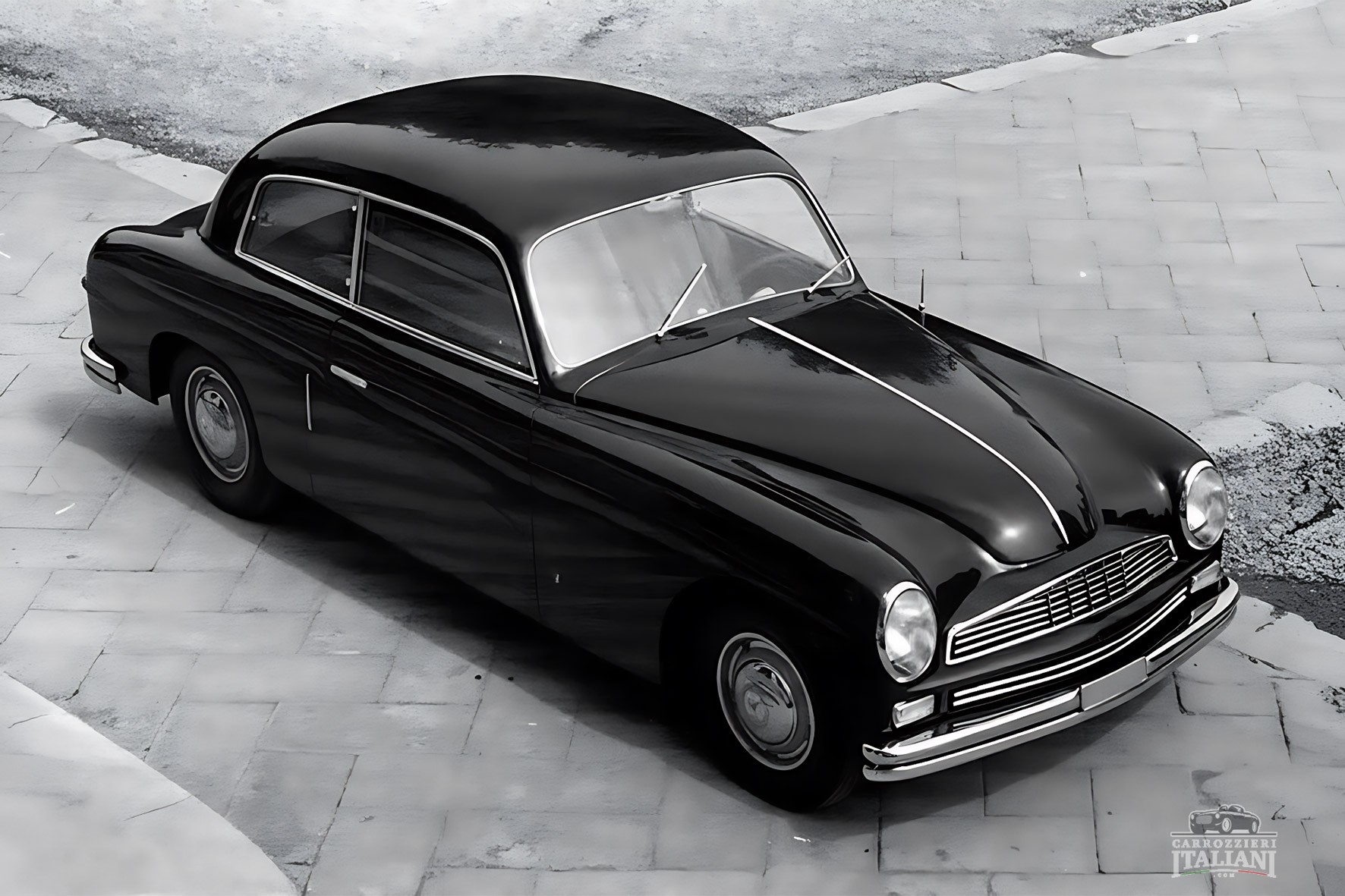
Its body was a harmonious blend of sleekness and muscularity: a pillarless cabin, fastback roofline, and subtle tailfins hinting at the coming 1950s trends. But the front end left no doubt as to the car’s lineage. At the forefront of the Fiat 1500’s design was the iconic fishmouth grille, here even wider and more assertive than before. The expansive oval opening, conceptualized by Revelli, lent the coupe a unique and aggressive presence on the road, instantly distinguishing it from any factory-standard Fiat. Contemporary witnesses described the car’s face as giving it an “assertive presence,” solidifying its status as a design icon of its era.
🔗 Read more: Elegance on Wheels: The Grand History of the Concours d’Elegance
Indeed, when the 1500 Bertone was shown, it reportedly wowed crowds and even earned accolades (legend has it one example took a Best of Show honor at Viareggio in 1949). Beyond aesthetics, the Fiat 1500 E was a true gran turismo in character – marrying Bertone’s stylistic prowess with a more powerful engine for high-speed touring. With its six-cylinder heart and that unforgettable visage, the 1500 Berlinetta encapsulated the spirit of Italian automotive rebirth: elegant yet extroverted, beautiful but unafraid to shout about it**. It was perhaps the ultimate evolution of the fishmouth theme – and, tellingly, one of the last. As the 1950s dawned, car design would shift toward new paradigms, but the legacy of these late-’40s coachbuilt wonders was already secured.
A Cultural Statement in Chrome and Steel
Looking back at Bertone’s fishmouth cars, it’s clear they were more than just a styling exercise – they were a cultural statement. In an era of collective catharsis, when Italians hungered for brightness to counter the darkness of war, such flamboyant designs were cathartic expressions of joy. Bertone’s creations, with their overflowing forms and dramatic flourishes, fit right in alongside other exuberant postwar coachworks that “exuded opulence” to banish the memory of wartime austerity. Some critics at the time sniffed that a few coachbuilders went too far, decrying “new designs at any cost” as gimmicks that risked lapses in taste. But Bertone’s fishmouth specials managed to walk the line between extravagance and elegance. They were undeniably daring, yet they remained grounded in the fundamentals of good design – proportion, functionality, and the overall harmony of the car’s shape. Giovanni Canestini, writing in Auto Italiana after seeing these machines, praised the “meticulous craftsmanship evident in every detail” and the skillful blending of forms that reflected highly experienced artistry. In other words, beneath the flash was substance.
Each fishmouth car was coachbuilt to an exacting standard, often on a modest chassis, but elevated to rolling sculpture by virtue of Bertone’s design and execution. Moreover, these cars captured hearts. They gave physical form to the era’s emotional renaissance – that feeling of liberation and creativity that permeated Italy’s late 1940s. The wide grilles even look like smiles, and perhaps that’s no coincidence. There’s a certain happiness to their visage, a jovial defiance as if saying: “We’re still here, and we’ll build beautiful things again.” It is this emotional resonance that makes the fishmouth design so beloved by classic car enthusiasts today. They are cars with soul, born from a very specific time and ethos.
Legacy of a Smile
The surviving Bertone fishmouth cars are treasured museum pieces and concours stars, admired not only for their rarity but for the story they tell. Each one – the Lancia, the Stanguellini, the pint-sized Fiat 500, the anglicized Healey, the extravagant Nardi-Danese, and the refined Fiat 1500 – is a chapter in a narrative of artistic rebirth. Together, they chronicle how a small Italian carrozzeria dared to establish a new identity in design, and in doing so, left an indelible mark on automotive history.
The influence of these cars can be seen echoing through later decades, in the confidence of Italian sports car styling and even in American concepts that took inspiration from the “wide mouth” look. But perhaps more importantly, these vehicles continue to captivate the imaginations of those who encounter them, just as they did when they first appeared. Their allure has not dimmed. As one modern account noted, a car like the Fiat 1500 Bertone still “continues to captivate enthusiasts and collectors alike,” embodying the spirit of innovation and excellence that defined the Bertone brand. Indeed, stand before any of these cars and you can feel it – the optimism, the daring, the artistry. Bertone’s fishmouth design may have been a short-lived chapter in the long book of automotive design, but it was a brilliant and unforgettable chapter, filled with romance and bold creativity. In the context of Italy’s postwar recovery, it stands as a shining testament to the power of dreams on wheels – a big, chrome-framed smile that announced to the world that Italian coachbuilding was back, and ready to inspire anew

ABOUT THE AUTHOR
Andreas Scheidl
Italian classic car enthusiast with German roots. Renowned as a respected figure in the classic car community, he serves as a jury member at various international concours d'elegance, including the Classic Gala Schwetzingen and Mantova. As a content creator, Andreas passionately shares his profound knowledge and appreciation for vintage automobiles. His heart beats for cars designed by Giovanni Michelotti, showcasing his discerning taste and dedication to preserving the timeless elegance of automotive history.
More stories by Andreas Scheidl ↗CONTINUE READING
Posts You Might Like
Reinterpreting the Past: When Coachbuilders revisited it’s Icons
When iconic coachbuilt cars are rebade through time, intent matters more than nostalgia. From experimental originals to modern reinterpretations, this article examines how legends are reimagined—and why some ideas refuse to stay…
Read story
Neither Coupé nor Spider: Italy and the Targa Roof
A deep dive into Italy’s decades-long exploration of the targa roof—from early post-war experiments to Ferrari and Lamborghini icons—revealing how Italian designers created a third way between coupé and spider.
Read story
Italian Vision of the MPV: The Monovolume Concept
Long before MPVs filled suburban driveways, Italian designers were shaping the monovolume with prototypes that ranged from pragmatic to outright outrageous. Their work rewrote how space, style, and function could fit under…
Read story
Italian Coachbuilt City Car Concepts: From Microcars to Urban EVs
How did Italy’s famed coachbuilders go from designing Ferraris to dreaming up tiny electric runabouts? From the quirky Tsé-Tsé to Pininfarina’s visionary Nido, discover how city cars became a proving ground for…
Read story
THE CONVERSATION
Comments 0
Share a memory, a period photograph or a documented detail about this story.