
The Ferrari 512S Speciale: The Wedge That Changed Everything
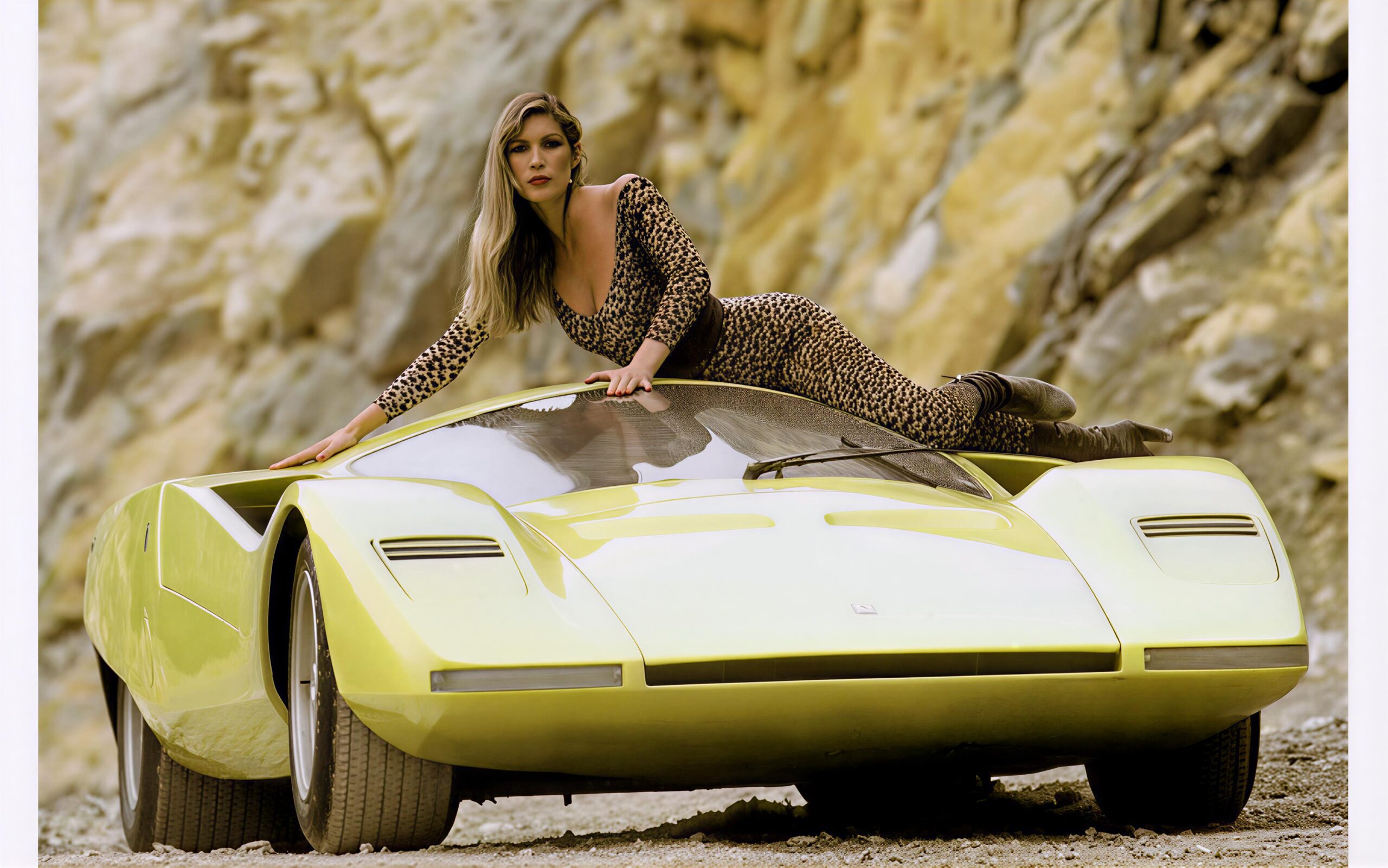
In the late 1960s, a revolution in car design was underway – the wedge era had arrived. Designers across Italy were exploring daring, low-slung shapes that looked like futuristic spacecraft. The trend was ignited by Bertone’s striking Alfa Romeo Carabo unveiled in 1968, a bright green dart of a car that made the world take notice. Pininfarina, Ferrari’s longtime design partner, was determined not to be outdone. They responded with their own wedge-shaped experiments: first came the Dino Pininfarina P6 concept in late 1968, followed by the wild Abarth 2000 Scorpione in early 1969. Each was a step toward a more extreme design language. It was within this context that Ferrari and Pininfarina embarked on a joint project to create something truly spectacular for the Turin Motor Show in the fall of 1969. Both companies had something to prove. Ferrari was gearing up for a fierce racing battle in 1970 with its new 5-liter V12 512 S endurance racers, and Pininfarina was eager to showcase its cutting-edge design prowess on Ferrari’s platform. The stage was set for a showstopper, and it would arrive in the form of the Ferrari 512S Speciale, a one-off dream car that perfectly encapsulated the spirit of its time.
From Racetrack to Show Stand
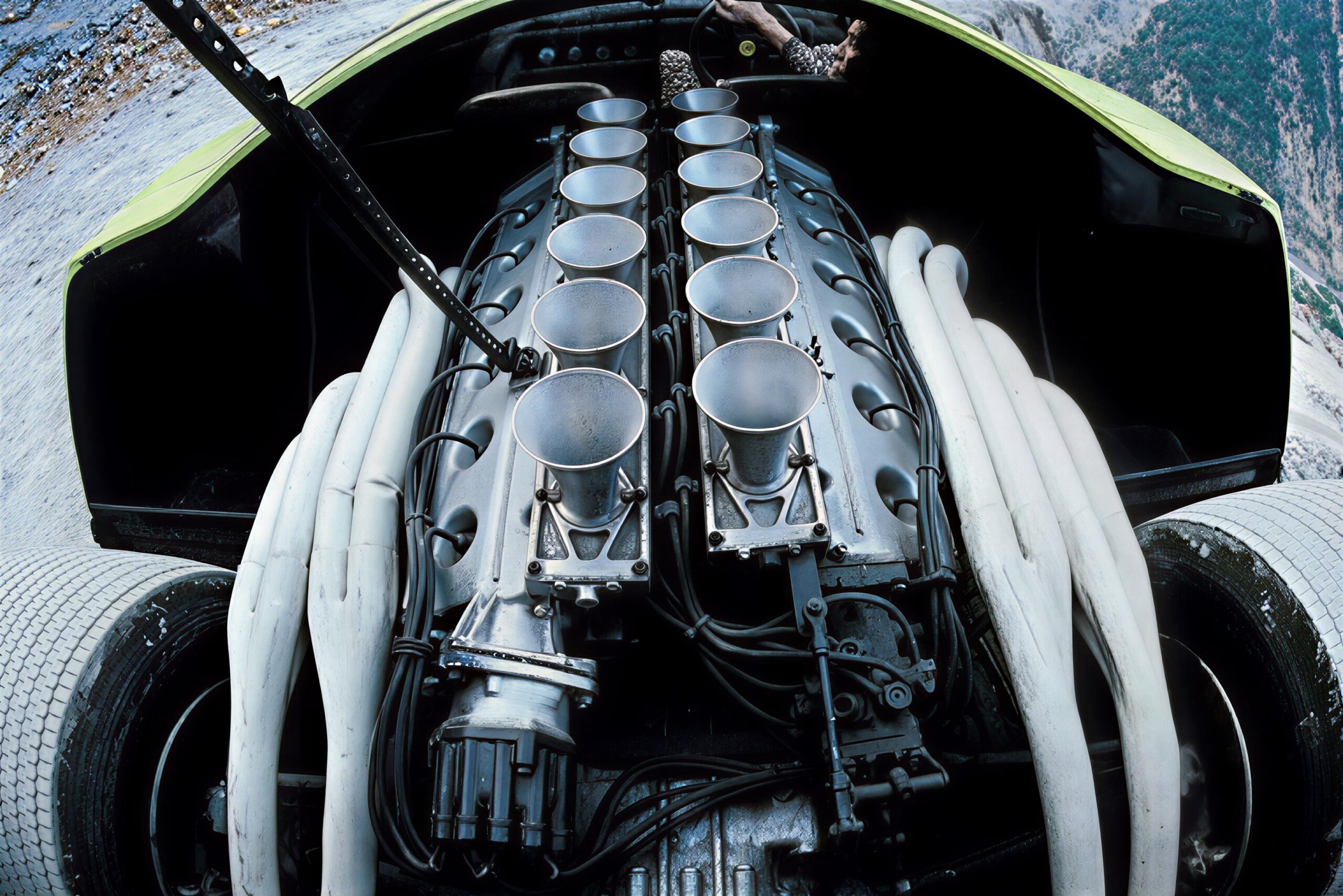
The story of the Ferrari 512S Speciale begins not in a design studio, but on the racetrack. Ferrari’s chassis number 0868, which would serve as the backbone of the Speciale, started life as a Ferrari 312 P racing car. In early 1969, this 3.0-liter V12 endurance racer (distinguished as a 312 P) competed valiantly – it even scored a second-place finish at the 12 Hours of Sebring with Mario Andretti and Chris Amon driving. However, fate took a cruel turn at the Monza 1000 Kilometers race later that year, when chassis 0868 was heavily damaged in a crash. Rather than scrapping or rebuilding the wrecked racer, Ferrari saw an opportunity. At Maranello, the 312 P chassis was repaired and modified as a test mule for the upcoming 512 S racing program: the rear frame was reworked to fit the wider 5.0L-spec bodywork, and it was even outfitted with a larger 6.0-liter V12 engine from Ferrari’s 612 Can-Am car. (In reality this engine was a dummy block with no internal parts – a powerful heart in appearance only.) By mid-1969, Ferrari had built its required batch of 25 new 512 S race cars for homologation, and chassis 0868 was no longer needed for testing. Thus, it was handed over to Pininfarina to be reborn as a show car. The once-battered racing frame was about to get a second life, this time not on the track but under the bright lights of an auto show.
Pininfarina assigned one of its young talents, Filippo Sapino, to lead the design. Sapino was just 29 years old and relatively new at Pininfarina, but he poured his passion into the project. He had witnessed the wedge trend gaining momentum and knew Ferrari’s concept needed to push boundaries. Working with Pininfarina’s engineers – and even conducting research in collaboration with the Polytechnic University of Turin – Sapino crafted an extreme low-profile berlinetta shape. The resulting design was unlike any Ferrari before it. So radical was his creation that within Pininfarina’s studios there was a debate: another designer, Paolo Martin, had a wildly futuristic concept of his own in the works (what would become the Ferrari Modulo). Ultimately, Sergio Pininfarina chose Sapino’s design as the star for 1969, feeling Martin’s idea was perhaps “too extreme” to debut at that time. Sapino’s project, known internally as Project 512 S Speciale, moved from sketches and clay models to reality in just a few short months. By October 1969, the car was ready. It was built on the modified 312 P chassis (now sometimes labeled with Pininfarina code “002”) and draped in a striking yellow body. This one-off Ferrari concept was about to make its grand entrance and steal the show.
Turin 1969: A Show-Stopping Debut
When the covers were pulled off the Ferrari 512S Speciale at the 1969 Turin Motor Show, the crowd’s reaction was immediate and intense. Onlookers were stunned – some in awe, others in disbelief. Ferrari had never shown anything like this before. The Speciale’s dramatic wedge form looked like it had come from another planet. Showgoers pressed in closer, their eyes tracing the arrow-like nose and the impossibly low silhouette. Many likely asked themselves: Is this really a Ferrari? Indeed, the 512S Speciale shocked and confused in equal measure. The shock came from its appearance – a complete departure from the voluptuous curves that defined 1960s Ferraris – while the confusion stemmed from its name. The car carried the badge “512S,” suggesting a 5.0-liter V12 engine lurked within. Yet everyone soon learned there was no 5.0-liter under those rear louvers at all. In fact, under the rear deck sat the big 6.0L V12 block from a Ferrari Can-Am racer (larger than 5.0, ironically), but this was merely for show and not a running powerplant. Ferrari had cheekily borrowed the upcoming race car’s name for this concept.
Why call it 512S Speciale if it wasn’t truly a 512 S under the skin? The answer lies in a bit of savvy marketing and circumstance. In 1969 Ferrari had just taken on a major investment from Fiat, and the company was focused on the new 5-liter 512 S race cars to battle Porsche in 1970. To race at Le Mans and the World Championship, Ferrari had to build 25 examples of the 512 S for homologation – an expensive and urgent undertaking. Naming the show car “512S” was likely a strategic move to drum up publicity and excitement around Ferrari’s latest efforts. Enzo Ferrari knew he needed every bit of buzz to help sell those competition cars to private entrants and meet the production quota. The Turin show provided the perfect spotlight. By adorning Pininfarina’s concept with the 512S name, Ferrari effectively turned it into a rolling advertisement for the forthcoming race program – even if the concept itself was mechanically an entirely different beast. If the public and press left Turin talking about “Ferrari’s new 512,” all the better for Maranello. And talk they did, because the 512S Speciale was the sensation of the show.
🔗 Read more: Sharper Than a Leisure Suit: The Wedge-Shaped Revolution of Italian Concept Cars
Contemporary reports describe the crowd around the car as three-deep, with flashbulbs popping incessantly. The Speciale’s ultra-low nose barely reached knee-height, and its bold lines and unusual proportions had people circling it repeatedly to soak in every angle. Automobile Year, the annual review, declared it “quite the most exciting looking closed car to come from Pininfarina in some time”. It was the first Ferrari ever to adopt the sharp wedge-shaped look that was then ultramodern. For a company known for voluptuous forms like the 275 GTB and 365 GT 2+2, this edgy geometric style was a revolution. Ferrari and Pininfarina had proven they could leap into the future of design – and they had done it seemingly overnight.
Design: A Radical Wedge on Wheels
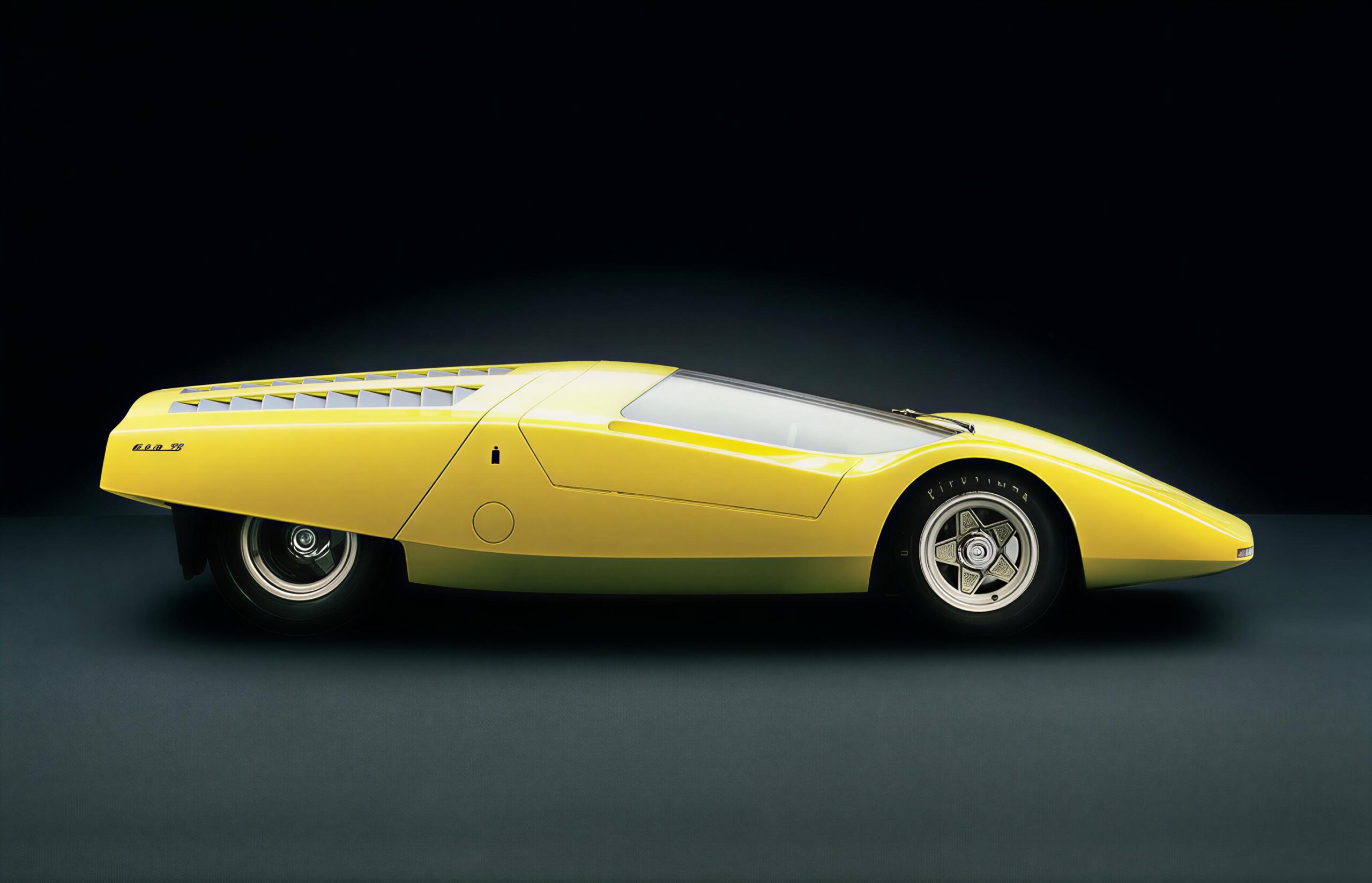
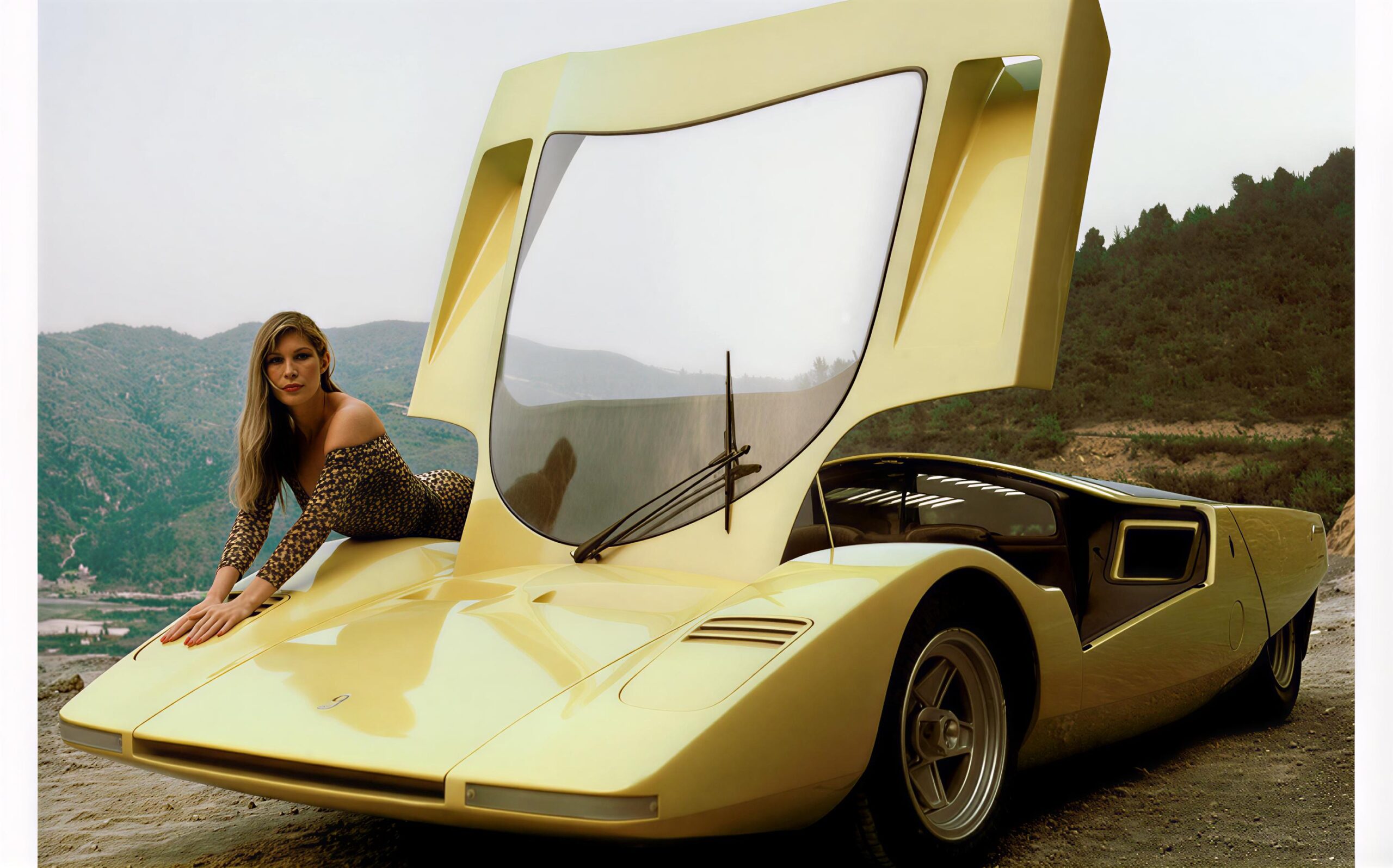
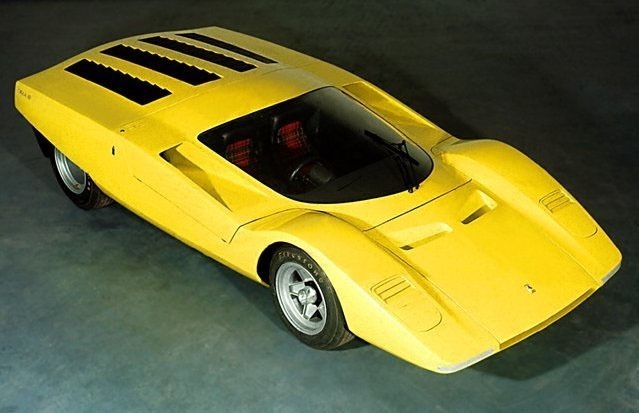
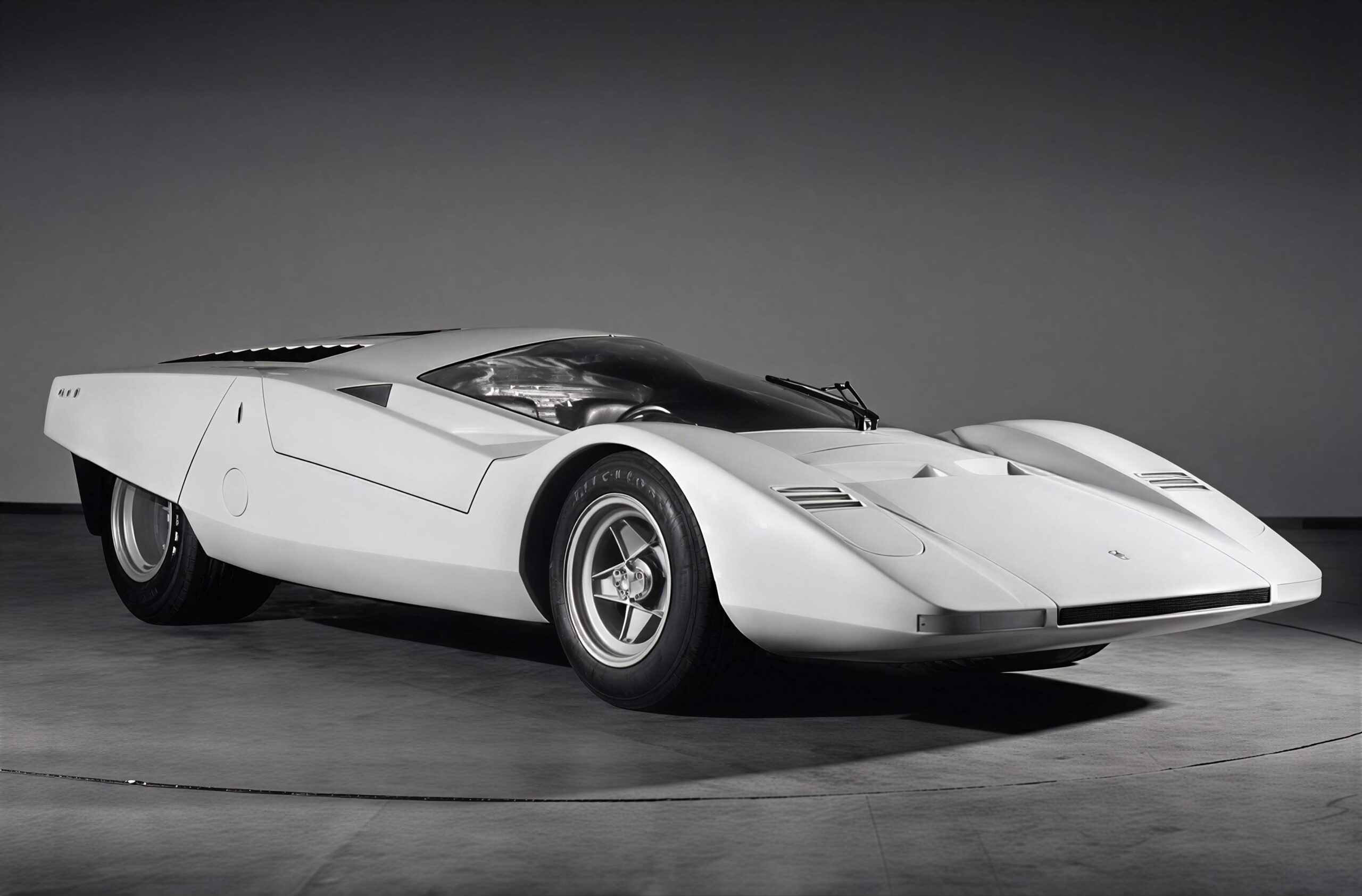
The Ferrari 512S Speciale’s design was nothing short of breathtaking. It was a Berlinetta Speciale (“special little coupe”) that pushed every aspect of form to an extreme. From the front, the car was essentially a wedge-shaped blade meant to pierce the air. The nose tapered to a sharp point housing a slim, rectangular air intake slit. Above that, almost invisible until activated, were pop-up headlights – necessary to keep the front end smooth and uninterrupted when the lights were off. On the hood just before the windshield sat a pair of large vent grilles, hinting at the radiator position and aiding cooling. The windshield itself was a single curved piece that flowed into the roofline – and what a roof design it was. Instead of conventional doors, the 512S Speciale featured a one-piece canopy that lifted up and forward to allow entry. Essentially, the entire central section of the car, including the windshield and roof, hinged open like a giant clamshell. This dramatic flip-up canopy was one of the car’s most theatrical flourishes, adding a sense of occasion to simply getting in or out. It made the Speciale look like a fighter jet or spaceship, reinforcing that futuristic aura.
On the sides, where normal cars had doors and windows, the Speciale had none – it was smooth metal, uninterrupted by side glass. Instead, two massive triangular air intakes behind the canopy gobbled up air to feed the mid-mounted engine’s radiators. Those intakes, outlined in black, contrasted with the glowing yellow bodywork and gave the car an aggressive, hooked appearance, as if the car had aerodynamic wings behind the cockpit. The body’s surfaces were relatively unadorned, relying on pure form and a few well-placed vents for detail. Sapino’s philosophy was to make the car look like “static transformed into supersonic speed” – and indeed every crease and line suggested motion. The car sat extremely low on its wheels, hugging the ground thanks to the compact race-car chassis beneath.
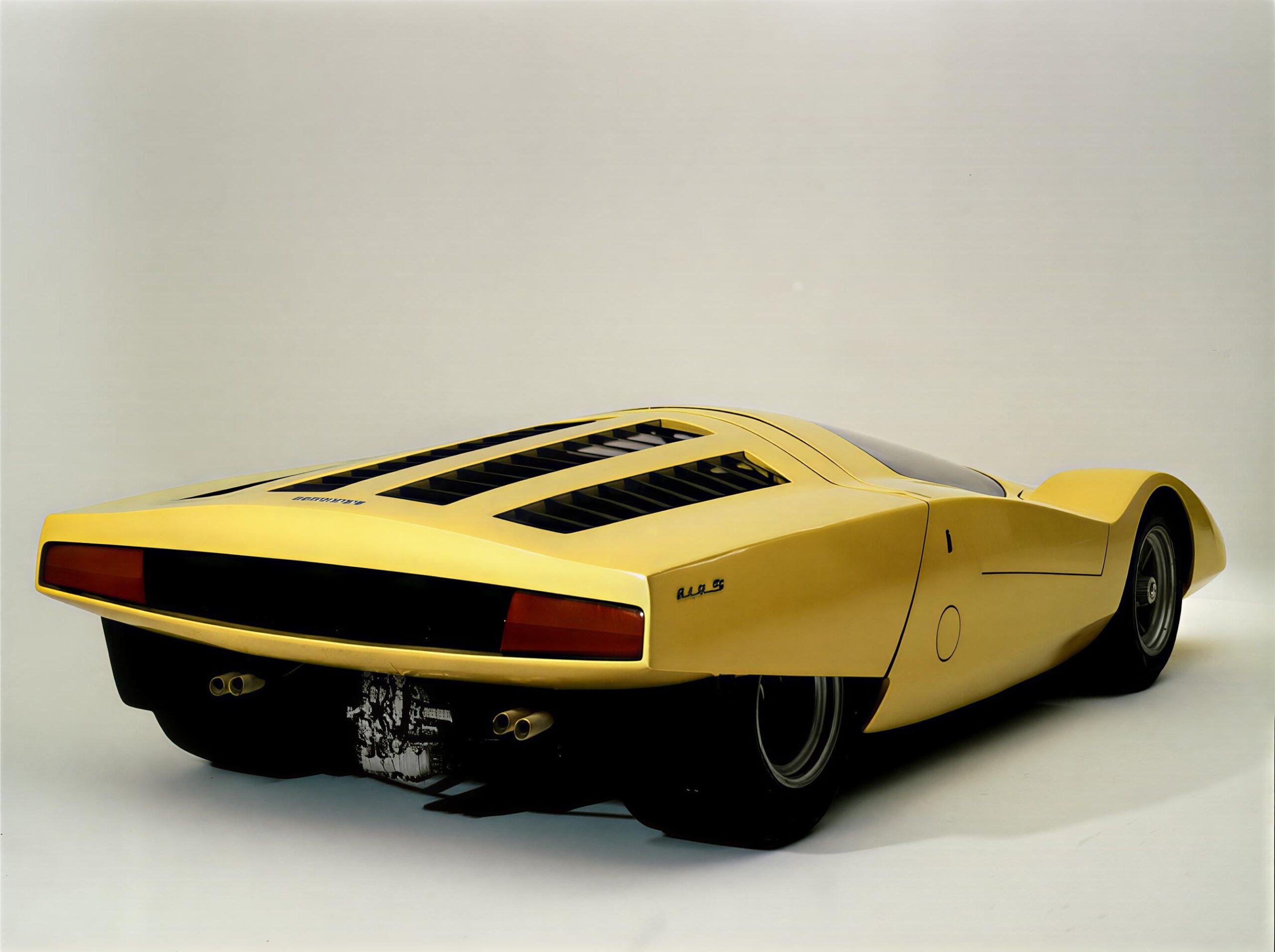
At the rear, the design took an unexpected turn – literally. The tail was abruptly cut off in Kamm-back fashion, with a high truncated tail deck. The rear wheels were partially enclosed by the bodywork, which swept down behind them in a subtle fin shape. Four giant banks of louvers dominated the engine cover, painted satin black to vent heat and visually break up the rear deck’s expanse. This sea of vents not only cooled the 6.0L V12 dummy engine beneath, but also looked striking against the yellow paint. A thin, full-width grille with black mesh formed the tail’s trailing edge, flanked by ultra-modern tail lights – simple horizontal rectangles glowing red. Below that, the exhaust and mechanicals were partly exposed, a nod to the car’s racing origins. One contemporary observer cheekily noted the Speciale’s “permissive rear end” revealed parts of the five-speed transmission to onlookers – a daring touch of mechanical exhibitionism in an era when most cars kept their mechanicals hidden. Every angle of the 512S Speciale offered something fascinating, and yet it all came together in a cohesive design. It was simultaneously brutal and beautiful. Pininfarina had taken the wedge theme and amplified it to the maximum, creating a show car that looked fast standing still.
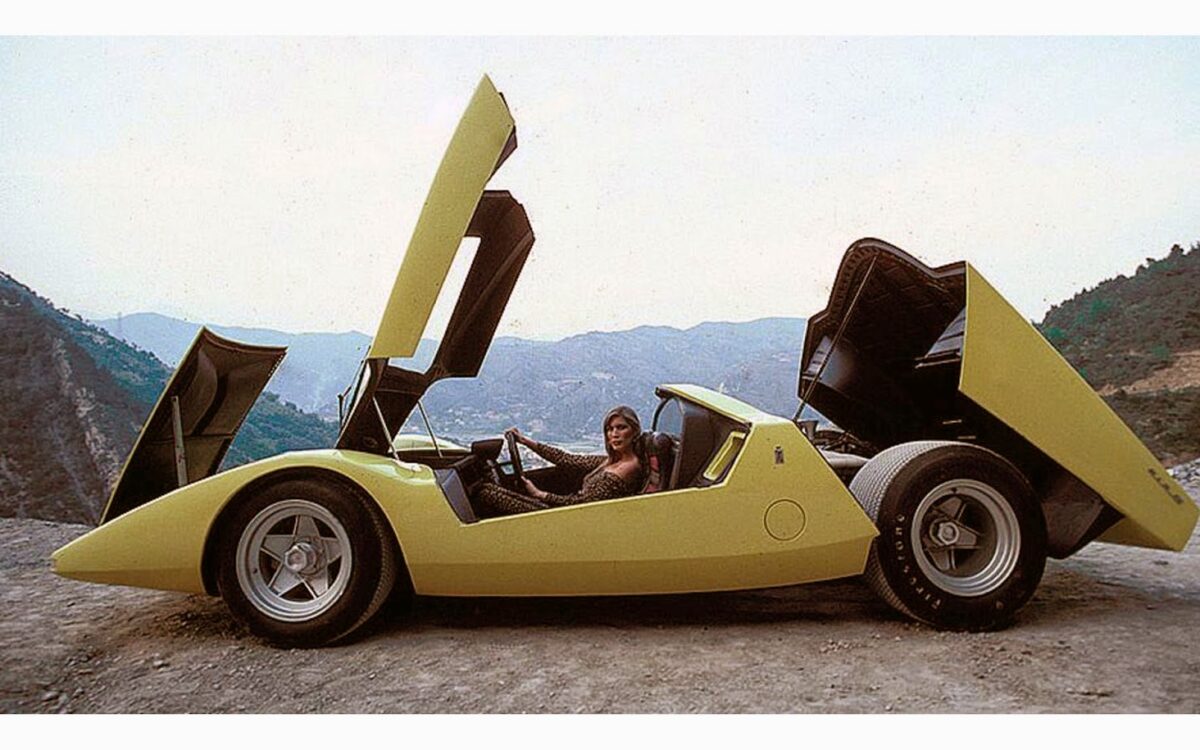
Despite the uncompromising exterior, Pininfarina did make accommodations for a passenger or two. Peering inside the canopy, one found a snug two-seat cockpit – a necessary consequence of using the small 312 P chassis. In fact, the earlier Pininfarina write-ups mistakenly claimed it could seat three, but in truth only two seats could fit between the wide racing fuel tanks and chassis tubes. Those seats were heavily reclined, almost lying down, in true racing car style. They were trimmed in a mix of black vinyl and a chic tartan plaid fabric, an unexpected touch of style and color hidden inside this space-age machine. A tall central tunnel divided the two occupants, housing the gear lever and an array of switches. The driver’s focus was a simple three-spoke Momo steering wheel and a large central tachometer (rev counter) mounted ahead of them. Other gauges for oil, temperature, etc., were placed in a horizontal panel in front of the passenger – after all, the driver of a concept car doesn’t need to worry about such things when the car isn’t meant to be driven at speed.
🔗 Read more: The Alfa Romeo Carabo: The Time Machine
On the right-side wall (for the driver’s right hand, since the car was configured with a typical left-hand driving position) there was a control console with more switches and the levers to release that huge canopy and the rear clamshell. The cockpit was minimalist and heavily constrained by the small space, but it served its purpose – show attendees could imagine themselves piloting this futuristic Ferrari, even if in reality the Speciale was more of a design exercise than a functional grand tourer. Forward visibility, incidentally, was said to be surprisingly good thanks to the expansive windshield and low hood – a point noted by testers who sat in the car. But lateral visibility was virtually nil (with no side windows) and rear visibility was unnecessary in a concept with no plans of being street-driven. None of that mattered, of course. The 512S Speciale was all about the look, the drama, and the statement it made about the future of car design.
The Politics of Design: Pininfarina’s Internal Rivalry
It’s worth noting that the 512S Speciale’s gestation was not just a story of Ferrari providing a chassis and Pininfarina executing a design – there was also an internal competition of ideas at Pininfarina. At the same time Filippo Sapino was shaping the 512S Speciale, another brilliant young designer at the firm, Paolo Martin, was working on an even more radical concept. Martin envisioned a completely streamlined, disc-like car with covered wheels – a design so extreme it looked like a prop from a science fiction film. This car would eventually become the famous Ferrari 512S Modulo, but in 1968–69 it was just a daring proposal on paper and in polystyrene model form. Sergio Pininfarina, the boss, was initially uneasy about Martin’s avant-garde creation. “Why would you draw a car like this?” he reportedly asked, to which Martin replied, “It’s important that they will speak of it.” Sergio retorted, “Yes, but they will speak ill of it”. In the end, Sergio decided that for the 1969 show, Sapino’s design – the Speciale – struck the right balance of innovation and recognizability. Compared to Martin’s Modulo, Sapino’s Speciale was indeed more conservative (a funny word for such an outlandish car), but it still pushed the envelope far enough. This choice turned out to be astute. The Speciale garnered rave reviews at Turin, proving that the public and press were ready to embrace a new design direction from Ferrari, so long as the car still retained some identifiable Ferrari cues (a low sloping nose, a mid-engine stance, etc.).
Emboldened by the Speciale’s success, Pininfarina green-lit Martin’s far-out dream for the next year. The following spring, the world would meet the Modulo at the 1970 Geneva show – a car that made the Speciale look almost tame by comparison. In hindsight, the 512S Speciale’s triumph gave Pininfarina the confidence to take an even bigger leap, effectively opening the door for one of the most famous concept cars in history. But while the Modulo might have stolen some limelight later, it was the 512S Speciale that truly pioneered the wedge Ferrari concept and proved such ideas could influence production designs. Within Pininfarina, both Sapino and Martin earned lasting recognition: Sapino soon left the firm after completing the Speciale, going on to lead design at Ghia (Ford’s studio in Turin) for three decades, while Martin’s Modulo became an icon of its own. The friendly rivalry between their two designs in 1969 ultimately benefited Ferrari and Pininfarina, yielding back-to-back showstoppers and firmly establishing the carrozzeria at the forefront of creative automotive design at the dawn of the 1970s.
Influence on Ferrari’s Future
Beyond the buzz of the Turin show, the Ferrari 512S Speciale left a lasting mark on automotive design, particularly on the Ferrari models that followed. This one-off concept signaled a sharp break from the past and pointed toward a new styling direction for Maranello’s road cars. In the ensuing years, several production Ferraris appeared to take cues from the Speciale’s angular aesthetic. In fact, the very next road-going Ferrari to debut, the 365 GTC/4 in 1971, carried traces of Sapino’s influence – not coincidentally, Filippo Sapino himself contributed to that design after returning to Pininfarina briefly. The 365 GTC/4 featured a much sleeker nose and flatter bonnet than its predecessor, and while it wasn’t a pure wedge, it moved Ferrari’s look in a straighter-lined, more modern direction. Then came the big one: the 365 GT4 Berlinetta Boxer, unveiled in 1971 (and produced from 1973 onward). The Berlinetta Boxer was Ferrari’s first mid-engine 12-cylinder road car, and it adopted a low, wedge-influenced profile clearly inspired by the concepts that preceded it. One can see echoes of the 512S Speciale’s front end and proportions in the Boxer’s design. By the mid-1970s, the trend was undeniable – Ferrari’s 308 GTB and 308 GT4 Dino (designed in the early ‘70s) wore chiseled lines and wedge-like silhouettes that would have been unthinkable a decade prior. These cars, especially the 308 series, became some of the most recognizable “wedge” Ferraris of all time, and they owe a debt to the path blazed by the 512S Speciale. In a 1976 photograph at Ferrari’s Fiorano test track, Formula 1 drivers Niki Lauda and Clay Regazzoni are seen admiring a new Dino 308 GT4; behind them sits a 312T F1 car, but the road car’s sharp nose clearly grabs their attention. It’s a “wedgey” Pininfarina design, and it’s hard not to imagine that the seeds of that design were planted back in 1969 with the Speciale.
Even beyond Ferrari, the 512S Speciale contributed to the momentum of wedge-shaped supercars that defined the 1970s. Competing design houses took note. Bertone, which had kicked off the trend with the Carabo, continued with the Lancia Stratos Zero concept in 1970 and the Lamborghini Countach prototype in 1971 – each more extreme than the last. Pininfarina, for its part, followed up the Speciale and Modulo with other edgy designs in the early ‘70s (for instance, the Ferrari Pininfarina 512S Berlinetta Speciale directly inspired later Pininfarina show cars like the Cuneo and influenced the aesthetics of production cars like the Fiat X1/9 and Ferrari’s own 328 in the 1980s). In the grand timeline of design, the 512S Speciale stands as a turning point – the moment Ferrari embraced the future. As one historian noted, the Speciale was the first built of the two great Ferrari wedge concepts (Speciale and Modulo), “and therefore could be said to be the more influential in showing the path and creating the inspiration for Ferrari’s angular/wedge road cars” that followed. Indeed, without the 512S Speciale breaking the ice, Ferrari might not have so readily evolved from the voluptuous 1960s into the sharply-cut 1970s.
Where Did the Speciale Go? The Fate of a One-Off
After its star turn in 1969 and 1970 on the show circuit (Turin and perhaps a few other appearances the following year), the Ferrari 512S Speciale quietly slipped out of the public eye. Unlike some concept cars that get scrapped or modified, the Speciale fortunately survived intact. For some time, it was kept by Pininfarina in their collection, occasionally shown off as part of the carrozzeria’s heritage. However, once its contemporary relevance waned, it was no longer a regular on the exhibition circuit. By the late 1970s and 1980s, it became something of a hidden gem that only popped up rarely in magazines or retrospectives. Pininfarina eventually sold the 512S Speciale to a private collector in Italy once its show duties were done, likely in the 1970s. In the decades since, it has changed hands a few times between dedicated enthusiasts (the term “custodians” seems more fitting, as each owner has preserved this rolling piece of history). It’s notable that for many years, some in the car community weren’t sure if Pininfarina still had it or not. A rumor persisted that it sat hidden in Pininfarina’s storage, perhaps because it wasn’t seen publicly for so long. But evidence suggests the car did enter private ownership and has been maintained lovingly out of the spotlight.
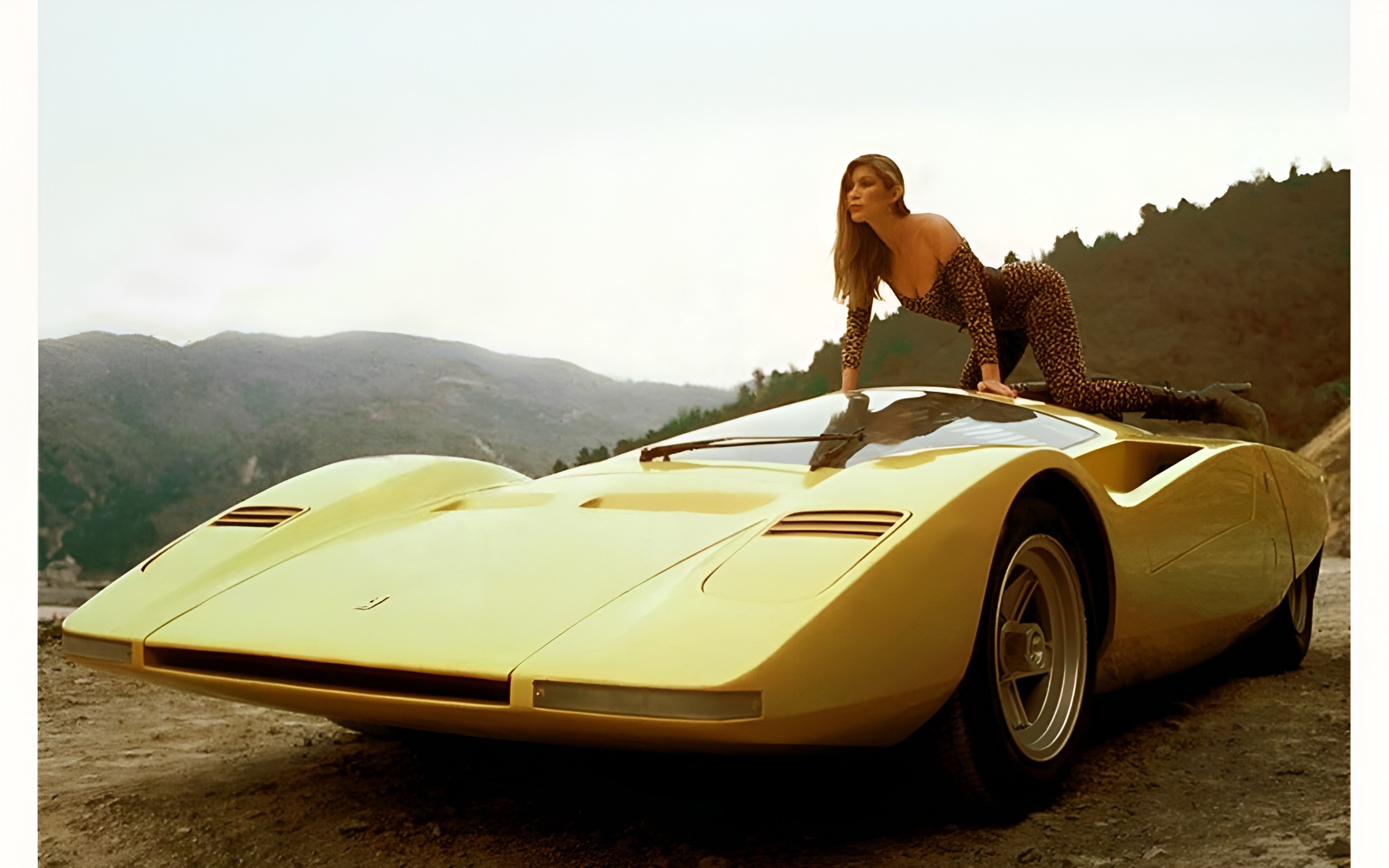
Unlike its sibling the Modulo – which was sold by Pininfarina much later and even restored to running condition in recent years – the 512S Speciale remains far more elusive. It has never been street-legal and was not a functional driver when built (remember that empty engine block), so it hasn’t been doing vintage rallys or track outings. On a few occasions, enthusiasts have caught glimpses of it: a photo shoot in the late 1960s famously had the yellow Speciale posed on a mountaintop near Lake Como, with a model by its side. (Legend has it an earth-mover had to tow the car up there, since it couldn’t drive itself!) In more recent times, one or two private showings or concours d’elegance might have featured the Speciale, but these instances are rare. By and large, this car lives a quiet life offstage. For Ferrari historians and design aficionados, the Speciale is a treasured artifact – one that, if you’re lucky enough to see in person, instantly transports you back to that electrifying moment in 1969 when Ferrari’s future arrived in a flash of yellow fiberglass and chrome.
The Show Car That Changed Ferrari Forever
The Ferrari 512S Speciale may have been a one-off concept, but its impact resonates decades later. It captures a unique moment in history when Ferrari, fueled by racing ambition and creative daring, leapt into the modern era of design. The Speciale’s wedge-shaped profile and bold features signaled that tradition could be challenged and reimagined. For Pininfarina, it was a triumph of both engineering and artistry – taking a shattered race chassis and transforming it into a rolling sculpture that still looks stunning today. For Ferrari, it was a statement that performance and style could evolve hand in hand, forging new identities without losing the marque’s essence.
Reading about the 512S Speciale is almost like reading a fairy tale in the automotive world. A ruined racer is rescued and reborn as a show queen. A young designer seizes his moment and creates an icon, while another visionary’s even wilder idea waits in the wings. A company in transition (with Fiat’s infusion and a new decade looming) uses a show car to spark excitement and signal its direction. And in the end, the creation lives on, hidden but remembered, as a piece of living history. The 512S Speciale’s story has drama, innovation, and even a touch of mystery – elements that make it as enchanting as the day it debuted. Enthusiasts who discover this car today, perhaps through a photograph or a rare public display, often find themselves captivated by its shape and story, eager to learn more. It’s the kind of car that ignites the imagination: one can picture the scene at that 1969 Turin Motor Show, envisioning the bright lights reflecting off the Speciale’s yellow flanks and the hushed gasp of the crowd as they encountered the future for the first time.
🔗 Read more: Pininfarina Through the Ages: The Complete History
More than fifty years on, the Ferrari 512S Speciale remains a benchmark in concept car lore – the moment Ferrari went wedgy and never looked back. It proves that sometimes the wildest dreams on the auto show floor do influence reality, and that bold design can cast a very long shadow. Every sharp-edged Ferrari that followed has a bit of the 512S Speciale’s DNA in it. In that sense, this “Speciale” lives up to its name: a truly special Ferrari that was not just of its time, but ahead of it, blazing a trail into the future. And for that, the 512S Speciale has secured its place in the pantheon of great Italian automotive designs – a legend born from ingenuity, competition, and a flair for the dramatic.

ABOUT THE AUTHOR
Andreas Scheidl
Italian classic car enthusiast with German roots. Renowned as a respected figure in the classic car community, he serves as a jury member at various international concours d'elegance, including the Classic Gala Schwetzingen and Mantova. As a content creator, Andreas passionately shares his profound knowledge and appreciation for vintage automobiles. His heart beats for cars designed by Giovanni Michelotti, showcasing his discerning taste and dedication to preserving the timeless elegance of automotive history.
More stories by Andreas Scheidl ↗CONTINUE READING
Posts You Might Like
A Central Driving Position, a Rear-Mounted V8. Was This Really a Lancia?
In 1948, visitors to the Turin Motor Show could see an unusual Lancia on the stand of Carrozzeria Ghia. It was a large two-door coupé with a two-litre V8 mounted behind the…
Read story
Fioravanti F100: The Ferrari He Was Allowed to Imagine
Enzo Ferrari’s centenary, Leonardo Fioravanti’s independent studio and a supercar that explored air brakes, steel wheels and a new way of driving—without ever wearing the Cavallino.
Read story
Michelotti Shellette: When the Fiat 850 Became a Yacht
The yacht designer, the Turin stylist and the tiny coachbuilt car that crossed between the quay, the royal holiday house and the auction room. Some automobiles were conceived for the open road,…
Read story
Maserati A6 1500: A New Road for the Trident
When the doors of the Geneva Motor Show opened in March 1947, Maserati was a name that required little introduction to anyone who followed motor racing. What it did not yet possess…
Read story
THE CONVERSATION
Comments 0
Share a memory, a period photograph or a documented detail about this story.