
The Lancia Stratos Zero Concept by Bertone
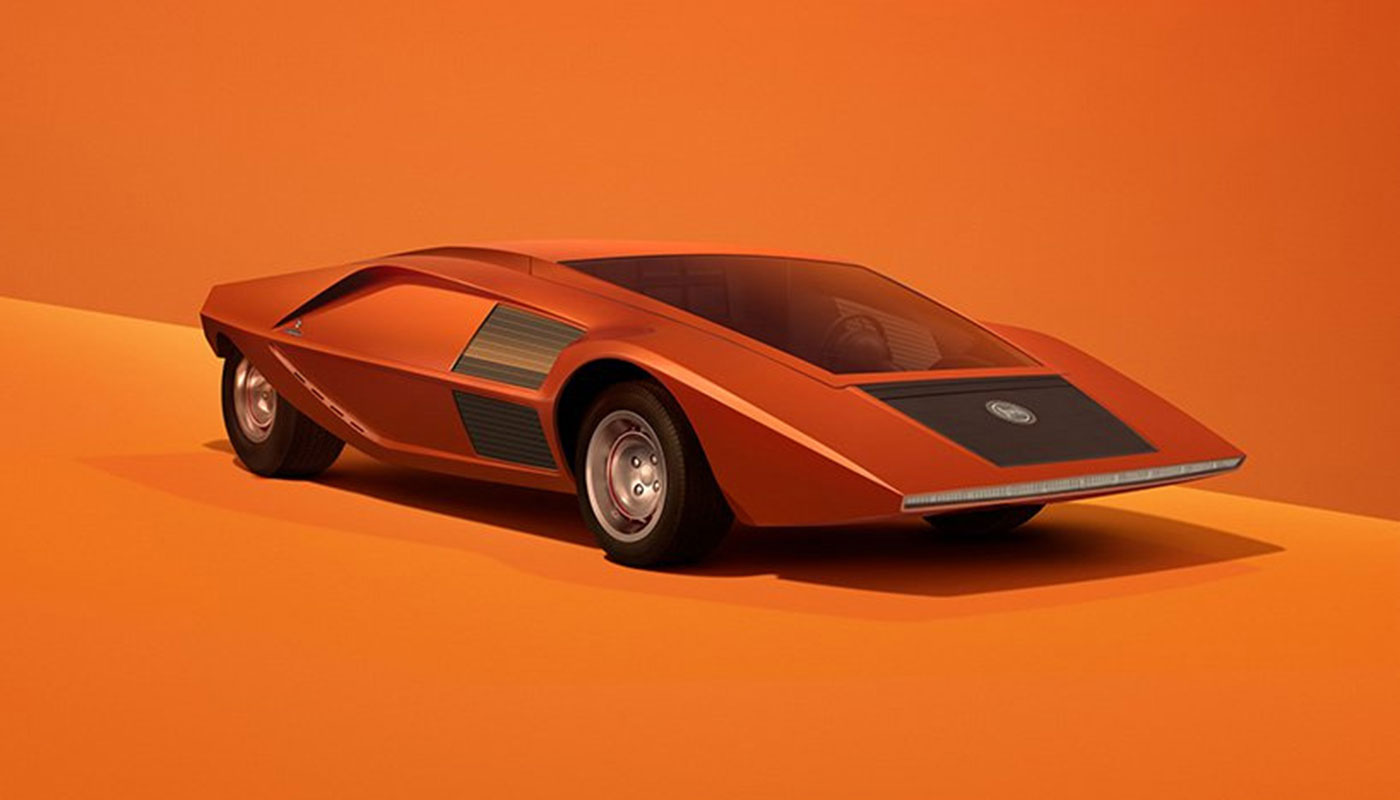
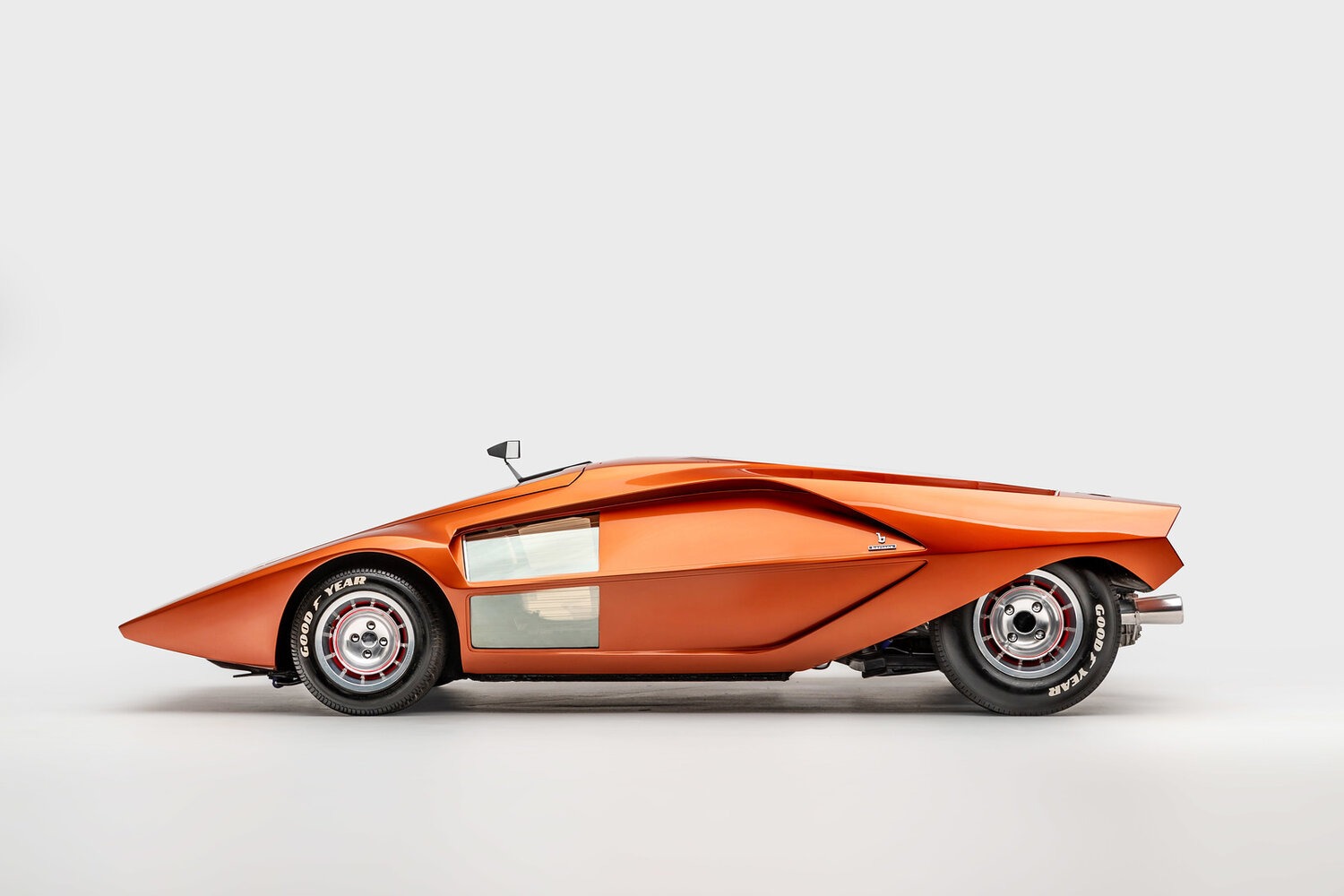
In the autumn of 1970, amid a golden age of Italian design, Carrozzeria Bertone unveiled a show car that would redefine the future of automotive styling. The Lancia Stratos Zero – often just called the “Zero” – burst onto the scene at the 1970 Turin Motor Show as a compact, ultra-low–slung concept unlike anything before. Conceived by Bertone’s lead designer Marcello Gandini under the auspices of company founder Nuccio Bertone, the Stratos Zero epitomized the sharp-edged “wedge” aesthetic of the 1970s. At just 84 centimeters (33 inches) tall, it was literally ground-hugging; contemporaries marveled that even Pininfarina’s wild Ferrari Modulo seemed “like a bus” beside it. Its bright orange, block-like body, flip-up windshield-door, and futuristic cockpit (digital instruments in a minimalist dashboard) looked more science-fiction than car. As one observer later put it, “Bertone transcended the limits of automotive styling and chiselled a shape as though made of solid metal – evoking speed and travel”. In truth, the Stratos Zero wasn’t just a wild showpiece – it was a fully functioning prototype built on a custom chassis and road-ready mechanicals. In Bertone’s own words, it was a “sculpture on four wheels” that “married concepts of architecture and pure artistic expression”.
The Wedge Era and Italian Design Rivalry
The Stratos Zero did not appear in isolation. By 1970 the Italian design world was locked in a fierce battle of avant-garde concepts. Pininfarina, Bertone and the upstart Italdesign were each pushing the envelope. Just two years earlier Bertone had stunned the world with the Carabo (1968), a wide, low Lamborghini concept with scissor doors – the template for the era’s wedge obsession. Italdesign jumped in with cars like Giugiaro’s Bizzarrini Manta and Alfa Romeo Iguana. Pininfarina countered with bold Ferrari-derived show cars (the P5, 512S Berlinetta) and the brain-twisting Modulo (first shown at Geneva 1970). As one historian notes, “the turn of the 1970s… was an all-time high of design rivalry, with each firm pulling out all the stops”. Nothing, however, prepared the crowd at Turin 1970 for Bertone’s newest vision. Exhibited as the “Lancia Stratos HF,” it was soon nicknamed the “Stratos Zero” – originally planned to be called “Stratolimite” (literally “limit of the stratosphere”) to evoke its space-age look. In the words of Car and Driver, the Zero was a “mobile ramp” and “the ultimate wedge-shaped supercar,” surpassing even the Modulo in outrageousness. It literally set “the design tone for the whole of the 1970s and ’80s: the future would be sharp.”
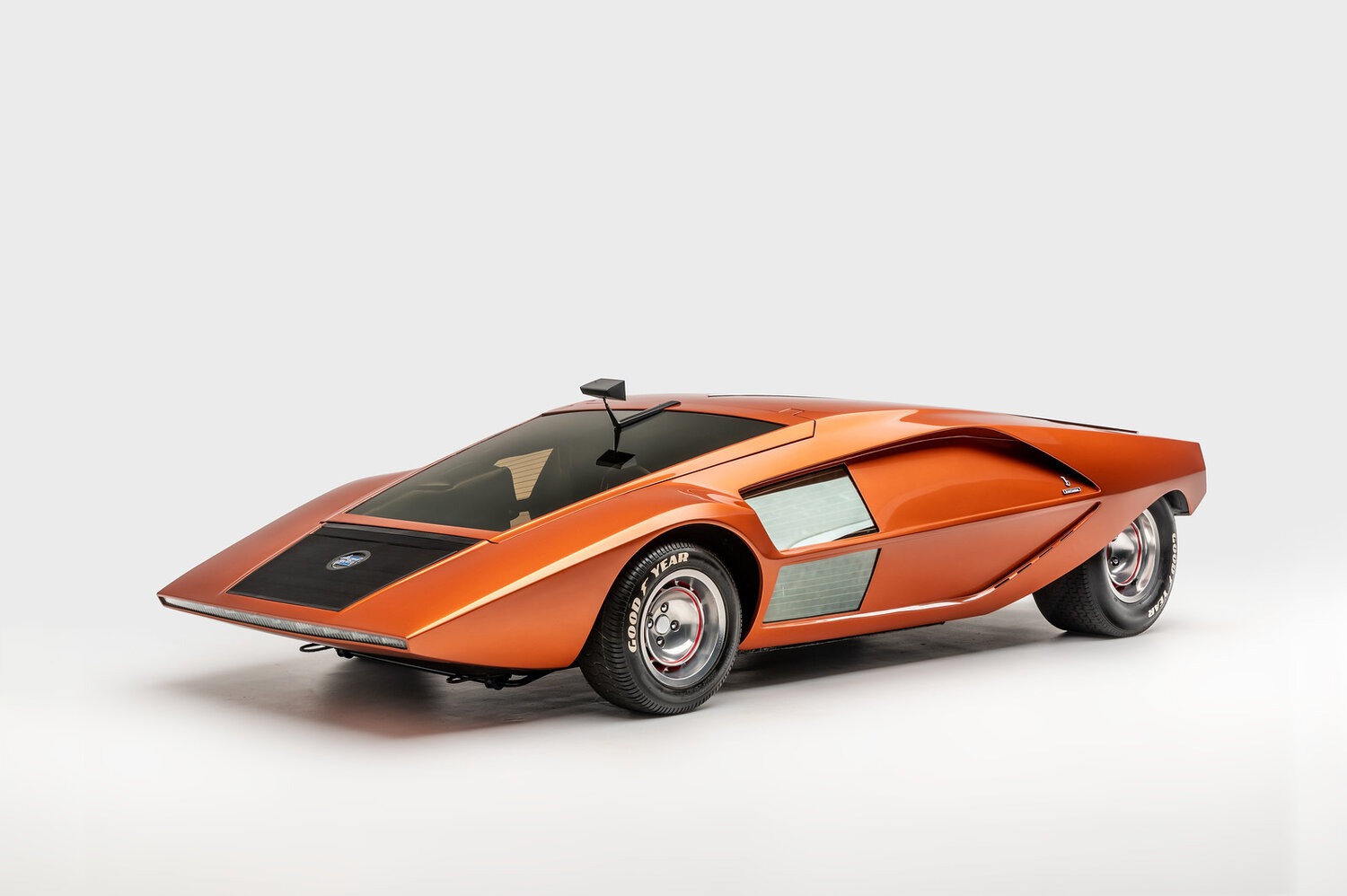
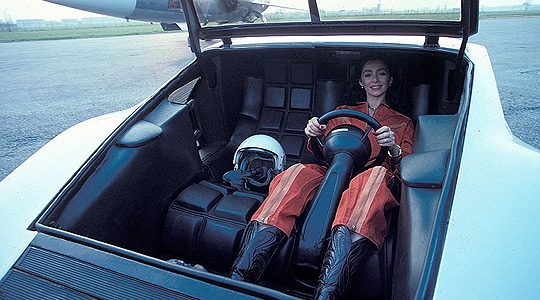
Behind this radical styling stood Marcello Gandini, Bertone’s charismatic chief designer (already famed for the Lamborghini Miura and soon-to-be Countach). Gandini was fascinated by aeronautics and racing cars – single-seaters of the day placed drivers nearly prone for low drag – and he translated those ideas into the Zero. The cockpit was pushed far forward over the front wheels; seats were set almost flat on the floor. To minimize frontal area, Gandini ditched conventional doors altogether: entry was through the giant angled windshield. In fact, the entire glazed roof-and-windshield assembly flipped up like a canopy for access. Even the steering wheel was mounted on a column that tilted and retracted, allowing occupants to slide in under the roof hatch – a marvel of ingenuity for 1970. Inside was a stark, digital-inspired cabin: a few switches and a flat instrument cluster set off to the side (the single dark panel below the windshield). There was no place for a traditional dashboard – as Gandini later quipped, anything bulky would have been a hindrance in that cockpit. In short, the Stratos Zero looked like a jet fighter as much as a car, and its design vocabulary – the unbroken, flat planes, the acute angles – immediately came to define the decade. As one contemporary Italian magazine put it, “Audacious, even seemingly abstruse ideas can have positive, barely anticipated results,” and the Stratos Zero certainly proved that, ushering in “the era of angular, wedge-shaped cars that characterized the 1970s and ’80s”.
Conception: Bridging Lancia and Bertone
The Stratos Zero’s story begins not with Lancia, but with Nuccio Bertone’s ambition. In 1969 Fiat had recently absorbed Lancia, and Bertone saw an opportunity to lure the storied rally firm into Bertone’s orbit. Lancia’s own road and racing cars had been styled almost exclusively by Pininfarina, and a new mid-engined rallyer was rumored to be in the works. Bertone’s answer was to show rather than tell: they would build a concept so spectacular that Lancia could not ignore it. As Gandini later explained, “The very first Stratos was designed…to establish a bridge between Lancia and Bertone”. To that end, Bertone constructed a running prototype using the chopped remains of a crashed Lancia Fulvia HF coupe. They kept the 1.6 L V4 engine, gearbox and front subframe from the Fulvia and built a bespoke tubular chassis to fit Gandini’s sleek body. This gave the Stratos Zero real mechanical credibility: it was a fully functional car, not just a mockup. (Even suspension parts were cleverly repurposed: the Fulvia’s front axle became the Zero’s rear suspension.) The little Fulvia engine was chosen precisely for its compactness – compact enough to tuck behind the driver in a midship layout. The result was a machine built to a single master prescription: “how low a car could they build.” The answer was a mere 84 cm (33 inches) at its highest point, making the Stratos lower than any production car of its time. (This ultra-low height – 3 inches less than the Modulo – was as much a statement about speed and aerodynamics as it was a stunt.)
Even its name came from a lofty source. Nuccio Bertone initially wanted to call it Stratolimite, literally “limit of the stratosphere,” to capture its skyward inspiration. By the time of its debut the name had been shortened to Stratos (usually written as “Strato’s” in some documents), echoing the era’s fascination with the high frontier. As Gandini recounted, the car’s title and design were meant to invoke the realm of the stratosphere – “a place only reachable thanks to massive speeds and cutting-edge technology.”
🔗 Read more: Marcello Gandini: The Man Who Designed the Future
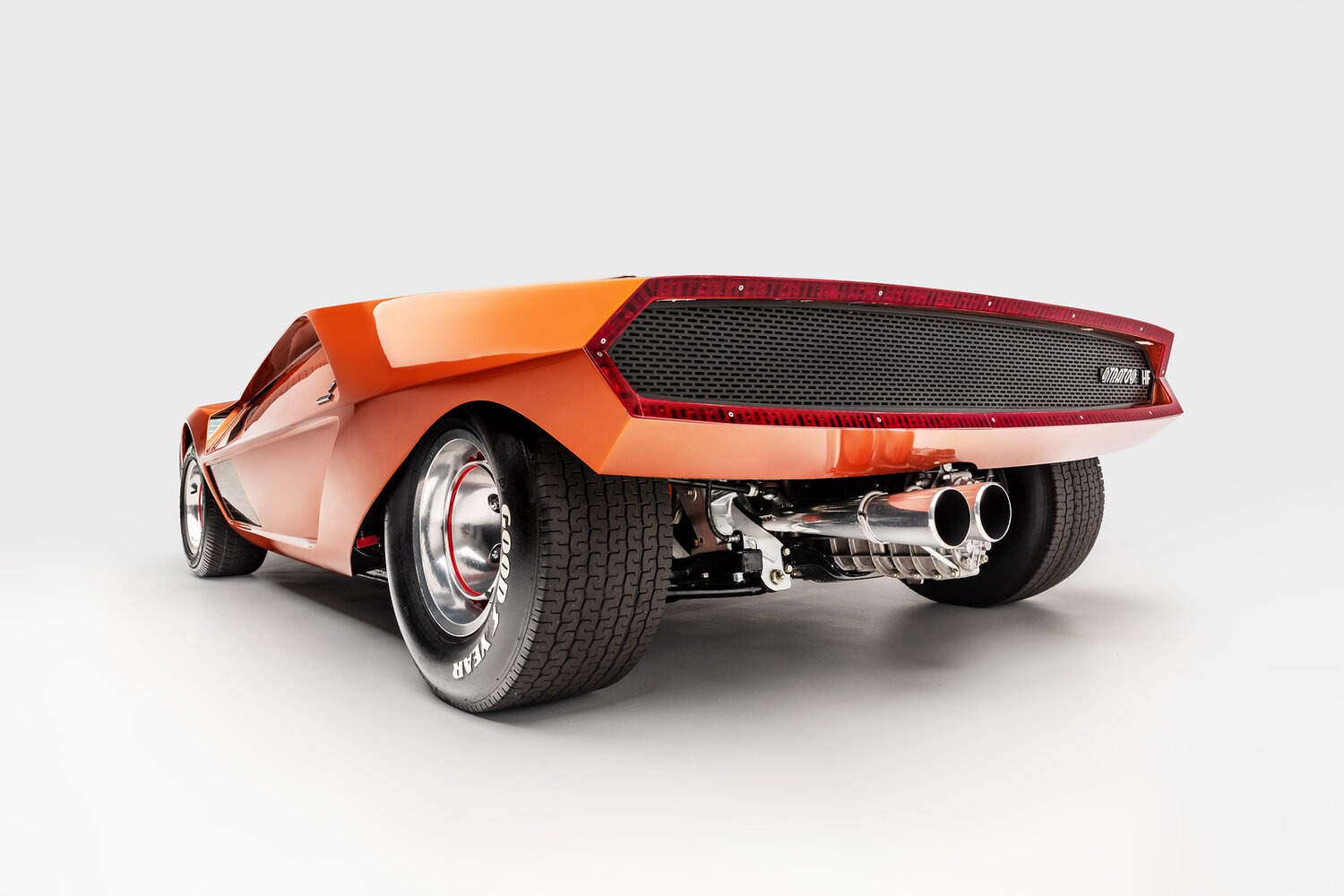
Behind the scenes, Bertone’s sketchbooks from 1970 reveal how the Zero was related to Gandini’s other projects. It directly followed the Carabo’s lead and preceded the Countach prototype: conceptually, these cars form a clear progression of Gandini’s wedge studies. In fact, design critic comments from the time note that Carabo, Zero and Countach blazed a continuous trail in formal research. But the Stratos Zero was perhaps the purest of the three – a “dream car that married architecture and artistic expression,” as one auction catalog put it. It even boasted technical flair: hidden grille light strips front and rear, clusters of dozens of tiny lamps for turn signals, and a striking triangular engine cover with built-in cooling vents. The steering wheel was custom-built by Gallino-Hellebore and gave way under hydraulic linkage when folded out of the way. Every aspect was designed to be radical yet purposeful.
The Unveiling at Turin 1970
When Bertone rolled the Stratos Zero onto the Turin show stand on 28 October 1970, it was an instant sensation. Italian press dubbed it a “revolution in automotive design”. The car’s bright orange paint and impossibly low profile drew crowds, and reporters gushed that here was a future-forward concept to rival the Modulo – but far more agile-looking. Inside the Stratos Zero, a minimalist cockpit with a flat, rectangular steering wheel and digital-style gauge lights looked decades ahead of its time. Under the hood (such as it was) lay the 1.6 L Lancia V4: production Fulvia hardware that underscored the car’s credibility as a working prototype.
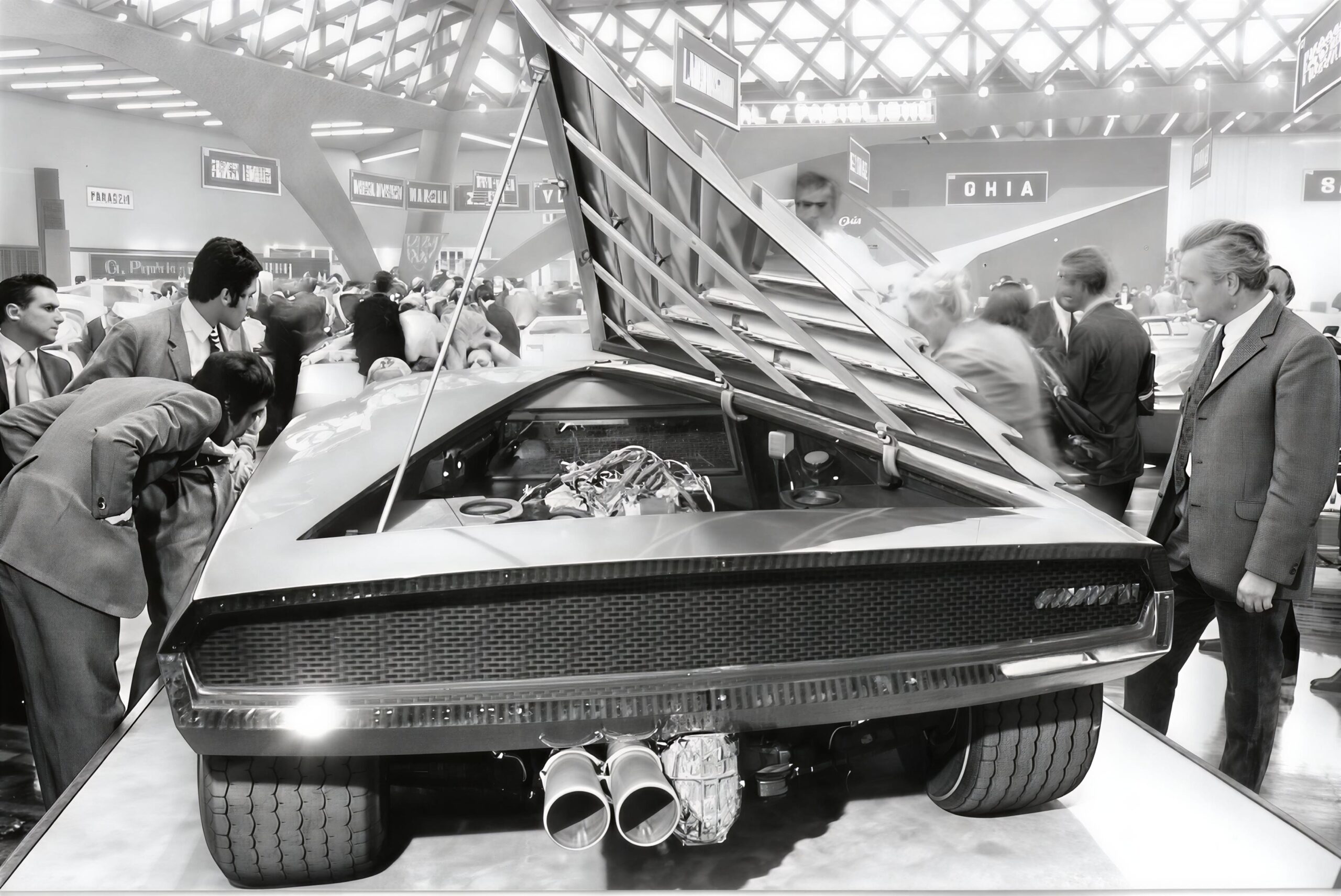
Surprisingly, Lancia’s top brass did not immediately embrace the showpiece. Officially no Lancia representative approached the Bertone display during the show. (According to one account, only Lancia’s racing director Cesare Fiorio took notice of the Zero on the stand.) For weeks afterwards, the Zero returned to Bertone with no word from Turin. This hit-and-run strategy was actually part of Bertone’s plan: Nuccio had famously shown up at Lancia’s factory after the show, driving the Stratos Zero under the entrance barrier to “force the issue”. The publicity stunt paid off – by February 1971 Bertone was summoned to Lancia headquarters, where Nuccio himself (along with engineer Beppe Panicco) presented the car to Lancia’s CEO Pier Ugo Gobbato and Sandro and Cesare Fiorio. Fiorio immediately recognized that Lancia needed a mid-engined rally car to stay competitive. The Stratos Zero, with its futuristic design and Fulvia-derived mechanics, looked like the perfect seed for that idea. Within days, Fiat boss Umberto Agnelli had given the green light for Lancia and Bertone to develop a true rally prototype.
From Concept to Rally Legend
The Stratos Zero thus served as a catalyst. Gandini and the Lancia team set about designing a proper rally car (later to become the production Stratos HF) over the next year. In 1971 a more conventional, red prototype of the Lancia Stratos HF was revealed at Turin, three years before the first customer Stratos appeared. Though that car bore only a passing resemblance to the Zero, it inherited key features: a mid-mounted engine, very short wheelbase, and the wide, wedge-like shape. As Gandini recalled, the only requirements he had were “small, light and easy to handle,” the very attributes embodied by the tiny Zero.
When the production Lancia Stratos HF finally arrived in 1973, it became one of the most successful rally cars of all time. Funded by the Stratos Zero’s demonstrative impact, Lancia won World Rally Championships in 1974, 1975 and 1976 with its namesake. (Ironically, it used a far larger Ferrari V6 – but that’s the Stratos HF story.) The concept had done its job: “Without the Zero,” one historian notes, “the car that became one of rallying’s most memorable icons would likely never have been.”. Gandini himself summarized it best: the Zero “reached the aim for which it was intended: to establish a bridge between Lancia and Bertone.”.
Design Details and Performance
Beyond its story, the Stratos Zero’s engineering was ingenious. Its 1.6 L Fulvia V4 engine (about 115 hp) drove the rear wheels through a 5-speed ZF gearbox, all packaged mid-ship. This tiny, narrow-angle V4 was chosen because it could fit in an extremely compact space. The fuel tank, a mere 45 liters, was nestled beside the engine, and cooling was aided by twin fans pointed at the rear-mounted radiator. All four corners had disc brakes – impressive for 1970 – and the suspension was custom: at the front, short McPherson struts sat under the broad wheel fairings; at the rear, a double-wishbone setup was ingeniously borrowed from the Fulvia’s front axle. (Many parts were literally “Lancia on board”: the engine came with its subframe and spring/damper suspension from the wrecked Fulvia.) Thanks to its extreme geometry, the Zero had a tiny 2.22 m wheelbase and measured only 3.58 m long, 1.84 m wide and 0.84 m high – smaller than a Fiat Panda on three dimensions. Performance was modest by today’s standards, but respectable: about 120 mph top speed. In 1971 it was even road-tested by Quattroruote magazine, driving through Milan to the Duomo, turning heads wherever it went.
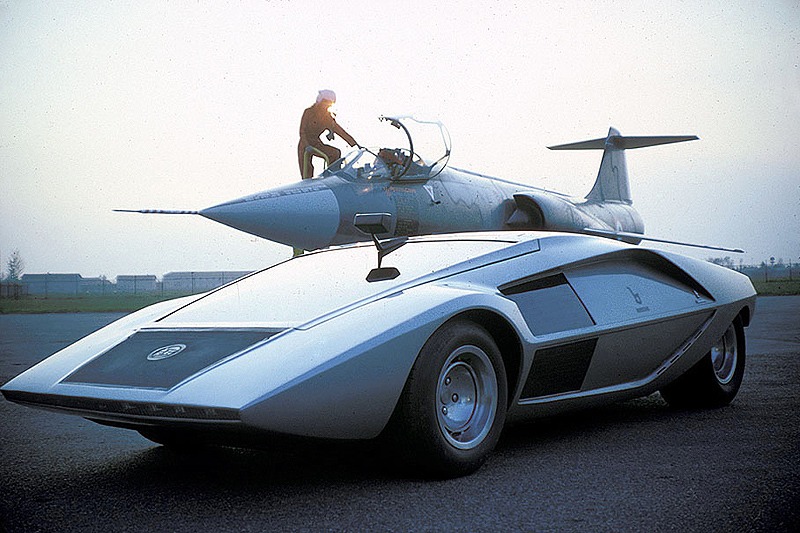
Visually, the Zero was a masterclass in detail. Its front fascia was a single flush strip of ten thin headlights – at night each turn signal would illuminate as a dozen bulbs sequenced to indicate direction. The sides had twin side-by-side windows ahead of the doors, and behind the cockpit the rear bodywork was mostly mesh for ventilation, encircled by a full-width band of taillights (84 bulbs in total). The cockpit itself was austere: two snug bucket seats were mounted between the front wheels, the windshield had almost no bottom frame, and the leather seats featured square-pattern stitching that would reappear years later on the Countach. Every switch was hidden or minimal. (Even the Lancia badge on the rubber mat covering the sill concealed the handle to open the windscreen hatch.) When seated, driver and passenger were so low it must have felt like piloting a fighter jet – the only things they really saw were “the road in front of him and the sky above him”.
🔗 Read more: Lancia Stratos: History, Design & Legacy of the Rally Queen
The whole effect was “futuristic beyond belief” in 1970. The car’s palette accentuated this: originally a gleaming copper color (a hue in the orange family), later repainted silver, and now again shown in its original bronze. The orange finish was meant to shout “break the mold, accelerate, and leave behind everything that had been seen”. In fact, the zero–themed name and hue came to symbolize a new era: as one writer observed, the Zero concept “ushered in the era of angular, wedge-shaped cars” and itself became the wedge’s premature culmination.
Whereabouts and Legacy
For decades the Stratos Zero lived quietly in Bertone’s museum and collection, a crown jewel among concept cars. In 2000 it was carefully restored at Bertone’s style center (in original bronze, undoing a later silver scheme). Since then it has made select appearances at concours shows and museums, including the Petersen Automotive Museum’s exhibitions, and was featured in a 2014 Dream Cars show at Atlanta’s High Museum. In 2011 it was consigned to RM Sotheby’s villa d’Este auction, where it sold for €761,600 – a testament to its significance. The buyer was American collector Phillip Sarofim, and today the Zero remains in his private collection (on loan sometimes to museums).
Its cultural impact endures in pop culture as well. The Stratos Zero famously appeared in Michael Jackson’s 1988 film Moonwalker, zipping through a neon Los Angeles (though the music video-style cameo only hinted at the car’s true story). More meaningfully, the Zero has inspired generations of designers. Renault design chief Serge Van Hove wrote that “what Gandini cares about more than anything else…is dreaming,” and the Zero is a perfect product of that dream – made real by Nuccio Bertone’s vision. One modern designer recalled deciding to become an automotive stylist the moment he saw the Stratos Zero. Indeed, there can be few show cars more evocative than this one-off wedge: it is a sculpture, a technical exercise, and the spark that lit Lancia’s greatest chapter.
In the context of Lancia’s history, the Stratos Zero stands as a legendary pivot point. It emerged when Lancia’s rally team needed new life, and by so boldly reconnecting Lancia with Italy’s wildest design house, it helped spawn the Stratos that dominated the 1970s World Rally Championship. In the annals of car design, it remains perhaps the purest embodiment of the 1970s wedge dream. As one author summed up: “Even though it made an abstract dream out of design, Italian magazine Quattroruote actually took the prototype on the road – a radical machine that, despite its fantastical look, was an actual working sports car”. The Zero may never have been intended for production, but it forever changed what was possible in car design. Its legacy is visible everywhere the wedge is revered, and it still captures the imagination of anyone who sees it: a literal concept car, born from a fantasy, that came wildly to life.
Photos courtesy of the Petersen Museum.

ABOUT THE AUTHOR
Andreas Scheidl
Italian classic car enthusiast with German roots. Renowned as a respected figure in the classic car community, he serves as a jury member at various international concours d'elegance, including the Classic Gala Schwetzingen and Mantova. As a content creator, Andreas passionately shares his profound knowledge and appreciation for vintage automobiles. His heart beats for cars designed by Giovanni Michelotti, showcasing his discerning taste and dedication to preserving the timeless elegance of automotive history.
More stories by Andreas Scheidl ↗CONTINUE READING
Posts You Might Like

A Central Driving Position, a Rear-Mounted V8. Was This Really a Lancia?
In 1948, visitors to the Turin Motor Show could see an unusual Lancia on the stand of Carrozzeria Ghia. It was a large two-door coupé with a two-litre V8 mounted behind the…
Read story
Fioravanti F100: The Ferrari He Was Allowed to Imagine
Enzo Ferrari’s centenary, Leonardo Fioravanti’s independent studio and a supercar that explored air brakes, steel wheels and a new way of driving—without ever wearing the Cavallino.
Read story
Michelotti Shellette: When the Fiat 850 Became a Yacht
The yacht designer, the Turin stylist and the tiny coachbuilt car that crossed between the quay, the royal holiday house and the auction room. Some automobiles were conceived for the open road,…
Read story
Maserati A6 1500: A New Road for the Trident
When the doors of the Geneva Motor Show opened in March 1947, Maserati was a name that required little introduction to anyone who followed motor racing. What it did not yet possess…
Read story
THE CONVERSATION
Comments 0
Share a memory, a period photograph or a documented detail about this story.