
The Italdesign Medici Series: Giugiaro’s Renaissance of the Luxury Sedan
In the mid-1970s, Italian design house Italdesign embarked on a bold automotive experiment worthy of a Renaissance name. The result was the Medici I and II, two striking concept cars that blended supercar flair with limousine luxury. Created by the legendary Giorgetto Giugiaro, these one-off Maserati-based sedans were Italdesign’s way of asking, “Can a four-door saloon be both opulent and sporty?” The Medici series – cheekily named after the powerful Florentine family – aimed to prove that you could have your cannoli and eat it too, combining Italian aristocratic comfort with V8 performance. The story of Medici I and II is a tale of innovation, second chances, and a lasting legacy that can still be seen on the road today.
Historical Context and Italdesign’s Vision
By 1974, Giorgetto Giugiaro was already an automotive design rockstar, having penned Maserati’s exotic Ghibli, Bora, and Merak sports cars. But those were low-slung two-door racers for the street – now Giugiaro set his sights on transforming a luxury sedan with the same magic. Maserati’s existing four-door offering, the Quattroporte II, had been a disappointment, hampered by a modest 3.0 L V6 making only 207 hp and front-wheel-drive complexity. Italdesign’s intention with Project Medici was clear: create a “super-saloon” that married the power of a thoroughbred GT with the comfort of an American limousine. In other words, Giugiaro wanted to out-Quattroporte the Quattroporte – in style and substance.
🔗 Read more: Giorgetto Giugiaro: Car Designer of the Century
The choice of name “Medici” underscored Italdesign’s ambitions. Like the Renaissance-era Medici family, the car would embody luxury, influence, and a patronage of artful design. Under the skin, Giugiaro used Maserati’s proven bones: the chassis of the Maserati Indy (a V8 grand tourer) stretched and reworked into a four-door layout. He mounted Maserati’s 4.9 L V8 engine up front, ditching the Quattroporte II’s anemic V6 for proper firepower. With rear-wheel drive and a five-speed manual transmission, the Medici wouldn’t just coddle passengers – it could keep the driver awake too. Italdesign envisioned a car that could cruise with aristocratic ease and show its taillights to lesser sedans on the autostrada.
Giugiaro’s role in all this cannot be overstated. Not only was he the mastermind designer, he was essentially Italdesign’s Renaissance man (pun intended). He oversaw the Medici project from sketchpad to full-size prototype, infusing it with his signature angular style. Fresh off inventing the origami-like looks of the Volkswagen Golf and Lotus Esprit, Giugiaro applied a similarly sharp-edged approach here – albeit tailored to a far larger, more luxurious canvas. As we’ll see, even a genius like Giugiaro didn’t hit the bull’s-eye on the first try. But the Medici saga proves that in design, as in life, sometimes you can get a do-over.
Medici I (1974): The First Draft of a Four-Door Masterpiece
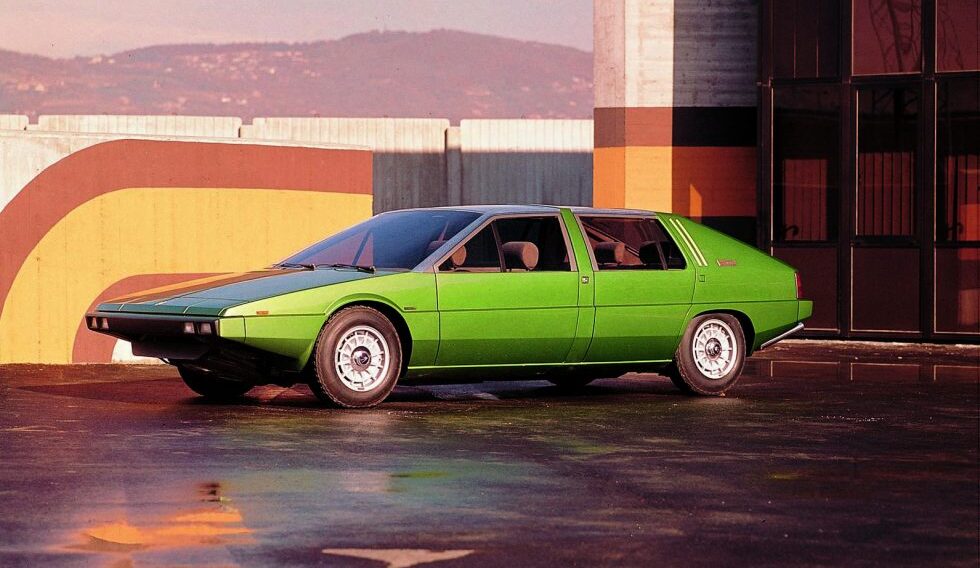
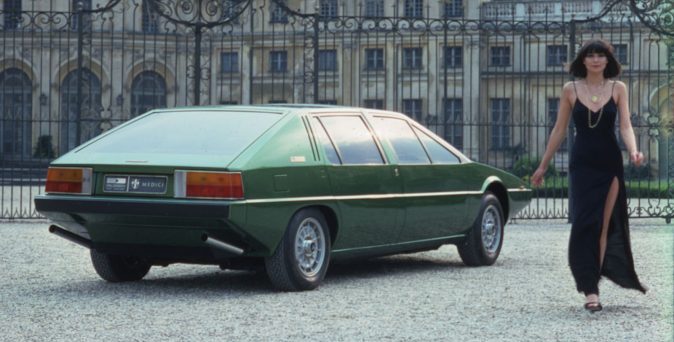
The Medici I premiered at the 1974 Turin Motor Show, instantly drawing attention with its avant-garde profile. Painted a vibrant green and boasting a decidedly futuristic form, the Medici I looked like a supercar that had magically grown an extra set of doors. Giugiaro gave it a sleek two-box fastback shape – essentially a wedge-shaped front end with a long, angular passenger compartment and a cut-off Kamm tail. This was a large car (over 5.2 m long) yet it eschewed the classic three-box sedan silhouette for a more daring hatchback-like roofline, in an effort to keep the look sporty and “compact” despite the limousine intentions. Up front, the Medici I featured a pointed nose inspired by a Maserati V8 coupé concept and Giugiaro’s earlier Asso di Picche design study. The hood tapered to a fine point and housed hidden pop-up headlights that maintained the smooth nose when retracted. A thin, subtle grille opening hinted at Maserati’s trident badge, but overall the front was kept super clean – perhaps too clean as it turned out. A bold character line ran along the body, and at the rear Giugiaro incorporated a trapezoidal C-pillar that grew broader toward the base of the car. That distinctive C-pillar (solid metal on the Medici) would become a Giugiaro trademark, later reappearing as a styling cue on cars like the Lancia Delta and Audi Coupe in the years to follow.
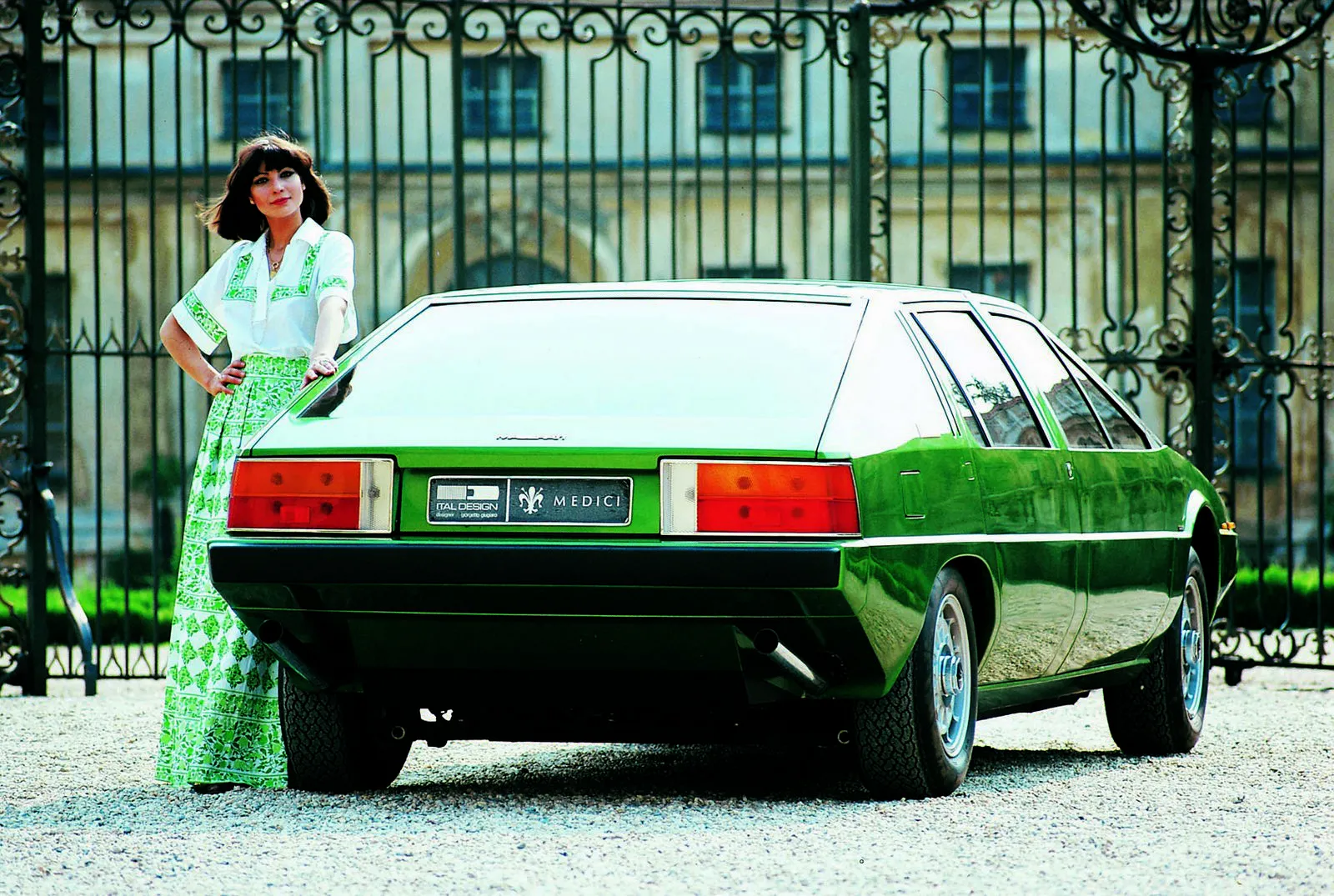
While the Medici I’s exterior was eye-catching, it wasn’t universally loved. Observers noted an odd tension in its proportions: the ultra-low, streamlined bonnet seemed at odds with the tall, square passenger cabin and hatchback rear. From some angles, the car almost looked like two different designs spliced together – a sports car that rear-ended a luxury sedan. This jarring contrast didn’t escape Giugiaro’s own critical eye. In fact, the perfectionist designer later admitted the Medici I was a rare misstep, with official Italdesign documents even acknowledging disappointment in the styling balance. The Turin Motor Show crowd in 1974 gave the car mixed reviews, echoing the sentiment that the Medici’s wedge-meets-breadbox shape was intriguing but perhaps not yet fully resolved. Ever the self-critical artist, Giugiaro took the feedback to heart – and to his drawing board – determined to refine his creation.
Interior Innovation and Amenities
If the Medici I’s exterior was a bold experiment, its interior was an executive lounge on wheels. Giugiaro managed to fit six seats inside, in a configuration worthy of a private jet. Two individual seats up front were supplemented by a pair of facing benches in the rear, creating a cozy four-seat rear cabin where passengers sat vis-à-vis like in a Pullman rail car. This arrangement, with the middle row facing backward, turned the Medici into a mobile meeting room – perfect for power brokers who’d rather discuss deals than watch the road ahead. The cabin was drenched in natural light thanks to generous glazing (including an extended glass roof panel), and trimmed in light-colored velvet upholstery that screamed 1970s Italian luxury. Plush carpeting and futuristic touches abounded, reminding occupants that this was as much a show car as a go car.
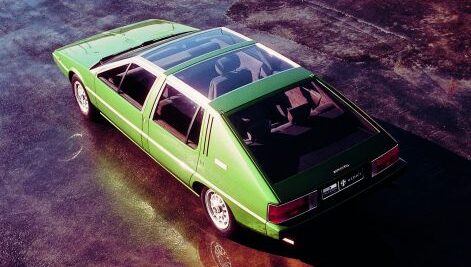
The Medici I’s rear compartment was truly its pièce de résistance – a lounge-like space complete with folding tables and even a minibar in some descriptions. Maserati and Italdesign wanted to demonstrate that performance need not come at the expense of comfort. However, cramming four lounge chairs and a cocktail cabinet into the back of a sedan did make for a tight squeeze when all six passengers were aboard. Let’s just say that if you invited six people into a Medici I, you’d better all be very good friends. The car’s technical specs were as impressive as its hospitality: under the hood sat Maserati’s 4.9 L DOHC V8 borrowed from the Indy, pumping roughly 300 horsepower through a 5-speed manual gearbox to the rear wheels. That was a significant upgrade in grunt over the Quattroporte II’s engine, giving the Medici the brawn to match its brains. At a time of oil crises and economic malaise, a 5.0-liter V8 luxury liner was a daring statement indeed. The Medici I showed that Italdesign was serious about building a “businessman’s Maserati” – one with boardroom seating in the back and a proper GT heart up front.
Despite its innovative concept and lavish appointments, the Medici I remained a one-off concept, and Maserati never put it into production. But the story doesn’t end there. Giugiaro wasn’t satisfied seeing his Medici vision fizzle; like any good Renaissance artist confronted with a flawed fresco, he set out to fix it. Enter the Medici II – a second draft, a makeover, the Pygmalion moment where the sculptor refines his statue into a thing of beauty.
Medici II (1976): Refinement and Renaissance
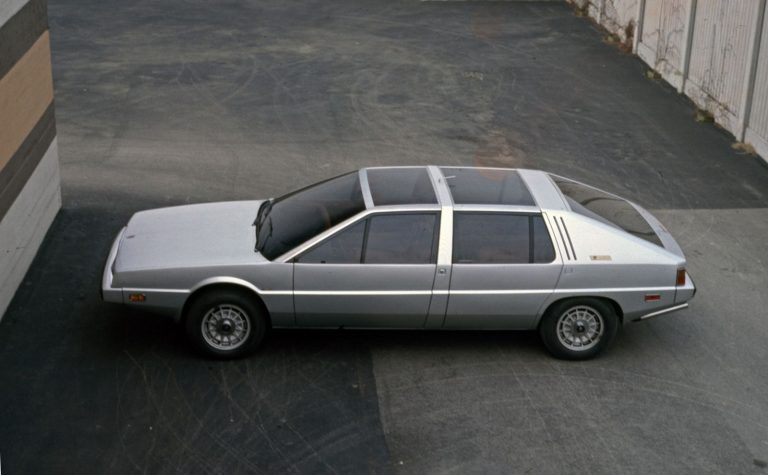
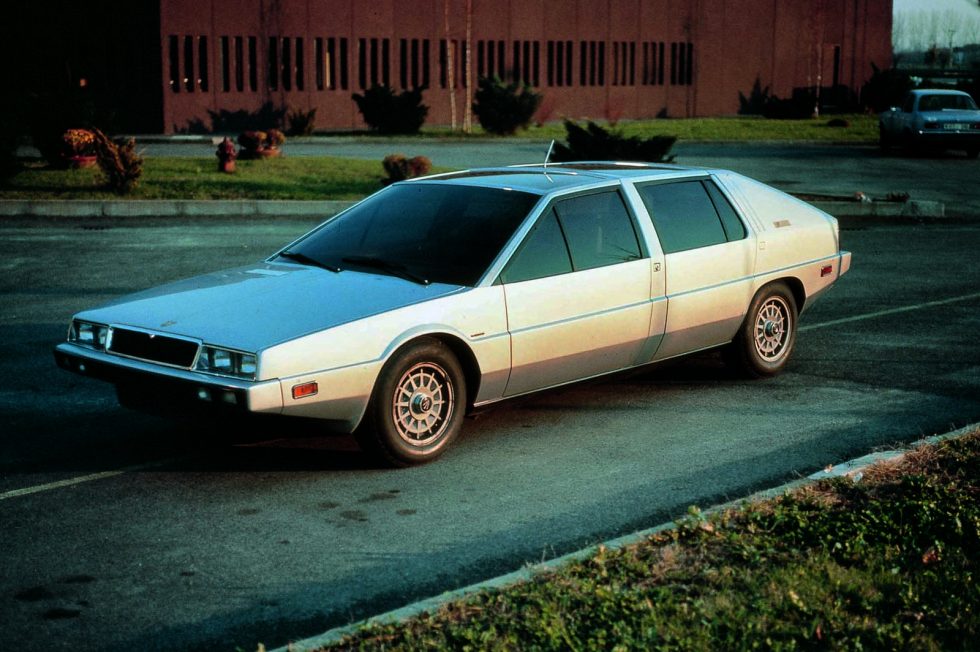
Only two years after the first Medici, Giugiaro went back to the garage (and the drawing board) to give his concept sedan a major makeover. The Medici II, unveiled at the 1976 Paris Motor Show, was essentially Giugiaro’s redemption arc on four wheels. Starting with the original car’s body, he performed some automotive plastic surgery – or as Italdesign joked, “cutting and stitching” the metalwork – to correct the Medici I’s ungainly proportions. Crucially, the bonnet line was raised to better align with the tall cabin, and the front fascia was completely reimagined. Out went the pointy nose and hidden pop-up lamps; in came a more upright, squared-off nose sporting four rectangular headlights and a bold, chrome-edged radiator grille that looked unmistakably Maserati. These changes gave the Medici II a far more cohesive and stately presence, even if it sacrificed a bit of the cheeky wedge character that the first version flaunted. In side profile, the Medici II still retained the stubby two-box silhouette and distinctive trapezoidal C-pillars, but subtle tweaks (like extending a horizontal character line through the front fenders) tied the design together more elegantly. Finished in a sophisticated silver-gray with tasteful chrome accents, the Medici II looked every inch the “executive express” Giugiaro intended from the start. This time, people weren’t scratching their heads – they were nodding in approval.
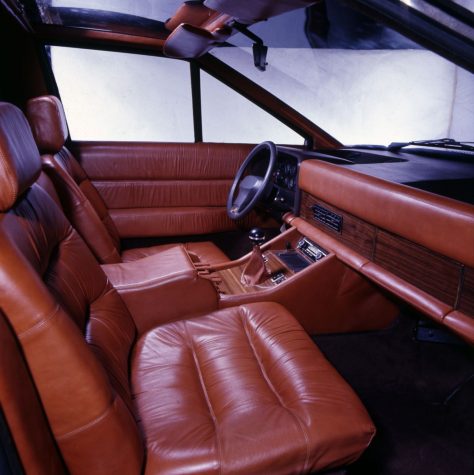
The Medici II’s interior also received a first-class upgrade. Giugiaro ditched the six-seat arrangement and its cramped benches in favor of a true four-seater layout. In the rear, the facing benches were replaced by two plush armchair-style seats, separated by a center console and custom cabinets. These built-in cabinets housed an array of C-suite amenities: a minibar and refrigerator for celebratory bubbly, a folding desk and file holder for work on the go, and even a television and radiophone (the 1970s equivalent of in-car Wi-Fi) for high-tech flair. The Medici II was essentially a private jet interior transplanted into a car – all that was missing was a flight attendant. Giugiaro also upgraded the materials, trading 1970s velour for rich brown leather and briarwood trim, achieving a more classic and upmarket ambiance. Two tinted glass roof panels overhead bathed the cabin in sunlight (or starlight), enhancing the airy, luxurious feel. If Medici I was a swinging ’70s lounge, Medici II was a CEO’s rolling office – complete with the scotch bar and rotary phone to close the deal.
Giugiaro’s revisions paid off. Shown in Paris in fall 1976, the Medici II earned a much warmer reception than its predecessor had in Turin. Critics and show-goers praised the more refined, dignified styling – noting that while some of the wild “Italian wedge” spirit was subdued, the design now looked production-ready and appropriately luxurious. In essence, the Medici had grown up. It also helped that under the skin the same formidable 4.9 L V8 and Maserati Indy underpinnings remained, so the car still had performance cred to back up its boardroom-on-wheels vibe. The ultimate validation of Giugiaro’s improvements came when a very important customer took notice. Mohammad Reza Pahlavi, the Shah of Iran (and a notorious connoisseur of exotic cars), was so impressed by the Medici II that he purchased the show car in 1977. (When a shah literally says “I’ll take the one and only,” you know you’ve done something right!) This unique vehicle became part of the Shah’s collection – a fleet that famously included several Maseratis – though its time in royal service was short-lived due to the Iranian Revolution. Today, the Medici II resides in the Louwman Museum in the Netherlands, where it remains a dazzling artifact of 1970s design innovation. Not many concept cars can claim a life of chauffeuring heads of state, but the Medici II nearly did. Giugiaro had not only redeemed his design; he’d created a showpiece worthy of a king (or at least a Shah).
Legacy and Influence
Neither Medici I nor II ever reached production – they were one-off concepts – but their influence can be felt across multiple cars that followed. In fact, the Medici II is often considered the direct stylistic precursor to the Maserati Quattroporte III sedan. It’s no coincidence that just a year after the Medici II’s debut, Maserati unveiled a new Quattroporte (penned by Giugiaro) that looked like a slightly toned-down Medici for the road. The Quattroporte III, which went into production in 1979, featured the Medici’s crisp angular lines, prominent four-headlight face, and a similar overall profile with a long hood and squared-off tail. Giugiaro essentially got to turn his Medici dream into a reality for Maserati – and this time the world could buy one. The Quattroporte III proved quite successful, remaining in production for a decade and even serving as Italy’s presidential limousine at one point. That kind of “businessman’s Maserati” cachet was exactly what the Medici had aimed for, finally fulfilled in the Quattroporte III’s elegant form.
Beyond the Quattroporte III, Giugiaro’s Medici concepts introduced design ideas that would trickle down through the automotive world in subsequent years. Some of these influences include:
Trapezoidal C-Pillars and Angular Lines: The Medici I’s broad-at-the-base C-pillar design became a Giugiaro signature. You can spot its lineage in the first-generation Lancia Delta (1979) and the late-1970s Audi 80/Audi Coupé, which feature similarly angled rear pillar shapes and crisp sheetmetal creases. Even the humble Hyundai Pony and Yugo Florida (both Giugiaro designs) carried forward that sharp-edged styling language into the 1980s, proving that Medici-style geometry wasn’t limited to Italian exotics.
Wedge Meets Practicality: The idea of blending a wedge-sports-car front with a roomy sedan body was unusual in 1974 – yet by the 1980s, many sedans showed a similar ethos of low noses and squared rears. The Medici’s overall form (aerodynamic nose, two-box cabin, hatchback-like tail) can be seen as a conceptual forerunner to later luxury fastbacks. Giugiaro’s own Lotus Esprit and DeLorean DMC-12 sports cars echoed the Medici’s front-end wedge aesthetic, and one could imagine the Medici II as a four-door DeLorean if such a thing had existed. Elements of the Medici II’s design also reappeared in Italdesign concepts like the 1984 Lancia Medusa, which further explored aerodynamics in a sedan form.
Luxury “Office on Wheels”: The Medici II’s indulgent interior foreshadowed the high-tech, high-comfort features now common in luxury flagships. A television and phone in the car was revolutionary in the 1970s; today, every luxury car is a connected mobile office. The concept of a rear executive seating package with pull-out tables, refrigerators, and entertainment – now a selling point in vehicles like the Mercedes S-Class Maybach – can trace spiritual roots back to what Medici II showcased. Giugiaro basically prototyped the idea of a rolling boardroom, something that has since become reality for the chauffeured elite.
🔗 Read more: Sharper Than a Leisure Suit: The Wedge-Shaped Revolution of Italian Concept Cars
Looking at the bigger picture, the Medici duo were ahead of their time. They pioneered the “super sedan” genre – a category of high-performance, high-luxury four-doors that only really gained popularity decades later. In the 2000s, cars like the Aston Martin Rapide, Porsche Panamera, and Mercedes CLS AMG would captivate enthusiasts by proving that a car could be sleek, fast, and have four doors to boot. The Medici was doing that in the 1970s. In fact, Giugiaro’s determination to merge sports car and sedan in the Medici might well be seen as an early blueprint for these modern machines. As one retrospective noted, the Medici II “went on to inspire one of the principal super-saloons” and through the Quattroporte’s lineage can even claim a kinship to today’s exotic four-door GTs. Not a bad legacy for a pair of concept cars that never sold a single unit.
Final Remarks
The Italdesign Medici I and II remain fascinating chapters in automotive history – a what-if scenario where Maserati’s luxury sedan took a radical turn under Giugiaro’s pen. These cars encapsulate the fearless experimentation of 1970s Italian design: sometimes flawed, often breathtaking, and never boring. From the Medici I’s audacious but imperfect first draft to the Medici II’s polished finale, Giugiaro demonstrated the power of persistence and iteration in design. Along the way, he gifted the world a vision of the future – one where style, speed, and comfort could co-exist in one dramatic four-door package.
Equal parts historical footnote and inspirational icon, the Medici series has earned a cult following among car enthusiasts and design aficionados. Their influence is visible in everything from late-70s production sedans to the very concept of the modern luxury sport saloon. And let’s not forget the human element: it’s hard not to smile at the image of Giorgetto Giugiaro, ruler of the Italdesign “kingdom,” naming his pet project after the Medici and effectively declaring a renaissance in car design. With a wink and a nod (and perhaps a glass from the onboard minibar), the Medici I and II remind us that even in the buttoned-up world of executive cars, innovation and a little humor never go out of style. The Medici may not have worn the crown in their day, but their legacy reigns on in the DNA of every luxury performance sedan that followed. Viva la Renaissance on wheels!

ABOUT THE AUTHOR
Andreas Scheidl
Italian classic car enthusiast with German roots. Renowned as a respected figure in the classic car community, he serves as a jury member at various international concours d'elegance, including the Classic Gala Schwetzingen and Mantova. As a content creator, Andreas passionately shares his profound knowledge and appreciation for vintage automobiles. His heart beats for cars designed by Giovanni Michelotti, showcasing his discerning taste and dedication to preserving the timeless elegance of automotive history.
More stories by Andreas Scheidl ↗CONTINUE READING
Posts You Might Like

A Central Driving Position, a Rear-Mounted V8. Was This Really a Lancia?
In 1948, visitors to the Turin Motor Show could see an unusual Lancia on the stand of Carrozzeria Ghia. It was a large two-door coupé with a two-litre V8 mounted behind the…
Read story
Fioravanti F100: The Ferrari He Was Allowed to Imagine
Enzo Ferrari’s centenary, Leonardo Fioravanti’s independent studio and a supercar that explored air brakes, steel wheels and a new way of driving—without ever wearing the Cavallino.
Read story
Michelotti Shellette: When the Fiat 850 Became a Yacht
The yacht designer, the Turin stylist and the tiny coachbuilt car that crossed between the quay, the royal holiday house and the auction room. Some automobiles were conceived for the open road,…
Read story
Maserati A6 1500: A New Road for the Trident
When the doors of the Geneva Motor Show opened in March 1947, Maserati was a name that required little introduction to anyone who followed motor racing. What it did not yet possess…
Read story
THE CONVERSATION
Comments 0
Share a memory, a period photograph or a documented detail about this story.