
Pininfarina Cambiano: The Concept That Reasserted Pininfarina’s Design DNA
When Fabio Filippini arrived at Pininfarina in 2011, he joined a design studio with a long history and a very clear identity. For decades the company had shaped the character of many Italian cars, building a design language based on proportion, balance, and a restrained sense of elegance. That heritage was an important reference point, but it also raised a practical question: how should that culture evolve within a rapidly changing automotive industry?
Filippini brought a broad international background. Before returning to Italy he had spent several years working across different design environments. At Renault he rose to Vice President of Interior Design, leading the development of cockpit architectures where ergonomics, information and materials define the driver’s experience. Earlier, his time in Japan with the Volkswagen Group exposed him to a design approach centered on precision, discipline and careful control of surfaces and details.
When he arrived in Turin, Pininfarina itself was going through a complex phase. The financial crisis had reshaped the automotive sector, and traditional coachbuilders were facing new structural challenges. At the same time, emerging technologies—electrification, alternative propulsion systems and advanced materials—were beginning to influence how cars were conceived.
In that context, the challenge was not simply to produce another show car, but to express clearly what Pininfarina’s design culture represented at that moment. From 2011 to 2017 Filippini would guide the design direction of the company. The project that would define that period was the Cambiano concept.
Searching for Clarity
When a design house faces uncertainty, the instinct is often to react loudly; through radical shapes, dramatic gestures, something bold enough to command attention. Yet that wasn’t the direction Fabio Filippini chose when discussions began inside Pininfarina. Instead of chasing spectacle, the conversation gradually returned to fundamentals, to a quieter but more demanding question: what are the values that truly define Pininfarina, regardless of the moment or the market around it?
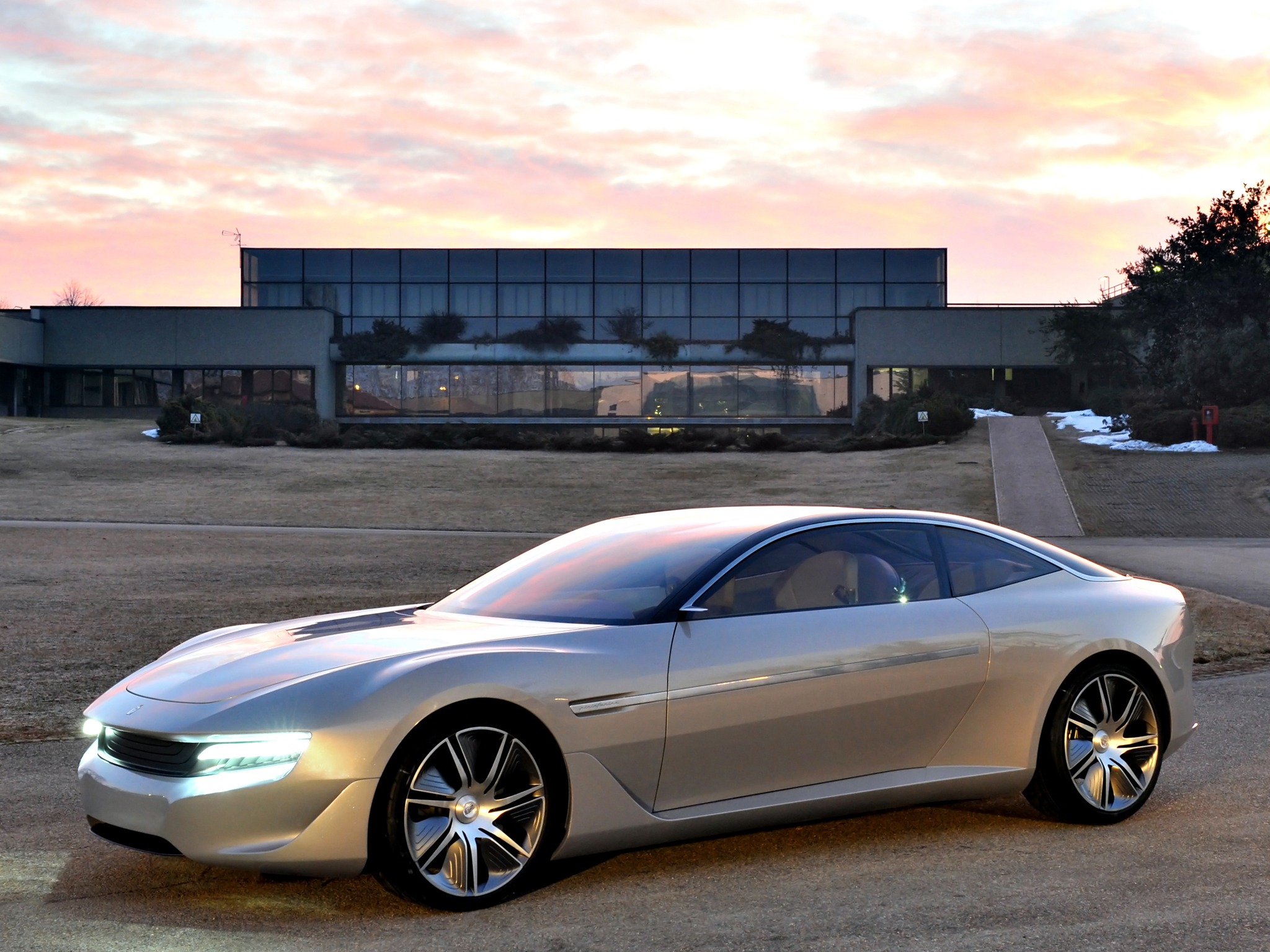
Three ideas kept resurfacing in those discussions: elegance, purity, and innovation. Not elegance as ornament or decoration, but as proportion—the subtle balance of volumes that makes a car feel resolved even before the eye begins to analyze it. Purity, in this sense, was not minimalism for its own sake but a form of discipline, the willingness to resist excess and allow the design to breathe. Innovation, meanwhile, had to be genuine. It could not be reduced to fashionable language or superficial technology; it needed to emerge from real exploration, particularly in aerodynamics, structural solutions, and new propulsion concepts that were beginning to shape the future of mobility.
The project that slowly took form was therefore conceived as a research prototype, something capable of demonstrating that the studio still possessed both deep technical competence and a forward-looking vision. Lightweight construction, advanced materials, and environmentally conscious engineering became central elements of the concept. Yet none of these aspects could stand alone, because within Pininfarina there remained one constant principle that guided every discussion: whatever form the project would take, it had to be beautiful.
From this balance of ideas emerged the concept of a modern luxury Gran Turismo, a typology closely connected to Pininfarina’s history but now reconsidered through the lens of sustainability and advanced engineering. The car that would embody this vision would eventually be known as the Cambiano, although at the beginning it was less a defined object than a direction—a clear commitment to clarity, proportion, and thoughtful innovation rather than visual excess.
Inspiration, Proportion and Design Language
Before the Cambiano became a physical object, it was first a question of form. The design team began with a deliberately restrained approach, working with very few lines and allowing proportion to carry most of the visual weight. The intention was not to overwhelm the eye with detail but to create a sense of calm balance, where every surface contributes to the overall harmony of the car.
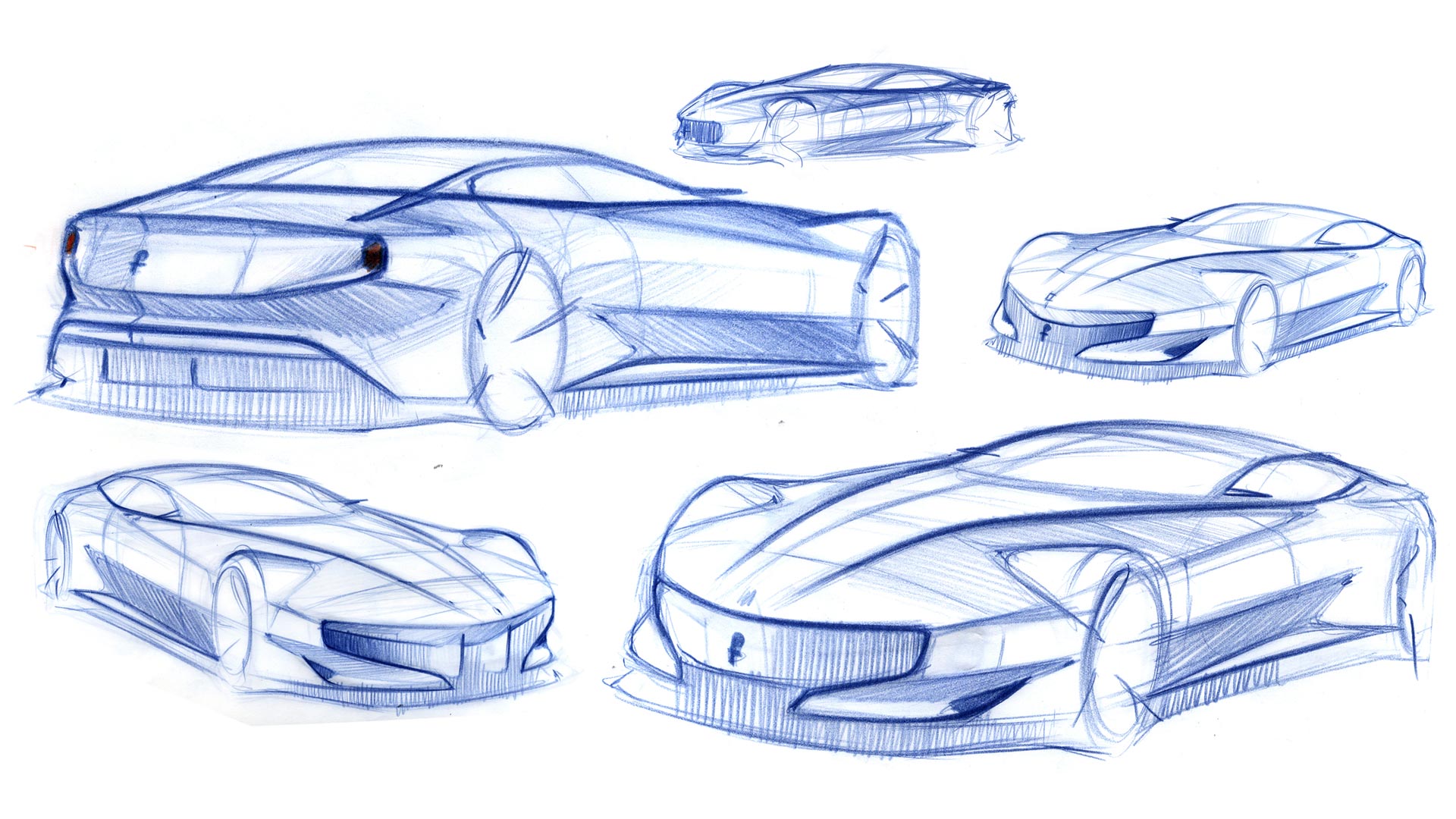
This philosophy shaped the entire exterior language. The body appears slender and fluid, yet the wheel arches rise with confidence from the surface, giving the car presence without resorting to aggressive styling. Light moves across the panels in soft transitions, revealing carefully controlled surfaces rather than dramatic creases. It is a design that rewards observation over time rather than demanding attention at first glance.
The cabin plays an important role in this composition. Its transparency brings luminosity into the interior while exposing the carbon-fiber lattice structure that forms the safety cell beneath. Instead of concealing this structural network, the design allows it to become part of the visual expression, tracing an intricate pattern that suggests the invisible flows of structural forces around the passenger compartment.
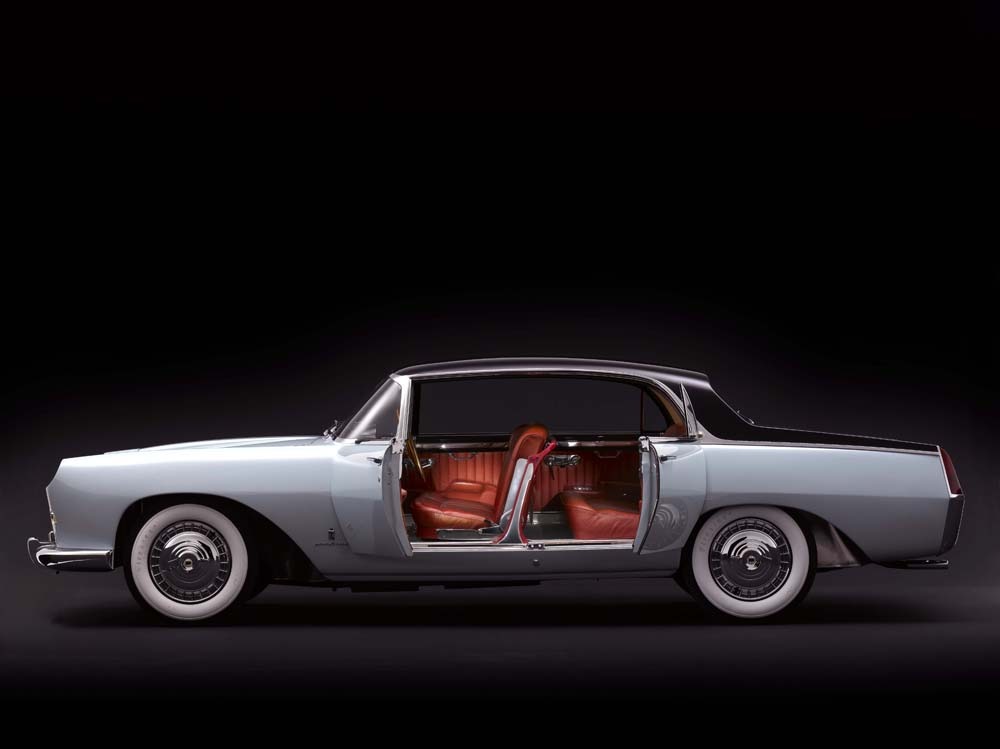
At the same time, the project maintained a subtle dialogue with the design culture that shaped Pininfarina over decades. The elegant sedan-coupé proportions recall the Lancia Florida II, particularly in the balanced relationship between body and glass and the refined aluminum outline of the window frame. Along the flanks, the controlled tension of the surfaces evokes memories of the Lancia Gamma Coupé. These references were never intended as nostalgic quotations; rather, they represent a continuity of formal sensitivity, a way of extending an established design language into a contemporary context.
Design Solutions and Technical Innovation
While the overall form remained calm and restrained, several distinctive technical solutions were integrated into the design. One of the most striking is the asymmetric door configuration. On the passenger side, two doors open in a book-like movement, creating a generous entrance and making access to the cabin particularly easy. On the driver’s side, however, there is only a single door, reinforcing the sporting character of the driving position. The arrangement reflects the dual personality of the car: part refined grand tourer, part machine centered on the act of driving.
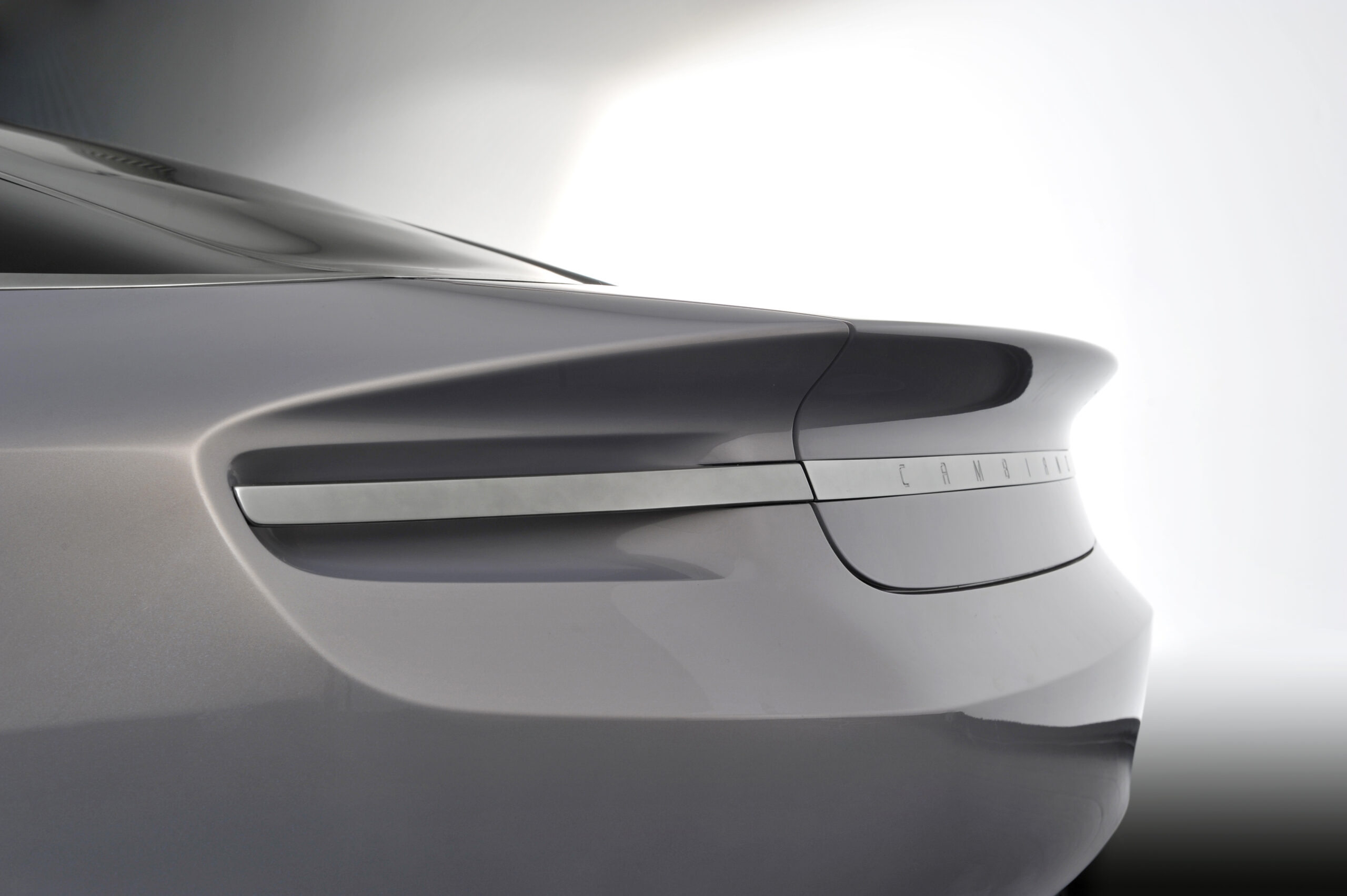
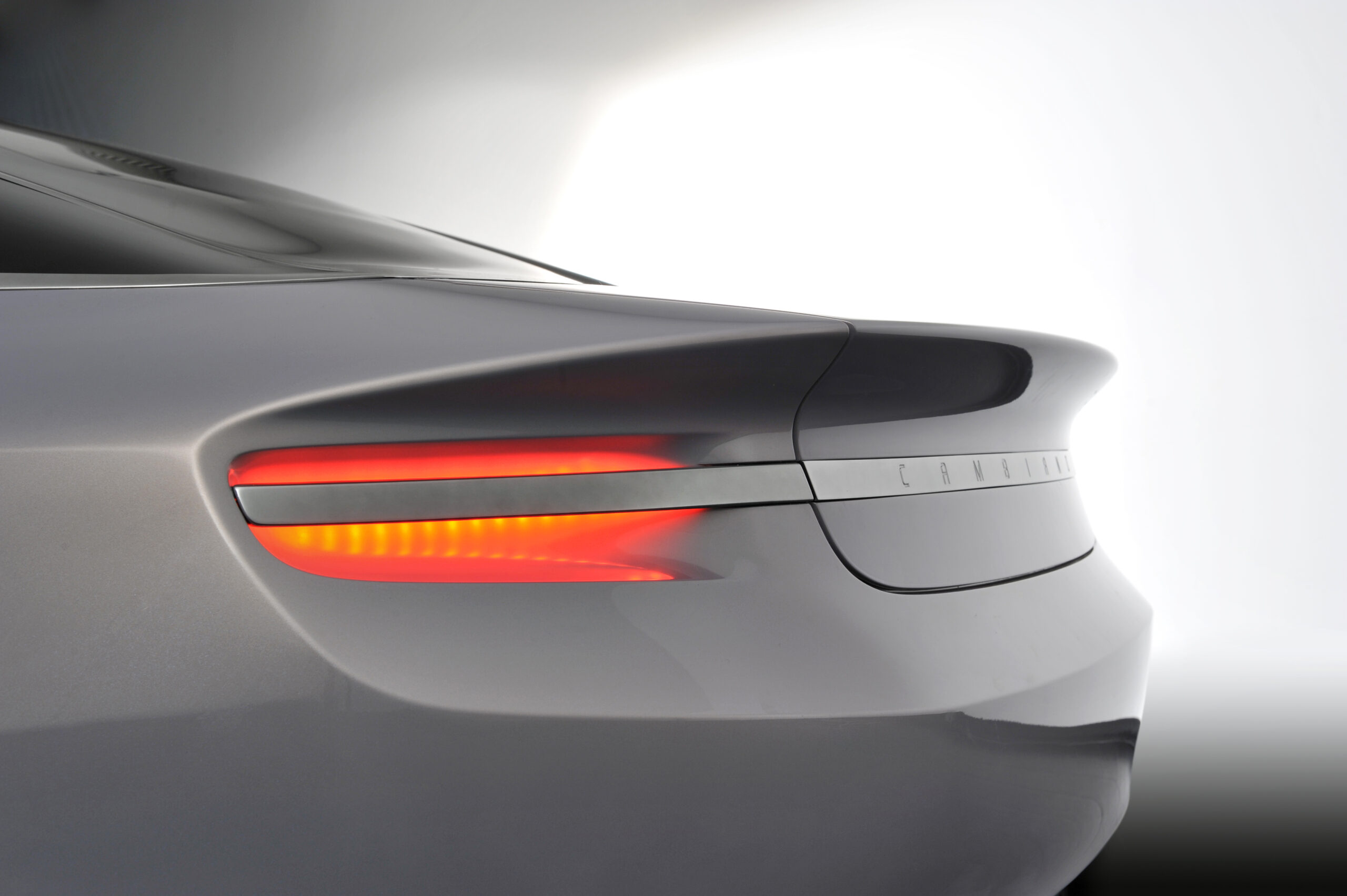
Other innovations were introduced with similar discretion. The front grille appears completely sealed, preserving aerodynamic efficiency, yet it can open automatically when the turbine range extender requires additional cooling during long journeys. Lighting elements follow the same philosophy. The rear lights and side indicators remain invisible when switched off, appearing only when activated as soft halos of reflected light across the bodywork, almost as if the illumination emerges from within the surface itself. The effect anticipates a direction that has since become more common in automotive lighting design. A similar philosophy can be observed years later on vehicles such as the 2025 Tesla Model Y, where lighting elements are carefully concealed within the body surfaces and reveal themselves only when illuminated, allowing the design to remain visually pure when the car is at rest.
Inside the car, the narrative becomes even richer. The cabin is organized into two distinct atmospheres. The driver’s side is technological and structured, with information layered according to priority and controls subtly oriented toward the driver to reinforce engagement with the vehicle. Integrated into this area is a small but symbolic detail: a chronograph designed by Pininfarina, mounted with a quick-release system so it can be detached and worn.
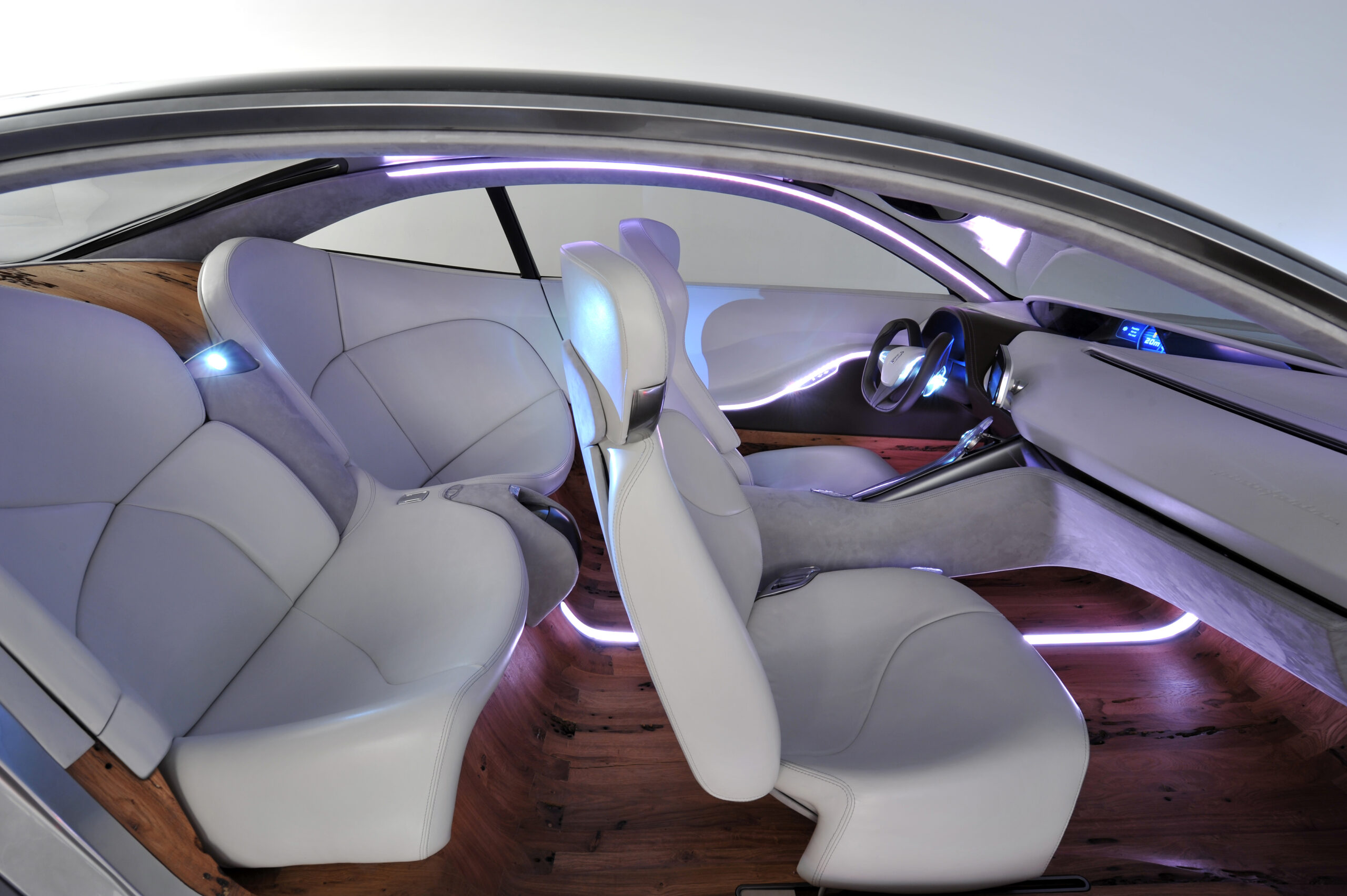
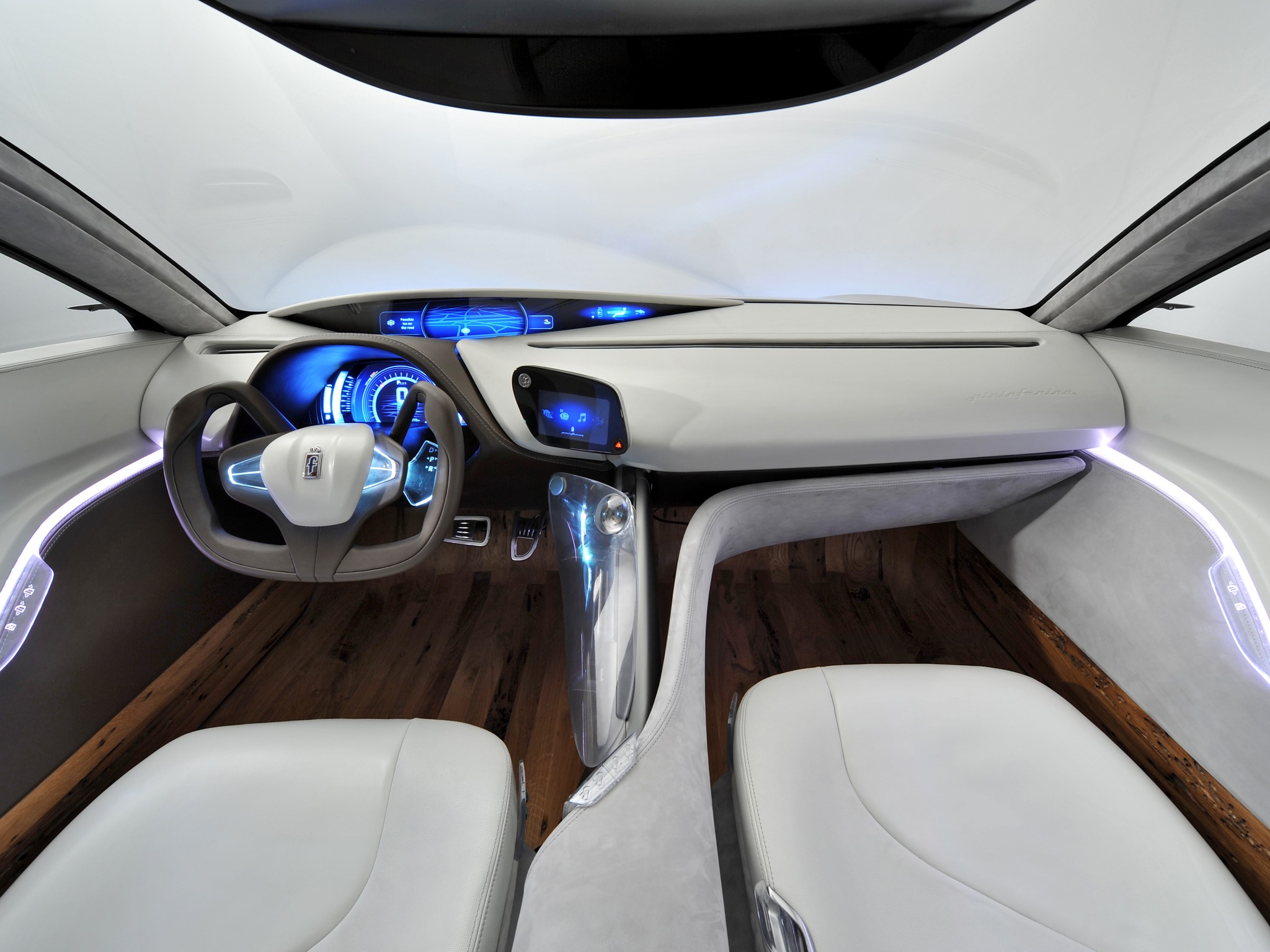
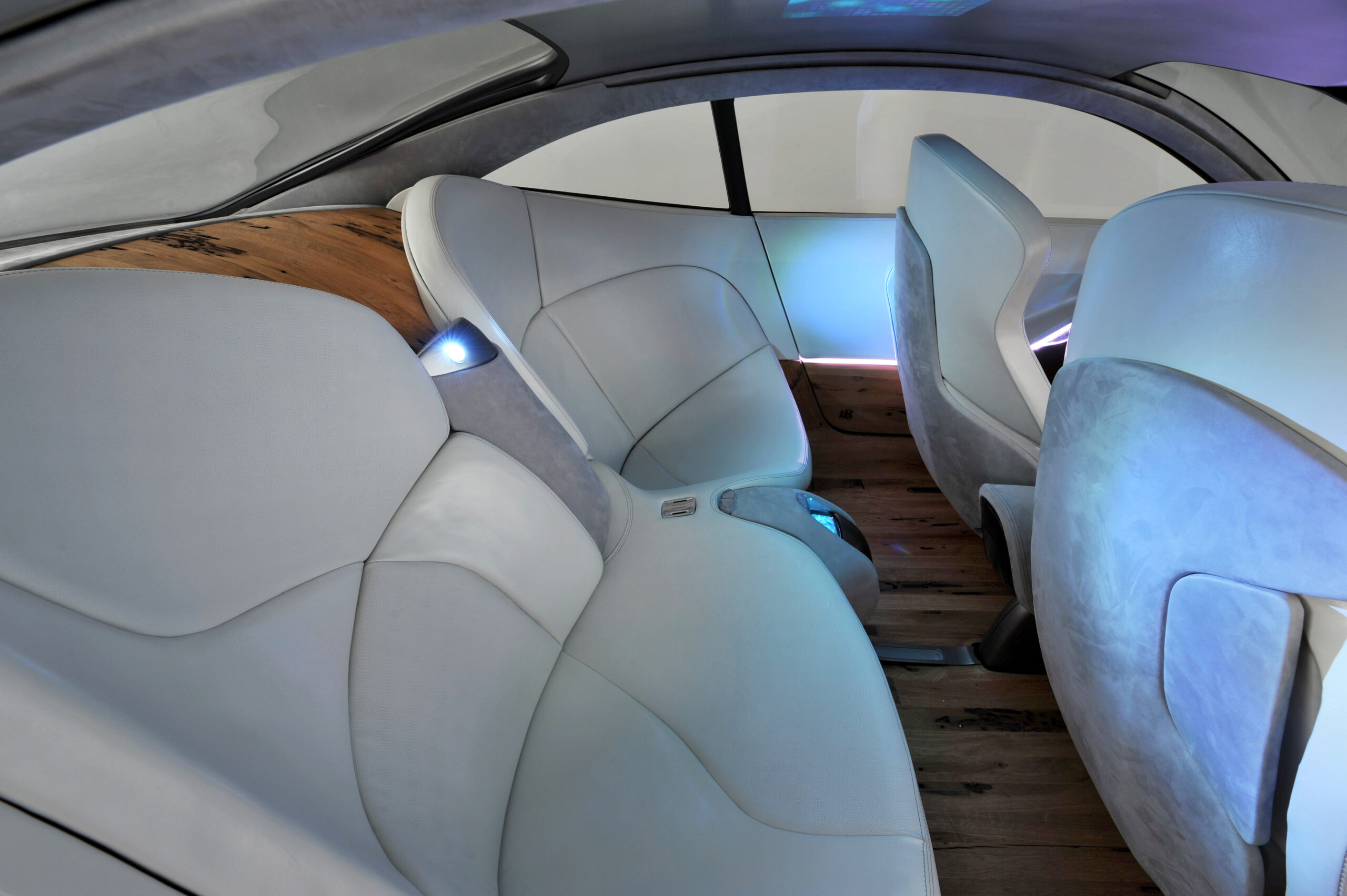
The passenger side, by contrast, becomes a lounge-like environment. Light leather and grey Alcantara create a calm and comfortable space, while sculpted seating emphasizes relaxation during long journeys. The asymmetry introduced by the door layout continues in the rear seating arrangement, subtly shaping the character of the cabin.
Perhaps the most distinctive material choice appears in the wood surfaces used throughout the interior. These panels are crafted from recycled Venetian briccole, the wooden posts that guide boats through the lagoon of Venice. Over decades they are shaped by water, salt and marine organisms, leaving organic perforations and textures that record the passage of time. Rather than concealing these marks, the design preserves them, allowing the material to retain its history.
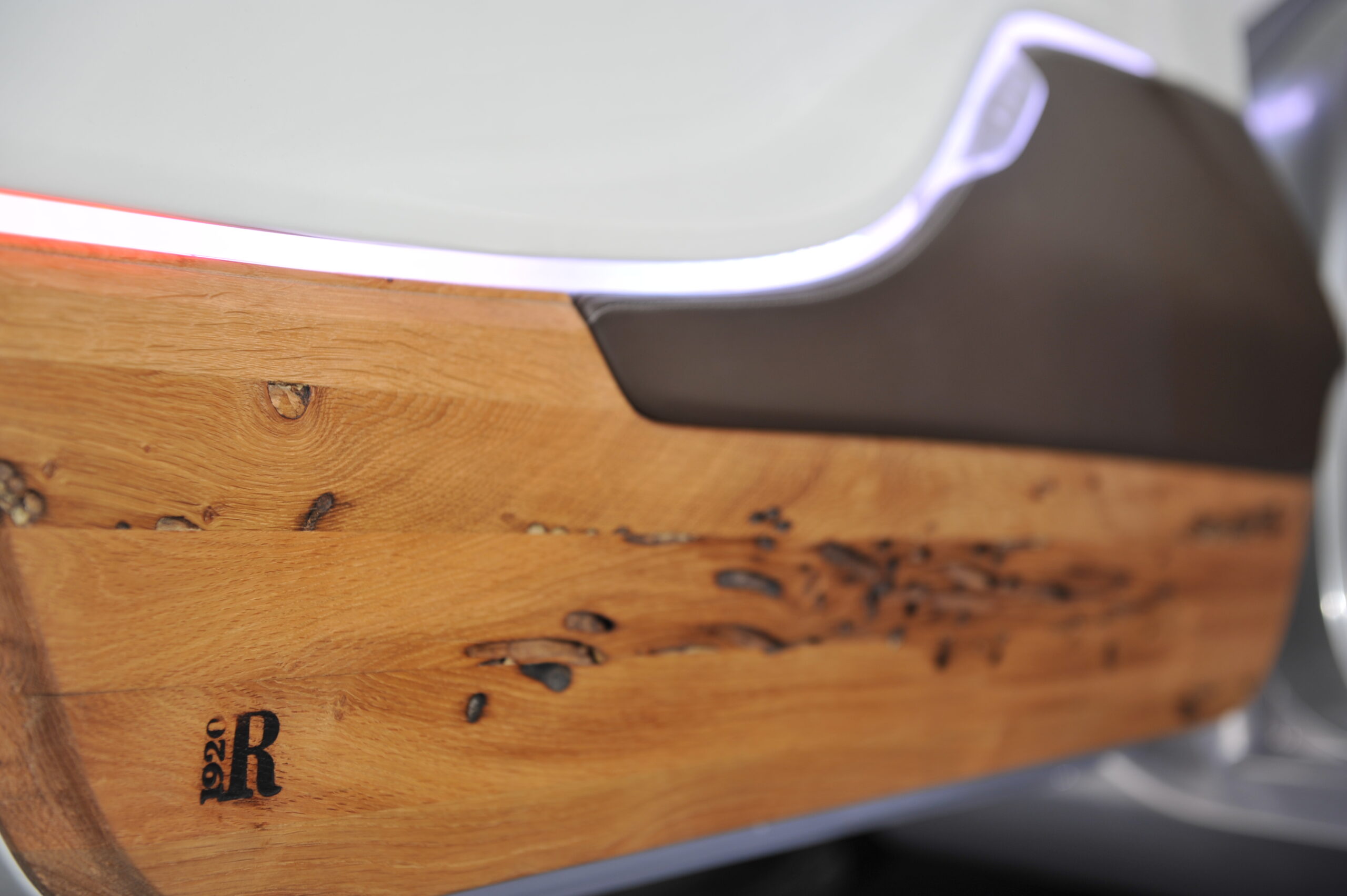
Integrating such irregular wood into a precisely engineered interior required careful planning. The team mapped areas where natural perforations could remain while ensuring that structural joints retained solid material. CNC milling provided the necessary precision, yet the process still allowed for small surprises: some holes disappeared during machining, others emerged unexpectedly. The final result is a quiet dialogue between technological precision and natural imperfection, a contrast that reflects the deeper philosophy behind the entire project.
Recognition and Resonance
When the car was unveiled at the 2012 Geneva Motor Show, the reaction came quickly—especially from people who spend their lives studying automotive design. The Cambiano didn’t try to dominate the room with spectacle or visual noise. Instead, it did something more difficult: it impressed through balance. The proportions felt resolved, the ideas coherent, the technology quietly integrated into the form rather than displayed as a separate layer.
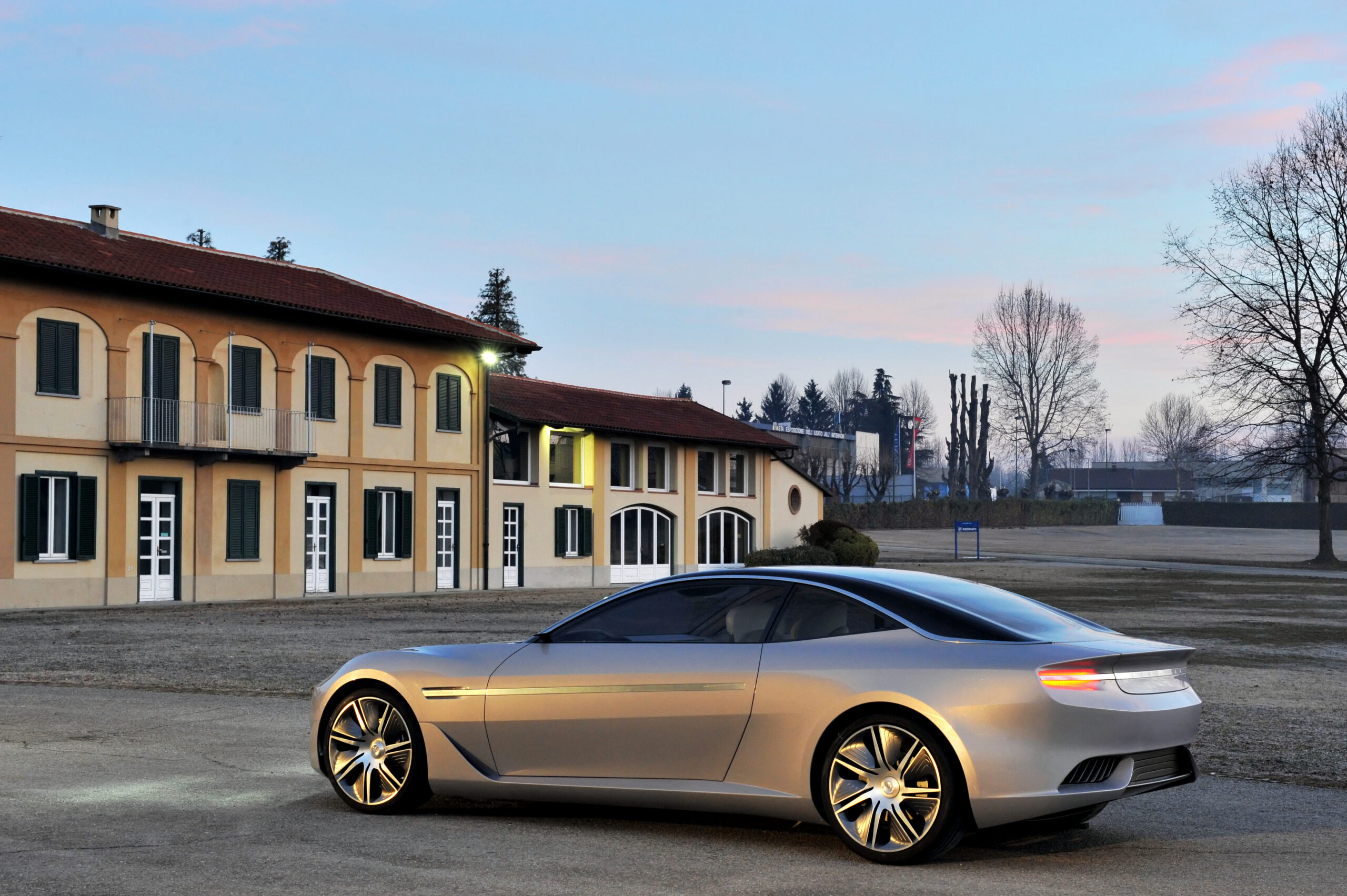
That approach did not go unnoticed. The car received the Interior Design of the Year award at the Geneva Motor Show in 2012, followed by the National Innovation Award for Design in 2013 and a mention of honor at the Compasso d’Oro in 2014. Awards are always appreciated, of course, but what mattered more was the broader perception within the industry. Observers saw a design studio reaffirming its identity not through nostalgia and not through shock value, but through clarity and maturity.
More than a decade later, the Cambiano continues to appear at international design events, and interestingly, it hasn’t aged in the awkward way many concept cars do. Its surfaces still feel composed. The ideas behind it—efficiency, material awareness, thoughtful innovation—remain surprisingly current. In an industry that sometimes equates novelty with progress, the restraint of the Cambiano feels almost refreshing today
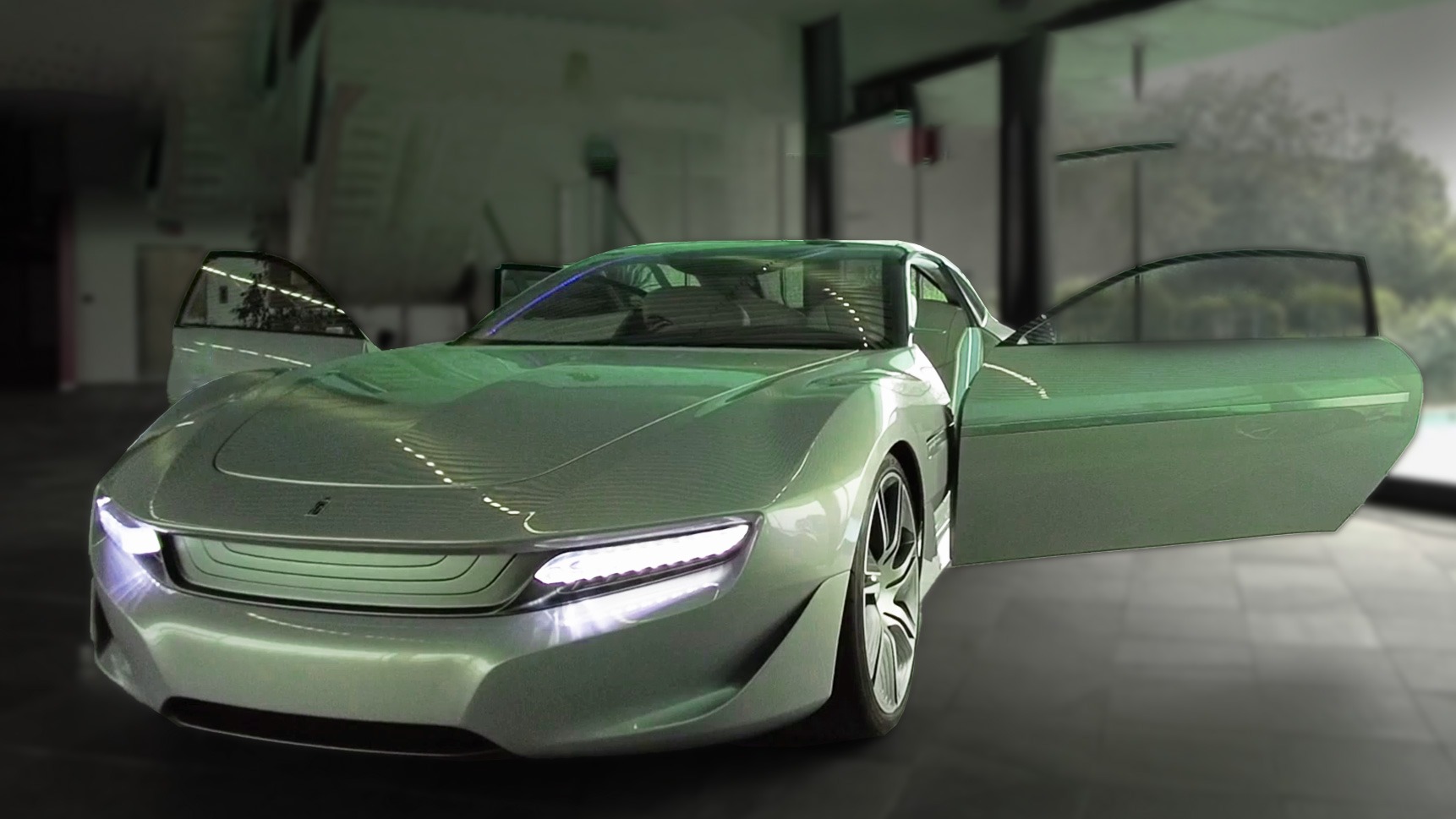
For Filippini, the project became a synthesis of what Pininfarina was capable of expressing at that particular moment—stylistically, technologically and culturally. It wasn’t simply a show car created for a single exhibition cycle. It was a statement of direction, a reminder that elegance, when treated as structure rather than decoration, can remain meaningful even during periods of uncertainty.
Many concept cars fade once the exhibition lights dim and the next season of prototypes arrives. The Cambiano followed a different path.
It simply remains calm.

ABOUT THE AUTHOR
Andreas Scheidl
Italian classic car enthusiast with German roots. Renowned as a respected figure in the classic car community, he serves as a jury member at various international concours d'elegance, including the Classic Gala Schwetzingen and Mantova. As a content creator, Andreas passionately shares his profound knowledge and appreciation for vintage automobiles. His heart beats for cars designed by Giovanni Michelotti, showcasing his discerning taste and dedication to preserving the timeless elegance of automotive history.
More stories by Andreas Scheidl ↗CONTINUE READING
Posts You Might Like

A Central Driving Position, a Rear-Mounted V8. Was This Really a Lancia?
In 1948, visitors to the Turin Motor Show could see an unusual Lancia on the stand of Carrozzeria Ghia. It was a large two-door coupé with a two-litre V8 mounted behind the…
Read story
Fioravanti F100: The Ferrari He Was Allowed to Imagine
Enzo Ferrari’s centenary, Leonardo Fioravanti’s independent studio and a supercar that explored air brakes, steel wheels and a new way of driving—without ever wearing the Cavallino.
Read story
Michelotti Shellette: When the Fiat 850 Became a Yacht
The yacht designer, the Turin stylist and the tiny coachbuilt car that crossed between the quay, the royal holiday house and the auction room. Some automobiles were conceived for the open road,…
Read story
Maserati A6 1500: A New Road for the Trident
When the doors of the Geneva Motor Show opened in March 1947, Maserati was a name that required little introduction to anyone who followed motor racing. What it did not yet possess…
Read story
THE CONVERSATION
Comments 0
Share a memory, a period photograph or a documented detail about this story.