
OSI Silver Fox: The Catamaran Built for Le Mans
Piero Taruffi, Sergio Sartorelli and the final experimental flourish of Officine Stampaggi Industriali
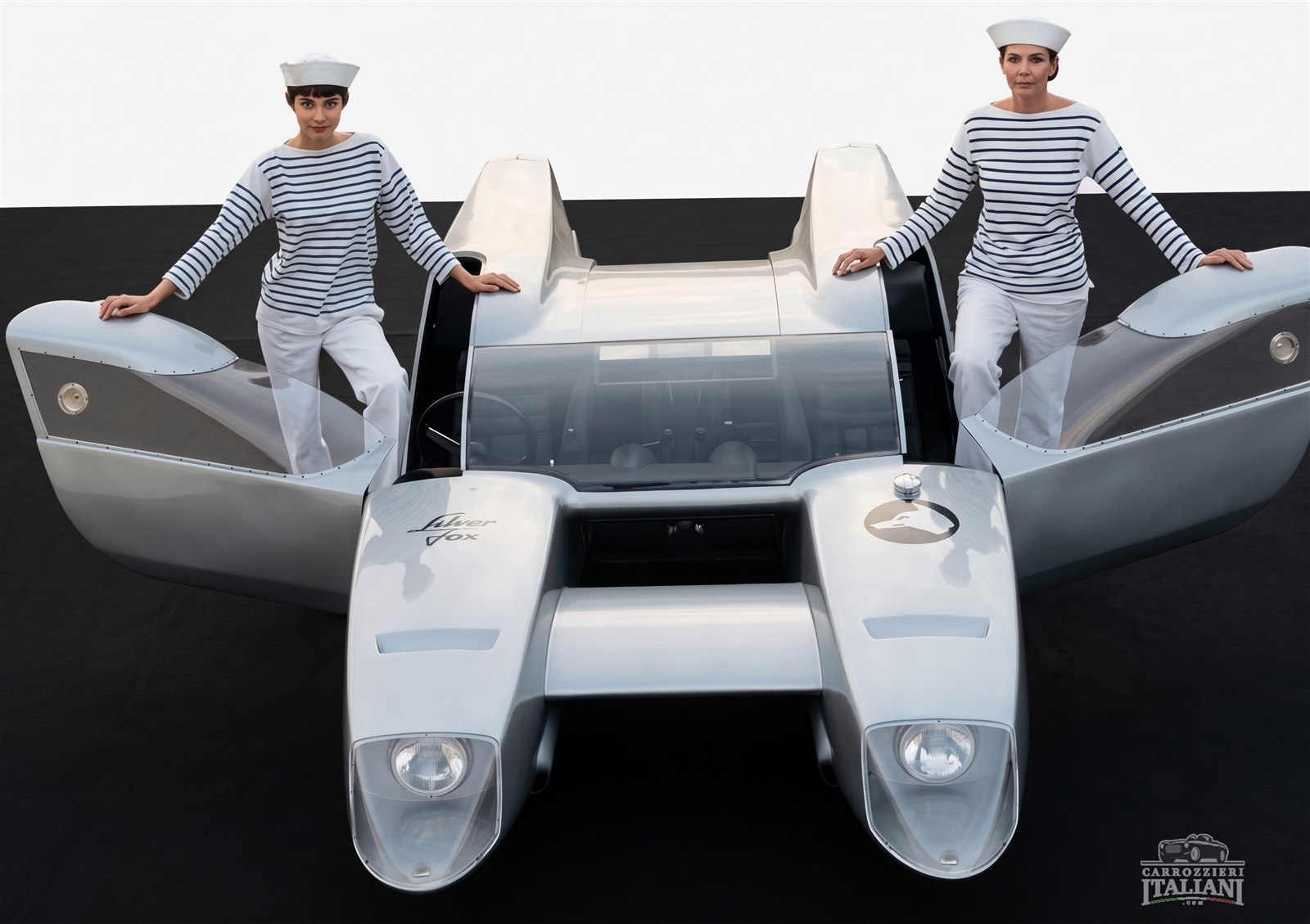
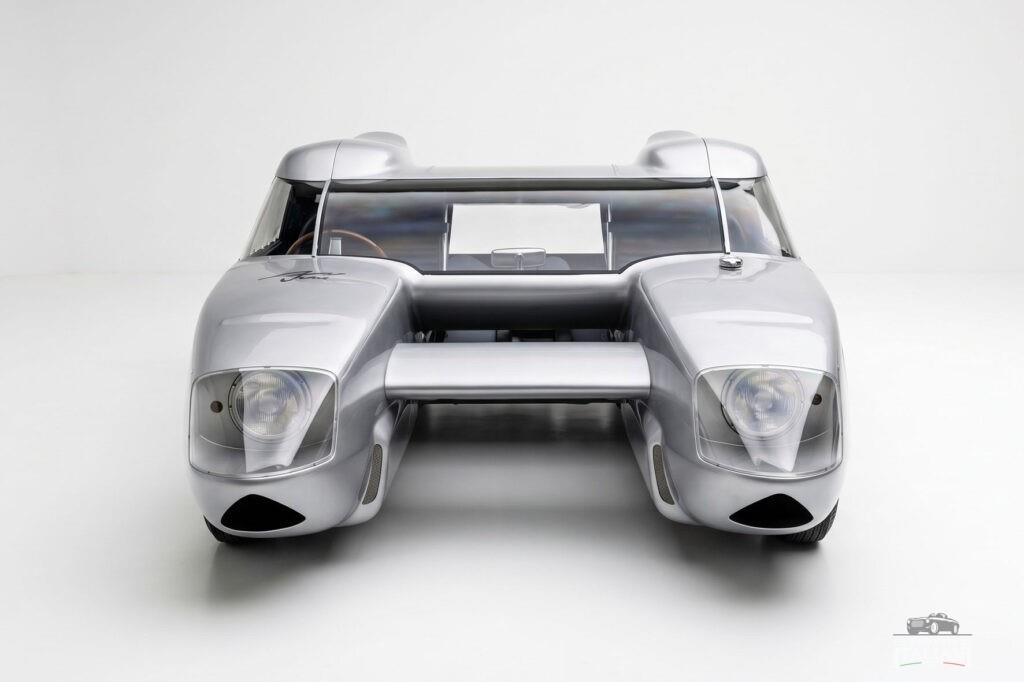
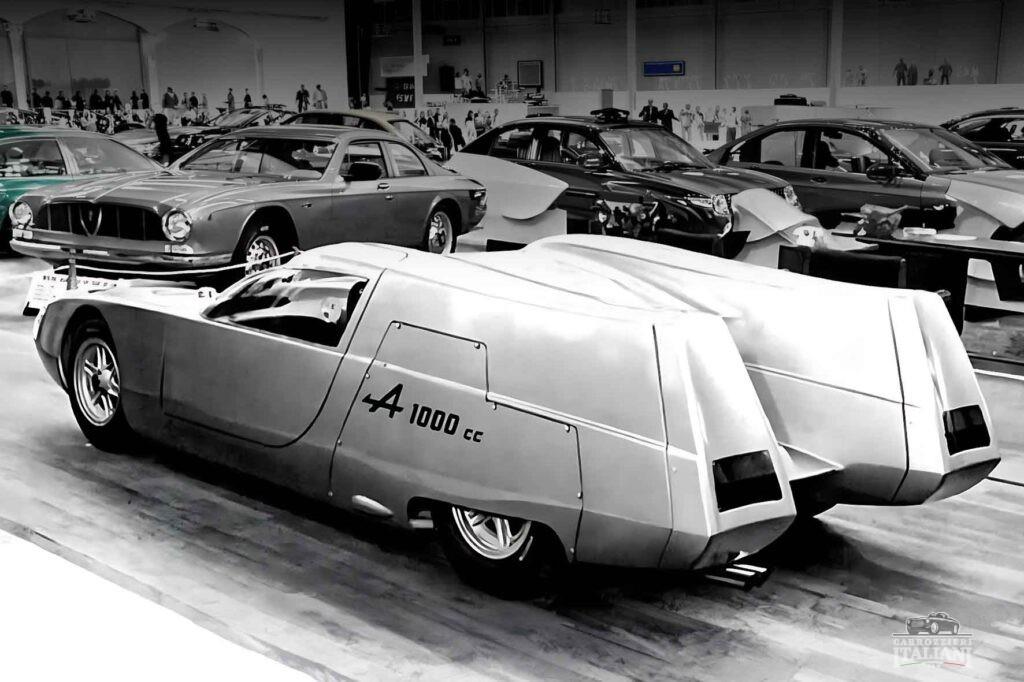
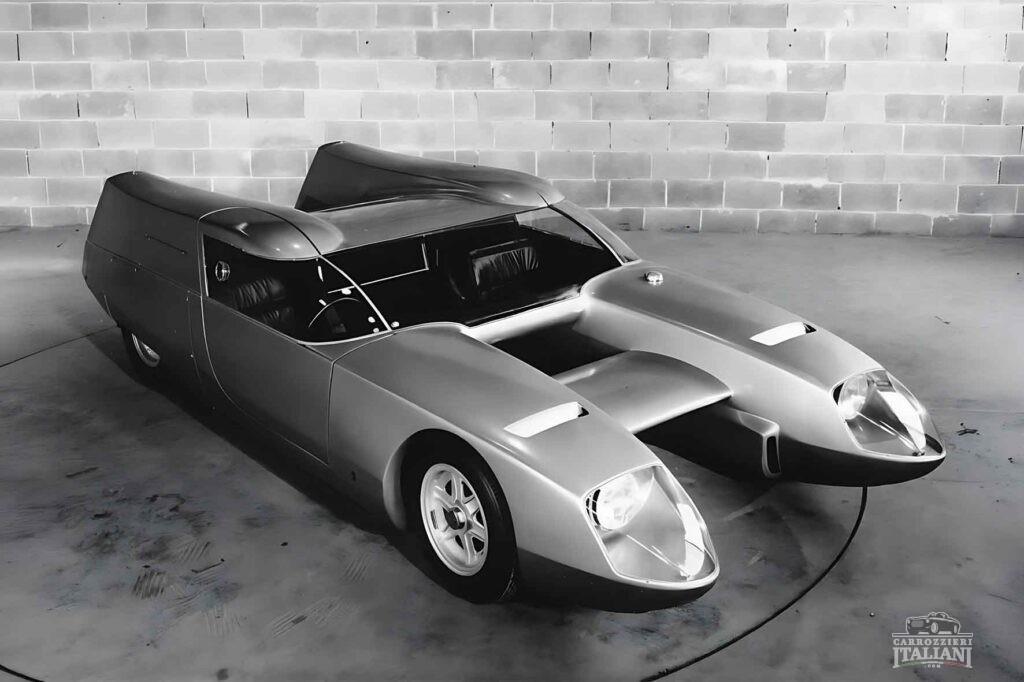
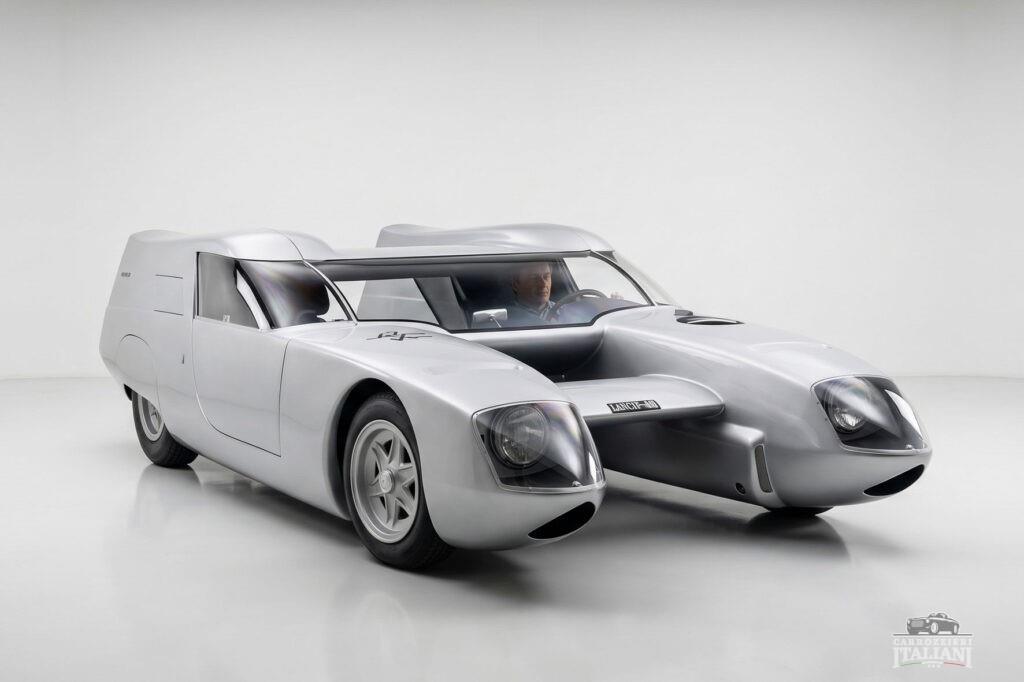
At the Turin Motor Show in the autumn of 1967, visitors found a silver machine that seemed to have arrived from somewhere outside the normal evolution of the automobile. It had no conventional central body. Instead, two long fuselages ran in parallel, joined by a cockpit and a series of transverse aerodynamic elements. The driver sat to the right; the engine occupied the left. Seen from above, it looked less like a sports car than a catamaran translated onto four wheels.
The name on it was Silver Fox. The company behind it was Officine Stampaggi Industriali — OSI — and the man who gave the idea its form was Sergio Sartorelli.
The car has often been filed away as another extravagant Italian concept of the 1960s, a showpiece produced during the great Turin age of improbable prototypes. That description misses the point. The Silver Fox was conceived with competition and record-breaking in mind. Its strange architecture was not a stylist’s provocation added after the engineering; it was the engineering.
Half a century later, the car’s return to the lawn at Villa d’Este in May 2025 made the original idea unexpectedly legible again. The jury awarded it the Trofeo Auto & Design for the most exciting design. It was an appropriate prize for a machine whose visual drama came directly from an attempt to solve the problem of stability and drag at high speed with only a one-litre engine.
To understand why OSI built it, however, it is necessary to go back to a racing driver who had spent much of his career thinking about cars with two bodies.
Taruffi and the bisiluro
Piero Taruffi was not merely one of Italy’s great drivers. He was an engineer, record breaker and persistent experimenter with unconventional vehicle architecture. Long before the Silver Fox, he had explored the bisiluro — literally “twin torpedo” — as a way of reducing frontal area while separating the masses of driver and powertrain.
The idea had a logic that was easier to appreciate on a drawing board than in a conventional sports-car paddock. Instead of placing driver, engine and transmission inside one broad body, a bisiluro could distribute them between two narrow pods. The frontal section could be reduced and the air between the two bodies managed rather than simply pushed aside.
Taruffi had already been associated with twin-boom record machines in the 1940s and 1950s. By the middle of the 1960s he was no longer a frontline racing driver — his famous final Mille Miglia victory had come in 1957 — but the intellectual fascination remained.
Early in 1966 he brought the idea to OSI. The ambition commonly associated with the proposal was not a decorative salon exercise but a lightweight competition machine, with Le Mans and international speed records among the targets. The project would become a meeting between Taruffi’s aerodynamic obsession and an unusually fertile moment inside OSI’s design and experimental departments.
The nickname Silver Fox suited Taruffi himself as much as the car. His grey hair and tactical intelligence had already made the description natural. Applied to the machine, it gave an otherwise technical experiment a memorable identity.
OSI after Ghia
OSI had been founded in Turin in 1960 by Luigi Segre, then one of the central figures at Ghia, together with Arrigo Olivetti of the wheel and component manufacturer Fergat. The company’s early purpose was closely connected to the gap between design and industrial manufacture. Ghia could create a prototype; OSI could develop tooling, stamp panels and build bodies in greater numbers.
That distinction quickly became more complicated. OSI did not remain simply a production arm. It built complete cars, undertook experimental programmes and gradually developed its own design capability.
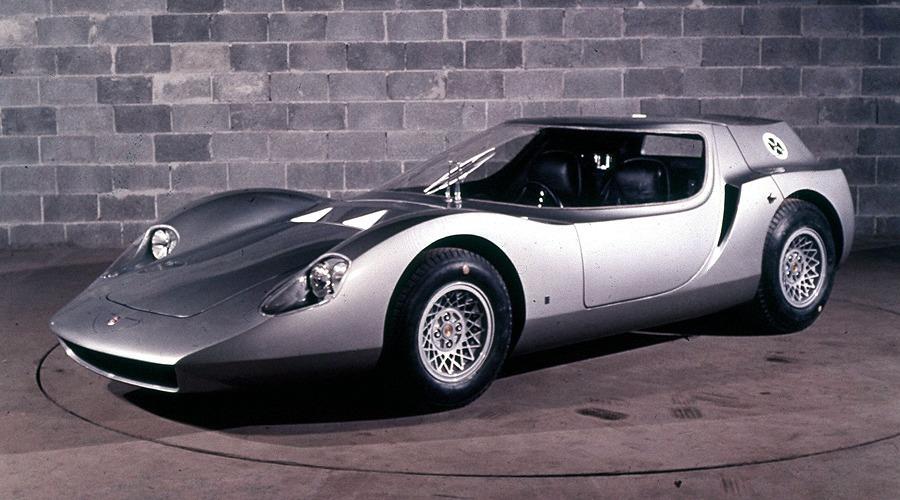
Its portfolio was unusually broad. The company manufactured bodies for the Innocenti 950 Spider, produced the Ford Anglia Torino, worked on Fiat-based specials, built the Alfa Romeo 2600 De Luxe and participated in experimental projects such as the Alfa Romeo Scarabeo. By 1966 it was also presenting the 20mTS, the elegant four-seat coupé designed by Sartorelli around German Ford mechanical components.
Sergio Sartorelli had joined OSI after an important period at Ghia. His earlier work included the Volkswagen Karmann Ghia Type 34, and at OSI he became much more than a stylist drawing an exterior skin. The company’s Centro Stile e Esperienze brought design, prototype construction and experimental engineering into unusually close contact.
That environment matters to the Silver Fox. The project did not emerge from a conventional production-car brief handed to a designer. It was the kind of machine that could only develop inside a company where styling, model-making, aerodynamics and workshop experimentation were allowed to overlap.
From sketch to wind tunnel
Sartorelli translated Taruffi’s bisiluro proposal into a series of studies during 1966. The two-pod layout immediately created questions that ordinary sports cars did not have to answer. Where should the engine sit? How should the two halves be tied together structurally? What would happen to the air passing through the large open central section? Could that airflow be used to stabilize the car rather than simply tolerated?
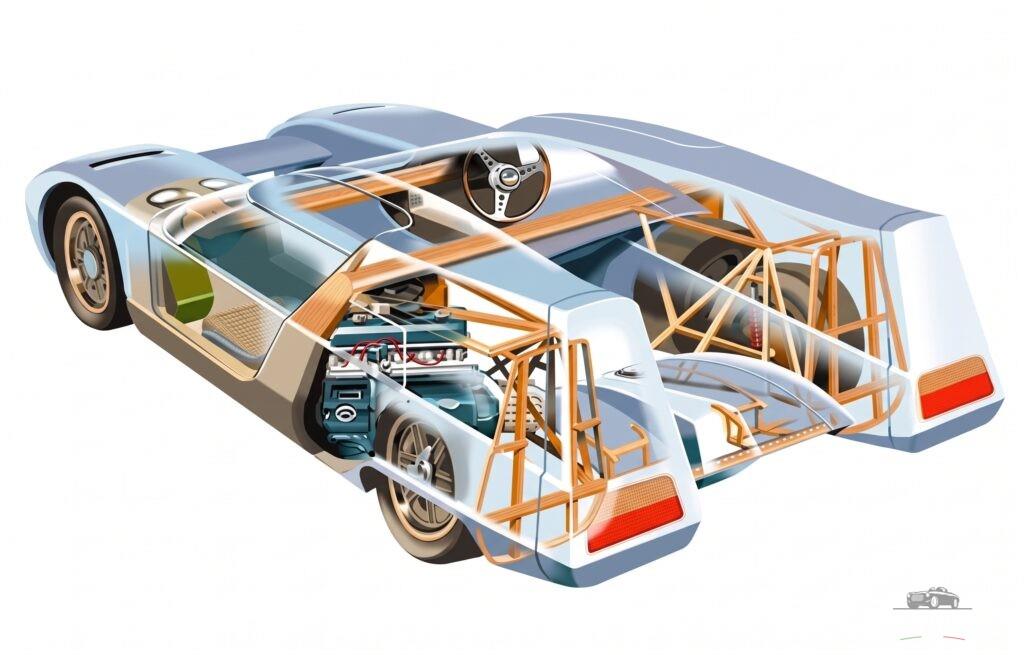
The project moved beyond paper. Accounts of the development describe scale models being tested in the wind tunnel of the Politecnico di Torino during 1966. That stage is essential to understanding the final form. The Silver Fox’s three transverse aerodynamic surfaces were not ornamental bridges between two sculpted bodies. They were part of an attempt to manage lift and balance.
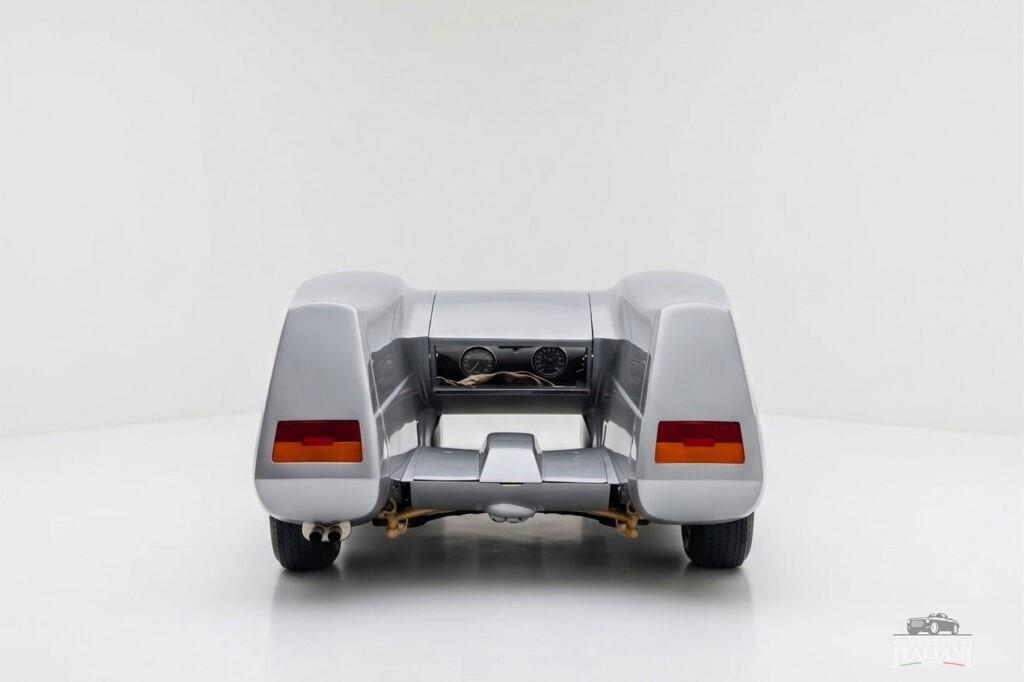
The front connecting element, around the base of the windscreen, could be adjusted while the car was stationary. A second aerodynamic surface could be altered while the vehicle was moving, allowing the balance to be changed in motion. The rearmost element was fixed and formed part of the tail treatment.
Different later descriptions sometimes simplify these elements into “spoilers” or “wings”. The distinction is less important than their purpose. OSI was trying to make the central void between the two hulls work aerodynamically.
The resulting frontal area has been reported at around 1.4 square metres — remarkably small for a two-seat automobile. The car’s shape therefore followed a simple proposition: if engine capacity was limited, speed had to be found by reducing the work required to move the air.
Two bodies, two jobs
The final Silver Fox made its asymmetry part of the concept.
The driver sat in the right-hand pod. The powertrain was placed behind the seats toward the left, rather than centrally in the manner becoming increasingly common among racing prototypes. This distribution allowed each fuselage to remain narrow.
Power came from a small Renault-derived four-cylinder engine associated with Alpine/Gordini tuning. Period-derived descriptions usually place capacity around one litre, with 956 cc frequently quoted. The modest engine is central to the car’s meaning. A large V8 or V12 would have made the performance ambition less surprising; the Silver Fox was an exercise in extracting speed from lightness and aerodynamics.
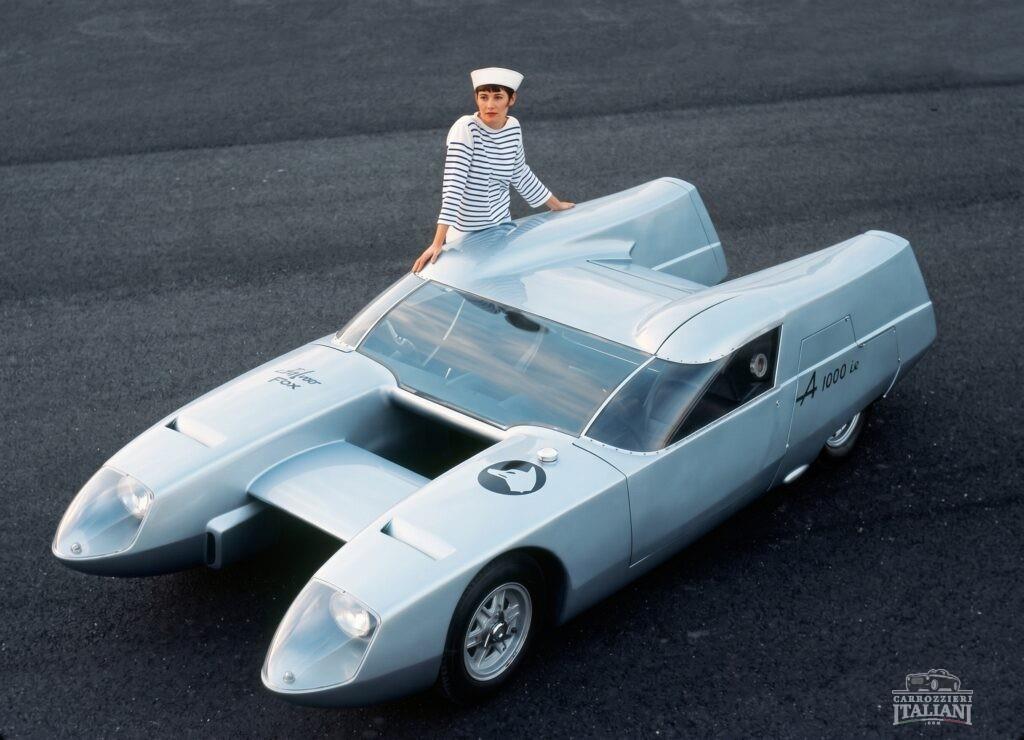
Cooling was equally unconventional. Radiators were positioned toward the front of the two pointed bodies, receiving air through openings around the nose and discharging heated air through vents behind them. The powertrain itself could be reached through the left side of the car.
The twin tails were cut away and raised in a manner intended to control the wake. Air passing through the central opening encountered the rear connecting structure, where the shape was used to generate stabilizing force over the driven end.
None of these solutions can be separated neatly into “styling” and “engineering”. Sartorelli’s authorship concerns the overall design, but the Silver Fox was produced by an experimental team responding to Taruffi’s concept and aerodynamic development. Calling it simply a body design understates the programme.
The Le Mans ambition
Le Mans gives the Silver Fox story much of its romance, but it also requires careful language.
The car was conceived with high-speed endurance competition in mind, and contemporary-derived histories repeatedly connect the programme with a possible attempt at the 24 Hours. Record running under international sporting regulations was another objective associated with the project.
What did not happen is just as important: the Silver Fox never established a competition history at Le Mans.
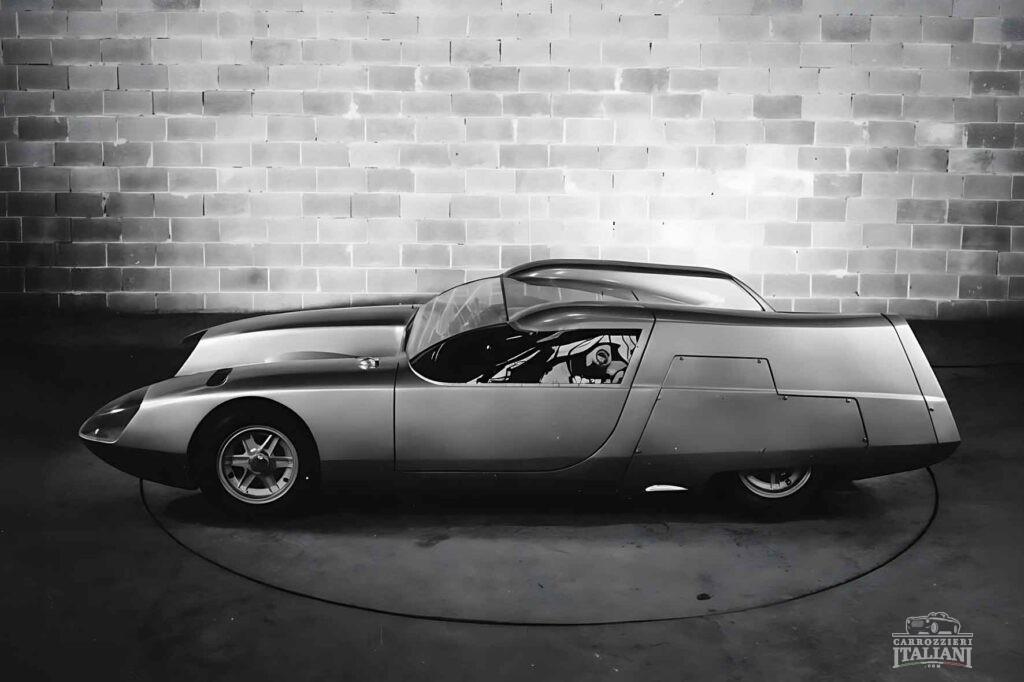
Later retellings occasionally allow the intended programme to harden into an implied racing career. There is no need to embellish it. The interesting fact is that OSI built a physical experimental prototype around the proposition.
The target often quoted for the project was a speed in the region of 225 to 250 km/h despite the one-litre engine. Such figures should be understood as programme ambitions or reported theoretical performance unless supported by a documented timed run. Claims that the car definitively achieved 250 km/h are difficult to reconcile with other accounts stating that OSI’s financial collapse prevented a complete test programme.
The distinction does not make the car less impressive. A wind-tunnel-developed one-litre prototype aimed at Le Mans is historically more interesting than a fictional racer with an invented result.
Turin, 1967
OSI unveiled the completed Silver Fox at the Turin Motor Show in 1967.
By then the company could place a startling experimental car alongside projects that demonstrated very different capabilities. The 20mTS showed that OSI could manufacture a refined coupé in series. The Scarabeo programme had exposed the company to advanced Alfa Romeo experimentation. The Silver Fox pushed the experimental side furthest.
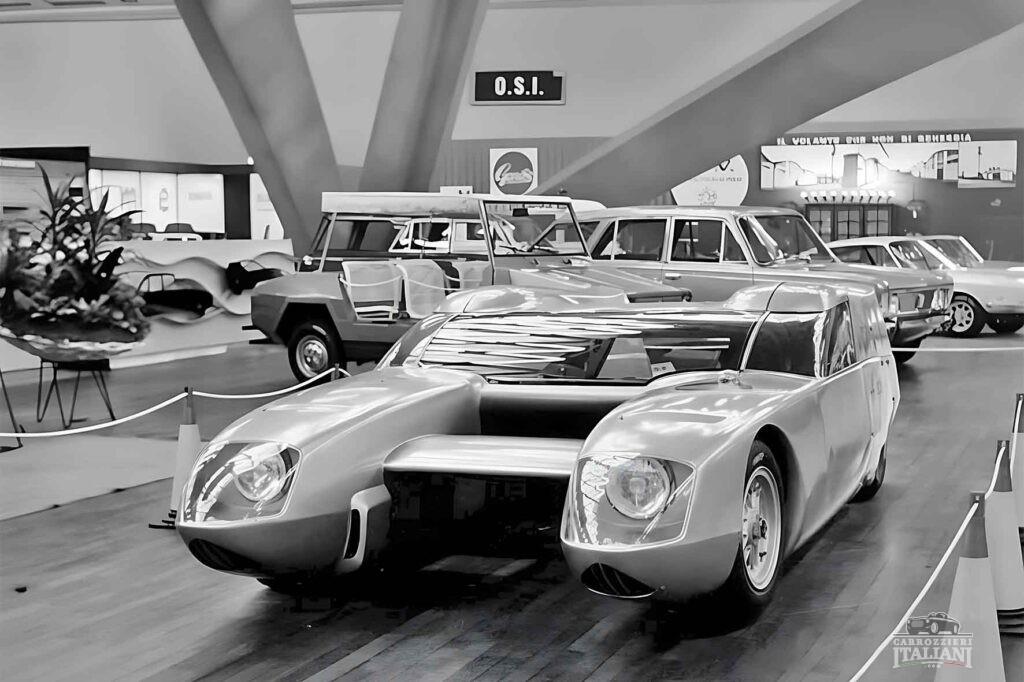
Its visual effect must have been extraordinary even in a salon accustomed to concept cars. The silver finish emphasized the uninterrupted length of the two hulls. Orange-red details and the lettering gave it the graphic character of a competition machine. The cockpit seemed suspended between two independent vehicles.
The architecture also challenged the normal way of reading a car. There was no central bonnet, cabin and tail sequence. The eye followed two parallel volumes and then the structures connecting them. The result was closer to aeronautical or marine thinking than to the classical Italian berlinetta.
Yet the Silver Fox was not an exercise in futurism for its own sake. Every bizarre feature could be traced back to a functional premise: narrow frontal area, separated masses, controlled airflow and high-speed stability.
That is why the car has aged differently from many 1960s show cars. Its forms remain strange, but they do not feel arbitrary.
A company running out of road
The Silver Fox appeared at the worst possible moment for OSI.
The company had expanded rapidly during the first half of the decade, taking on production contracts that required a substantial workforce and industrial capacity. But the economics of specialist body manufacture were fragile. When major programmes ended or volumes fell, the same factories that had enabled growth became expensive liabilities.
Luigi Segre’s death in 1963 had already removed one of the figures who had connected Ghia, OSI and international manufacturers. During the later 1960s several important production contracts weakened or disappeared. The ambitious experimental programme could demonstrate technical ability, but it could not substitute for sustained series work.
The Silver Fox therefore became almost a valedictory statement. OSI still possessed enough creative and technical confidence to build one of the most radical prototypes of the decade, while the industrial structure around it was becoming unsustainable.
The automotive manufacturing activity contracted dramatically around 1968. Many people from OSI’s design and prototype organisation subsequently moved into Fiat’s orbit, Sartorelli among them.
The Le Mans programme disappeared with the company that would have had to develop it.
What survived
The Silver Fox itself survived, which is remarkable.
Many experimental cars of the period were dismantled after their salon life, cannibalized for components or simply lost as companies closed. OSI’s bisiluro escaped that fate.
Its later history has included appearances at major historic-car events. It was shown at Rétromobile in Paris in 1997 and appeared at the Goodwood Festival of Speed in 2013. By the twenty-first century it was in the hands of French collector and racing driver Paul-Emile Bessade.
The most important recent appearance came at the Concorso d’Eleganza Villa d’Este in May 2025. Entered as the 1967 OSI Silver Fox Prototype, the car received the Trofeo Auto & Design, awarded by the jury for the most exciting design.
That award did more than add another concours line to the car’s history. Villa d’Este has increasingly become a place where prototypes and concept cars can be judged alongside conventional coachbuilt automobiles. In that context the Silver Fox was not merely a curiosity from a vanished company. It could be examined as a complete design proposition.
Nearly sixty years after Turin, the jury reached much the same conclusion as the original salon audience: there was still nothing else quite like it.
Sartorelli beyond the surface
The Silver Fox also sharpens the picture of Sergio Sartorelli.
He is frequently introduced through the cars that make him easiest to categorize: the Volkswagen Karmann Ghia Type 34, the Fiat 2300 S-related Ghia work, the OSI 20mTS and later Fiat projects. Those cars demonstrate proportion, surface discipline and the ability to create attractive production forms.
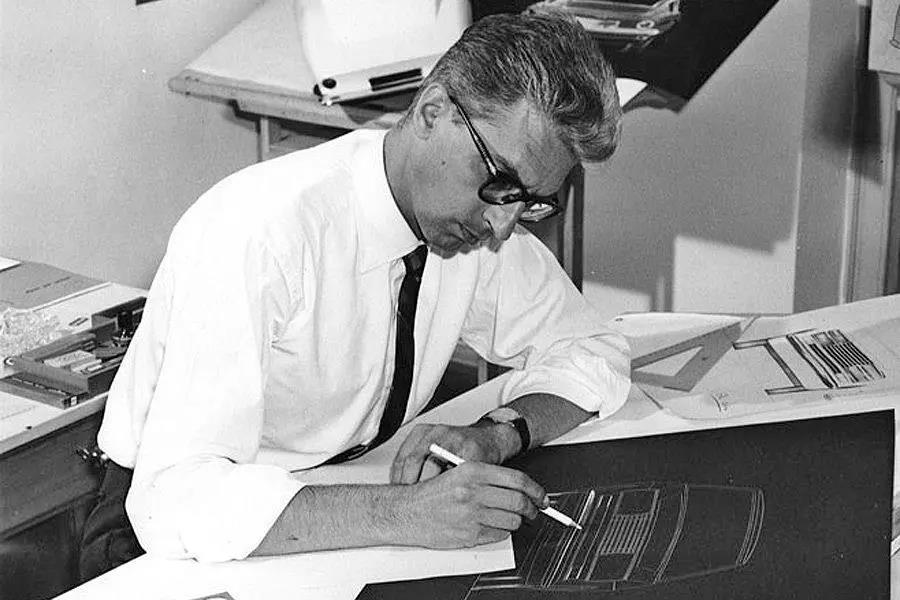
The bisiluro reveals another side.
Sartorelli was working inside a design culture in which the stylist could remain close to engineering, model construction and physical experimentation. The Silver Fox demanded that kind of engagement. The two fuselages could not be drawn first and justified later. Driver position, engine location, cooling, structural connections and aerodynamic surfaces determined the appearance from the beginning.
The project also belonged to a team. Taruffi supplied the fundamental twin-body concept and competition ambition. OSI’s experimental personnel developed the physical machine. Wind-tunnel work informed the aerodynamic treatment. Sartorelli gave the programme its coherent form.
Separating those roles does not dilute authorship; it makes the car more intelligible. Sartorelli was the designer, Taruffi the conceptual instigator, OSI the developer and constructor. The Silver Fox was not a production programme and did not reach a documented racing campaign.
The company in miniature
Look closely at the Silver Fox and much of OSI’s short history is compressed into one object.
The company’s origins lay in industrial stamping and contract body manufacture. Its growth depended on being able to turn other designers’ ideas into repeatable metal structures. Yet by the middle of the decade OSI had built a design and experimental organisation capable of originating projects of its own.
The Silver Fox sits at the far end of that transformation. Nothing about it suggests a subcontractor waiting for drawings from elsewhere.
At the same time, its fate exposes the limits of that independence. A prototype could win attention; a series contract paid the factory. OSI’s most adventurous period coincided with growing financial pressure, and the machine intended to prove what the company could do arrived as the company was losing the industrial foundation required to continue doing it.
That tension was common among the Italian carrozzieri, but OSI experienced it with unusual speed. Founded in 1960, it moved from production partner to experimental design house and into crisis within less than a decade.
The Silver Fox is therefore more than OSI’s strangest car. It is the clearest physical expression of the company’s ambition.
The speed of an idea
There is a temptation to judge every experimental racing car by the races it won. By that measure the Silver Fox has no record.
A better measure is the question it asked.
Could a sports prototype with a tiny engine find its speed not through more power, but by reorganizing the automobile around the air? Could driver and engine be separated into two narrow fuselages? Could the empty space between them become an active aerodynamic channel? Could adjustable surfaces control balance at speed?
Those questions were serious enough for OSI to sketch, model, test and build the answer.
The car never reached the development stage at which those ideas could be proven over twenty-four hours at Le Mans. Its performance figures remain entangled with theoretical targets and later repetition. That uncertainty should remain part of the story rather than being replaced with false precision.
What survives is the prototype itself and the clarity of its premise.
In 1967 it looked like a machine from the future. At Villa d’Este in 2025 it looked almost more radical, because six decades of sports-car development had still produced very few cars willing to abandon the central body so completely.
The Silver Fox did not predict what the automobile would become. It demonstrated how far the automobile could be reimagined when a racing driver, a designer and an experimental coachbuilder began with the airflow instead of the styling convention.

ABOUT THE AUTHOR
Andreas Scheidl
Italian classic car enthusiast with German roots. Renowned as a respected figure in the classic car community, he serves as a jury member at various international concours d'elegance, including the Classic Gala Schwetzingen and Mantova. As a content creator, Andreas passionately shares his profound knowledge and appreciation for vintage automobiles. His heart beats for cars designed by Giovanni Michelotti, showcasing his discerning taste and dedication to preserving the timeless elegance of automotive history.
More stories by Andreas Scheidl ↗CONTINUE READING
Posts You Might Like

A Central Driving Position, a Rear-Mounted V8. Was This Really a Lancia?
In 1948, visitors to the Turin Motor Show could see an unusual Lancia on the stand of Carrozzeria Ghia. It was a large two-door coupé with a two-litre V8 mounted behind the…
Read story
Fioravanti F100: The Ferrari He Was Allowed to Imagine
Enzo Ferrari’s centenary, Leonardo Fioravanti’s independent studio and a supercar that explored air brakes, steel wheels and a new way of driving—without ever wearing the Cavallino.
Read story
Michelotti Shellette: When the Fiat 850 Became a Yacht
The yacht designer, the Turin stylist and the tiny coachbuilt car that crossed between the quay, the royal holiday house and the auction room. Some automobiles were conceived for the open road,…
Read story
Maserati A6 1500: A New Road for the Trident
When the doors of the Geneva Motor Show opened in March 1947, Maserati was a name that required little introduction to anyone who followed motor racing. What it did not yet possess…
Read story
THE CONVERSATION
Comments 0
Share a memory, a period photograph or a documented detail about this story.