
Mercedes F200 Imagination: The Concept Car That Predicted the Future (Sort of)
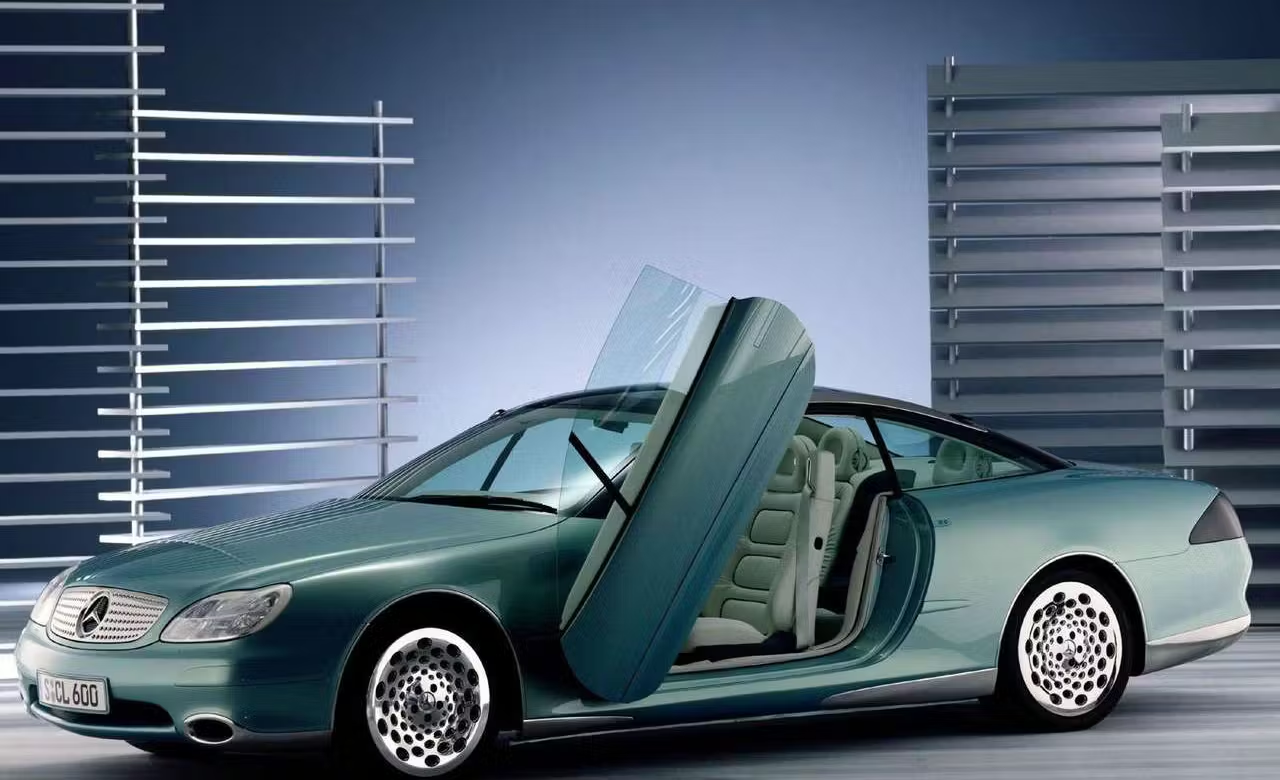
In late 1995, Mercedes-Benz embarked on an ambitious project to showcase the future of automotive design and technology. The task was to create a fully functional concept car – not just a static showpiece – that would debut at the 1996 Paris Motor Show. Codenamed the Mercedes-Benz F200 “Imagination”, this concept would encapsulate the most advanced ideas Mercedes had for the 21st century. Unusually, the car would not be built in Germany, but by the Italian coachbuilder Stola in collaboration with Mercedes’s own design and research teams. What resulted was a behind-the-scenes story of international teamwork, technical innovation, and creative daring – a story that produced one of the most remarkable concept cars of the 1990s.
A Bold Vision Takes Shape
The F200 Imagination (sometimes referred to as Vision F200 Immagination in internal documents) was conceived under Mercedes’s experimental “Vision” program, which aimed to push the envelope of futuristic design and technology. The Mercedes board gave the green light in 1995, buoyed by recent successful prototype collaborations with Stola – notably the production of several C-Class SportCoupé (W203) models that proved Stola’s capabilities. The brief for the F200 was clear: it should represent “the culmination of all the technological innovation” Mercedes could envision at that time. In other words, this single vehicle would be a testbed for advanced features that might find their way into the Mercedes cars of the future.
From the outset, Mercedes treated the F200 as far more than a styling exercise. The concept would be fully driveable, equipped with a real powertrain and working electronics. In fact, under its sleek coupé bodywork the F200 packed a hefty 6.0-liter V12 engine (the same type used in Mercedes’s flagship models) mated to a 5-speed automatic transmission. This ensured that the show car was not just a hollow shell—it could move under its own power and demonstrate its innovations in a realistic way. The exterior design was advanced in style but also rooted in Mercedes’s design language: the shape previewed the upcoming S-Class (W220) and especially the CL-Class coupé that would appear a few years later. In essence, Mercedes wanted the F200 to look like something from tomorrow’s showroom, not a wild alien spacecraft, while still overflowing with cutting-edge ideas.
An Unconventional Partnership
To bring the F200 Imagination to life, Mercedes-Benz partnered with Stola, the respected Italian coachbuilder known for its precision and discretion in handling advanced prototypes. Founded in 1919, Stola had quietly built a reputation among Europe’s top manufacturers for its ability to translate bold design into fully realized concept cars. Choosing Stola for such an ambitious project reflected the confidence Mercedes-Benz placed in its capabilities. Building the car in Turin meant more than outsourcing a task—it created a rare collaboration where German innovation met Italian craftsmanship. Designers and engineers from Stuttgart worked closely with Stola’s team, combining technical complexity with the kind of hand-finished detail only an experienced coachbuilder could provide. The result was more than just a concept—it was a functioning showcase of forward-thinking design, executed under intense time pressure.
Harald Leschke, Mercedes’s Director of Advanced Design, led the styling and conceptual development of the F200. Leschke’s advanced design studio in Sindelfingen had been working on ideas for the car, and designer Christopher Rhoades produced the sketch that was ultimately chosen as the F200’s definitive look. On the engineering side, Mercedes assigned Gunter Hölzel and Jürgen Weissinger from its Research and Development department to develop the novel mechanical, electrical, and electronic systems the car would require. These Mercedes experts became deeply involved in the project, frequently traveling to Stola’s facilities in Rivoli (near Turin, Italy) to oversee the integration of their high-tech systems into the hand-built vehicle.
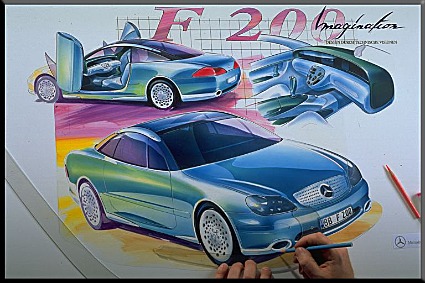
Meanwhile in Italy, Stola’s own team of designers, engineers, and craftspeople took on the challenge of building the physical car. Key figures on the Stola side included project managers and master coachbuilders like Felice Chiara, Rocco Tartaglia, Beppe Comollo, and others who had honed their skills on previous prototype builds. Even Stola’s founder, Alfredo Stola, remained closely involved as the build progressed, underscoring the project’s importance to the company. Communication between Stuttgart and Rivoli was constant; Mercedes sent over design data and engineering specifications, and the Italian team provided feedback from the workshop floor. In December 1995, a pivotal meeting took place at Stola’s studio in Rivoli, where Mercedes’s top design brass – including legendary stylist Bruno Sacco, along with Peter Pfeiffer and Olivier Boulay – gathered to review the F200’s full-size model and iron out final design details. This meeting of minds ensured that everyone, from corporate design chiefs to the craftsmen who would hammer the metal, shared a unified vision of the car.
Crafting the Futuristic Show Car
Building the F200 Imagination was an exacting, labor-intensive process. Unlike mass-produced cars, concept vehicles of this era were essentially hand-made. At Stola’s workshops, artisans began constructing the body of the F200 using traditional panel-beating techniques. The entire body shell was fashioned out of aluminum – each panel painstakingly formed by hand on wooden bucks and English wheels to match the curves of the design. “The whole body is made of hand-beaten aluminum sheet,” notes Stola’s own chronicle of the project, highlighting that the metal panels were custom-shaped for this one-off vehicle. Stola built the initial forms and tooling in-house, but they also partnered with another Italian firm, Coggiola, which supplied high-quality aluminum sheets and assisted in forming some of the complex panels. The choice of aluminum kept the car light and workable, but it required enormous skill to shape – a challenge the Italian craftsmen were ready to meet.
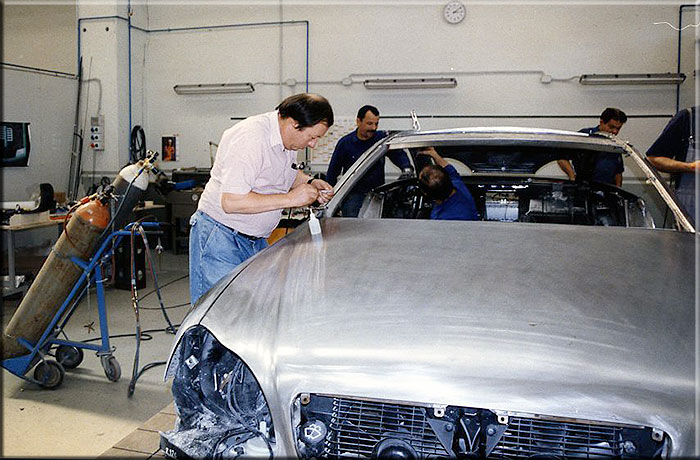
During the spring and summer of 1996, Stola’s workshop buzzed with activity. Photographs from the period show a small army of technicians gathered around the bare aluminum shell in various stages of completion. In one image from June 1996, Felice Chiara stands at the front, overseeing the fitment of interior components alongside colleagues like Tesauro and Comollo inside the unfinished cabin. At another moment, craftsmen like Mulargia focus on details such as sculpting the front bumper by hand. Every day brought new challenges: aligning the dramatic gull-wing doors to open smoothly under power, routing the wiring for the unprecedented array of electronic gadgets, and making sure the futuristic one-piece windshield-roof canopy fit perfectly. All of this had to be achieved on a tight deadline – the Paris show in early October was immovable – which meant long hours and intense problem-solving on the fly.
🔗 Read more: The Porsche Moncenisio: Craftsmanship, Heritage, and Unforgettable Adventures
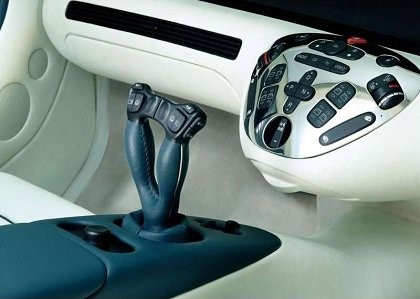
Mercedes’s engineering team was deeply embedded in this build process. Specialists from Stuttgart – including R&D expert Jürgen Weissinger – worked side by side with Stola’s crew in Italy to install and test the concept’s advanced systems. They were effectively inventing new technology on the shop floor. For example, the F200’s radical “Sidestick” controls (essentially joysticks that replaced the steering wheel and pedals) required a drive-by-wire system that had never been implemented in a passenger car before. Getting these electronic controls to safely actuate the steering, throttle, and brakes of a powerful V12-powered car was a significant undertaking. Similarly, the active suspension system and other electronics had to be custom-fitted and debugged. By July 1996, the team had wired and programmed so many new components that the F200 was described as “for that time, the most electronic prototype ever built”. This level of complexity was unheard of in the mid-1990s – the car was literally bristling with sensors, control units, and experimental devices, all of which had to function in harmony.
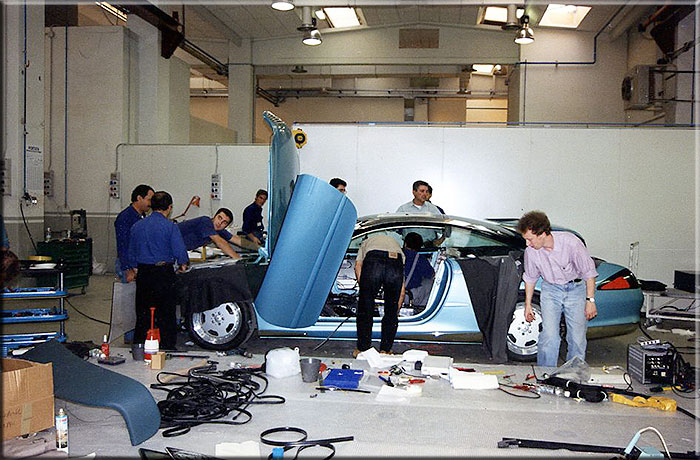
The atmosphere in the workshop was a mix of excitement and pressure. Stola’s team took pride in meeting Mercedes’s exacting standards, but it wasn’t easy. As the summer wore on, there were moments of fatigue and doubt. Some of the photos from August 1996 candidly show team members, including both Stola staff and Mercedes engineers like Leschke, looking exhausted – a testament to the long nights spent troubleshooting and perfecting the car. Yet, despite the occasional despair, the project never derailed. The camaraderie between the German and Italian team members grew stronger under pressure. They were united by the sense that they weren’t just building a car; they were making automotive history by prototyping features that had never been seen before.
Features from Science Fiction
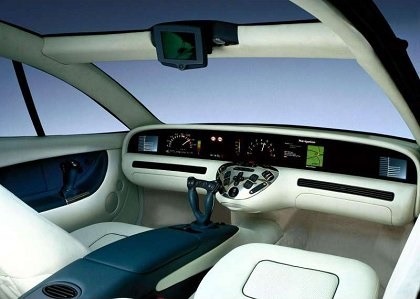
The Mercedes F200 Imagination truly lived up to its name by incorporating features that seemed like science fiction in 1996. Many of these innovations were integrated directly into the prototype and made fully functional for demonstration. Foremost among them was the replacement of the traditional steering wheel and pedals with joysticks – one on the center console and one on the door, allowing either front occupant to steer and control speed. Termed “sidesticks” by Mercedes, these drive-by-wire controls were inspired in part by the aviation industry. The design team actually drew inspiration from the Airbus aircraft cockpit, which uses side-stick controllers instead of a conventional control yoke. (Not coincidentally, Mercedes’s parent company at the time was a partner in Airbus, giving the car a direct aerospace connection.) The arrival of Sony’s PlayStation in 1995 also influenced the concept – Mercedes imagined that the “drivers of tomorrow” who grew up with video games would feel at home piloting a car with a device resembling a game controller].
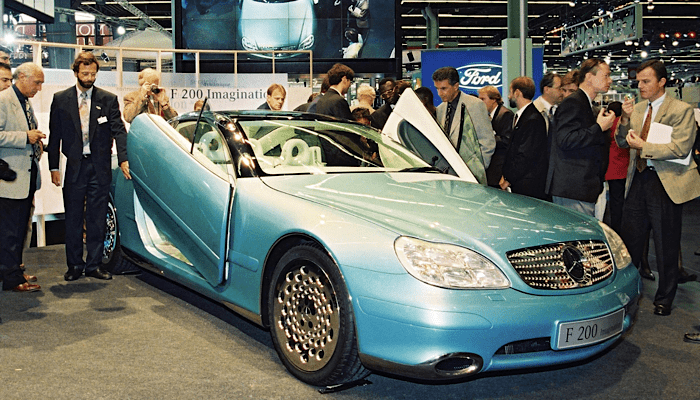
Beyond the joystick controls, the F200 was packed with other groundbreaking features. The doors were a spectacle in themselves: two large gull-wing (butterfly) doors that swung up automatically at the touch of a sensor, giving access to both front and rear seats in this four-seat coupé. For convenience, the trunk (boot) was also fully power-operated – it would open and close on its own, activated by a mere touch or via remote command. The glass canopy roof was made of electrochromic glass, meaning it could change its tint electronically. At the push of a button, the panoramic roof could go from clear to dark, controlling the sunlight and heat entering the cabin – a feature that wouldn’t reach production cars until years later (it eventually appeared on the Maybach 62 in 2002)].
🔗 Read more: Italian Super Cars in Video Game History
In place of conventional side mirrors, the F200 mounted tiny video cameras on small stalks, feeding live images to displays inside the cabin. This presaged the future of mirrorless cars, a concept that only started becoming legal and common in the 2010s and 2020s. Safety was another domain of innovation: the F200 introduced the idea of a window airbag, an airbag that deploys upward from the door to cover the side windows, providing head protection in side collisions]. Mercedes would later commercialize this as the Windowbag, first available on the 1998 S-Class (W220) a couple of years after the concept].
The advanced features continued under the skin. The F200 was equipped with a fully active suspension system that could adjust on the fly to maintain stability and comfort – known as Active Body Control (ABC). This system was so ahead of its time that it only reached production in 1999 on the Mercedes CL-Class, but in the F200 the team had a working prototype showcasing its potential. The concept also experimented with an intelligent headlight system that could adjust beam patterns for better illumination around curves; a similar idea (called Active Curve Illumination) would later debut on Mercedes models in the early 2000s. Additionally, the car featured voice-activated controls – one demonstration allowed the driver to control a built-in cellphone via voice commands, using a technology Mercedes dubbed LINGUATRONIC when it launched in production S-Class models. Inside the cabin, the traditional gauge cluster was replaced by a digital display screen, and a host of other electronic conveniences (from advanced navigation to multimedia systems) were integrated, predicting the kind of high-tech user experience that modern luxury cars deliver.
All of these innovations were not just theoretical ideas; they were implemented on the F200 Imagination to the point where they could be shown off to the public. It’s no wonder that the team regarded the F200 as an “innovation carrier” for the company – a rolling laboratory that carried within it the seeds of future Mercs. By the time the car was nearing completion, it was loaded with so many novel systems that even seasoned engineers marveled at it. The F200 was a daring answer to the question, “What will the car of the 21st century be like?” – and many of its answers turned out to be on target.
The Final Push and Paris Unveiling
By early autumn 1996, the hard work in Rivoli was drawing to a close. On October 1, 1996, just days before the car was due in France, the F200 Imagination sat completed in Stola’s workshop for a final inspection. The gleaming prototype – painted a pearlescent silver-white – was now fully assembled and operational. Stola’s and Mercedes’s team members gathered around to congratulate each other and also to make sure nothing was overlooked for the show. There was palpable relief and pride; they had managed to build one of the most complex concept cars ever attempted, on schedule. In group photos taken at that moment, one can spot the mix of Italian and German faces – engineers like Weissinger and designers like Leschke alongside Stola’s craftsmen and managers – all smiling in celebration and perhaps a bit of disbelief that they pulled it off.
A few days later, on October 4, the F200 was carefully loaded onto a covered transport truck to be taken to a photo studio in Turin for official press photographs. The next morning, it would depart for Paris. The photo shoot in Turin produced the striking images that would soon grace magazines and newspapers – shots of the F200’s futuristic interior, its joystick controls, the dramatic doors open wide, and the car posed against backdrops to highlight its sleek form. These images would be the world’s first glimpse of the car before the actual unveiling. Notably, Mercedes and Stola took one last opportunity to document every detail, from the sophisticated flush-fitted trunk lid to the intricately milled aluminum front grille, knowing that these features would be talked about for years to come.
When the Mercedes-Benz F200 Imagination finally debuted at the 1996 Paris Motor Show, it caused a sensation. The Paris show, one of the biggest stages for new automotive ideas, was the perfect venue for such a bold concept. Visitors and press flocked to see this exotic-looking coupé that promised a hi-tech driving experience unlike anything else. Reporters were amazed to watch Mercedes representatives demonstrate the joystick steering, and crowds gathered to see the big butterfly doors glide open automatically. The F200’s sleek shape also drew admiration – while undeniably a Mercedes in its elegance and proportions, it had surprising touches (like narrow tail-lights and a pillared wraparound windshield) that made it look like a car from the future. It was clear to onlookers that many features on display were ahead of their time. Industry analysts recognized that some of these innovations would likely make it to production, while others might remain concept fantasies. In any case, Mercedes-Benz had emphatically announced that it was looking forward, using the F200 to test and tease what was coming next.
Legacy
After its world premiere in Paris, the F200 Imagination continued to make appearances as a showcase of Mercedes technology. It was shown at other events – for instance, it made its North American debut at the Chicago Auto Show in early 1997, dazzling a new audience with its joystick driving and gadgetry. The car also became something of an internet legend in the early 2000s: pictures of the F200 circulated in chain emails and on websites, often with the mistaken label “Mercedes SCL600,” fooling some into thinking it was an upcoming production model. These urban legends only added to the F200’s mystique, illustrating how outlandish its design seemed to the general public at the time.
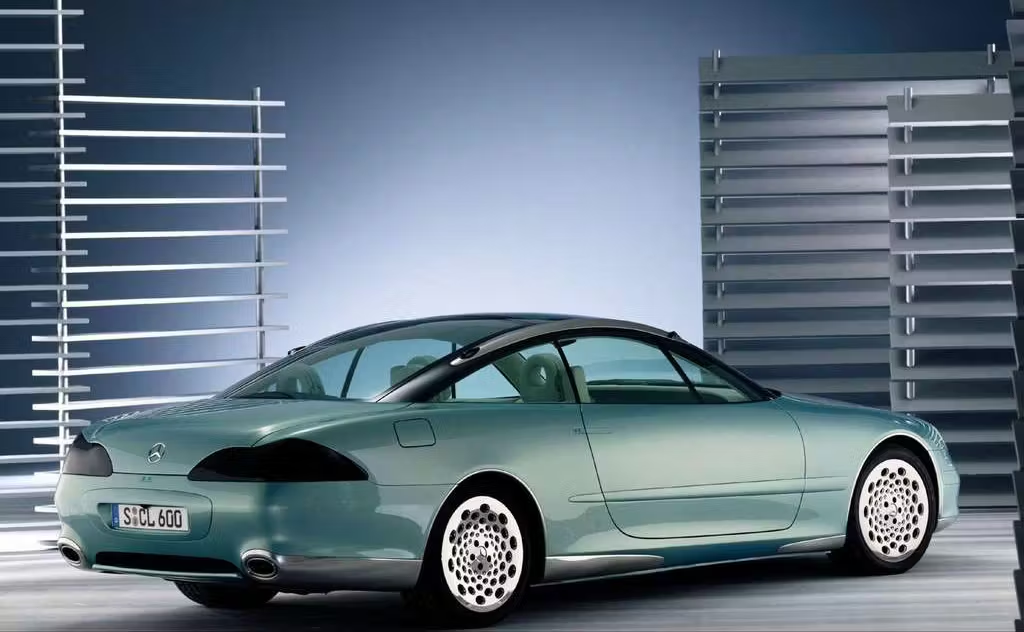
More concretely, the F200 Imagination had a profound influence on Mercedes-Benz’s production vehicles in the subsequent years. Nearly all of the major innovations it showcased found their way (in one form or another) into real models. The Active Body Control suspension, for example, arrived in the 1999 CL-Class coupé, giving that production car uncanny smoothness and handling for its size. The panoramic electrochromic roof idea was implemented in the ultra-luxury Maybach sedans in the early 2000s]. The side window airbag (renamed Windowbag) became a standard safety feature on the new S-Class (W220) by 1998]. Mercedes also rolled out voice command technology (LINGUATRONIC) in its high-end models around the same time, fulfilling the F200’s vision of voice-interactive systems. Even design elements of the F200 were clearly visible in later cars: the general silhouette and certain styling cues were reflected in the Mercedes CL-Class (C215) introduced in 1999, as the concept had essentially been a preview of that grand tourer’s aesthetic. In these ways, the F200 wasn’t just a one-off flight of fancy – it was a blueprint that guided Mercedes’s design and engineering direction into the new millennium.
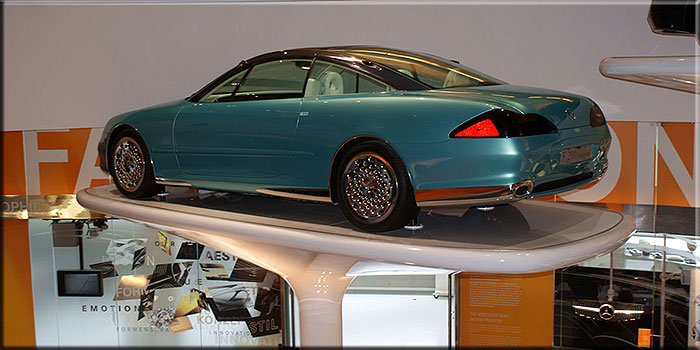
Today, the sole F200 Imagination prototype survives as an important piece of Mercedes-Benz history. After touring the international auto show circuit in the late 90s, the car eventually found a home in the Mercedes-Benz Museum in Stuttgart, Germany. There it sits alongside other legendary Mercedes research vehicles, preserved for posterity. As of 2019, museum visitors can admire the F200 up close, marveling at how many of its “futuristic” features have since become reality. The car’s well-maintained condition – and the fact that it remains fully intact – is also a credit to Stola’s craftsmanship. Even decades later, the F200 still looks striking and modern, a testament to the forward-thinking vision that created it.
The story of the Mercedes F200 Imagination is a remarkable behind-the-scenes tale of innovation and collaboration. It brought together German engineers and Italian artisans to build a car that was years ahead of its time. In the mid-1990s, features like joystick controls, camera mirrors, and active suspension were almost unheard of in the automotive world, yet this single concept car showcased them all. The partnership between Mercedes-Benz and Stola proved incredibly fruitful – Mercedes got a rolling showcase for its advanced ideas, and Stola solidified its reputation by executing one of the most complex concept builds ever attempted. The F200 Imagination stands as a visionary creation that blurred the line between concept and reality. Its legacy lives on every time a modern car parks itself at the touch of a button, dims its glass roof, or keeps its occupants safe with a curtain airbag. What was once imaginative fantasy on the show floor in Paris has become part of everyday driving. And it all began with that daring concept car built by Stola, the Mercedes F200 Imagination – a true icon of automotive innovation].

ABOUT THE AUTHOR
Andreas Scheidl
Italian classic car enthusiast with German roots. Renowned as a respected figure in the classic car community, he serves as a jury member at various international concours d'elegance, including the Classic Gala Schwetzingen and Mantova. As a content creator, Andreas passionately shares his profound knowledge and appreciation for vintage automobiles. His heart beats for cars designed by Giovanni Michelotti, showcasing his discerning taste and dedication to preserving the timeless elegance of automotive history.
More stories by Andreas Scheidl ↗CONTINUE READING
Posts You Might Like

A Central Driving Position, a Rear-Mounted V8. Was This Really a Lancia?
In 1948, visitors to the Turin Motor Show could see an unusual Lancia on the stand of Carrozzeria Ghia. It was a large two-door coupé with a two-litre V8 mounted behind the…
Read story
Fioravanti F100: The Ferrari He Was Allowed to Imagine
Enzo Ferrari’s centenary, Leonardo Fioravanti’s independent studio and a supercar that explored air brakes, steel wheels and a new way of driving—without ever wearing the Cavallino.
Read story
Michelotti Shellette: When the Fiat 850 Became a Yacht
The yacht designer, the Turin stylist and the tiny coachbuilt car that crossed between the quay, the royal holiday house and the auction room. Some automobiles were conceived for the open road,…
Read story
Maserati A6 1500: A New Road for the Trident
When the doors of the Geneva Motor Show opened in March 1947, Maserati was a name that required little introduction to anyone who followed motor racing. What it did not yet possess…
Read story
THE CONVERSATION
Comments 0
Share a memory, a period photograph or a documented detail about this story.