
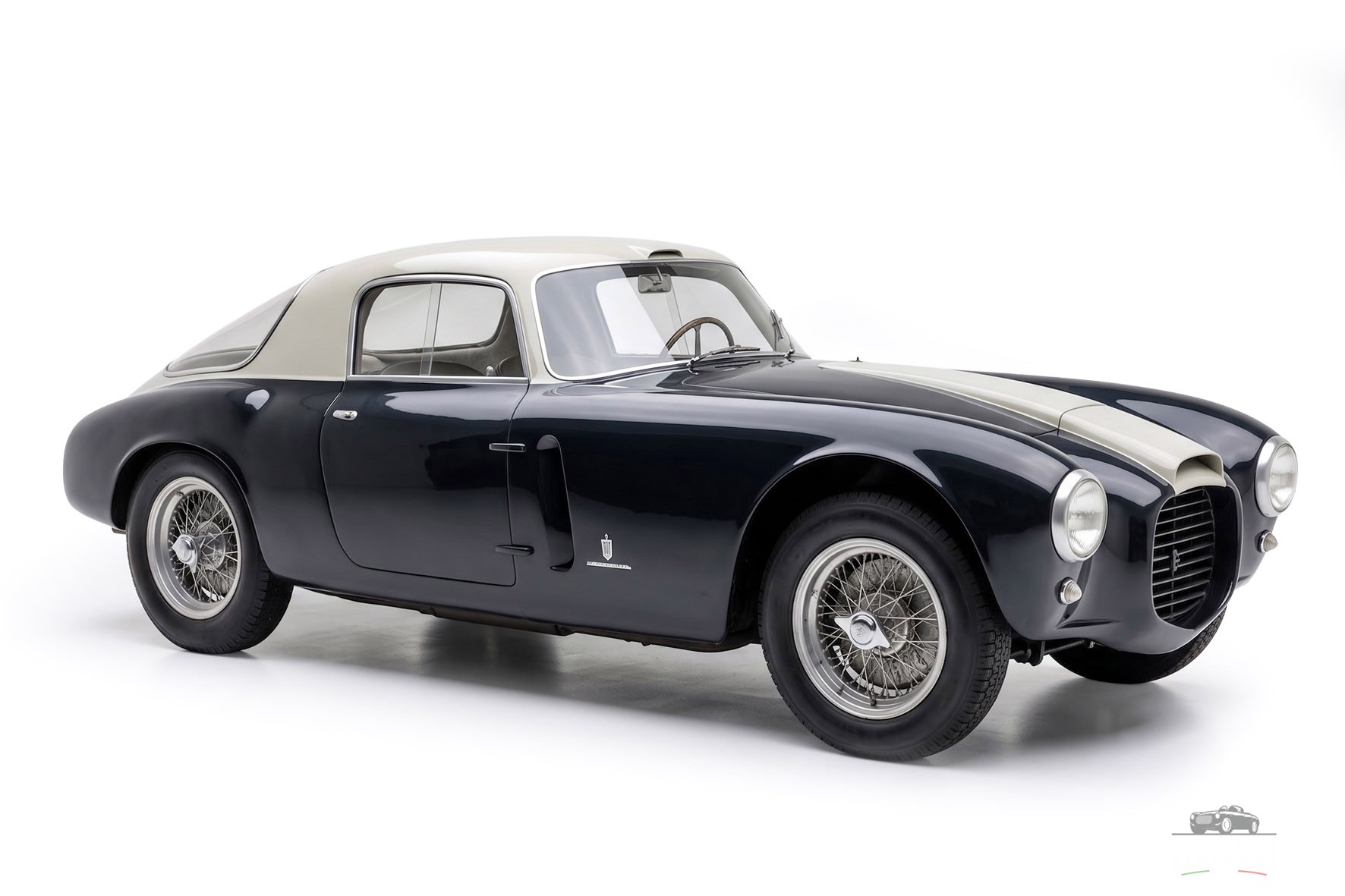
THE VEHICLE AT A GLANCE
Model dossier
- Production period
- 1953
- Body style
- Berlinetta
- Engine
- V6 · 3.0 L and supercharged 2.7 L variants
- Type
- Limited
THE PEOPLE BEHIND THE CAR
Coachbuilding, design & conversions

PRICE & SALES RECORD
Vehicle value
- Original price
- Not documented
- Latest recorded sale
- Not documented
01 / THE STORY
History & context
The Lancia D20 Pininfarina stands as a pivotal chapter in Lancia’s storied history, marking the brand’s bold entry into competitive motorsport under the leadership of Gianni Lancia. Unlike his father, Vincenzo Lancia, who, after a successful early career as a driver, refrained from making Lancia a racing-oriented marque, Gianni was determined to establish the brand’s presence on the track. His commitment to motorsport began shortly after the launch of the Aurelia, a model that, particularly in its B20 coupé form, showcased the potential for high-performance competition. Lancia initially supported private entrants in racing events in 1951, offering technical assistance to customers eager to push the Aurelia to its limits. By 1952, however, the company officially entered racing, fielding factory-prepared Aurelia B20s in major competitions. But Gianni Lancia’s ambition extended beyond modifying road-going modelshe wanted a purpose-built racing machine. This vision materialized in 1953 with the debut of the Lancia D20, a car often mistakenly regarded as an Aurelia derivative due to its 2900cc displacement. In reality, the D20 was a bespoke creation, designed by legendary engineer Vittorio Jano, known for his work on iconic Alfa Romeo and Ferrari race cars. The D20’s development began between 1952 and 1953, with a team of highly skilled engineers, including Ettore Zaccone Mina (engine specialist), Francesco Faleo (chassis design), Mattei (engine testing), and Luigi Bosco (transmission expert). Early prototypes featured a 2,494cc V6 (Type B110) producing over 180 HP, but it was soon replaced by a more powerful unit. The final D20 engine, still a 60° V6, had a displacement of 2,950cc, producing over 215 HP at 6,500 rpm. It featured four overhead camshafts, twin-spark ignition, and triple twin-barrel carburetors, making it a highly advanced powerplant for its time. The D20’s chassis was equally sophisticated, featuring four-wheel independent suspensiona transverse leaf spring and oscillating arms at the front, and a trapezoidal setup with a transverse leaf spring at the rear. From a design perspective, the D20 was a strikingly sleek and elegant coupé, penned by Pininfarina, showcasing both aerodynamic efficiency and Italian styling flair. Gianni Lancia’s ultimate goal was to compete in the newly established World Sportscar Championship (1953), but the D20 was merely a stepping stone. Despite its innovative engineering, it lacked the raw power needed to challenge Ferrari, Alfa Romeo, Jaguar, and Aston Martin at the highest level. Recognizing this limitation, four of the eleven D20s were converted into D23 Spiders, a transitional model bridging the gap between the D20 and the D24. The D24 would go on to achieve Lancia’s most famous racing triumphs, including victory in the grueling Carrera Panamericana. The Lancia D20 Pininfarina remains a significant yet often overlooked part of Lancia’s motorsport legacy, representing the brand’s bold leap into competitive racing. Though it was not the ultimate race winner, it laid the foundation for Lancia’s future dominance in sports car racing, proving that the Turin manufacturer could challenge the best in the world.
IN THE ARCHIVE
Coachbuilders & design studios
02 / TECHNICAL IDENTITY
Specifications & construction
Production & construction
- Production type
- Limited
- Mechanical platform
- Lancia Aurelia B20 GT evolution
- Production notes
- Canonical D20 competition family/programme record. Six exact race chassis (0001-0006) are documented in the 1953 programme. Legacy CI statement that eleven D20s were begun is not a completed-car production count and must not be imported as production_units. Exact race results, registrations and body wording live on child records.
Engine & performance
- Engine configuration
- V6 · 3.0 L and supercharged 2.7 L variants
- Specification notes
- D20 family retains multiple factory engine configurations rather than collapsing to one displacement/power figure. Official heritage source confirms the Aurelia B20 GT development basis and 3.0/2.7-supercharged V6 programme.
Individual vehicle
- Documented chassis
6 chassis
- 0001
- 0002
- 0003
- 0004
- 0005
- 0006
Design & manufacture
- Manufacturer · Documented
- Lancia
- Coachbuilder / Body Builder · Documented
- Pininfarina
06 / EVENTS & AWARDS
Events & awards
No events or documented awards are currently recorded for this vehicle.
07 / THE VEHICLE IN DETAIL
Photo gallery 9 photographs
Show 3 more photographs Show fewer photographs
08 / FROM THE ARCHIVE
Archive
References held in the vehicle dossier. Their inclusion does not establish that every historical claim has been independently verified.
| Reference | Source type |
|---|---|
| Racing Sports Cars — Lancia D20 chassis records www.racingsportscars.com | Competition specialist database |
| Stellantis Heritage — Lancia D24 Spider Sport / D20 development www.stellantisheritage.com | Manufacturer heritage official |
THE CONVERSATION
Comments 0
Share a memory, a period photograph or a documented detail about this car.