
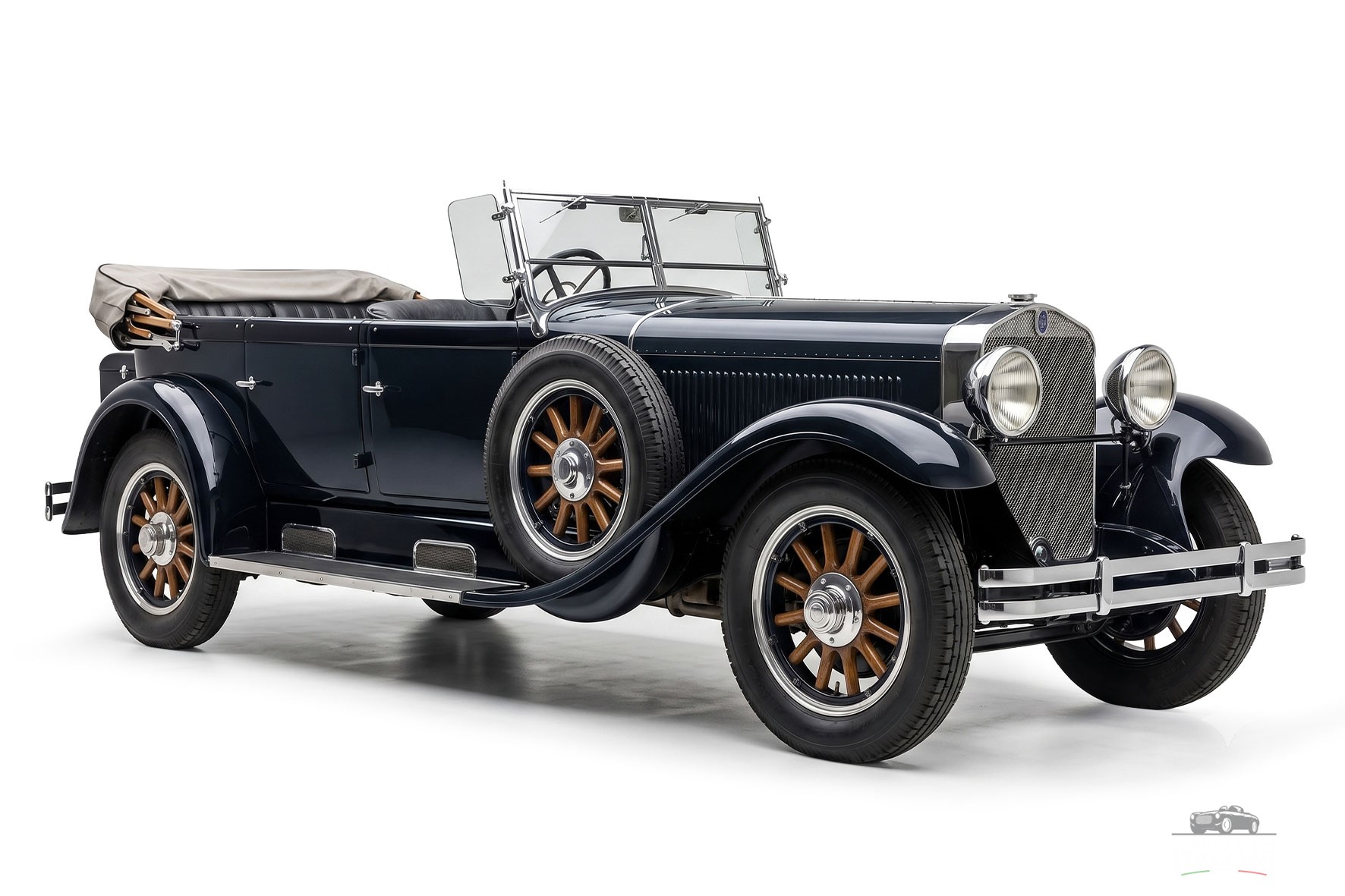
THE VEHICLE AT A GLANCE
Model dossier
- Production period
- 1931
- Body style
- Cabriolet
- Engine
- 8 cilindri in linea — donor/base Isotta Fraschini Tipo 8A/S
- Type
- One-off
- Production
- 1
- Displacement
- 7,370 cc
THE PEOPLE BEHIND THE CAR
Coachbuilding, design & conversions

PRICE & SALES RECORD
Vehicle value
- Original price
- Not documented
- Latest recorded sale
- Not documented
01 / THE STORY
History & context
The Isotta Fraschini Tipo 8A S, completed in 1931 with coachwork by Pininfarina, belongs to the final development phase of Isotta Fraschini’s flagship chassis. The “S” designation identified a lighter and more performance-oriented specification within the Tipo 8A range, intended to accommodate less formal and more streamlined bodies while retaining the marque’s standards of comfort and refinement. Introduced in 1924, the Tipo 8A was supplied exclusively as a rolling chassis to independent coachbuilders. The Tipo 8A S retained the fundamental architecture of the standard model but was optimized for reduced body mass and improved dynamic behavior. Power was provided by a 7,370 cc inline eight-cylinder engine with overhead valves and an aluminium crankcase. Depending on specification and tuning, output ranged between 135 and 160 horsepower. The engine emphasized smooth torque delivery and mechanical quietness, characteristics central to Isotta Fraschini’s engineering philosophy. Power was transmitted through a three-speed manual gearbox to a live rear axle. The chassis incorporated four-wheel servo-assisted mechanical drum brakes, semi-elliptic leaf springs front and rear, and a long wheelbase suited to luxury coachwork. Suspension tuning prioritized stability and ride quality at sustained cruising speeds, aligning with the intended grand-touring use of the S variant. Pininfarina’s coachwork for the Tipo 8A S reflected early-1930s stylistic trends, with attention given to proportion, surface continuity, and reduced visual mass compared with earlier formal saloons. Bodies executed on the S chassis included cabriolet and semi-sporting closed configurations, characterized by elongated bonnets, more compact passenger compartments, and restrained decorative elements. Construction followed traditional coachbuilding practice, using a wooden frame covered with hand-formed metal panels. Interior layouts were tailored to individual commissions, combining high-quality upholstery, wood veneers, and discreet metal fittings, while placing greater emphasis on driver ergonomics than purely ceremonial bodies. Production of the Tipo 8A S was limited, forming a small subset of the approximately 950 Tipo 8A chassis built between 1924 and 1931. Surviving Pininfarina-bodied examples are documented in private collections and institutional archives and provide reference material for the study of late-period Isotta Fraschini engineering and the transition toward lighter, more streamlined luxury automobiles in the early 1930s.
IN THE ARCHIVE
Coachbuilders & design studios
02 / TECHNICAL IDENTITY
Specifications & construction
Production & construction
- Production
- 1
- Production type
- One-off
Engine & performance
- Engine configuration
- 8 cilindri in linea — donor/base Isotta Fraschini Tipo 8A/S
- Displacement
- 7,370 cc
- Specification notes
- DONOR_BASE_ONLY — Museo Nicolis documents the Tipo 8A/S with a 7,370 cc inline-eight. Only displacement/configuration are projected; the exact Pininfarina Cabriolet identity and specific engine tune remain independently researchable.
Design & manufacture
- Coachbuilder / Body Builder · Documented
- Pininfarina
- Manufacturer · Documented
- Isotta Fraschini
06 / EVENTS & AWARDS
Events & awards
No events or documented awards are currently recorded for this vehicle.
07 / THE VEHICLE IN DETAIL
Photo gallery 1 photographs
08 / FROM THE ARCHIVE
Archive
No publishable archival references are currently catalogued for this vehicle.

THE CONVERSATION
Comments 0
Share a memory, a period photograph or a documented detail about this car.