
GILCO: a history of lightness in Italian racing cars
The scene is Rome, late spring of 1947. The air has that faintly dusty, post-war brightness to it—sunlight bouncing off stone, the smell of warm oil, and spectators leaning in with the particular hunger you only get when a country has decided it’s time to live again. On the Grand Prix of Rome route around the Terme di Caracalla Circuit, a small red car called the Ferrari 125 S takes the chequered flag. At the wheel is Franco Cortese, and this is the first proper Ferrari victory—Ferrari itself calls it their first win, and frames it as the moment the legend stops being an idea and starts being a result.
Now here’s the important bit, the bit that gets lost when history is told only through badges and bodywork: that victory wasn’t just an engine story, or a driver story, or even a “Maranello found its destiny” story. It was also a structure story. A story about the thing you normally never see, never photograph, never hang on a wall—unless you’re the sort of person who thinks a perfectly brazed joint is more beautiful than a fender line. Beneath that first winning Ferrari was a steel tube frame philosophy that, in time, would become one of Italy’s most quietly influential performance signatures. And in the middle of that philosophy sits a name that doesn’t get shouted enough: Gilberto Colombo.
GILCO, at its core, is the story of how Italy learned—again—to go fast by going light. Not as a marketing slogan. As a way of building. As a discipline. As a kind of mechanical manners.
Milan before Maranello
Long before there was a Ferrari chassis to obsess over, there was Milan, and there was a tube workshop. In 1919, A.L. Colombo opens in Milan with a practical mission: making metal tubes, initially for bicycle frames. It’s the kind of beginning that sounds modest until you remember that whole universes are built out of “modest” parts—tubes, fasteners, welds, the geometry you can’t cheat.

By 1928 the business has moved into a larger plant on Via Tanzi and grown sharper: precision steel tubes, alloy steels, and work that overlaps with aviation and high-stress applications. In parallel—because this is Italy, and Italy refuses to keep engineering and aesthetics in separate rooms—A.L. Colombo also gets deeply involved in tubular steel furniture under the Columbus name, working with modernist design currents that stretch well beyond Lombardy. Contemporary reconstructions of that Columbus story show how the company’s tubular output sat inside the broader European rationalist moment, with strong ties to designers and architects who treated the tube as both structure and style.
That detail matters for an automotive reader because it hints at something that will define GILCO later: in this family and in this shop culture, tubing is never “just material.” It’s a language. It’s what you use when you want strength without clumsiness, stiffness without brute thickness, lightness without fragility.
The company’s cycling pedigree makes that explicit. By 1930, Columbus is producing advanced, competition-oriented chrome-moly bicycle tubing—tapered, reinforced, engineered for racing success. That pursuit of stiffness-to-weight isn’t a footnote; it’s an early rehearsal for what comes next in cars.
When Gilberto Colombo arrives into this environment—born in 1921—he isn’t stepping into a generic steel business. He’s stepping into a culture where a tube can be a chassis rail, a bicycle down tube, or the hidden backbone of a modern chair, and the common denominator is always the same question: how much performance can you extract from geometry and metallurgy before you ever reach for “more material”?
By 1938, still a teenager, Gilberto is already collaborating in the family firm, working on production techniques and special tubing associated with demanding applications. By the early 1940s, while studying engineering at the Politecnico di Milano, he encounters Mario Speluzzi, who appears repeatedly in period accounts as a technical figure linked to motorsport contexts, including the Scuderia Milan environment. Those connections don’t just provide inspiration; they provide a bridge between “tube expertise” and “car problem-solving.”
The important thing here is that Gilberto Colombo’s entry into automobiles is not romantic luck. It’s continuity. If you’ve spent years thinking about how to make a bicycle frame win races without folding in half, the leap to a sports car chassis is less of a leap than it sounds.
The meeting in Modena that changed the skeleton
In 1946, Gilberto Colombo meets Enzo Ferrari in Modena, and Italian post-war racing history quietly clicks into a new alignment. On one side you have Ferrari, transitioning from running and managing racing efforts to building cars that will carry his own name. On the other you have Colombo, who understands something fundamental: a racing car’s truth is often decided not by the headline power figure but by the structure that has to carry that power through corners, bumps, braking zones, and fatigue cycles.
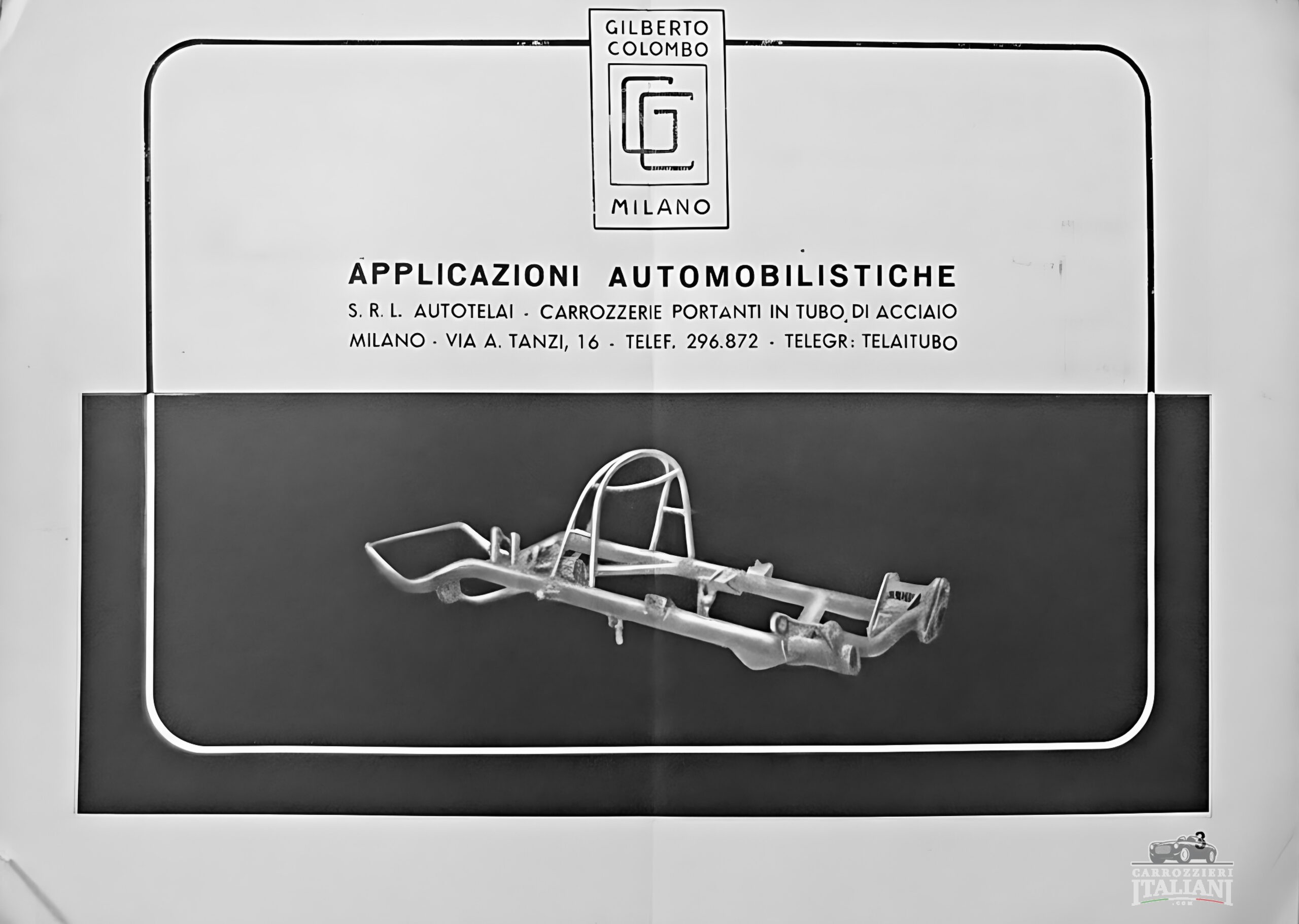
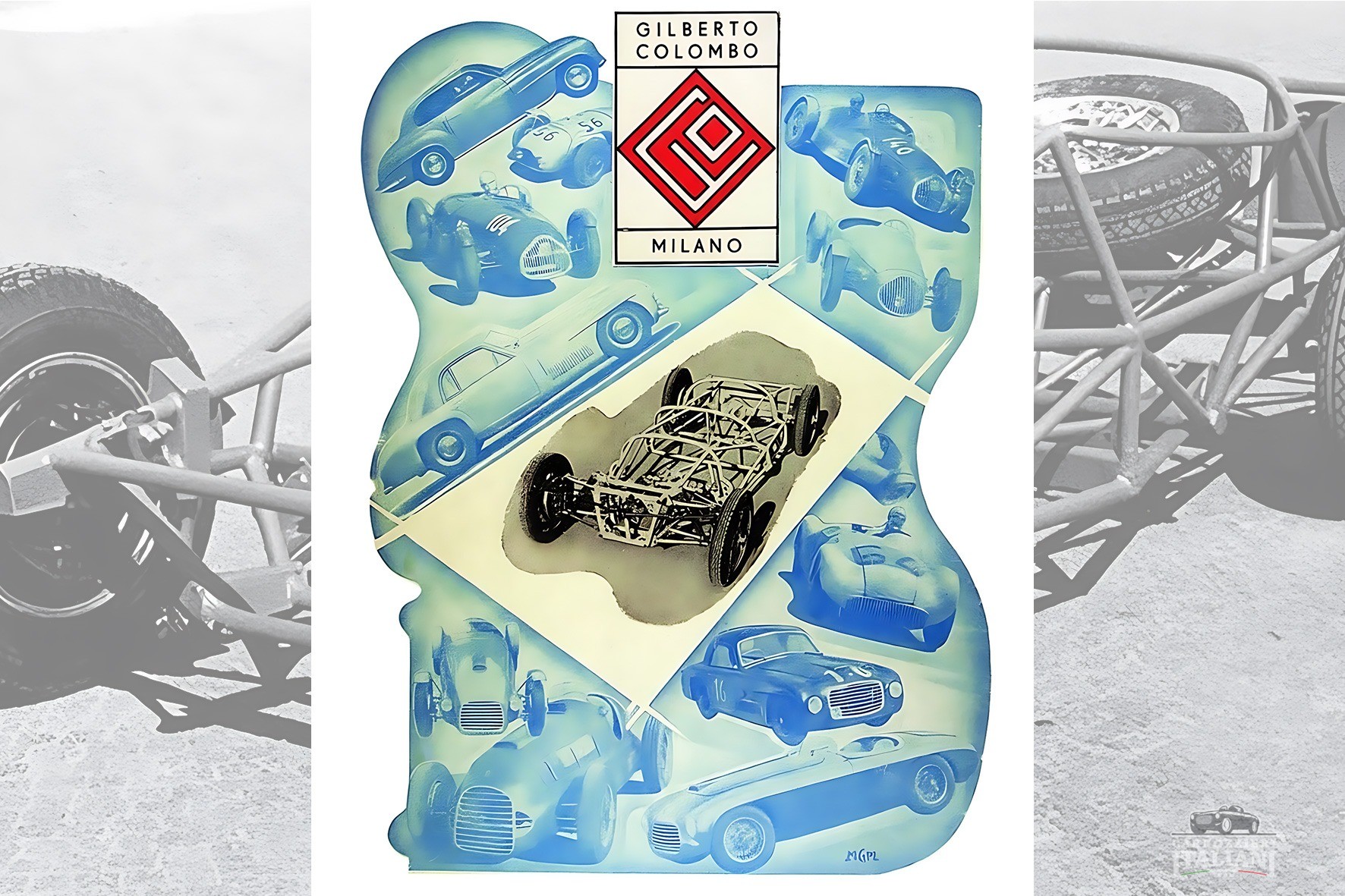
Within the A.L. Colombo orbit, Gilberto creates an automotive applications unit—described in Gilco sources as GC—then establishes Gilco Autotelai in 1947, formalising what had already become a specialised pursuit: producing innovative tubular chassis for sports and racing cars. Trafiltubi’s own historical outline also places the GILCO mark into this immediate post-war window, presenting the brand as an identifier attached to Gilberto’s projects and noting its earliest automotive work.
What’s striking, reading the way the Gilco Historical Register presents this birth, is the scale of the operation: a specialised atelier, small and exacting, built to do work that bigger organisations either couldn’t do quickly enough or couldn’t do with the same obsessive attention to thin-wall tubing and controlled craftsmanship. The register explicitly frames the early Gilco mission as developing high-strength, lightweight tubular structures, extending competencies learned from aviation-related applications into the racing world.
The first Gilco chassis, according to Gilco’s own historical accounts, is built for a reworked Maserati Formula 1 car connected to the Scuderia Milan of the Ruggeri brothers. That detail isn’t just trivia: it shows that Gilco begins not in the comfort of road cars but in the hot, improvisational zone where privateers and small teams need real engineering solutions yesterday.
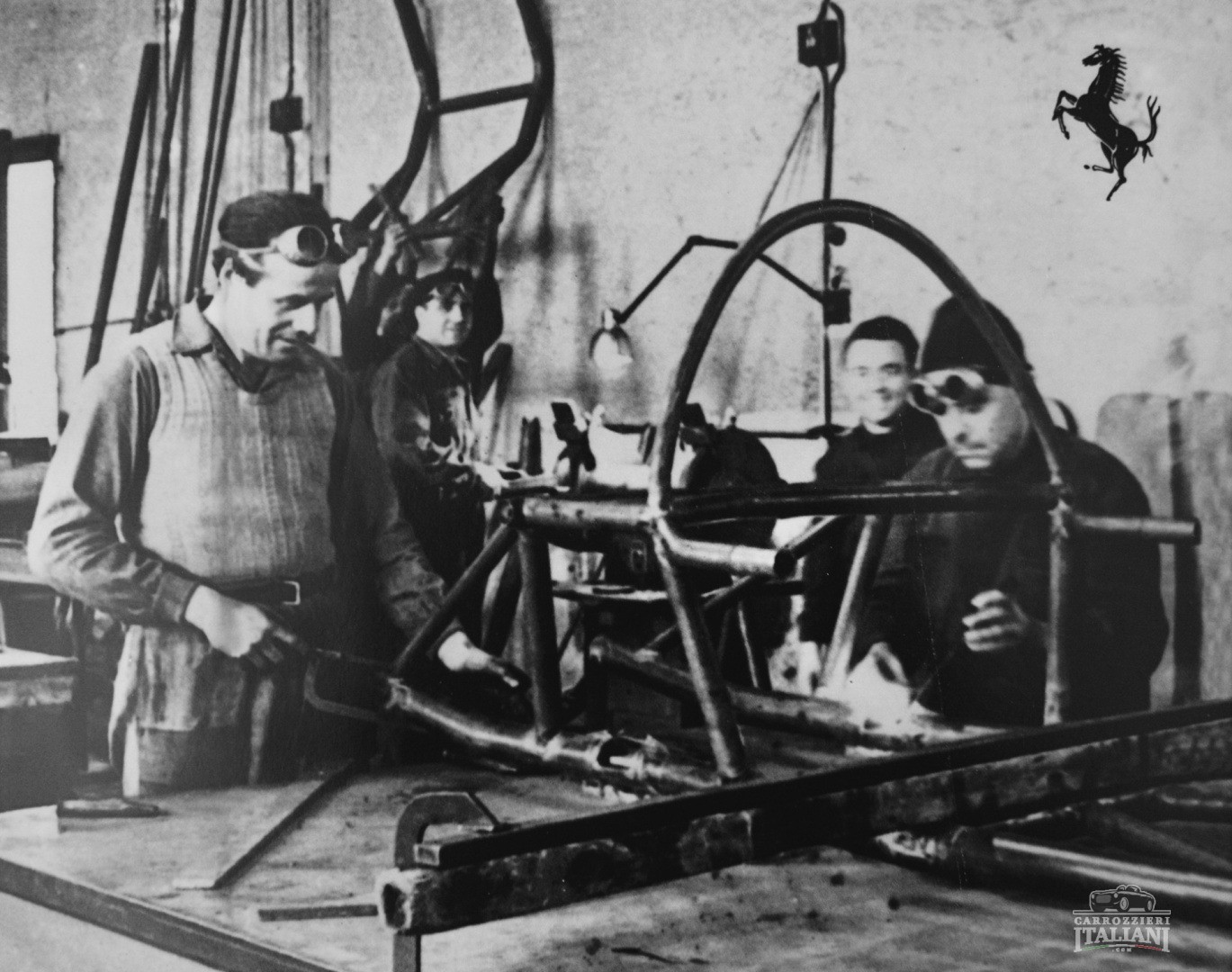
And then, almost immediately, the Ferrari story begins to run in parallel. Ferrari starts racing the 125 in 1947, and the Gilco accounts describe a rapid growth rhythm—quarterly batches of chassis, delivered in a matter of weeks per frame. This is the industrial version of a well-drilled pit stop: small-volume, high-precision output feeding a racing programme that is learning, iterating, and scaling in public.
The first Ferrari win, and why the chassis makes it feel inevitable
Ferrari’s own historical timeline is very clear: the first victory arrives in 1947 with the 125 S, driven by Franco Cortese at the Rome Grand Prix. The company’s magazine version of the story adds colour: distance, average speed, margins to rivals—details that remind you how raw and close-run early post-war racing could be.
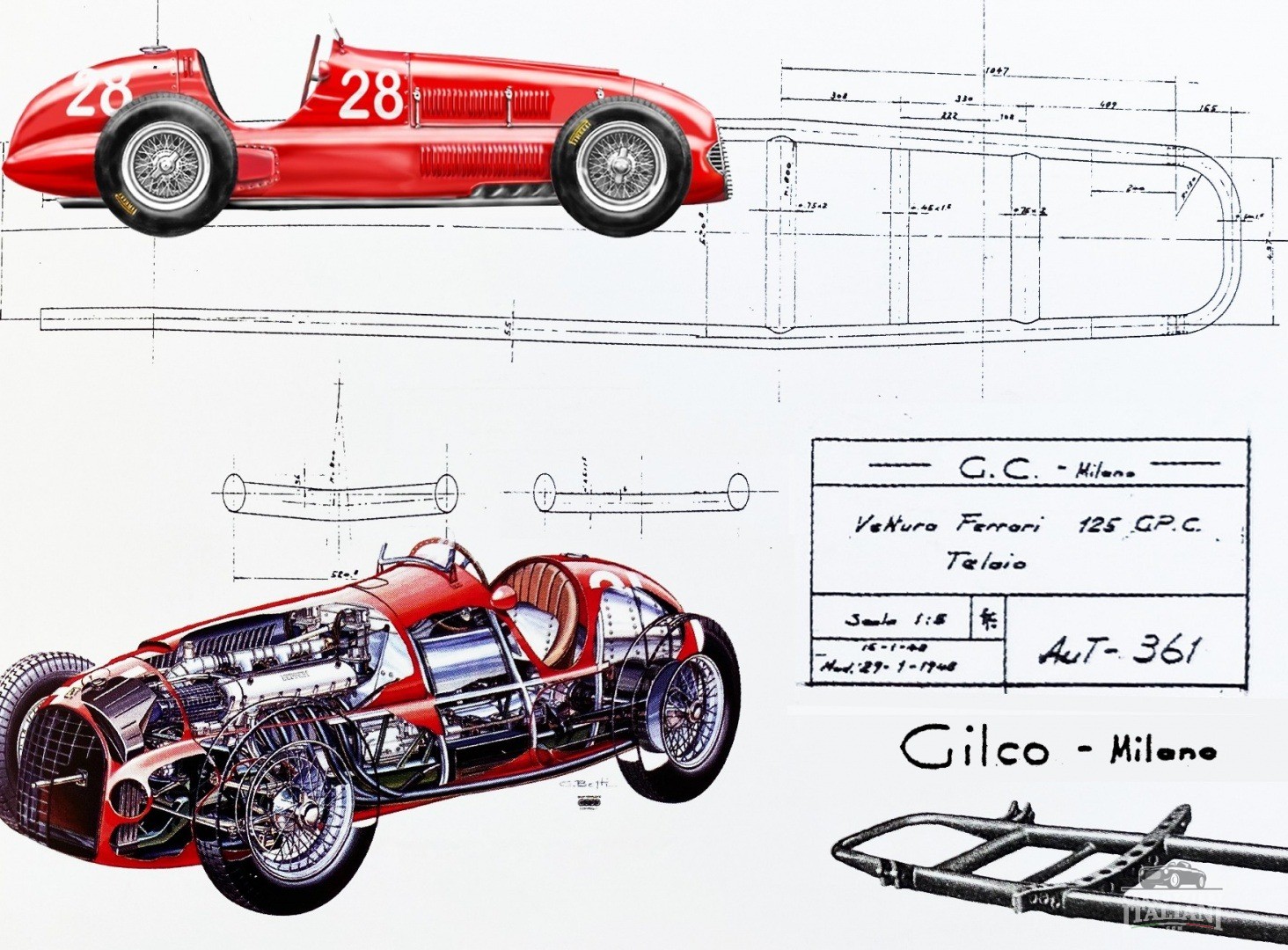
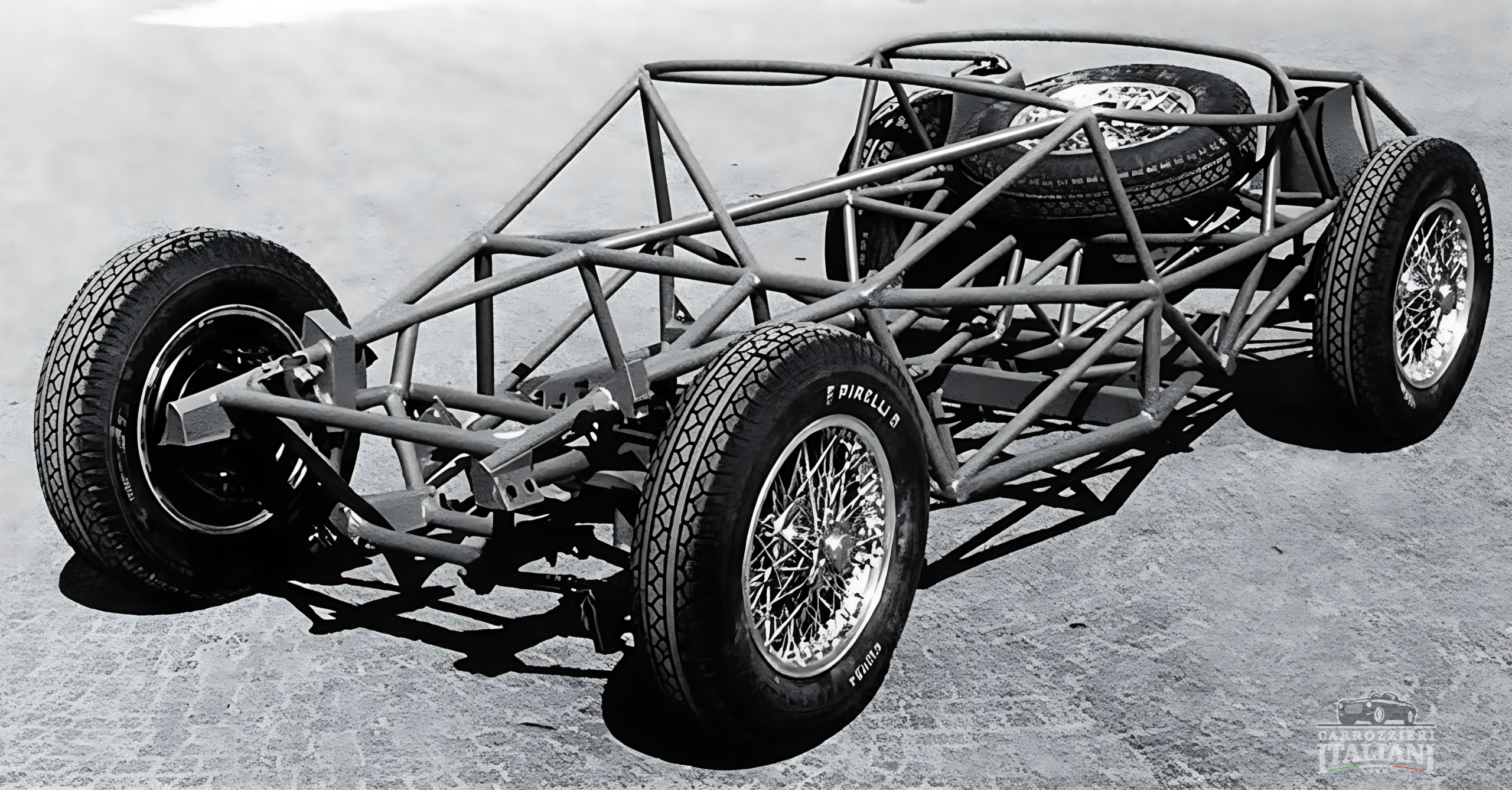
What GILCO brings to that moment—according to Gilco’s own technical storytelling—is a chassis philosophy that treats weight as the first enemy. Gilco sources describe a Ferrari 125-era frame concept using shaped tubing, aiming for rigidity and lightness simultaneously, and they present a comparative weight claim that captures the point: around 650 kg for the Ferrari versus roughly 720 kg for a contemporary Maserati reference in their narrative. Whether you’re a modern engineer or a pub philosopher, you don’t need a supercomputer to understand what 70 kg means in a small-displacement racing car on narrow tyres and imperfect roads.
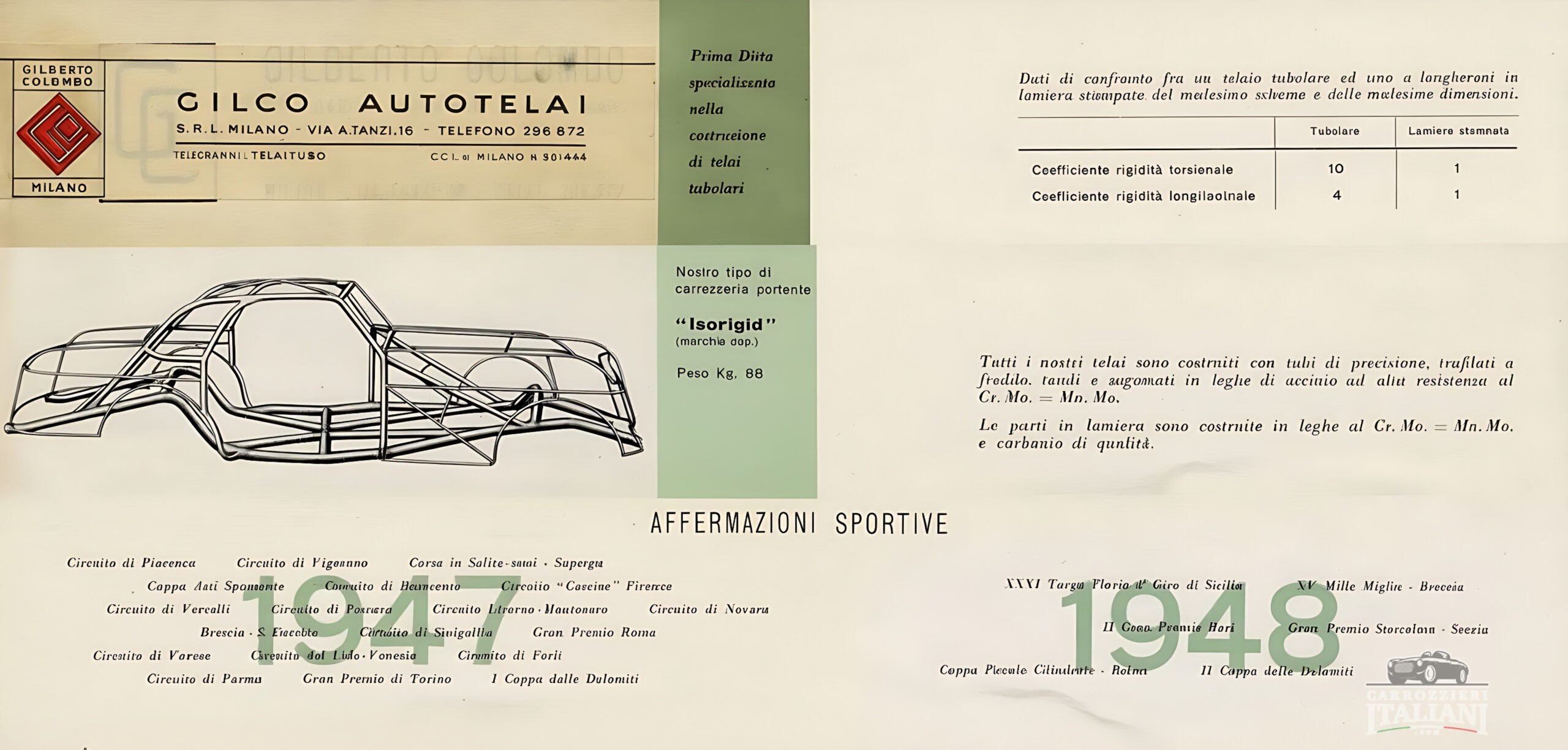
And then there’s the evidence of intent: the first Gilco catalogue, published in 1947, which Gilco’s Historical Register uses as a key reference. It lists chassis weights down to 32 kg for the Gilco 750 Sport and up to 88 kg for the “Isorigid,” described as an integrated chassis-and-load-bearing-body concept, a structure meant to support the coachwork as part of the system rather than merely carrying it like luggage. Even if you never see one in person, the idea is telling: Gilberto Colombo isn’t just shaving grams—he’s rethinking what the skeleton is supposed to do.
🔗 Read more: The Legend of Ferrari and Pininfarina’s Partnership: When Enzo Met “Pinin”
This is where an automotive perspective meets a coachbuilder’s reality. In the late 1940s, Italian performance cars are becoming a modular art form: engines, frames, and bodies often come from different specialists. When the frame is lighter and stiffer, it doesn’t just improve lap times. It changes what a carrozzeria can dare to draw and to build. It can influence proportions, overhangs, rooflines, and how confidently you can hang aluminium panels on the underlying structure without relying on heavy, crude reinforcement. The chassis is the unseen editor of the body’s first draft.
The Gilco story also insists—repeatedly—that Colombo was not only a “frame supplier” but a designer in the broad, almost Renaissance sense: someone who treated “machine” as anything that organises matter toward purpose. That concept appears in Gilco’s long-form biographical material, and it’s key to understanding why his chassis work reads differently from simple fabrication. If you see the car as an integrated object—mechanical, dynamic, and aesthetic—you don’t design a chassis as a standalone part. You design it as the beginning of a whole car.
The early Ferrari ecosystem, and the way lightness becomes culture
Once Ferrari begins winning, the structure story expands fast. The 125 gives way to the 159, and then to the evolving 166 family. Ferrari’s own history pages narrate the importance of the 166 MM as a pivotal early model, and the Le Mans organisation itself treats the 166 MM as Ferrari’s breakthrough endurance artifact—Ferrari’s first win at Le Mans in 1949, achieved on debut in that event.
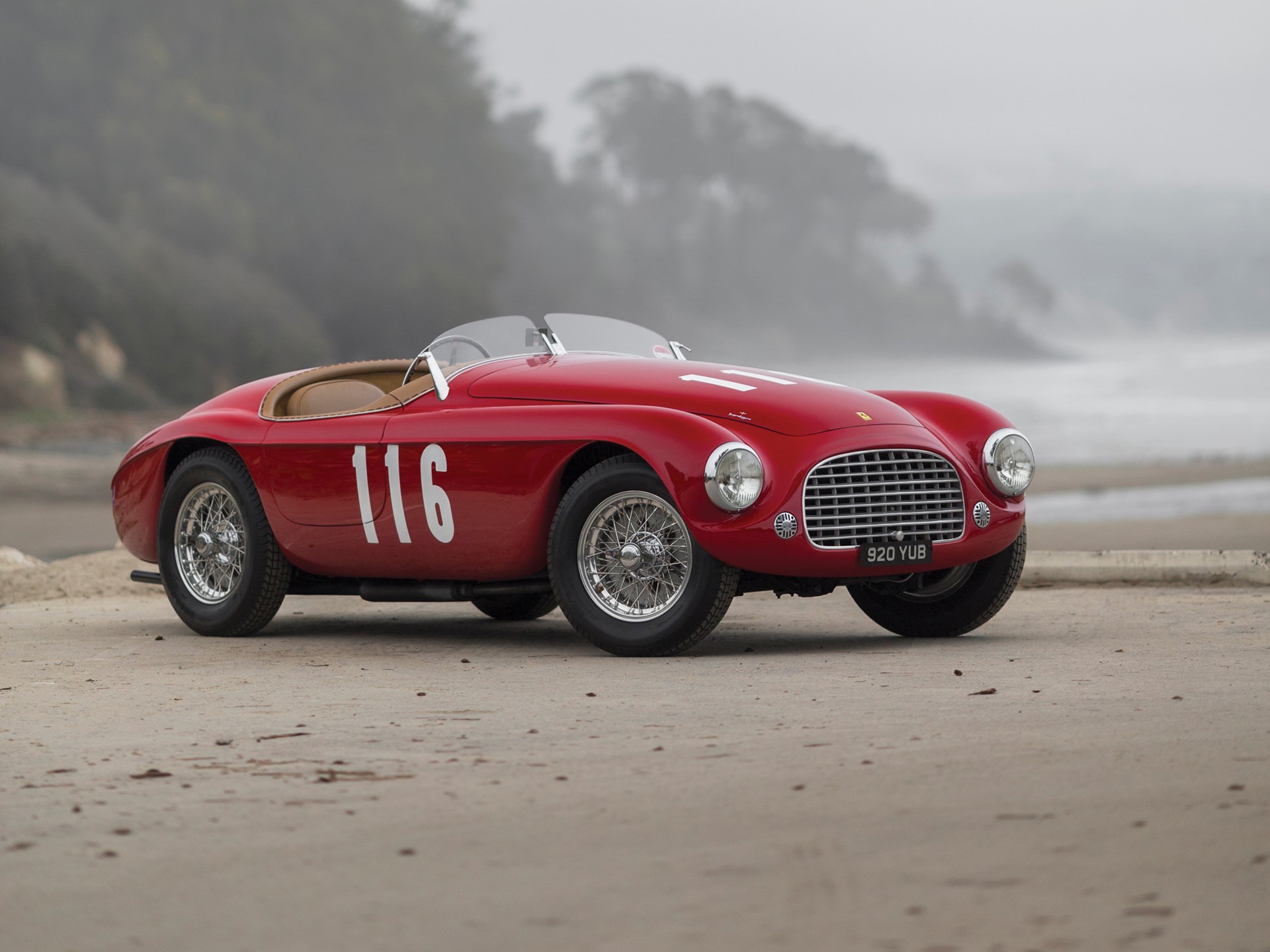
From a carrozzeria-focused viewpoint, this is when the storyline becomes irresistibly linkable, because the early Ferrari cars are inseparable from the varieties of bodywork they wear. On our website, you already have the Ferrari 166 MM Barchetta Touring Superleggera framed as a long-distance competition tool whose identity is tied to the Mille Miglia name and Touring’s lightweight construction method. We also covers the 166 MM in Touring Berlinetta form—the closed-roof expression of the same era’s obsession: airflow, weight, and endurance speed.
This is where it’s worth pausing and saying something that feels almost too obvious, but isn’t: in that era, “lightness” is not a single company’s trick. It’s a network effect. Touring has Superleggera methods, Vignale shapes panels like sculpture, Zagato pushes aerodynamic ideas into dramatic forms, Pinin Farina chases proportion and elegance. Underneath, the chassis has to be worthy of all of it. A flimsy frame is like a bad sentence structure: you can decorate the surface, but the whole thing collapses when you try to read it at speed.
🔗 Read more: The Superleggera System by Carrozzeria Touring
The Gilco Historical Register describe Ferrari commissioning Gilco chassis without interruption through much of the early-to-mid 1950s, with production rhythms explicitly stated—25–30 chassis per quarter and delivery cadence around 15 days per unit in their accounts. These aren’t just “fun facts.” They are a blueprint for how post-war Italian motorsport scaled: not by building giant factories overnight, but by relying on small, elite suppliers who could iterate quickly and deliver repeatable quality.
And this industrial rhythm sits inside something bigger: the Italian “economic miracle,” where the car is not only a product but a cultural object. GilcoDesign’s biographical essay cites a Milan-specific statistic drawn from Gianfranco Petrillo’s work: the growth in registered cars in the province from 1950 to 1960. Whether you read that as economics or as anthropology, the point is the same—the automobile is becoming the national stage on which technology, aspiration, and identity play out. In that environment, how a car is built becomes part of what it means.
In Ferrari’s case, the prestige escalates rapidly. Ferrari’s own official history emphasises the 1952 season as a sweep of Grand Prix victories culminating in a World Championship for Alberto Ascari, and Ferrari’s historical pages mark Ascari’s championship status explicitly. For Gilberto Colombo, Gilco sources present a symbolic moment of recognition: a bronze Cavallino trophy from Ferrari with an inscription of gratitude, tied to the 1952–1953 championship period in their narrative.
Gilco’s own historical register goes further, presenting the Gilco-chassis era as broad enough that Ferrari competition cars driven by figures like Juan Manuel Fangio and Luigi Villoresi are included within the period where Gilco frames appear on Ferrari machinery, in their telling of the relationship. That claim should be read in context—as an archive-driven overview rather than a chassis-by-chassis declaration—but it captures the scale of how central Gilco understood itself to be to the Ferrari competition ecosystem.
The key point, especially for a coachbuilder-oriented readership, is this: in the 1950s, the chassis is not just an engineering substrate. It’s a form of permission. It permits slenderness. It permits low rooflines without creaking. It permits that impossibly delicate door cutline on a Vignale coupe, or the taut, purposeful stance of a Touring barchetta, because the car underneath isn’t fighting the body. It’s working with it.
And if you want to see how that ecosystem radiates beyond Ferrari, you don’t need folklore—you can look at the Gilco Historical Register’s own documentation. The Register publishes a provisional list of “candidate vehicles,” explicitly labelled as work in progress, and it includes a striking spread of marques and models—racing Alfas, Maseratis, OSCAs, Lancia-based specials, and a host of small constructors. The document also states plainly that GILCO is a registered trademark managed by Gilberto Colombo’s heirs.
That’s the 1950s in one snapshot: big names, small names, and an underlying belief that if you can improve the structure, you can improve the car.
The day the sport changed, and the pivot from building to designing
Then comes June 1955 and the Le Mans disaster, a catastrophe so severe it reshapes public tolerance for racing risk and triggers bans and regulatory responses across parts of Europe. Broad historical summaries note that France eventually lifted its complete ban later in 1955, while Switzerland’s motorsport restrictions persisted for decades.
For companies living off the bloodstream of racing—builders of frames, bodies, special components—the effect is not abstract. It’s immediate. It’s calendars collapsing, budgets tightening, programmes pausing, and the mood shifting from romantic bravery to grim responsibility. In Gilco’s own chronology, this period is framed as a point after which Colombo’s activity moves increasingly from production toward design and broader technical work.
By the late 1950s, Gilco sources describe a reduction in chassis production, and they also stress something that feels inevitable: once Colombo’s ideas spread, other producers appear and a field that once had a near-monopoly begins to fill with competitors. In other words, Gilco’s greatest success—normalising tubular lightness—also plants the seeds for its own shift away from being “the” supplier.
This is also where the relationship with Ferrari evolves. The Gilco Historical Register describes Ferrari attempting, more than once, to absorb the Gilco workshop into the company, and it presents Colombo declining on practical grounds—because he had his own industrial responsibilities—while later collaborating to help Ferrari establish internal chassis capability.
From the outside, that looks like a quiet ending. From an engineering perspective, it’s actually an indicator of victory: when the factory internalises what the specialist taught it, the specialist has already changed the world.
Why GILCO still matters when you’re looking at a body, not a badge
If the GILCO story ended in 1957, it would already matter. But it doesn’t. It keeps resurfacing, in part because tubing is a long game—what you learn making a light, rigid chassis for a 1949 racer can echo into any field where structure matters.
In 1966, Gilco-linked sources describe Trafiltubi being acquired and specialised toward high-quality tubing for bicycles, motorcycles, and automobiles, alongside a continued emphasis on research, special sections, and sophisticated profiles. Trafiltubi’s own published “history” page places GILCO inside its broader corporate identity, explicitly tying the brand to Gilberto Colombo’s projects and describing early automotive applications.
For an automotive reader today, the most tangible continuation is restoration and authentication. GilcoDesign’s “Autotelai Oggi” material describes support for restoration or faithful reconstruction of period Gilco frames, including the ability—on request—to provide conformity and material quality certification, and it explicitly points to the production of required tubes through Trafiltubi using specified steel and documentation. Meanwhile, the Gilco Historical Register presents itself as a tool created around the centenary of Colombo’s birth, aimed at census, verification, and eventual certification of surviving cars built on Gilco chassis.
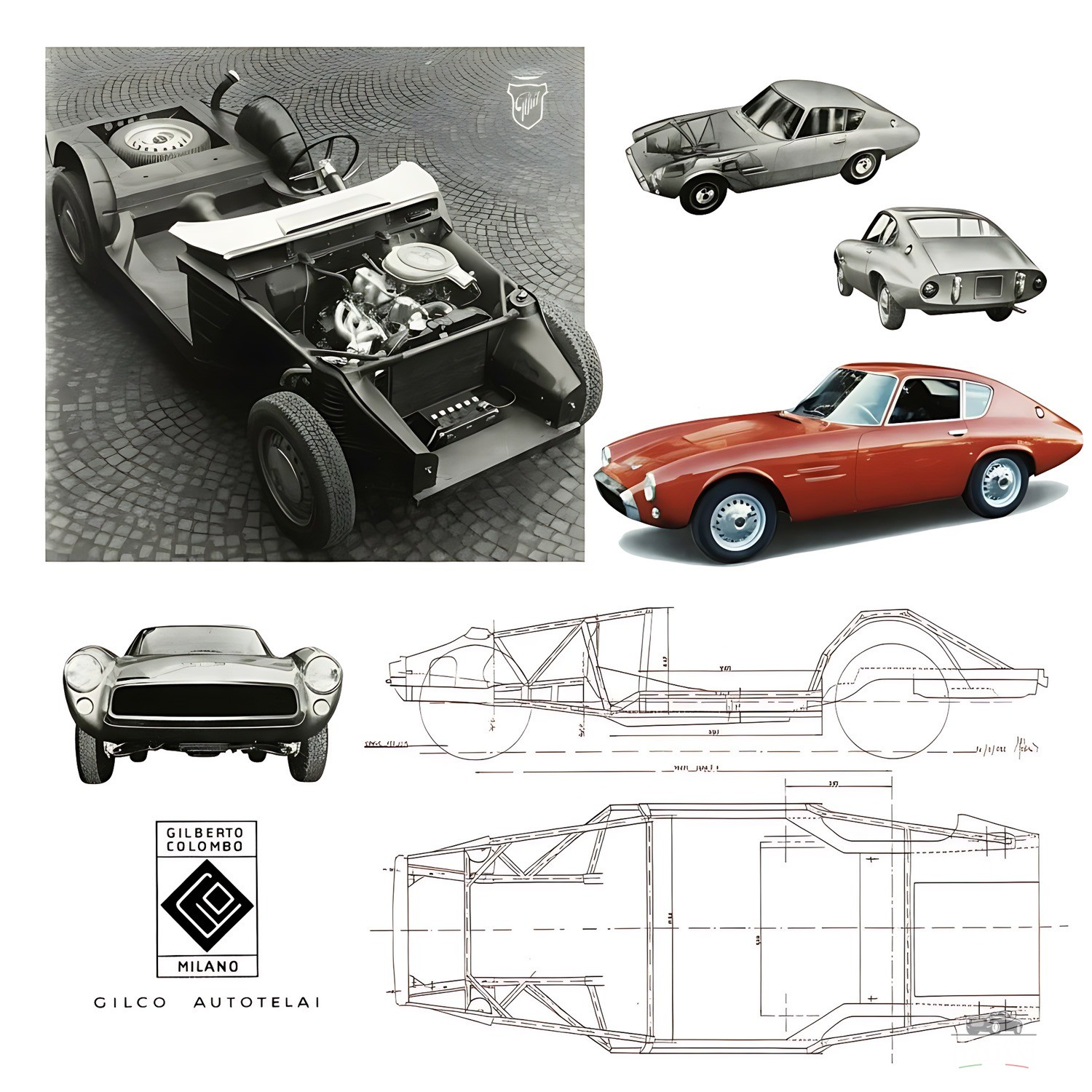
This matters because the chassis is often where authenticity lives or dies. Coachwork can be re-skinned. Mechanical parts can be swapped. But a tubular frame carries signatures: welding style, tube section choices, bracket placement, and those little decisions made by a human hand in a specific era. The Register even publishes a technical chassis-description form that makes clear, in its own structure, what the experts look for—attachments, welding type, tube profiles—because those details are where truth hides.
🔗 Read more: The History of Carrozzeria Ghia – Part 1
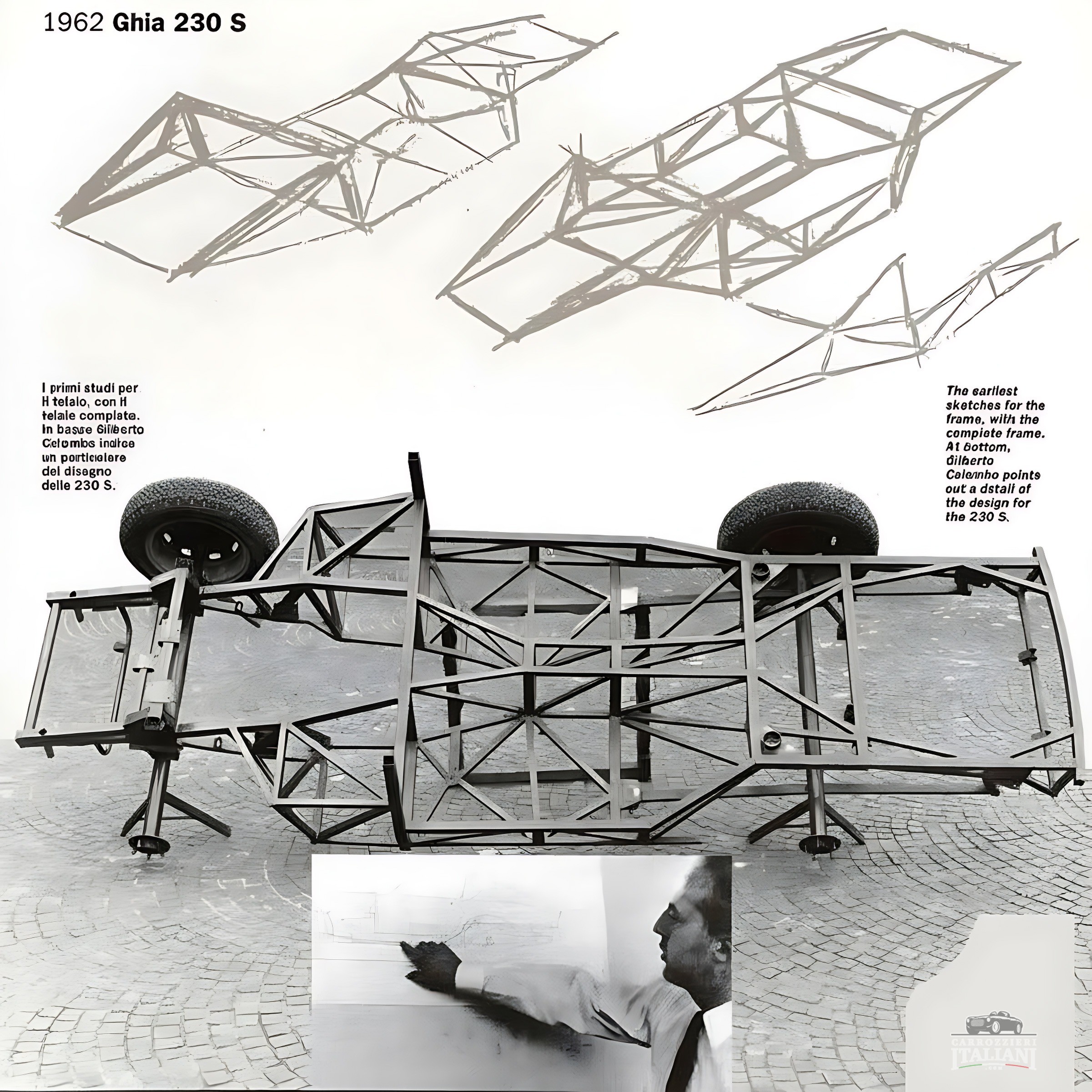
And then there is the way GILCO reappears in unexpected coachbuilt places. On carrozzieri-italiani.com, the Ghia G230 S Coupe is presented as being built around a tubular chassis developed by Gilco, pointing directly to Gilco’s reputation for lightweight frames. Independent reference summaries of Ghia’s history also describe the Fiat 2300-based G230S as being built on a tubular spaceframe designed and built by Gilco specialists, reinforcing that this wasn’t a myth that grew later—it was a recognised feature of the concept.
So even when you arrive in the 1960s, in the show-lit world of Turin salons and coachbuilt prototypes, GILCO shows up again as the invisible enabler: the reason a designer can ask for a lower bonnet line, a different glass profile, a more dramatic stance—because the structure underneath can carry the idea.
That is the essential automotive lesson of GILCO, and it’s the reason this story belongs on a coachbuilder-focused platform. We celebrate bodies because we can see them, and because Italy—more than almost anywhere—made bodies into art. But the art often starts with a skeleton that’s disciplined enough to disappear.
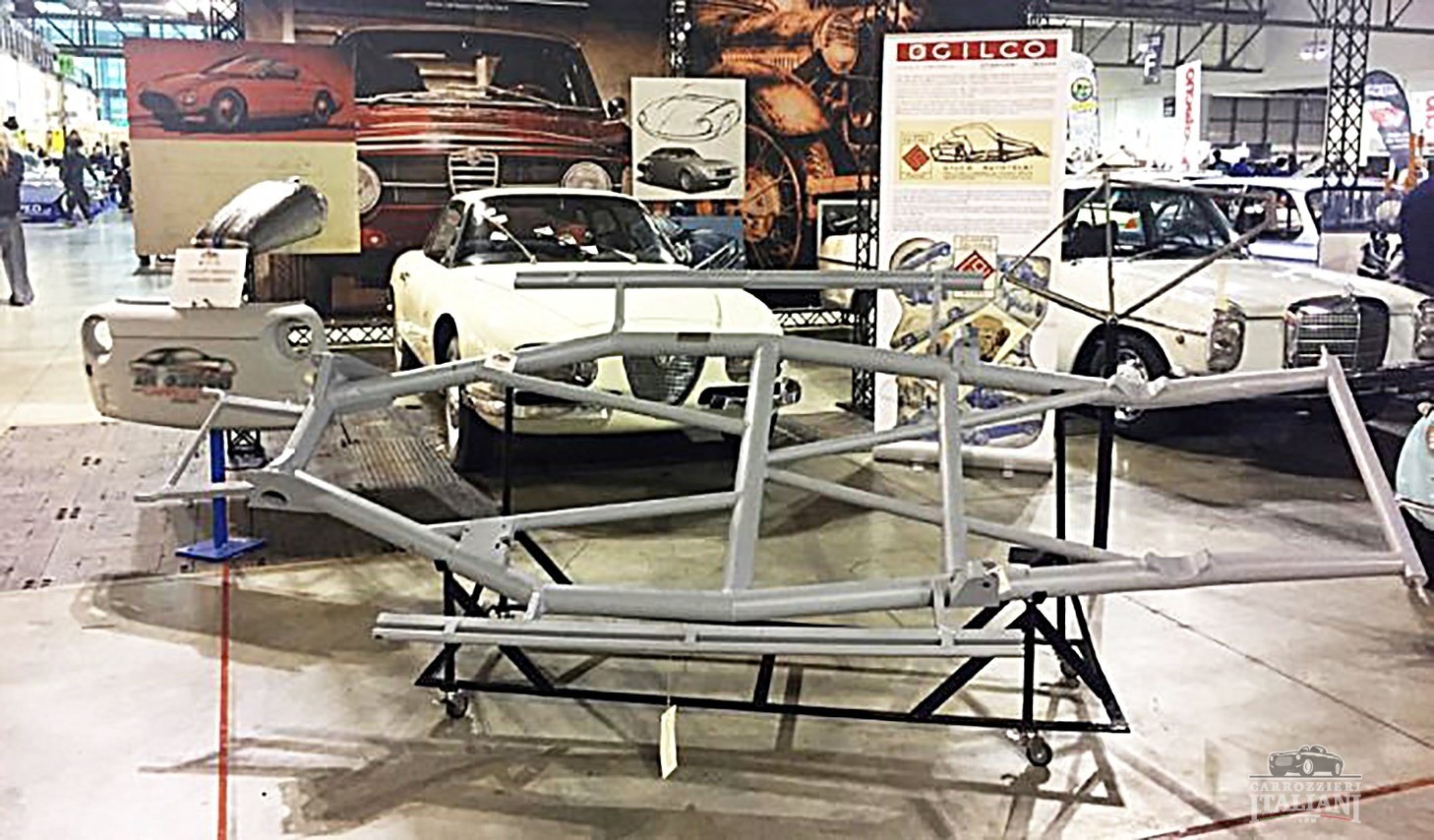
In the end, GILCO’s greatest achievement may be that it did its work so well that the world looked past it. The best chassis is like the best rhythm section: if you notice it, something has probably gone wrong. But when it’s right, everything else looks inevitable—the proportions, the way the car sits, the way it takes a set into a corner, the ease with which a Touring barchetta feels both delicate and tough, or a Vignale coupe feels elegant without feeling flimsy.
Go back to that Roman afternoon in 1947. The headlines are about Ferrari’s first win, and rightly so. But the deeper story—the one that survives in tubes, archives, and the quiet logic of structural lightness—is that Italy’s post-war performance renaissance was built not only by dreamers and racers, but by people who understood that speed begins with the courage to remove weight, and the skill to make what remains strong.

ABOUT THE AUTHOR
Andreas Scheidl
Italian classic car enthusiast with German roots. Renowned as a respected figure in the classic car community, he serves as a jury member at various international concours d'elegance, including the Classic Gala Schwetzingen and Mantova. As a content creator, Andreas passionately shares his profound knowledge and appreciation for vintage automobiles. His heart beats for cars designed by Giovanni Michelotti, showcasing his discerning taste and dedication to preserving the timeless elegance of automotive history.
More stories by Andreas Scheidl ↗CONTINUE READING
Posts You Might Like
Fiat Panda Cabrio: The Italian Coachbuilders Who Opened Giugiaro’s Box
From Moretti’s Panda Rock to Italdesign’s experimental Strip, Maggiora’s four-wheel-drive convertible and Stola’s remarkable Destriero, the history of the open-top Panda reveals an unexpected chapter in Italian coachbuilding. When Giorgetto Giugiaro designed…
Read story
Gabriele d’Annunzio and the Cult of the Automobile
There was a time when the automobile had not yet become part of the landscape. It announced itself from afar through the beating of an engine, the smell of petrol and hot…
Read story
Fiat 1400: The Last Great Playground of the Carrozzieri
From Touring and Abarth to Farina, Ghia, Vignale, Boneschi, Bertone, Viotti and the smaller carrozzerie, the new Fiat quickly became one of the richest bases for Italian special bodies in the early…
Read story
How a Swiss Dealer Challenged Ferrari: The Story of Monteverdi
How Peter Monteverdi went from Swiss Ferrari dealer to creator of rare Frua and Fissore-bodied GTs, the Hai supercar and luxury off-roaders.
Read story
THE CONVERSATION
Comments 0
Share a memory, a period photograph or a documented detail about this story.