
Maserati A6 1500: A New Road for the Trident
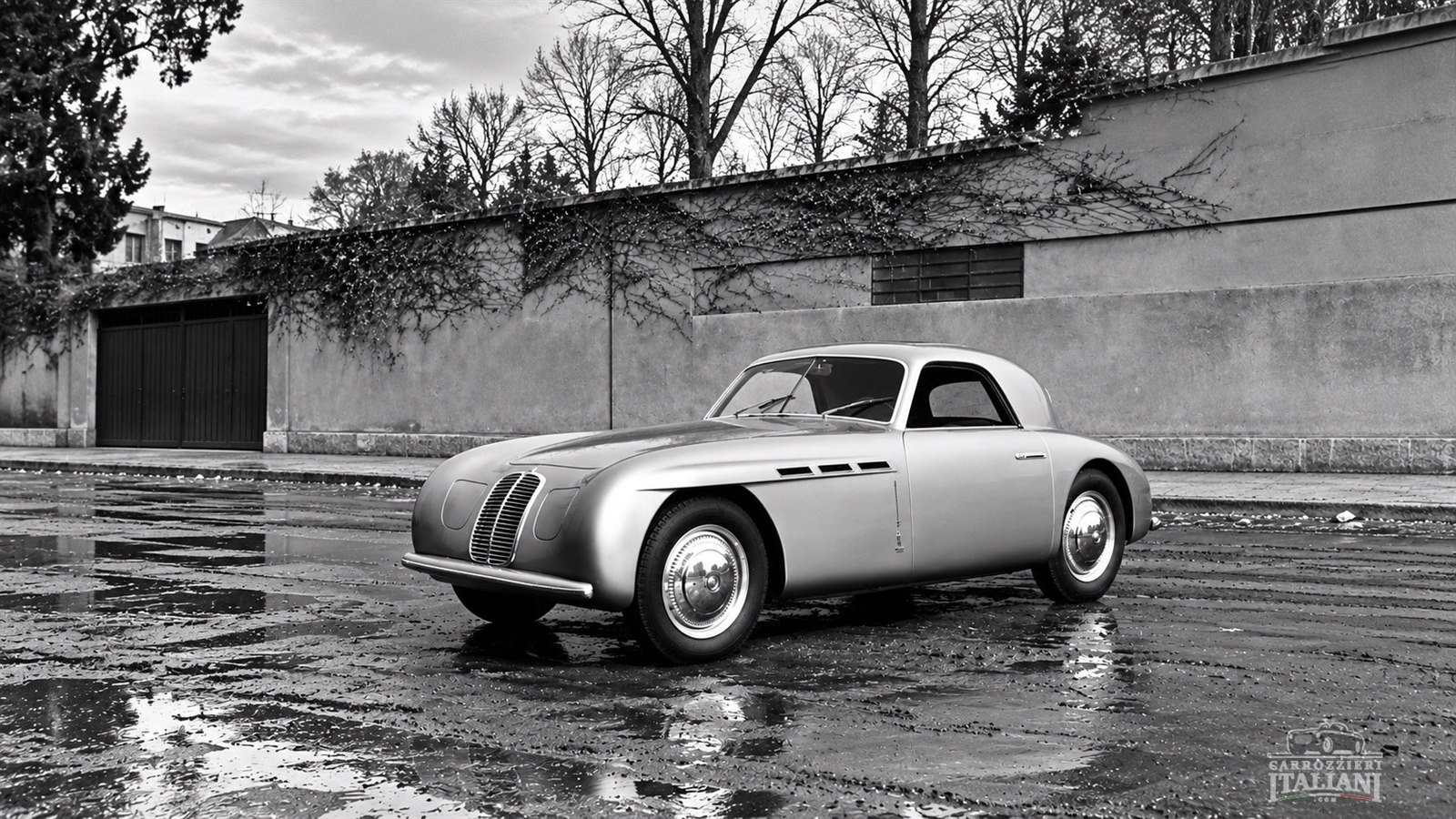
When the doors of the Geneva Motor Show opened in March 1947, Maserati was a name that required little introduction to anyone who followed motor racing. What it did not yet possess was a road-car tradition. The Trident had been forged in competition, from the early Bologna years to the great pre-war machines and the Indianapolis victories of 1939 and 1940, but the automobile standing on the Geneva show floor represented something fundamentally different. Beneath an elegant Pinin Farina berlinetta body was a Maserati intended not for the starting grid but for the road, conceived for an owner who might appreciate the pedigree of a racing engine yet expect leather upholstery, luggage space and the ability to cross countries without first putting on goggles and racing overalls.
The idea had been developing for years. After Adolfo Orsi took control of Maserati and transferred the company to Modena, plans for a road-going grand tourer began to take shape before the war. Work on the chassis and engine was already under way in 1940, Touring produced a scale berlinetta proposal the following year, and a development mule existed during the war years. Alberto Massimino, whose career had already taken him through Fiat and the Scuderia Ferrari, subsequently joined the technical effort. By the time Europe emerged from the conflict, Maserati therefore possessed more than an aspiration: it had the foundations of a car through which an almost exclusively sporting manufacturer could begin to redefine itself.
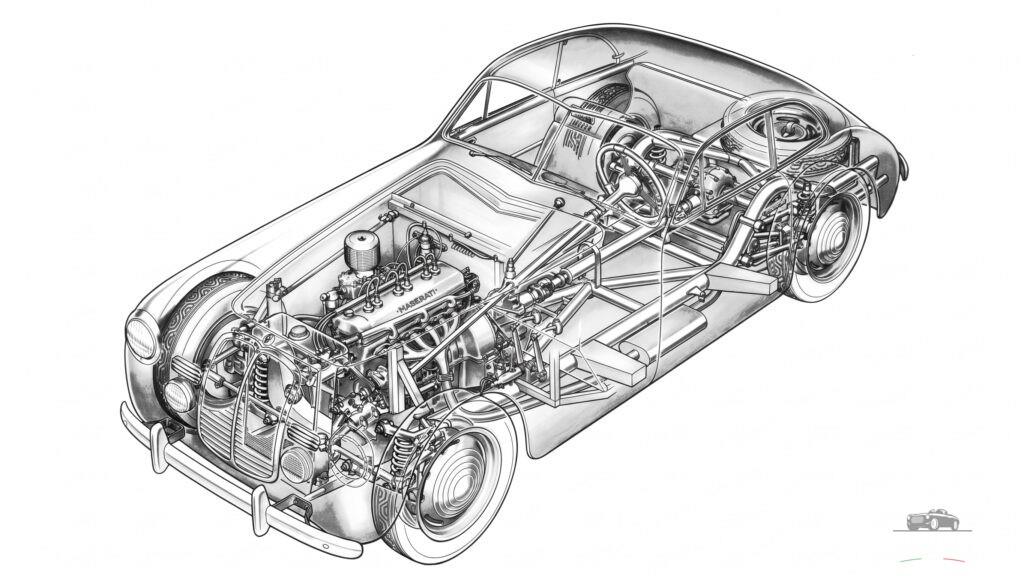
The name chosen for it was deceptively simple. A6 combined the initial of Alfieri Maserati with the number of cylinders, six arranged in line. The 1,488 cc engine retained a clear connection with the firm’s competition experience but was deliberately civilised for road use, with a single overhead camshaft and approximately 65 horsepower in standard form. The structure underneath was equally revealing of Maserati thinking: a light tubular chassis fabricated from round-section steel tubing, independent front suspension, a live rear axle and hydraulic drum brakes. None of those elements alone made the A6 revolutionary, yet together they produced something that had scarcely existed in the Maserati vocabulary before — a refined sporting automobile intended to cover distance rather than simply cover it faster than everybody else.
What transformed that mechanical proposition into a modern Italian Gran Turismo was the work carried out in Turin by Pinin Farina. The distinction of roles matters. Maserati was responsible for the conception and engineering of the chassis and powertrain; Battista “Pinin” Farina and his carrozzeria were responsible for turning that platform into an automobile whose appearance could communicate an entirely new identity for the marque. The A6 was not simply a racing Maserati dressed for dinner. Its proportions and surfaces belonged to the profound change taking place in Italian coachbuilding immediately after the war, when separate wings, freestanding lamps and the architectural complexity of the 1930s were giving way to increasingly integrated bodies.
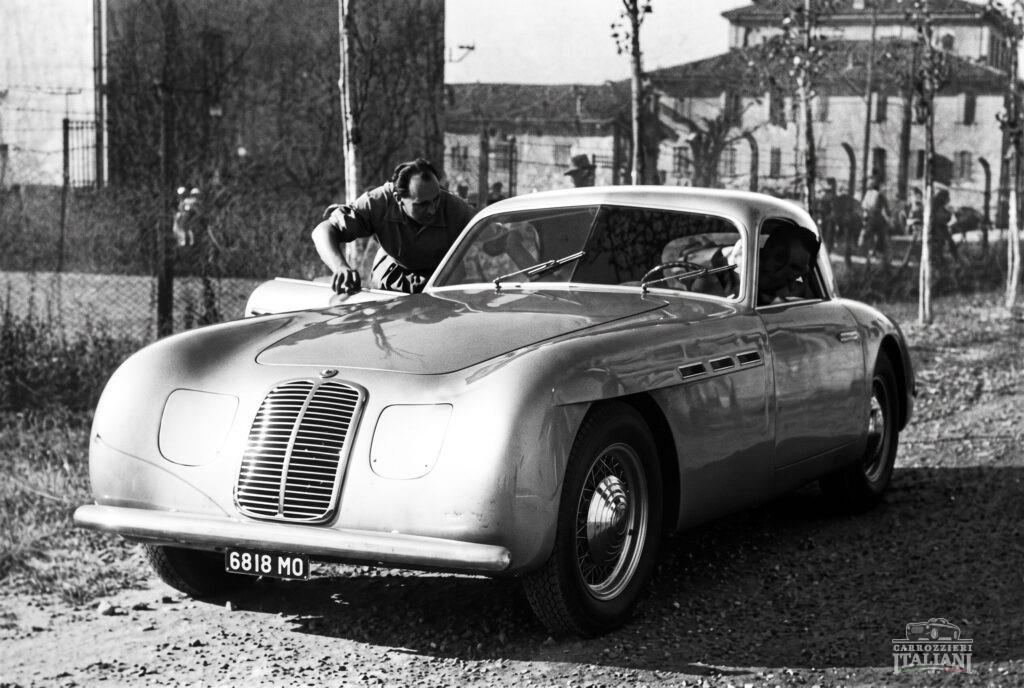
On the A6 the front wings flowed into the flanks rather than standing apart from them, the bonnet became part of a continuous volume, and the roof descended gently into a compact tail. The familiar pre-war language of a long bonnet followed by a distinct passenger compartment had not disappeared entirely, but Pinin Farina softened the transitions and placed the Maserati grille at the centre of a much cleaner composition. It was the same cultural moment that produced the Cisitalia 202, yet the Maserati should not be treated as an appendage to that more frequently discussed design. The A6 had different packaging, different proportions and, more importantly, a different responsibility: Pinin Farina was helping a celebrated racing manufacturer discover what its first road-going visual identity should be.
Two prototypes, two ideas of the future
That identity did not emerge fully formed from a single drawing. The two official Pinin Farina prototypes built in 1947 are particularly revealing because they show how quickly the design was being revised while the programme was still new. Chassis 054, the car displayed at Geneva, possessed the most theatrical interpretation, with retractable headlamps concealed within the front bodywork, a transparent roof panel and an ingenious bonnet that could be opened from either side or removed altogether. It looked every inch the salon prototype, an automobile designed to demonstrate not only the arrival of a new Maserati but also the ingenuity of its coachbuilder.
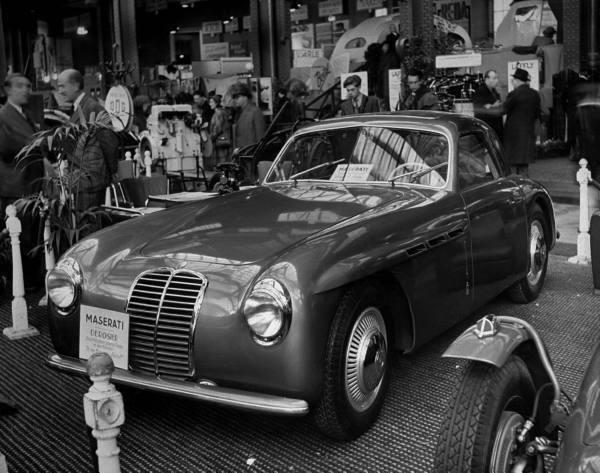
The sister prototype, chassis 053, moved noticeably closer to the form customers would eventually receive. Its lamps were fixed and integrated into the front wings, the side glazing was reconsidered, the rear window and tail were altered and the overall treatment was less demonstrative. Looking at the pair together is more instructive than asking which one was “the first” A6. One records the moment of presentation; the other records the process of conversion from an experimental show car into a credible Gran Turismo.
Chassis identification is especially important here because the early A6 chronology has been repeatedly blurred in later captions and secondary literature. The stronger reconstruction supported by the Museo Nicolis material identifies 054 as the retractable-headlamp Geneva prototype and 053 as the second official Pinin Farina prototype, while an older identification of 051 that entered parts of the literature should be regarded with caution. In a production programme numbering only a few dozen cars, such distinctions are not academic details: moving one early chassis to the wrong position can alter the perceived sequence through which the model developed.
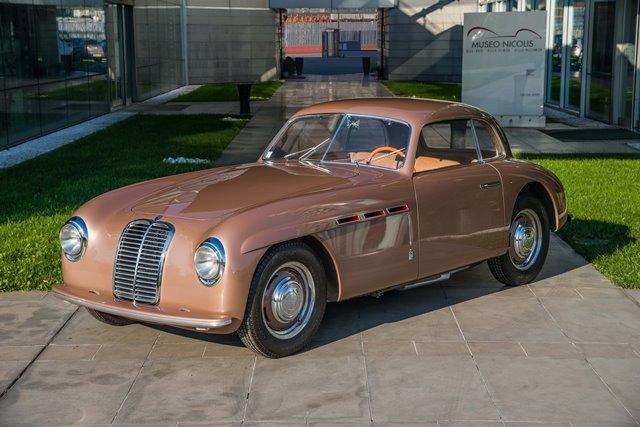
The second prototype received its own important public debut in October 1947, when chassis 053 appeared at the first Mostra della Carrozzeria Italiana at the Palazzo della Triennale in Milan. The setting was almost symbolic. Rather than being presented solely as a new automobile, the Maserati was placed within an exhibition devoted to Italian coachbuilding at precisely the moment when that industry was beginning to define the international image of post-war Italian design. Contemporary reconstruction also associates the car with Maserati advertising carrying the phrase “per lo sportivo la Maserati 1500”, a remarkably concise expression of what the new model was attempting to be: not a softened limousine from a sporting company, but a road car for the sporting motorist.
Pinin Farina’s work on the A6 also received recognition on the concours circuit. Contemporary accounts record an award connected with the car at the 1947 Concours d’Élégance Automobile in Monte Carlo, further evidence that the significance of the new Maserati was understood from the beginning as much in terms of its coachwork as of its mechanics. The distinction is important when reading the A6 today, because its historical importance comes from precisely that partnership between Modena and Turin: Maserati supplied the engineering credibility, while Pinin Farina gave the road-going Trident a shape through which that credibility could be understood.
From show car to production Gran Turismo
Production inevitably removed some of the prototypes’ more extravagant details. The disappearing headlamps did not survive into the series, glazing became more generous, cabin arrangements evolved from strict two-seater configurations toward 2+2 layouts, and grille, trim and detail treatments varied throughout the short production run. Yet the essential architecture of Pinin Farina’s design remained intact, and the result was sufficiently coherent that the A6 could establish a visual language rather than remain an isolated experiment.
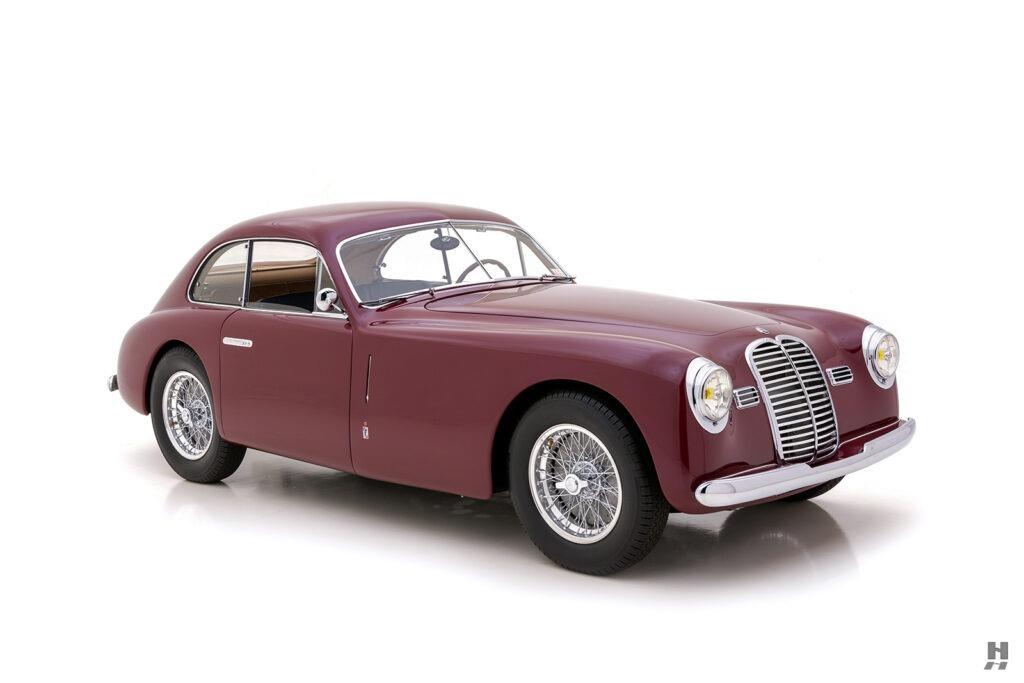
Maserati today records 61 A6 1500s built between 1947 and 1950, the majority with Pinin Farina coachwork. The figure is worth stating because totals of 58, 59 or simply “about sixty” continue to circulate in older publications. Sixty-one remains the most appropriate model total unless future examination of period production records produces a more precise chassis-by-chassis accounting.
At approximately 950 kilograms in berlinetta form, powered by its small 1.5-litre six-cylinder engine and capable of around 140–150 km/h depending on specification and contemporary source, the A6 was not conceived around spectacular figures. Its achievement was balance. Performance that would once have belonged to specialised sporting machinery was combined with a properly trimmed interior, full instrumentation and the sort of carefully considered detail that signalled a fundamentally different relationship with the customer. Leather upholstery, luggage capacity and details such as the clock incorporated into the glovebox door were small things, but small things were precisely what differentiated a competition-derived machine from a Gran Turismo.
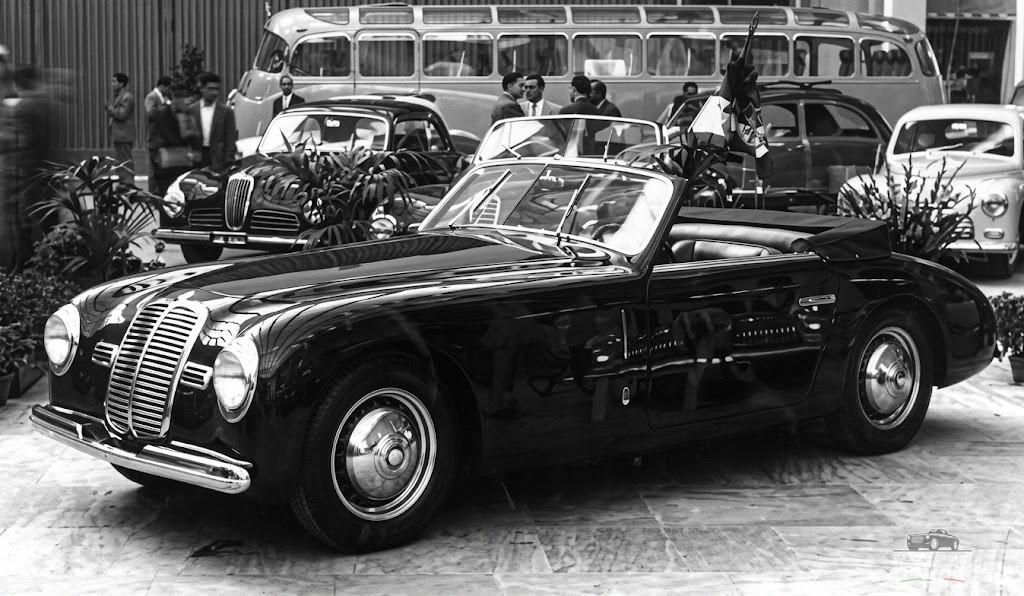
Nor was the family confined to one Pinin Farina berlinetta shape. Maserati’s first road chassis soon became a canvas for the coachbuilding culture that would define many of the marque’s most interesting cars during the following decade. Pinin Farina itself produced open interpretations, including the A6 1500 Spyder chassis 057, shown at Turin in 1948, while Zagato transformed chassis 052 into the extraordinary A6 1500 Panoramica. Its enlarged glazed surfaces and radically different relationship between roof, pillars and passenger compartment demonstrated just how much the character of the same underlying Maserati could change in the hands of another carrozzeria.
That ability of the chassis to accommodate different interpretations would become one of the defining features of the entire A6 lineage. A Maserati could share its mechanical foundation with another car yet acquire an almost completely different personality through coachwork. For the historian this is precisely why the chassis number often tells a more useful story than the model name alone.
Chassis 053, from Modena to Argentina and back
The later life of chassis 053 makes it one of the most useful surviving witnesses to the birth of the A6. After its appearances during 1947, the car was registered Modena 18300 on 15 January 1948 and acquired by Ciro Basadonna, the gentleman driver who would later win the 1954 Monte Carlo Rally alongside Louis Chiron. Few first owners could have fitted the concept of the A6 better. Basadonna belonged to precisely the world for which the new Maserati made sense, where sporting ability and long-distance road use complemented rather than contradicted one another.
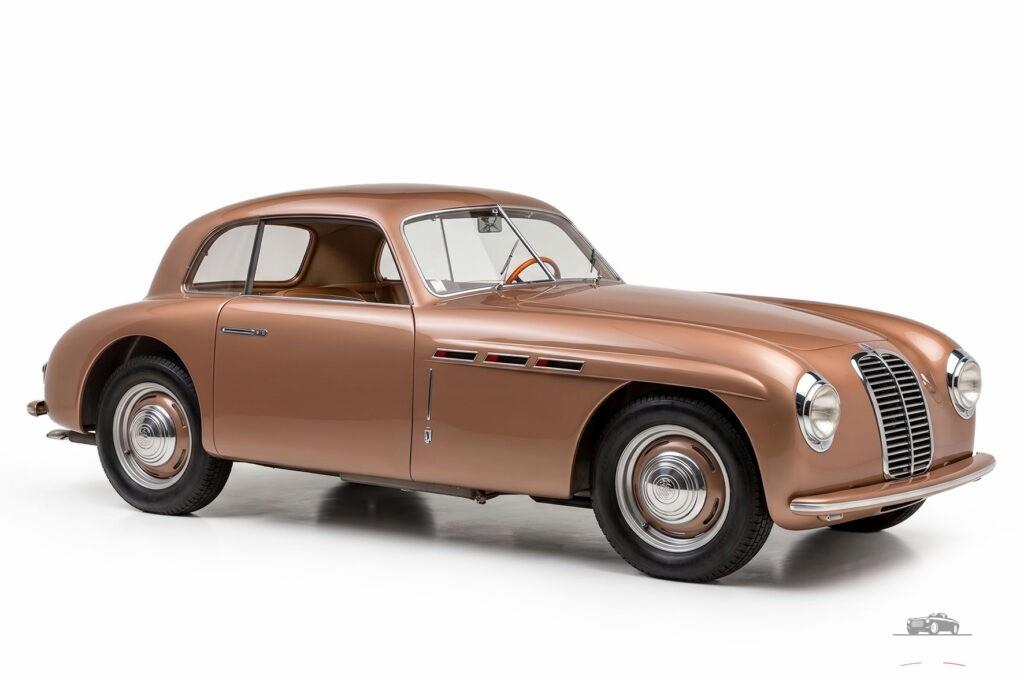
In November 1949 he sold the berlinetta to Piero Carini of Milan, and in 1950 the car left Italy for Argentina, where it was to remain for decades. It is here that the documented history meets one of the more seductive stories surrounding the early A6. The car has frequently been connected with Eva Perón, and the affectionate name Maserita has become part of the folklore repeated around it. The association is colourful enough to have survived through numerous retellings, but colour is not documentation. In the absence of an Argentine registration document, customs record, correspondence or another primary source directly connecting chassis 053 with Perón, the story is better preserved as an attribution than presented as an established ownership fact.
The car returned to Italy at the end of the 1970s and in 2007 was acquired by Luciano Nicolis, founder of the Museo Nicolis. Its restoration, undertaken with historical guidance from Adolfo Orsi, grandson of the industrialist whose family had transformed Maserati, concentrated on recovering the prototype’s original characteristics rather than simply producing a cosmetically perfect A6. The champagne-coloured berlinetta with its striking red intake details became one of the last restoration projects personally followed by Luciano Nicolis before his death in 2012.
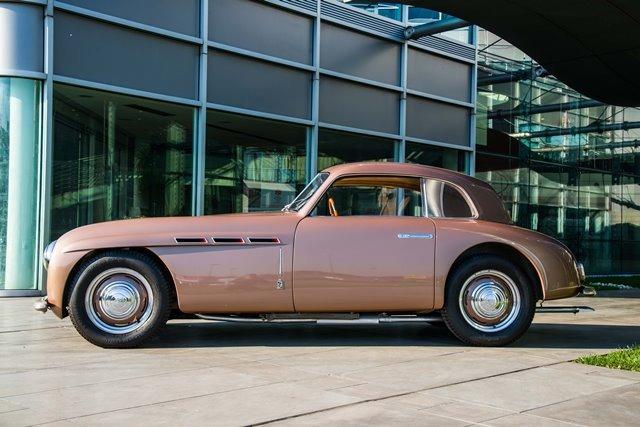
Its second public life has been almost as rich as its first. In 2012 the car was selected for the opening exhibition of the Museo Casa Enzo Ferrari in Modena and appeared at the Concorso d’Eleganza Villa d’Este; it was also included that year in the MAUTO exhibition devoted to the automotive paintings of Enrico Ghinato. Two years later it returned to Modena for the celebrations marking Maserati’s centenary, subsequently appeared at Verona Legend Cars in 2016 and in 2018 was chosen by Poste Italiane for a commemorative philatelic postcard.
The importance of those appearances lies less in accumulating a modern concours résumé than in the changing role of the object itself. In 1947 chassis 053 demonstrated that Maserati could make a sophisticated road car. Seven decades later the same automobile had become evidence of how that transformation occurred: through the interaction of a Modena engineering programme and a Turin carrozzeria, with the finished car dependent on both.
The A6 becomes a family
Maserati did not allow the original 1500 formula to stand still for long. Italian economic conditions were changing, customers expected more performance and the potential of the A6 chassis encouraged development. The A6G 2000, presented in 1950 and delivered to its first customers from the following year, enlarged the six-cylinder engine to two litres and raised output to roughly 90–100 horsepower depending on specification. The letter G referred originally to ghisa, the cast iron used for the engine block, although light alloys would soon re-enter the story. Pinin Farina produced a small series of four-seat fastback coupés, while other coachbuilders increasingly gave the Maserati their own interpretation.
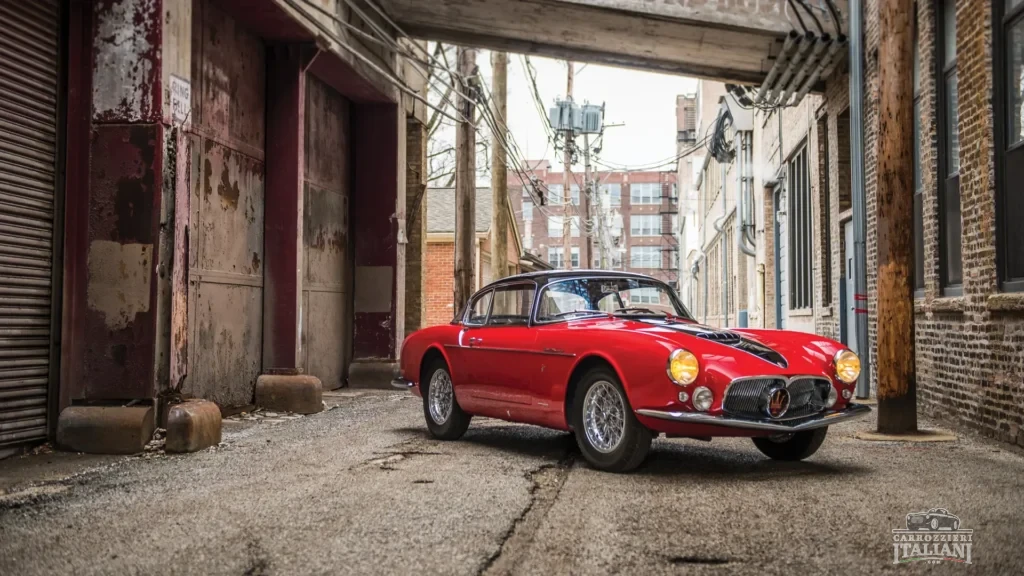
This is where the A6 story becomes inseparable from the extraordinary richness of Italian carrozzeria culture. Pietro Frua developed some of the most elegant open and closed versions, giving the Maserati a more decorative and sensual character; Zagato, unsurprisingly, pursued lightness, compact dimensions and a much more explicit sporting vocabulary; Allemano would later create restrained grand touring bodies whose formality contrasted with Zagato’s competition-minded approach. The identity of the Maserati was no longer fixed by a single body style. The chassis became a framework around which different visions of the Italian Gran Turismo could coexist.
The relationship between competition and road cars meanwhile remained fluid. The A6 architecture evolved into the A6GCS competition family, and eventually into the twin-cam A6G/54 road cars, where the two strands came remarkably close together. Few automobiles express that exchange more clearly than the A6GCS/53 Berlinetta Pinin Farina. The initiative came not directly from Maserati but from Roman dealer and Scuderia Centro Sud founder Guglielmo “Mimmo” Dei, who acquired bare competition chassis and commissioned Pinin Farina to create closed bodies for customers seeking more protection in long-distance events. Four berlinettas were ultimately completed.
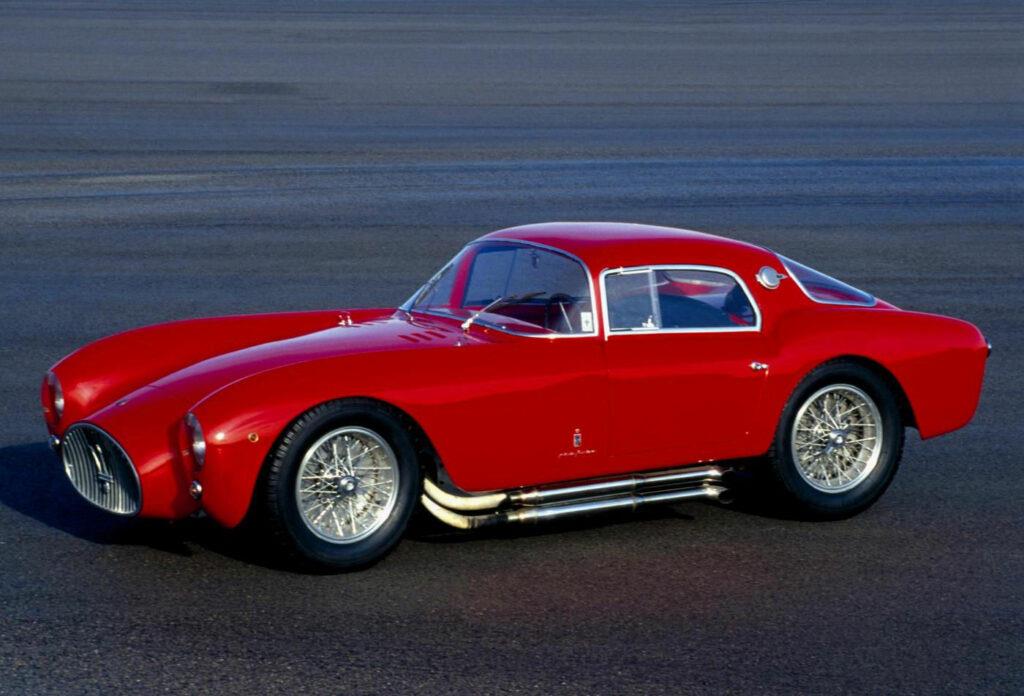
Presented publicly at the 1954 Turin Motor Show, the A6GCS berlinetta was an extraordinary reconciliation of a racing car’s narrow mechanical package with the elegance expected of an Italian coupé. Its low nose, tightly wrapped body, delicately drawn roof and muscular rear haunches produced one of the definitive shapes of the decade. It was also an unusual episode politically: Pinin Farina’s increasingly close relationship with Ferrari meant that Maserati itself could not simply commission the coachbuilder in the normal way, making Dei’s intervention essential. The four surviving cars have since become among the most celebrated coachbuilt Maseratis, but their importance within the A6 story is greater than their rarity. They demonstrate how far the formula had evolved in only six years: from a 65-horsepower road berlinetta to a 170-horsepower competition machine wearing a body of almost implausible sophistication.
The later A6G/54 brought that maturity back to the road. Frua, Zagato and Allemano produced markedly different interpretations, from the elegant Frua spyders to Zagato’s lightweight berlinettas, whose competition-derived forms were among the most purposeful Maseratis of the period. By then the experiment begun in 1947 had become a genuine model culture. Maserati no longer needed to prove that it could build a road car; it could choose what sort of road car it wanted to build and invite Italy’s leading coachbuilders to provide different answers.
Before Gran Turismo became a Maserati tradition
The success of the 3500 GT at the end of the 1950s would change the scale of Maserati road-car production altogether. With Touring coachwork and a far more industrialised approach, the 3500 transformed the company from a producer of tiny numbers of individually bodied automobiles into a serious manufacturer of high-performance Gran Turismo cars. Seen from that perspective, the A6 1500 is sometimes treated merely as a preface, an interesting but tentative step before the “real” Maserati GT story began.
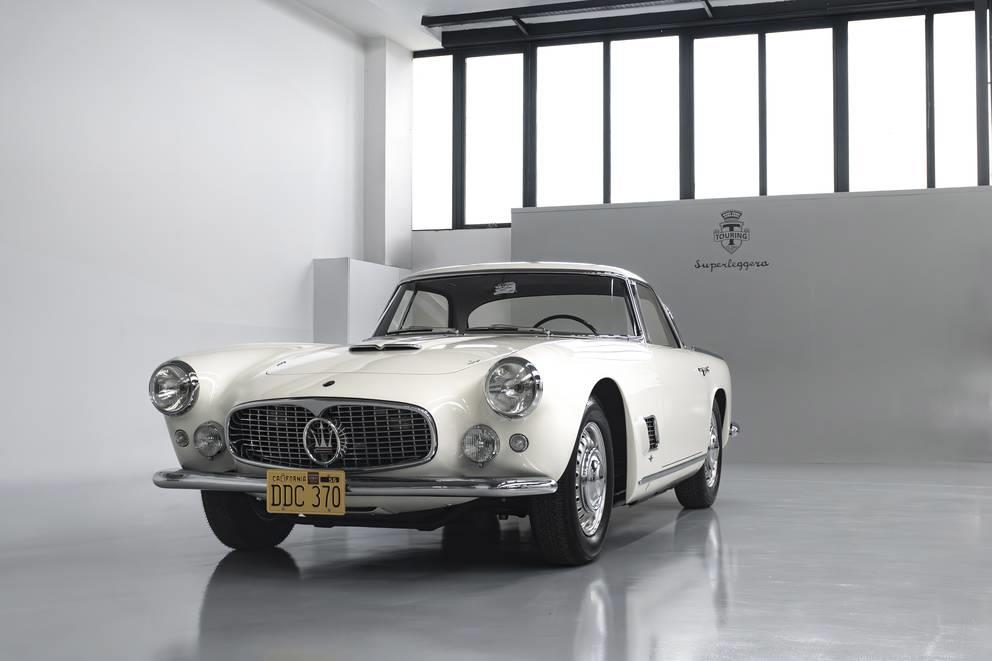
That interpretation underestimates it. In 1947 there was no established Maserati road-car language to inherit. The A6 had to create one. It had to decide how a company associated with racing cars should present itself to a private customer, how much of competition technology should be retained, how luxury should be introduced without diluting the marque and, crucially, what a road-going Maserati should actually look like.
The answer was not produced by Maserati alone, nor would it have made sense without Maserati. Adolfo Orsi provided the industrial decision to broaden the company’s future beyond competition; the Maserati technical tradition and engineers such as Alberto Massimino supplied the mechanical basis; Pinin Farina translated that basis into a body capable of belonging to the new post-war world. Later Frua, Zagato, Allemano and others would take the same idea in their own directions, while cars such as the A6GCS berlinetta would close the circle by dressing a competition chassis with the elegance of a Gran Turismo.
Chassis 053 allows that entire process to be understood in a single automobile. Its fixed lamps and revised glazing show Pinin Farina already moving beyond the Geneva prototype toward production. Its display at the Milan Triennale places Maserati inside the rebirth of Italian coachbuilding. Its ownership by Basadonna shows the car leaving the exhibition stand and entering the life of the gentleman driver for whom it had been conceived. Its journey to Argentina and eventual return to Italy reflect the international lives led by many bespoke Italian automobiles, while its preservation at Museo Nicolis has turned an early production experiment into a physical historical document.
The later Maseratis became faster, more powerful and more numerous, but none had to solve quite the same problem. The A6 1500 was the car with which Maserati learned that the qualities which made a racing machine desirable did not have to be discarded on the road; they had to be translated. A tubular frame, a modest six-cylinder engine, the experience of Modena and the hand of a Turin coachbuilder were enough to establish the formula.
And before GranTurismo became the name of a Maserati, the A6 made it an idea.

ABOUT THE AUTHOR
Andreas Scheidl
Italian classic car enthusiast with German roots. Renowned as a respected figure in the classic car community, he serves as a jury member at various international concours d'elegance, including the Classic Gala Schwetzingen and Mantova. As a content creator, Andreas passionately shares his profound knowledge and appreciation for vintage automobiles. His heart beats for cars designed by Giovanni Michelotti, showcasing his discerning taste and dedication to preserving the timeless elegance of automotive history.
More stories by Andreas Scheidl ↗CONTINUE READING
Posts You Might Like

A Central Driving Position, a Rear-Mounted V8. Was This Really a Lancia?
In 1948, visitors to the Turin Motor Show could see an unusual Lancia on the stand of Carrozzeria Ghia. It was a large two-door coupé with a two-litre V8 mounted behind the…
Read story
Fioravanti F100: The Ferrari He Was Allowed to Imagine
Enzo Ferrari’s centenary, Leonardo Fioravanti’s independent studio and a supercar that explored air brakes, steel wheels and a new way of driving—without ever wearing the Cavallino.
Read story
Michelotti Shellette: When the Fiat 850 Became a Yacht
The yacht designer, the Turin stylist and the tiny coachbuilt car that crossed between the quay, the royal holiday house and the auction room. Some automobiles were conceived for the open road,…
Read story
Ferrari FX: Beyond the Limits of Maranello
Six documented chassis, the disputed seventh car, Williams transmission development and the anatomy of one of the least understood Ferraris of the 1990s
Read story
THE CONVERSATION
Comments 0
Share a memory, a period photograph or a documented detail about this story.