
Michelotti Shellette: When the Fiat 850 Became a Yacht
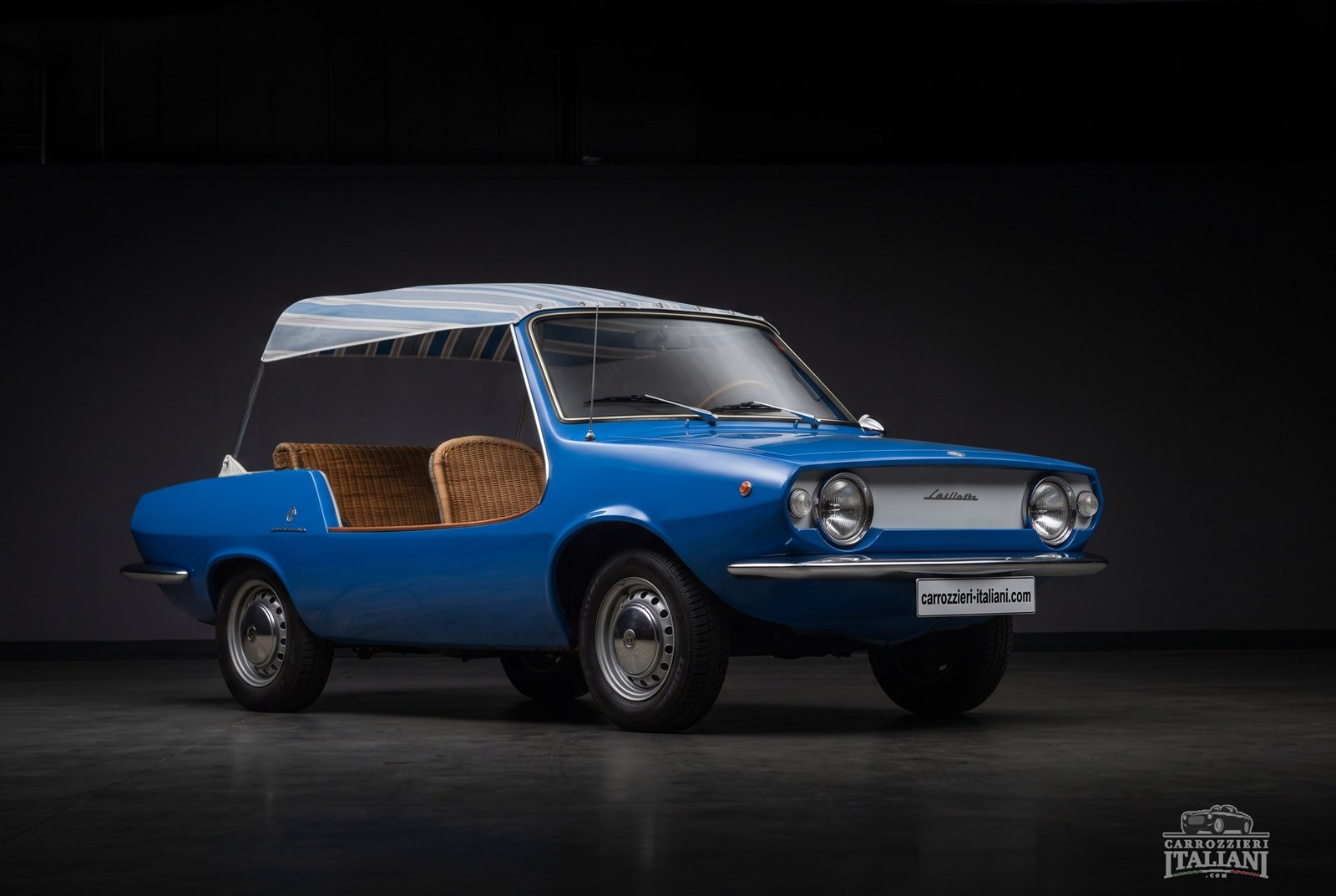
The yacht designer, the Turin stylist and the tiny coachbuilt car that crossed between the quay, the royal holiday house and the auction room.
Some automobiles were conceived for the open road, others for racing circuits or the ceremonial arrival beneath the portico of a grand hotel. The Michelotti Shellette belonged to a rather more particular environment, one in which the distance between a yacht and a seaside residence might be measured in a handful of kilometres, yet the vehicle chosen to cover it was expected to display as much individuality as the yacht itself. Along the Mediterranean coast during the 1960s, the small beach car had become one of the more curious expressions of European luxury, combining the mechanical simplicity of an everyday automobile with the craftsmanship and exclusivity normally reserved for considerably more expensive machines.
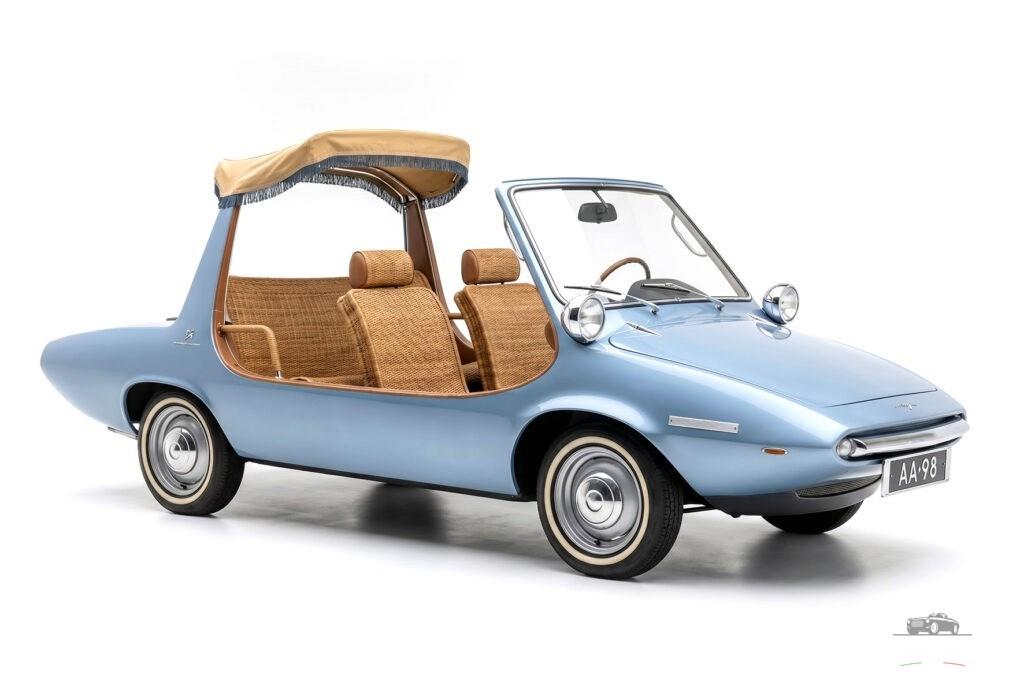
The Shellette was among the most sophisticated interpretations of this idea. Its compact dimensions, generously open passenger compartment, wicker furnishings and fringed canvas roof gave it an unmistakably playful appearance, but beneath those apparently frivolous details lay a carefully considered design that owed as much to the practical requirements of nautical life as it did to the traditions of Italian coachbuilding. Conceived through the collaboration of yacht designer Philip Schell and Turin stylist Giovanni Michelotti, the car represented a meeting between two disciplines accustomed to treating proportion, material and space as essential elements of luxury.
There was something particularly appropriate about a car that could be carried aboard a yacht, lowered onto a quay and driven through the narrow streets of a Mediterranean village without requiring the dimensions, horsepower or ceremony of a conventional luxury automobile. Its purpose was not to impress through mechanical excess, but through the elegance with which it fulfilled a remarkably specialised function. The Shellette could accommodate passengers returning from the beach, negotiate the roads above Monaco and wait outside a private villa with an assurance that had little to do with its humble Fiat origins.
That combination of modest engineering and expensive individuality explains why the Shellette attracted the attention of wealthy industrialists, prominent families and yacht owners, while its subsequent history reveals a much more complex genealogy than the familiar photographs of cane seats and striped canopies might suggest.
From the Italian Spiaggina to Michelotti’s Modern Interpretation
The Shellette arrived during the maturity of a tradition that Italian coachbuilders had been developing since the 1950s, when the country’s smallest production cars began appearing in forms that bore little resemblance to their inexpensive origins. Among the earliest celebrated examples was the Fiat 500 Spiaggina by Boano, associated with Gianni Agnelli, whose special body demonstrated how a modest automobile could become an almost bespoke accessory to a particular way of life.
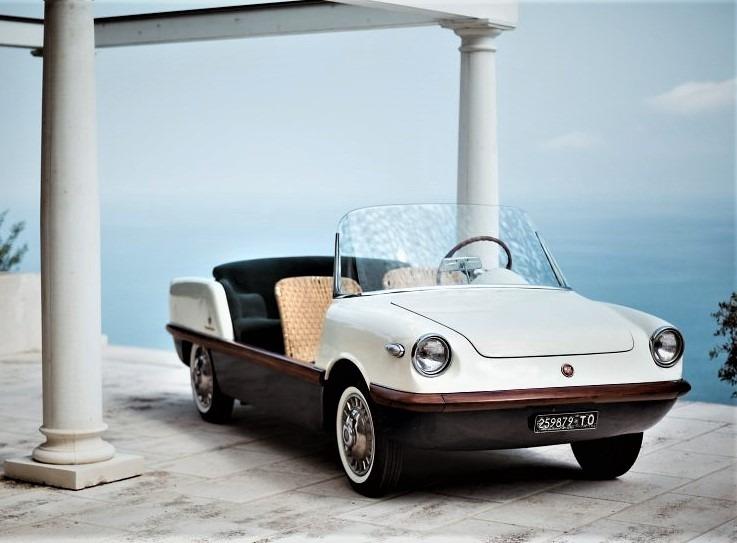
The concept found wider recognition through the Fiat 600 Jolly by Ghia, whose open doorways, woven seats and characteristic canopy established many of the visual conventions that would define the Italian beach car. Pininfarina approached the same subject with a different sensibility in the Fiat Multipla Eden Roc, where the relationship between the automobile and the motor launch was particularly evident. These vehicles were not cabriolets in the conventional sense, because their entire architecture had been conceived around short journeys in warm climates rather than the broader demands of everyday motoring.
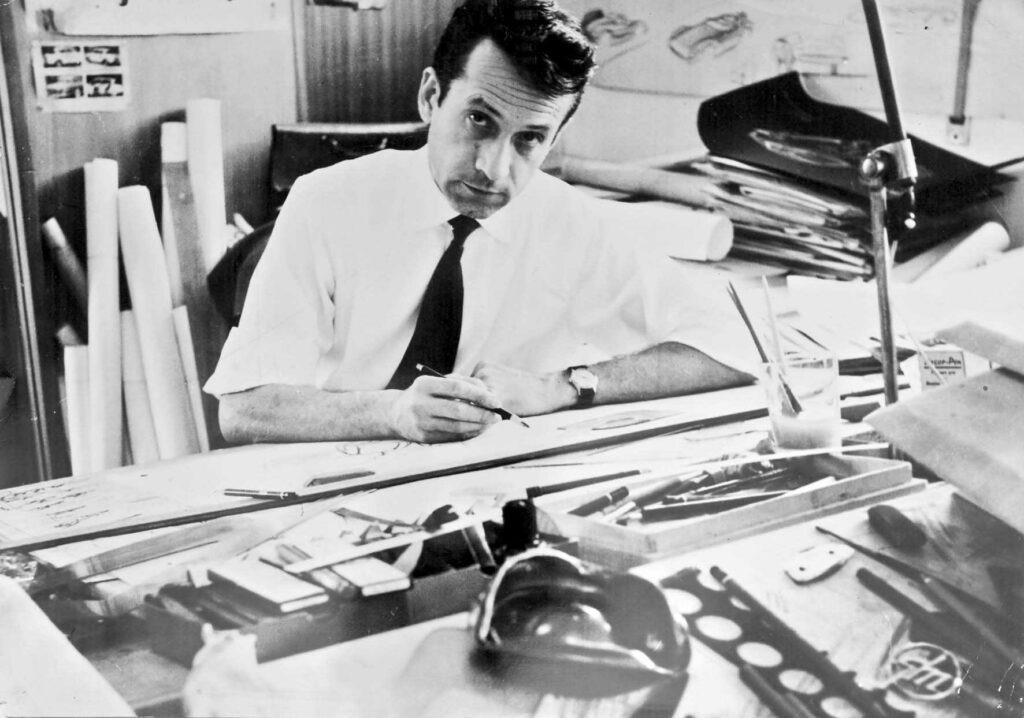
By the middle of the 1960s, the spiaggina had become a recognisable feature of the Riviera, yet the genre still offered considerable freedom for experimentation. Giovanni Michelotti, whose work ranged from Italian gran turismo coachwork to production automobiles for Triumph, BMW and DAF, recognised that the concept could be developed into something less decorative and more architecturally resolved than many earlier examples.
Where the Jolly relied on the rounded forms and cheerful character of the Fiat 500 and 600, Michelotti preferred flatter surfaces, stronger horizontal lines and carefully integrated openings that made the entire body appear designed for its purpose rather than derived from a conventional car with its doors and roof removed. It was an approach consistent with his work for the Dutch manufacturer DAF, whose increasingly modern production models demonstrated his ability to give relatively modest mechanical platforms a distinct and coherent visual identity.
The Shellette would eventually become the best-known commercial expression of these ideas, although the first chapter of its story involved neither Fiat nor Philip Schell’s celebrated namesake.
Alassio, the DAF Kini and a Royal Connection
In 1966, Michelotti presented an unusual open-bodied automobile at Alassio, the fashionable Ligurian resort whose name the car initially adopted. Constructed around DAF mechanical components, the Alassio was a compact leisure vehicle with the crisp appearance and practical openness that would later characterise the Shellette. Historical accounts associate its presentation with a prize at the local concours d’élégance, an appropriate setting for a vehicle designed to reconcile automotive craftsmanship with the social atmosphere of the Italian coast.
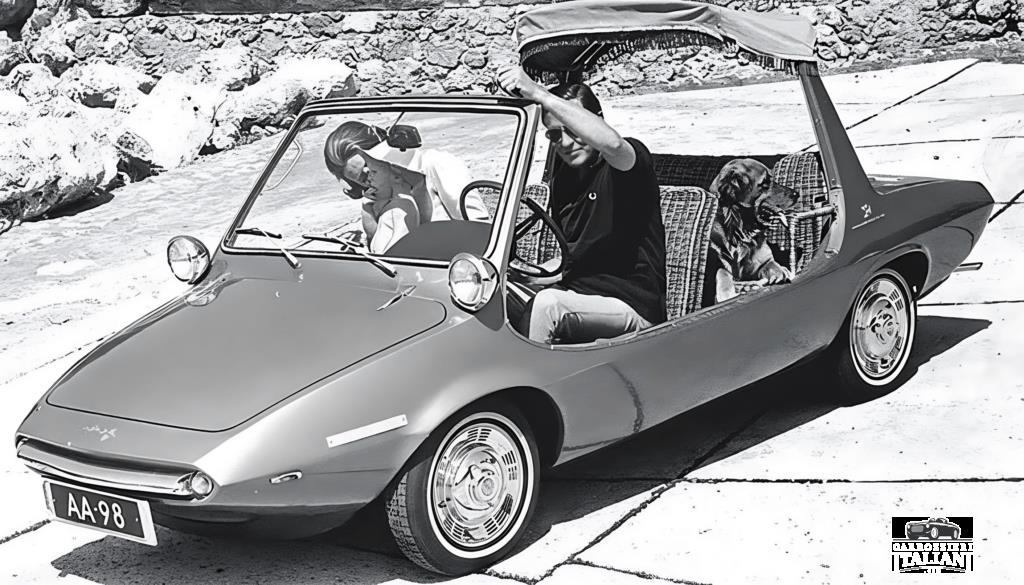
The Alassio soon acquired an identity that would make it considerably more famous. Following the birth of Willem-Alexander in April 1967, the car became a gift to Princess Beatrix and Prince Claus of the Netherlands, having previously been associated with DAF co-founder Wim van Doorne. Renamed Kini, it entered the Dutch royal family’s private world and found a particularly suitable home at their holiday residence in Porto Ercole, on the Tuscan coast.
The choice was entirely consistent with the vehicle’s conception. Rather than using the car in the Netherlands, where its open body offered limited protection against the climate, the royal family employed it in the Mediterranean surroundings for which Michelotti had designed it. Porto Ercole, with its harbour, narrow roads and summer residences, provided the Kini with a setting that made its unusual configuration seem perfectly natural.
Its mechanical identity has nevertheless become somewhat confused in later accounts. The car has been described under several DAF model designations, including DAF 32, DAF 33 and DAF 55, while the Archive Storico Michelotti itself has used the DAF 55 Kini designation in material relating to the designer’s centenary exhibition. The distinctions are not insignificant, since they concern the precise development stage and donor components of a unique automobile. Without a conclusive identification from original construction records, the safest historical description remains that of a DAF-based Michelotti prototype.
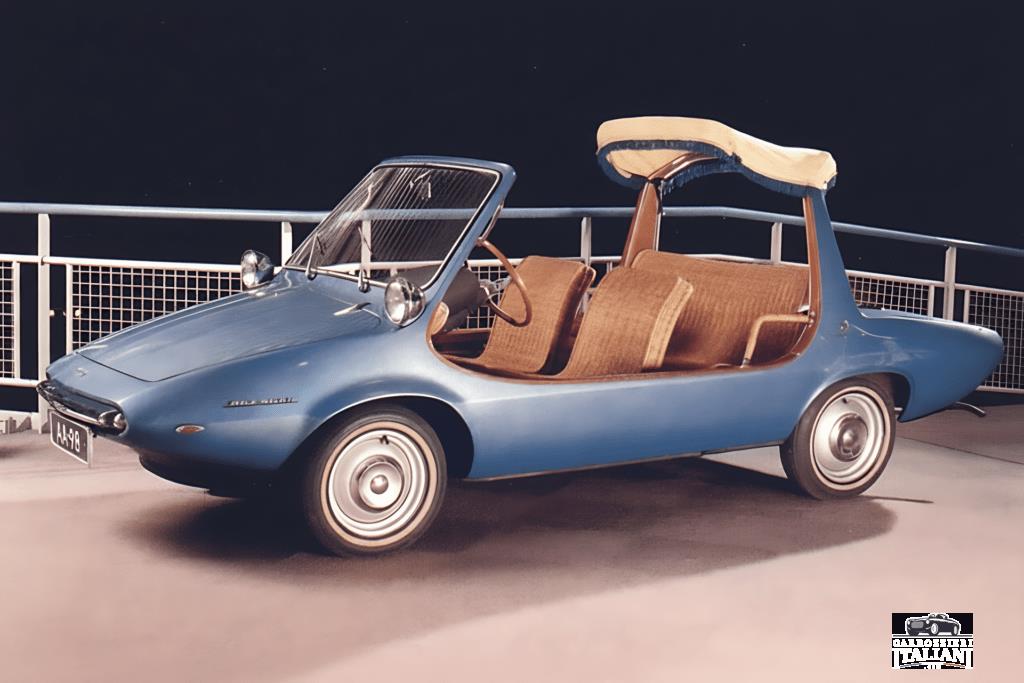
The chronology, however, leaves little room for doubt about the direction of the design’s development. The Alassio appeared in 1966, received its royal association in 1967 and preceded the Fiat-based Shellette introduced around 1968. It was therefore the earlier DAF project that anticipated the later Fiat design, rather than a royal variation of an already established Fiat model.
More than half a century after its creation, the Kini retained its special place in Dutch automotive history. During the King’s Day celebrations of 2021, King Willem-Alexander drove the car through Eindhoven with Princess Amalia beside him, offering a rare public appearance for a vehicle closely associated with his family’s private history. Later that year, the DAF Museum opened an exhibition celebrating the centenary of Giovanni Michelotti, with the Kini and other creations recalling the remarkably productive relationship between the Turin designer and the Dutch manufacturer.
Philip Schell and the Birth of the Shellette
The name Shellette derived from Philip Schell, the yacht designer whose involvement helped transform Michelotti’s earlier experimentation into a vehicle suited to the requirements of an international nautical clientele. Schell’s professional world was naturally concerned with the efficient use of space, the relationship between structure and weight, and the practical problems associated with transporting passengers and equipment between vessel and shore. These considerations gave the projected beach car a purpose extending beyond the fashionable appeal of its appearance.
For an owner who spent the summer aboard a large motor yacht, a conventional automobile created several difficulties. It occupied valuable space, could be awkward to load and unload, and provided more equipment and weather protection than might be required for occasional journeys between the harbour, a nearby residence and local amenities. A carefully proportioned open car offered a different solution, especially when its body could be shaped around ease of access, relatively low weight and simple maintenance.
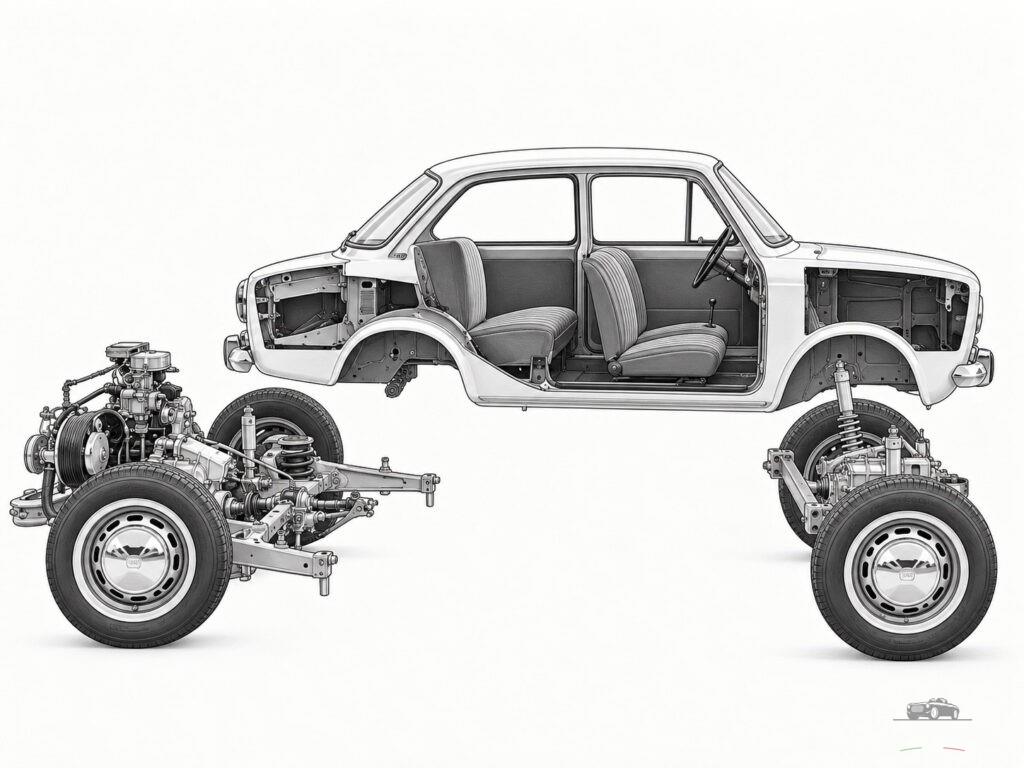
Michelotti supplied the automotive interpretation of this brief, while the Fiat 850 provided a mechanical foundation that was particularly suitable for a compact four-seat leisure car. Introduced in 1964, the rear-engined Fiat was larger and more capable than the 500 and 600 models that had underpinned many earlier spiaggine, yet remained sufficiently small to retain the advantages that made these vehicles attractive as yacht tenders.
The partnership between Schell and Michelotti also explains the distinctive balance of the finished car. Its nautical inspiration appeared not through superficial marine ornamentation, but in the economy of its surfaces, the openness of the passenger compartment and the use of materials closely associated with outdoor furniture and boat fittings. The designer gave a highly specialised object the visual coherence of a production automobile, while preserving the individual character expected of a hand-built creation.
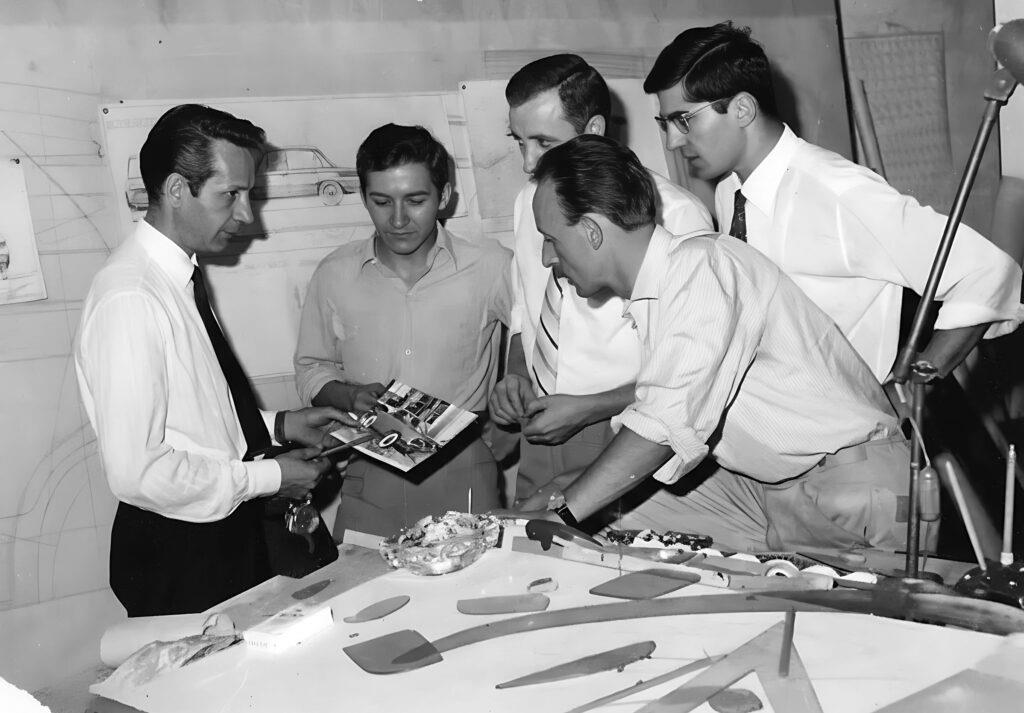
Although the mechanical components came from Fiat, the Shellette was fundamentally a Michelotti automobile in its conception and coachwork. The precise distribution of manufacturing responsibilities within Michelotti’s workshop and any associated suppliers remains insufficiently documented to assign every example to a particular subcontractor, but the cars clearly belonged to the designer’s independent activities rather than to Fiat’s regular production programme.
The Fiat 850 Reimagined
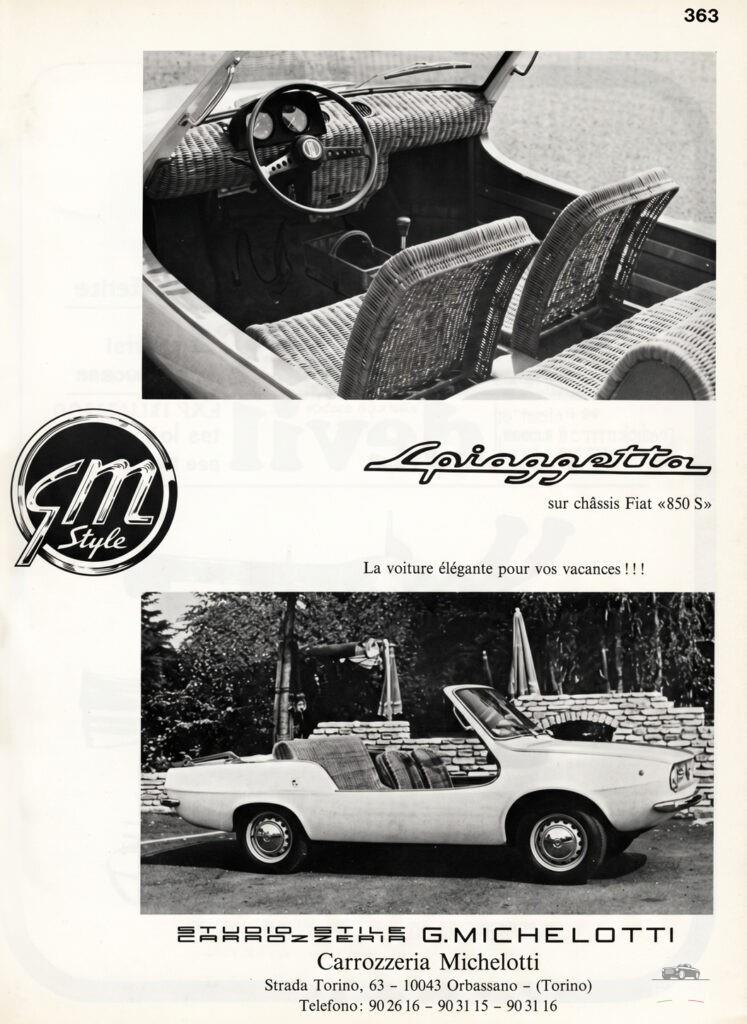
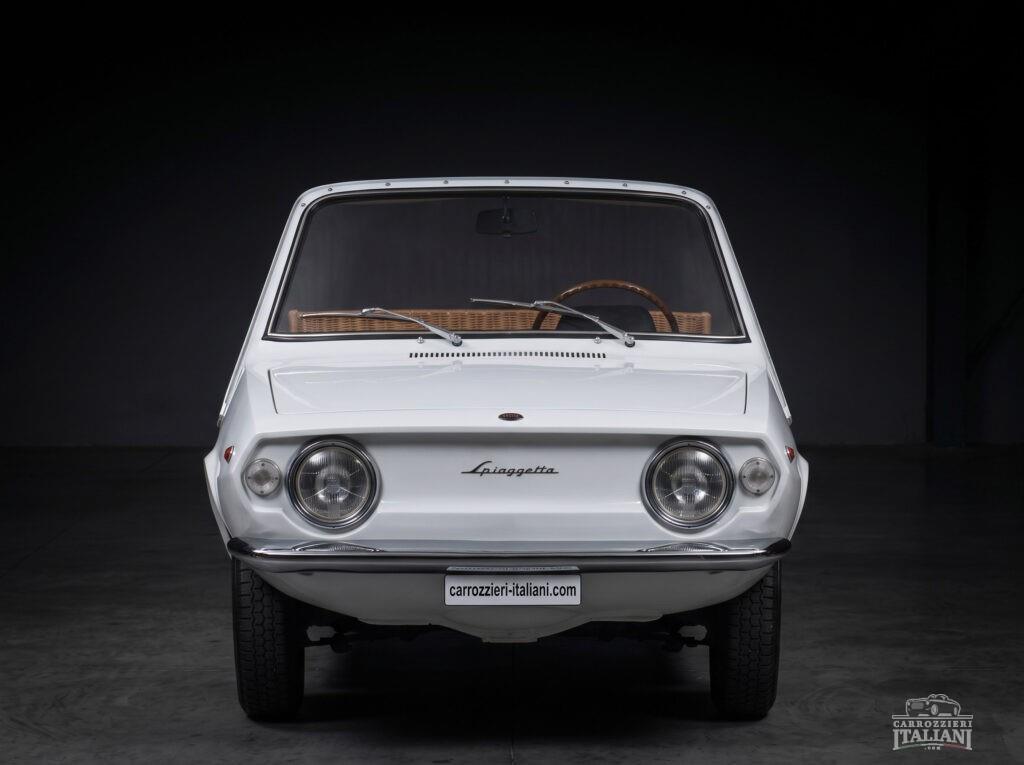
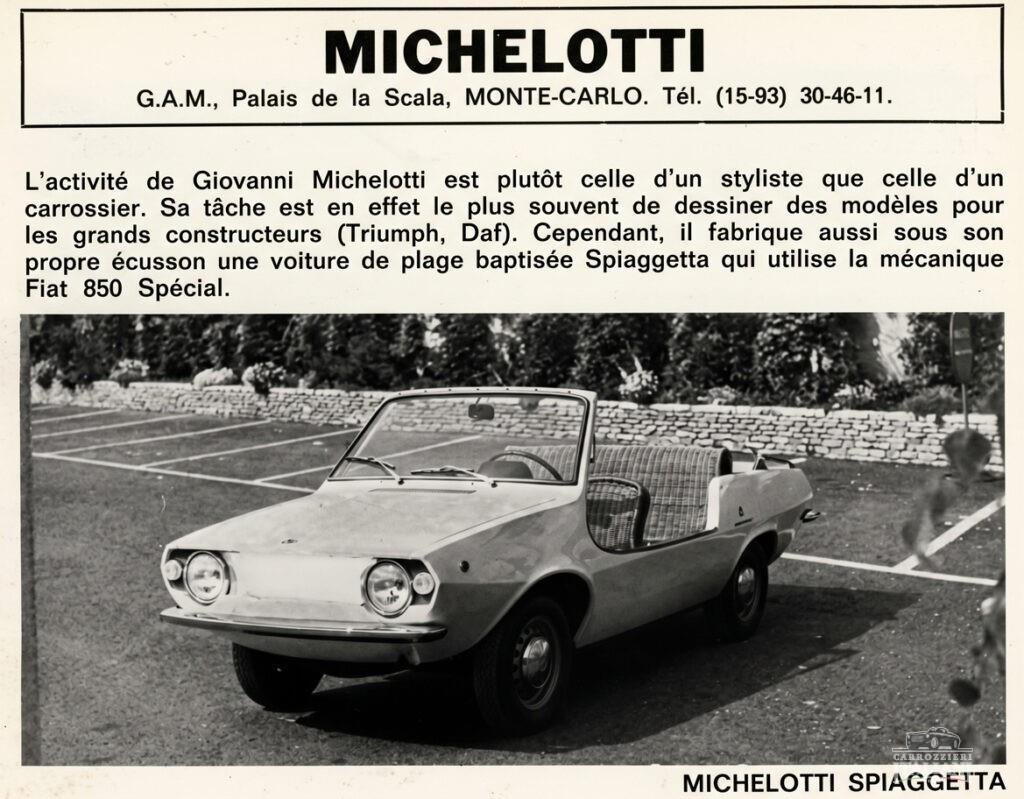
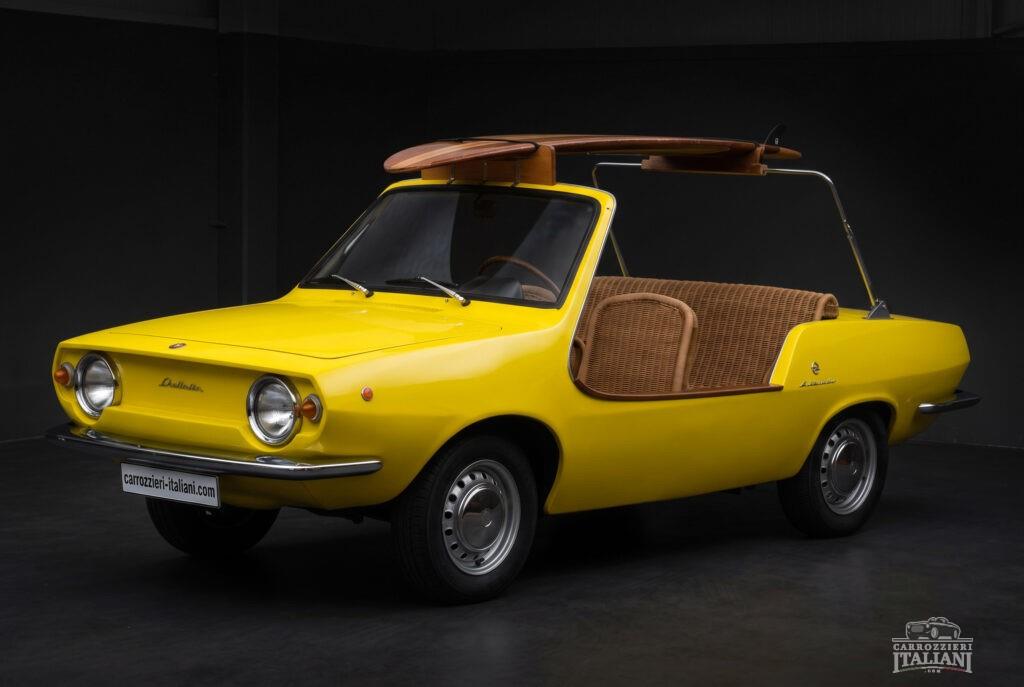
The Fiat-based Shellette appeared around 1968, adopting a body whose proportions transformed the familiar rear-engined saloon into something considerably more distinctive. The front was broad and relatively flat, with simple lighting arrangements and restrained detailing, while the sides were organised around an uninterrupted horizontal waistline and generously cut passenger openings. The result was compact without appearing cramped, its clean surfaces producing an impression of width and solidity that contrasted with the deliberately exposed nature of the interior.
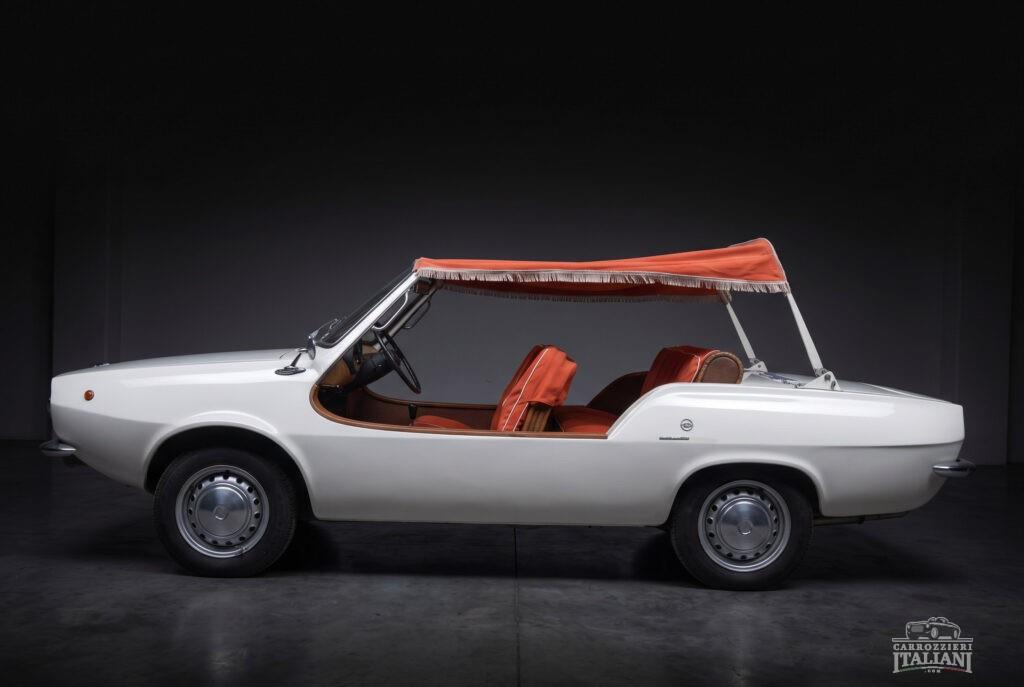
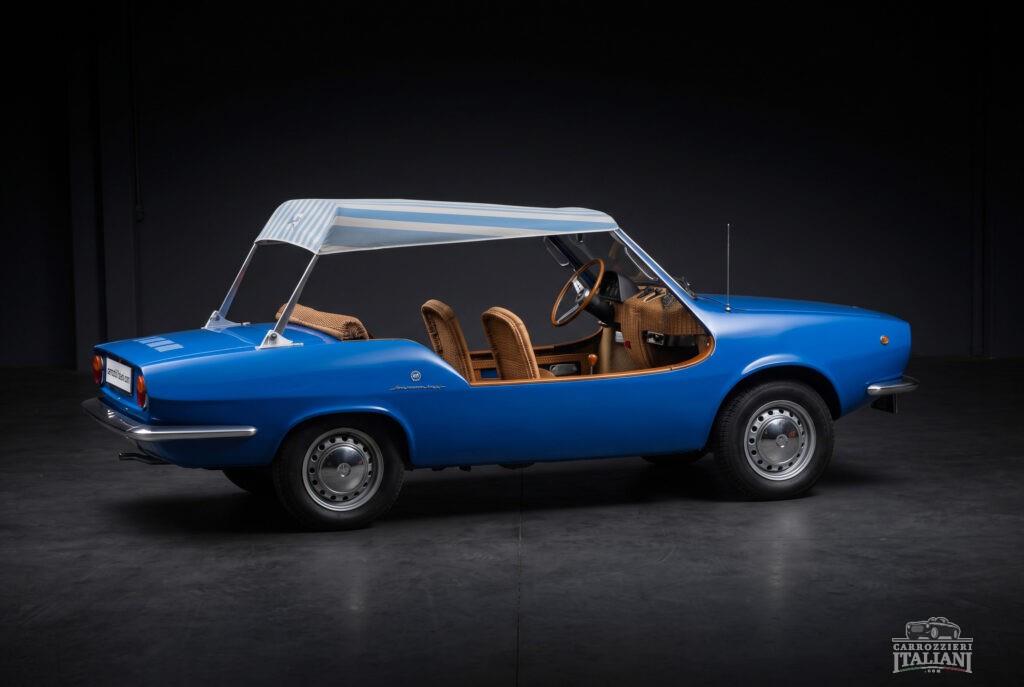
The absence of conventional doors was one of the most important characteristics of the design. Passengers could enter directly through the deep side apertures, stepping over the reinforced sill structures into a cabin almost entirely open to the surrounding landscape. This configuration also made the Shellette especially suitable for seaside use, where repeated short journeys and passengers in summer clothing placed different demands on accessibility from those of an ordinary road car.
Above the passenger compartment sat a lightweight canvas canopy, frequently finished with decorative fringe along its edges. The roof offered protection from direct sunlight and occasional light weather, but never attempted to provide the complete enclosure of a conventional convertible top. Its proportions were carefully matched to the body, and its delicate structure contributed considerably to the car’s silhouette.
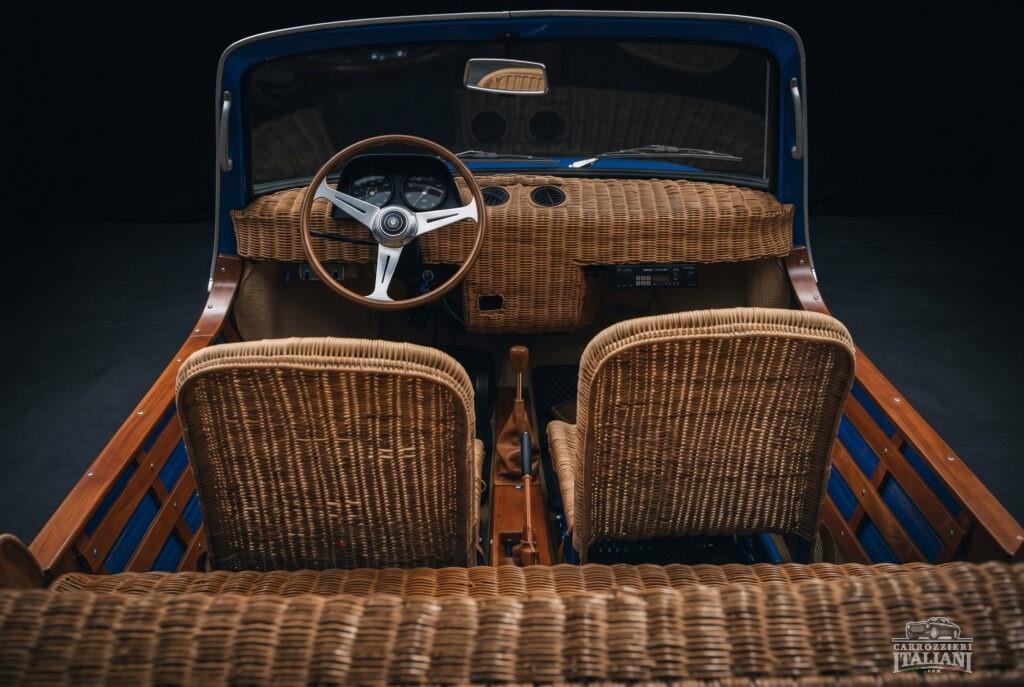
The interior provided the clearest expression of its nautical character. Woven cane seating replaced the more familiar upholstered surfaces of the standard Fiat, while wicker could also be applied to the dashboard and surrounding trim. Timber was used on interior panels and other surfaces, creating a combination of materials that would have seemed entirely appropriate aboard a motor yacht or on the terrace of a Mediterranean residence.
These details were not selected solely for appearance. Wicker offered ventilation in hot conditions, dried more readily than conventional padded upholstery and tolerated the occasional exposure to damp bathing clothes that was almost inevitable in a vehicle of this type. The seats, visually light but carefully constructed, helped make the Shellette’s passenger compartment feel closer to a piece of specialised outdoor furniture than the interior of a mass-produced automobile.
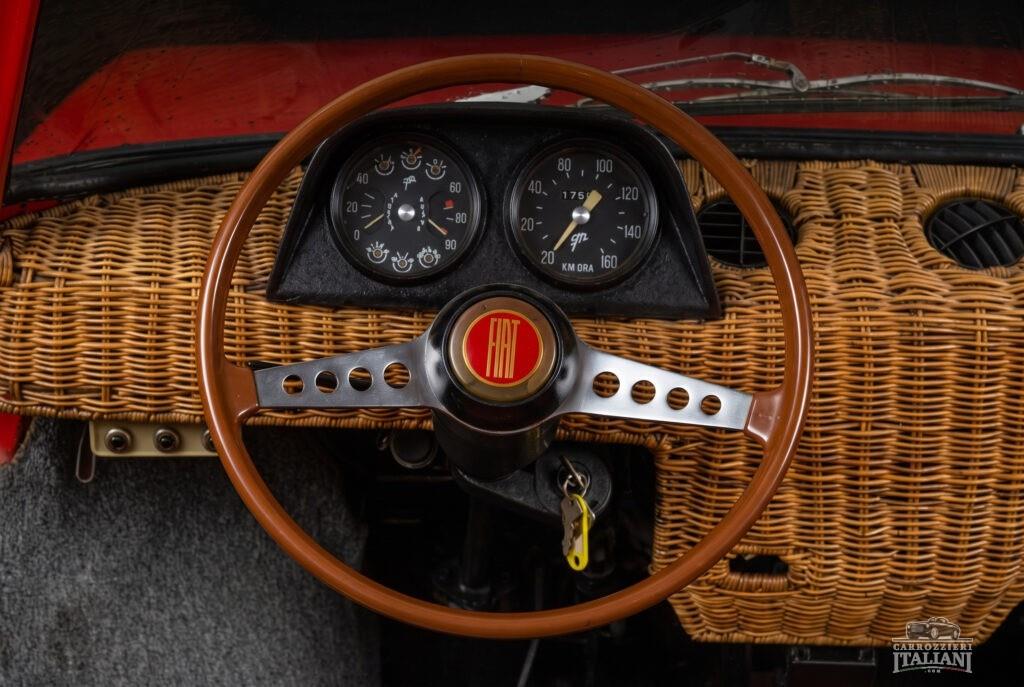
Unlike some of the most elementary beach cars, the Shellette could also be equipped with useful concessions to ordinary motoring, including a heater and radio equipment. The mechanical layout remained conventional for a Fiat 850, with the four-cylinder engine mounted at the rear, a manual four-speed transmission and rear-wheel drive. These components gave the car sufficient performance for journeys beyond the immediate harbour area, allowing its owners to use it on the winding roads and gradients of the Riviera rather than limiting it to the waterfront.
The considerable variation encountered among surviving examples makes it difficult to establish one definitive mechanical specification. Individual auction catalogues describe engines of 843 and 903 cc, and surviving interiors also differ in colour, trim and equipment. Some of these distinctions may reflect original customer preferences or mechanical variations, while others could result from later restoration and maintenance. It would therefore be misleading to apply one surviving car’s specification indiscriminately to the entire production.
As with many small-series Italian coachbuilt automobiles, the precise construction history of each example is essential to understanding the model as a whole.
The Shellette and Its Mediterranean Clientele
The Shellette was created for a clientele whose requirements were not easily satisfied by a conventional manufacturer’s catalogue. Wealthy yacht owners, industrial families and prominent international personalities formed a market in which a relatively inexpensive mechanical platform could be transformed into an expensive personal object through specialist craftsmanship and individual specification.
The Agusta family was among the distinguished names associated with the model, while auction catalogues have also connected the Shellette with Jacqueline Kennedy Onassis and the broader Onassis circle. These associations contributed greatly to the car’s later reputation, although the surviving evidence requires some care in distinguishing between the Fiat and DAF versions.
The Dutch royal family’s Kini was a separate, earlier DAF-based automobile, and reports concerning the Onassis household also refer to a DAF-based beach car, whose Variomatic transmission would have offered the convenience of automatic operation. Later descriptions have sometimes identified an Onassis-associated vehicle as a Fiat Shellette, but without a corresponding chassis number or contemporary registration documentation, the various accounts cannot confidently be reduced to a single identifiable car.
It remains possible that more than one related Michelotti vehicle was connected with the same social circle, just as it is possible that later captions confused visually similar automobiles. The distinction matters because the story of the Shellette encompasses several closely related designs rather than a uniform series of identical Fiats.
A particularly revealing example of the car’s original purpose survives today in the collection of the Louwman Museum in The Hague. Described as a 1976 Fiat 850 Shellette Spider, the museum’s automobile was one of two examples owned by Simon Kingston, a wealthy industrialist from Santa Barbara, California.
Kingston spent his summers aboard his private yacht moored at Monte Carlo, using the two small Fiats whenever he came ashore. This documented arrangement provides an unusually precise illustration of the Shellette’s intended role. For Kingston, the little cars were not merely amusing possessions brought out for occasional display, but part of the practical organisation of life aboard a yacht, providing transport whenever passengers needed to reach destinations beyond the harbour.
The existence of two Shellettes in the same ownership also suggests how naturally such specialised vehicles could become part of a larger private fleet. Their modest size and simple mechanical construction made them comparatively convenient to maintain and operate, while their individual coachwork ensured that they remained perfectly in keeping with the luxury of their surroundings.
The Louwman example is significant for another reason. Its 1976 date indicates that the Fiat Shellette’s history cannot simply be confined to the years immediately following its introduction. Whether individual late cars were assembled, delivered or first registered at different dates remains a matter for further archival investigation, but the surviving evidence demonstrates that the design continued to circulate during the 1970s.
Chassis 100GB1231722: From Michelotti to an American Barn
Among the surviving Fiat Shellettes, few have a documented history as compelling as chassis 100GB1231722, a 1969 example whose provenance links the car directly to the circle in which the project originated.
According to the historical documentation presented by RM Sotheby’s, the Shellette was purchased new by Lois Philips Poster, reportedly a friend of Philip Schell. Italian registration papers accompanying the car identified Michelotti’s premises as the delivery address, an unusually valuable detail that places the individual vehicle within the original environment of its construction and early ownership.
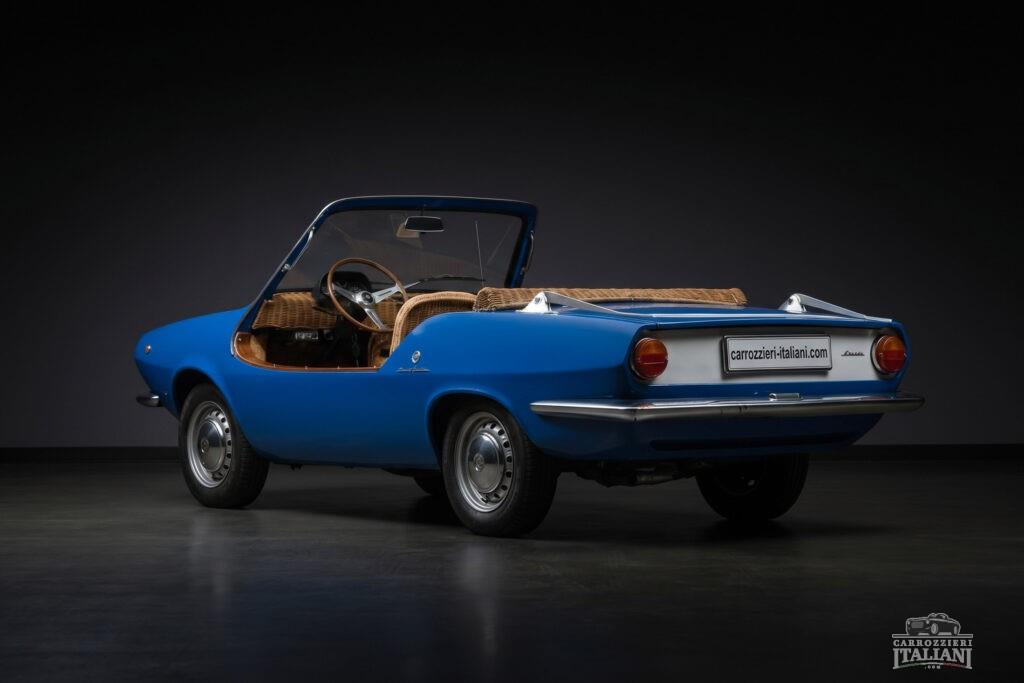
The car reportedly remained with its first owner for more than four decades, an exceptional period of continuity for a small, highly specialised automobile that might easily have disappeared through successive changes of summer residence, yacht or collection. Eventually, however, it was removed from regular use and discovered in a barn in New Hampshire in 2012.
Its rediscovery was followed by a sympathetic cosmetic restoration that preserved the original wicker seating while renewing the canvas canopy according to the original design. Retaining the woven interior was especially important because such materials, despite being among the Shellette’s most recognisable features, are particularly vulnerable to neglect and insensitive restoration.
In March 2014, the car appeared at Gooding & Company’s Amelia Island auction, where it sold for $55,000. The catalogue emphasised its long-term ownership and preserved character, presenting the Shellette not simply as a fashionable beach car but as a rare survivor whose history could be followed back to its first owner.
Ten years later, the same automobile returned to the auction market when RM Sotheby’s offered it in Miami in March 2024. Identified by the same chassis number, 100GB1231722, it achieved $53,200, providing a useful comparison between two public sales separated by a decade.
The relatively modest difference between those results should not be interpreted as a definitive statement about the development of Shellette values. Individual condition, venue, presentation, exchange rates and buyer participation can all influence the outcome of an auction, particularly when dealing with vehicles produced in very small numbers.
What makes the two sales especially valuable from a historical perspective is the continuity of identification. They concern the same physical automobile, rather than two different 1969 examples. The chassis number connects its original ownership, American rediscovery, restoration and subsequent auction history, demonstrating how much can be recovered when individual cars are investigated beyond their familiar model names.
The Agusta Spiaggetta: Chassis 100GB1290331
Another important surviving Shellette is the 1970 Fiat 850 Spiaggetta bearing chassis 100GB1290331, a car whose history is closely associated with the Agusta industrial family.
It appeared at RM Sotheby’s Monaco auction on 14 May 2016 as part of the Count Agusta Collection, carrying a distinctive specification that included white exterior paint, red seat cushions, red carpeting and a matching canopy. Wicker seating and dashboard trim were accompanied by timber-finished interior panels, creating an arrangement that reflected the unusually personal character of these automobiles.
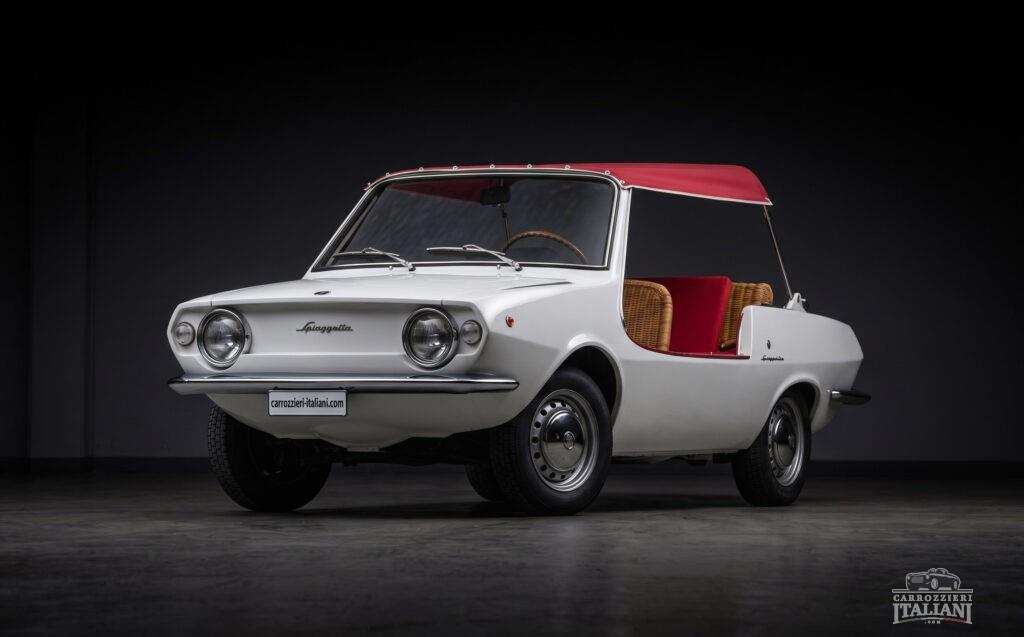
The car was described with an 843 cc four-cylinder engine and a four-speed manual gearbox, although the catalogue also contained technical descriptions inconsistent with the conventional Fiat 850 layout, including references to air cooling and leaf-spring suspension. Those details are better regarded as catalogue inaccuracies than evidence of an otherwise unknown mechanical configuration, and they underline the importance of distinguishing original factory information from later auction descriptions.
At Monaco, the Agusta Shellette achieved €61,600, confirming the collector appeal of an example with an identifiable connection to a prominent Italian family. Four years later, an Agusta-associated 1970 Spiaggetta appeared in RM Sotheby’s celebrated Elkhart Collection sale in October 2020, realising $109,200.
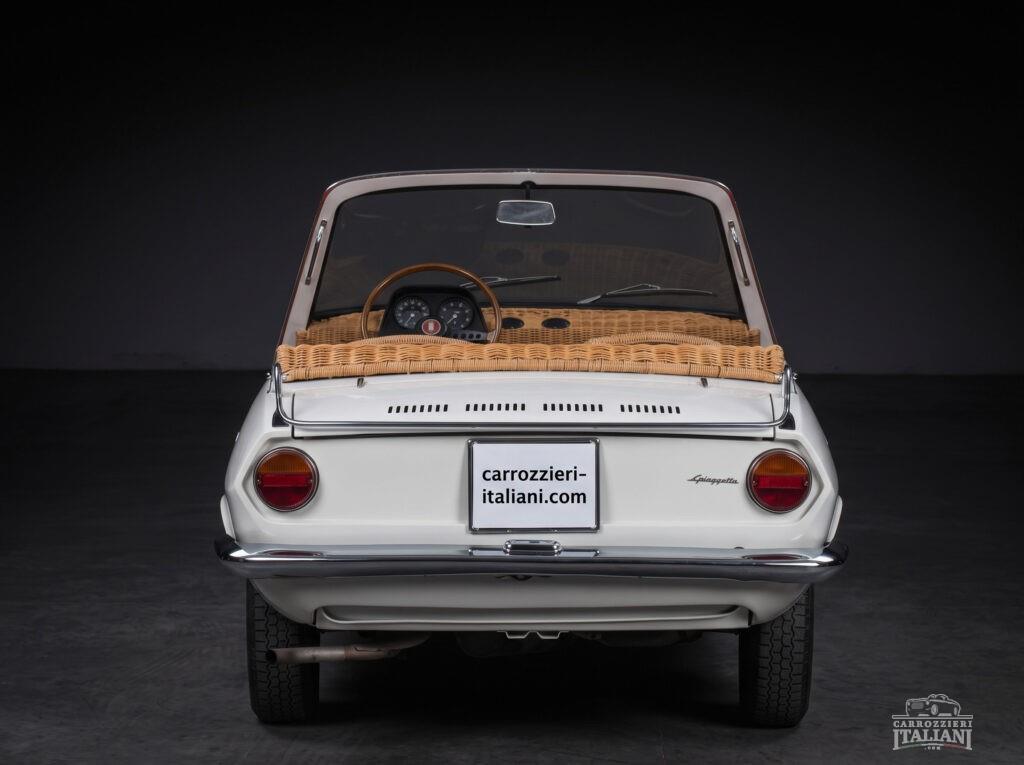
Specialist auction-history records connect the Monaco and Elkhart appearances to chassis 100GB1290331, although the identification would benefit from direct reconciliation against the original complete sale files. Taken together, the public records nevertheless offer a particularly interesting picture of the Shellette’s changing status, from specialised summer transport to a collectible example of Italian coachbuilding.
The Agusta provenance also adds another dimension to the model’s history. Here was a family associated with aviation, industrial engineering and exceptional high-performance machinery, yet among its vehicles was a diminutive Fiat-derived beach car whose appeal lay almost entirely outside the traditional measures of automotive performance.
Beyond Fiat: The DAF Shellette and the Morris Prototype
The Shellette was not confined to the Fiat 850 platform. Michelotti’s earlier work with DAF had already demonstrated the suitability of the beach-car concept for different mechanical architectures, and a separate DAF Spiaggetta/Shellette project appeared around 1968.
Unlike the earlier royal Kini, this later DAF project belonged to the continued development of the Shellette family. Period and museum documentation establish its existence, although the precise donor designation remains unsettled. References to both DAF 33 and DAF 55 appear in historical material, while the Archivio Storico Michelotti has explicitly documented the presence of a DAF 55 Spiaggetta at the designer’s centenary exhibition.
The mechanical differences between Fiat and DAF were substantial. Whereas the Fiat 850 employed a rear-mounted engine and conventional manual transmission, the DAF arrangement featured a front-mounted engine and the manufacturer’s characteristic Variomatic transmission. The latter was particularly relevant to the intended use of a beach car, providing convenient operation without the need for manual gear changes during repeated short journeys.
Michelotti’s professional relationship with DAF extended well beyond these specialised vehicles. He was instrumental in shaping the appearance of the company’s production models and explored more experimental directions with designs such as the DAF 55 Siluro of 1968. The contrast between the aerodynamic Siluro and the relaxed openness of the beach cars illustrates the extraordinary range of work undertaken by his Turin studio during the period.
An even less familiar branch of the programme emerged in 1969 with a Morris/BMC-based Spiaggetta prototype, preserved as a separate project in the CI Historical Chassis & Knowledge Master. Research testimony attributed to Edgardo Michelotti describes the vehicle as a proposal for a possible series-produced leisure car intended for the Australian market, a territory where the climate and outdoor lifestyle might have provided favourable conditions for such a model.
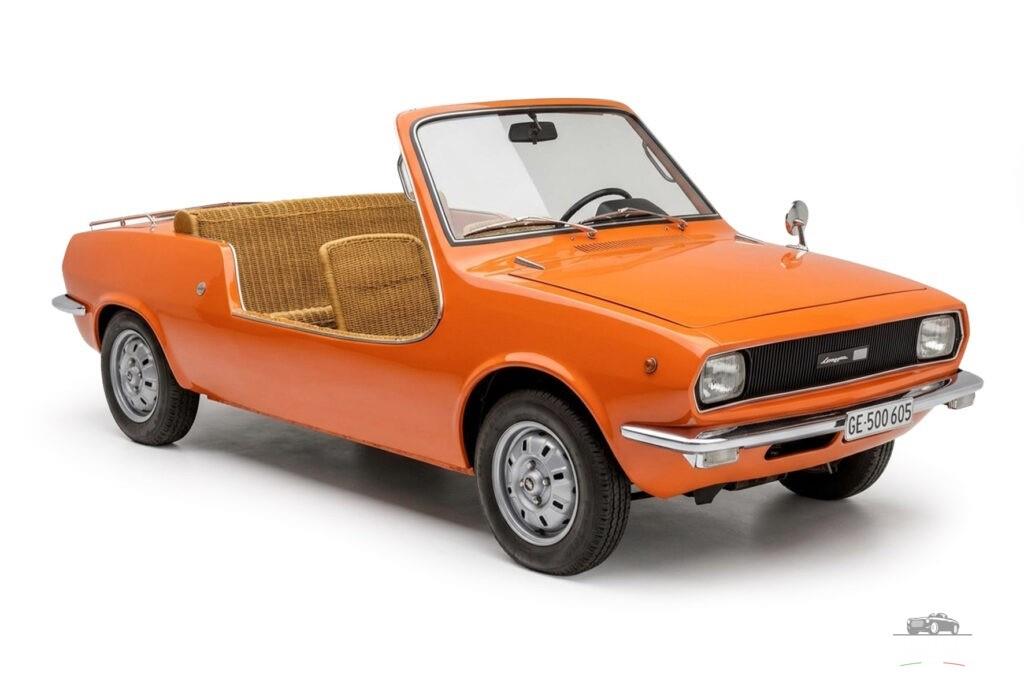
The proposed production programme did not materialise, reportedly because the intended mechanical donor was no longer available in production. Nevertheless, the prototype survived, providing valuable evidence that Michelotti regarded the beach-car concept as adaptable to several different manufacturers rather than as a one-off commercial opportunity tied exclusively to Fiat.
The car’s more recent history includes an appearance at the 2026 Crans-Montana concours, where the surviving Morris-based prototype was recorded in the ownership of Sandro De Giuli and received the Esprit d’Eclectica award. Its survival adds an important piece to the genealogy of Michelotti’s beach cars and demonstrates how ideas first developed for individual commissions could also form the basis of wider production proposals, even when circumstances prevented those proposals from reaching the market.
How Many Shellettes Were Built?
The figure most frequently associated with the Michelotti Shellette is approximately eighty examples, a total repeated in specialist publications, museum descriptions and international auction catalogues. It is sufficiently well established to provide a useful indication of the model’s rarity, but its exact meaning remains open to interpretation.
Some accounts describe eighty Fiat 850 Shellettes, while others appear to apply the same number to a broader group of related vehicles. Without a complete production register connecting chassis numbers, construction dates, mechanical donors and individual delivery records, it is difficult to establish whether the figure represents Fiat production alone or includes other derivatives.
The same uncertainty affects the number of survivors. Auction descriptions have occasionally referred to fewer than ten surviving cars, although such figures usually reflect the examples publicly known at a particular date rather than an exhaustive register of every vehicle remaining in private ownership. The reappearance of previously unknown or long-stored automobiles can change these estimates, and a car recorded in several auctions must not be counted as several survivors simply because it appears in multiple catalogues.
Production chronology is another area in which considerable caution is necessary. The Fiat version was introduced around 1968 and is frequently associated with the early 1970s, yet the 1976 Louwman Museum example demonstrates that the surviving record extends beyond some of the production periods commonly quoted. Build dates, registration dates and later descriptions should therefore be treated separately whenever possible.
What can be established is that the Shellette was a genuinely small-series automobile whose individual examples were frequently supplied to highly specialised customers, often with differing equipment, colours and interior arrangements. This limited, personal nature of production is as important to its historical identity as the precise number eventually constructed.
Michelotti’s Independent Vision
The Shellette appeared during a period of profound change for the Italian coachbuilding industry. The traditions that had supported independent carrozzerie for decades were increasingly challenged by manufacturers developing their own design departments, more sophisticated industrial production methods and tightening technical requirements. The market for individually bodied automobiles was changing, and workshops that had once relied on expensive transformations of production chassis faced the need to develop new forms of activity.
Giovanni Michelotti occupied an unusual position within this transformation. Having established his reputation as a freelance stylist whose designs were realised by firms such as Vignale, he progressively developed the ability to undertake increasingly complete projects within his own organisation. His extraordinary range of clients, from Italian coachbuilders to international manufacturers, provided a breadth of experience that few independent designers could match.
The Shellette demonstrated how this independence could be translated into a small commercial product aimed at an exceptionally specific market. Unlike a conventional design commission undertaken for a major manufacturer, the car was closely associated with Michelotti’s own identity, joining a relatively small group of automobiles whose appearance and execution were inseparable from his personal studio.
Its conception also belonged to a broader tradition of Italian designers reinterpreting the automobile according to the wishes of individual patrons. The Ferrari 365 GTC/4 Spiaggetta, based on chassis 16017, would later take the idea of open-air leisure motoring in a radically different direction, transforming a powerful twelve-cylinder grand tourer into an unconventional recreational vehicle. Although unrelated mechanically and commercially to the Shellette, the Ferrari reflected the same willingness to reconsider the traditional boundaries of automotive design.
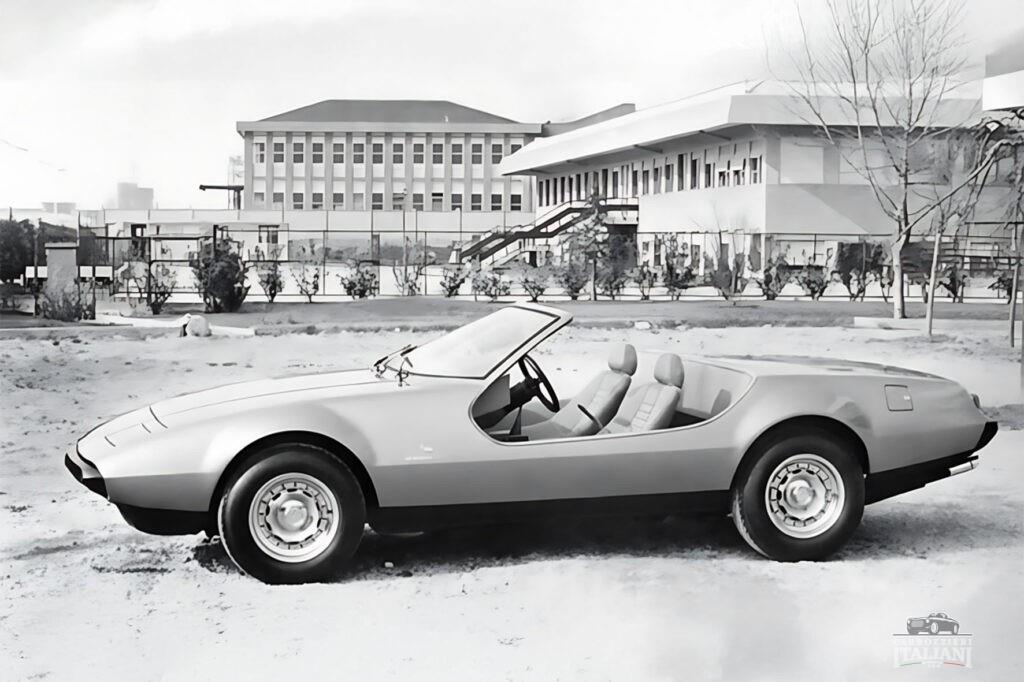
In the Shellette, however, Michelotti achieved something rather more coherent and commercially persuasive. Its modest Fiat mechanicals, compact body, outdoor materials and nautical origins formed a unified proposition, one whose suitability for its intended environment was demonstrated by clients such as Simon Kingston and the Agusta family.
The little car that emerged from Michelotti’s workshop around 1968 belonged to the same period as some of the most ambitious Italian sports cars ever created, yet it expressed an entirely different understanding of automotive pleasure. Its proportions were dictated by narrow roads and limited deck space, its interior by the heat of the Mediterranean summer, and its character by owners for whom individuality mattered more than speed.
A Shellette arriving at Monte Carlo from the deck of a yacht offered a curious reversal of the usual hierarchy of luxury automobiles. The enormous vessel might represent the greater investment and engineering achievement, but the tiny wicker-seated Fiat possessed a personality entirely its own. In an age increasingly fascinated by performance, Michelotti and Schell had created an automobile whose appeal depended on knowing precisely where it belonged, who would use it and what kind of journey it was expected to make.

ABOUT THE AUTHOR
Andreas Scheidl
Italian classic car enthusiast with German roots. Renowned as a respected figure in the classic car community, he serves as a jury member at various international concours d'elegance, including the Classic Gala Schwetzingen and Mantova. As a content creator, Andreas passionately shares his profound knowledge and appreciation for vintage automobiles. His heart beats for cars designed by Giovanni Michelotti, showcasing his discerning taste and dedication to preserving the timeless elegance of automotive history.
More stories by Andreas Scheidl ↗CONTINUE READING
Posts You Might Like

A Central Driving Position, a Rear-Mounted V8. Was This Really a Lancia?
In 1948, visitors to the Turin Motor Show could see an unusual Lancia on the stand of Carrozzeria Ghia. It was a large two-door coupé with a two-litre V8 mounted behind the…
Read story
Fioravanti F100: The Ferrari He Was Allowed to Imagine
Enzo Ferrari’s centenary, Leonardo Fioravanti’s independent studio and a supercar that explored air brakes, steel wheels and a new way of driving—without ever wearing the Cavallino.
Read story
Maserati A6 1500: A New Road for the Trident
When the doors of the Geneva Motor Show opened in March 1947, Maserati was a name that required little introduction to anyone who followed motor racing. What it did not yet possess…
Read story
Ferrari FX: Beyond the Limits of Maranello
Six documented chassis, the disputed seventh car, Williams transmission development and the anatomy of one of the least understood Ferraris of the 1990s
Read story
THE CONVERSATION
Comments 0
Share a memory, a period photograph or a documented detail about this story.