
Fiat Panda Cabrio: The Italian Coachbuilders Who Opened Giugiaro’s Box
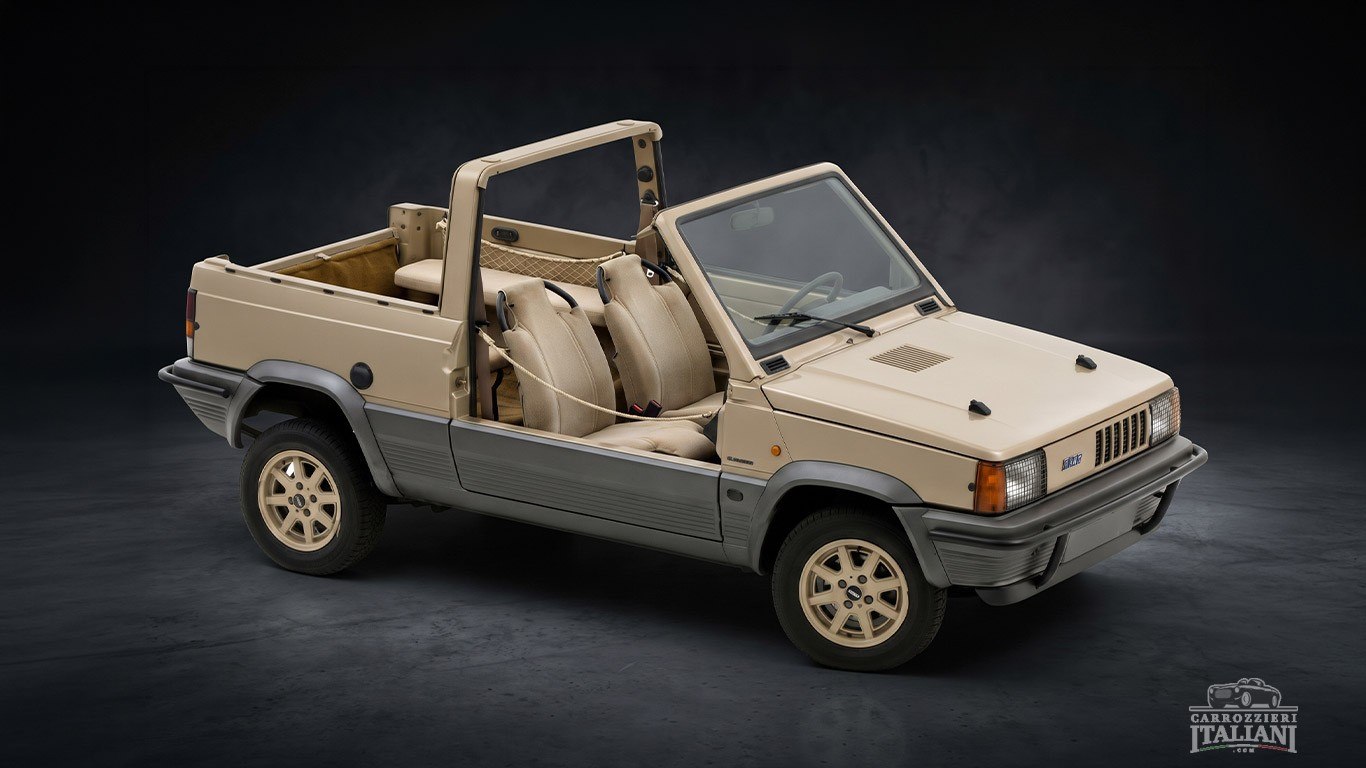
From Moretti’s Panda Rock to Italdesign’s experimental Strip, Maggiora’s four-wheel-drive convertible and Stola’s remarkable Destriero, the history of the open-top Panda reveals an unexpected chapter in Italian coachbuilding.
When Giorgetto Giugiaro designed the Fiat Panda, he created an automobile whose character depended almost entirely on the intelligent arrangement of its essential components. Introduced in 1980, the Panda rejected the stylistic conventions of contemporary small cars in favour of flat surfaces, simple glazing, generous interior space and a body conceived around economical manufacture. Its proportions were determined by practical considerations rather than fashionable details, while an unusually versatile passenger compartment made it possible to rearrange the seats and use the interior for purposes extending well beyond ordinary passenger transport. The apparent simplicity of the finished car concealed a sophisticated design process developed at Italdesign, where Giugiaro worked alongside engineer Aldo Mantovani to reconcile Fiat’s demanding brief with the realities of large-scale production.
The Panda’s formal economy would prove particularly attractive to Italy’s specialist coachbuilders, many of whom were searching for new business as the traditional market for individually bodied automobiles continued to contract. Its square profile could accommodate substantial alterations without losing its identity, while its modest dimensions and familiar mechanical components made it an accessible starting point for experimental vehicles and commercially viable conversions. Removing the roof, modifying the doors or replacing entire sections of the body could transform its intended use without necessarily requiring the development of an entirely new automobile.
Over the following two decades, the Panda became the basis for an unusually varied collection of cabriolets, off-road prototypes, recreational vehicles and spiaggine. Moretti developed an open Panda that customers could actually purchase, Italdesign explored modular body construction, Savio and Maggiora investigated alternative interpretations of the four-wheel-drive model, and Stola produced a pair of exceptionally finished beach cars whose origins lay closer to the traditions of bespoke coachbuilding. The story would continue into the following century, when the second-generation Panda inspired further experiments from I.DE.A Institute, Fiat and Bertone.
Italdesign Panda Strip: The First Open-Air Experiment
The earliest expression of this versatility appeared in 1980 with the Fiat Panda 4×4 Strip, an experimental recreational vehicle developed by Italdesign around the mechanical possibilities of the Panda’s future four-wheel-drive configuration. Rather than simply removing the roof to produce a conventional cabriolet, Giugiaro explored a body that could be adapted to different circumstances, combining the qualities of a small off-road vehicle with those of a lightweight utility machine intended for outdoor work and leisure.
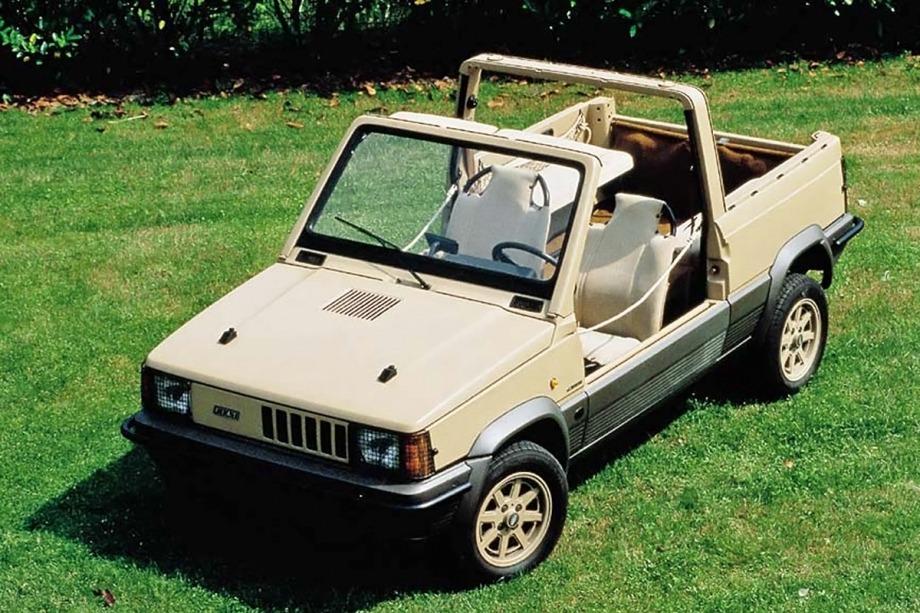
Among the Strip’s most distinctive features was its windscreen, hinged at the base so that it could be folded forward onto the bonnet, leaving the passenger compartment almost completely exposed. A central rollover structure replaced the conventional arrangement of door pillars, while the rear platform could be removed to alter the vehicle’s carrying capacity. The tubular seats, covered in simple fabric, continued the functional approach of the standard Panda and could be removed or rearranged according to the intended use. With the canvas covering fitted, the usual rear seating could also be replaced by longitudinal benches, providing a different passenger configuration.
These details gave the Strip a character closer to a small military or agricultural utility vehicle than to a fashionable beach convertible, although the same adaptable architecture made it equally suitable for recreational use. Its construction explored how a production automobile might accommodate several distinct functions without the expense and complexity of developing separate bodies for each application.
The project’s 1980 date is particularly significant because the production Fiat Panda 4×4 would not appear until 1983, following Fiat’s collaboration with Steyr-Puch on the four-wheel-drive system. The Strip therefore belonged to the experimental development of the concept rather than to the commercial history of the production 4×4, even though its design anticipated the possibilities that the later model would make more widely available.
Moretti Panda Rock: From Experiment to Commercial Reality
While Italdesign investigated the Panda’s potential as a modular vehicle, Carrozzeria Moretti approached the same platform with a more immediate commercial objective. The Turin company, founded by Giovanni Moretti and once responsible for manufacturing complete automobiles with its own engines, had gradually adapted its operations to the transformation of mass-produced Fiat models. By the 1970s, vehicles such as the Fiat 126 Minimaxi and the Fiat 127 Midimaxi had established Moretti in the market for inexpensive recreational automobiles, combining ordinary mechanical components with specialist open bodies that the major manufacturers were reluctant to offer themselves.
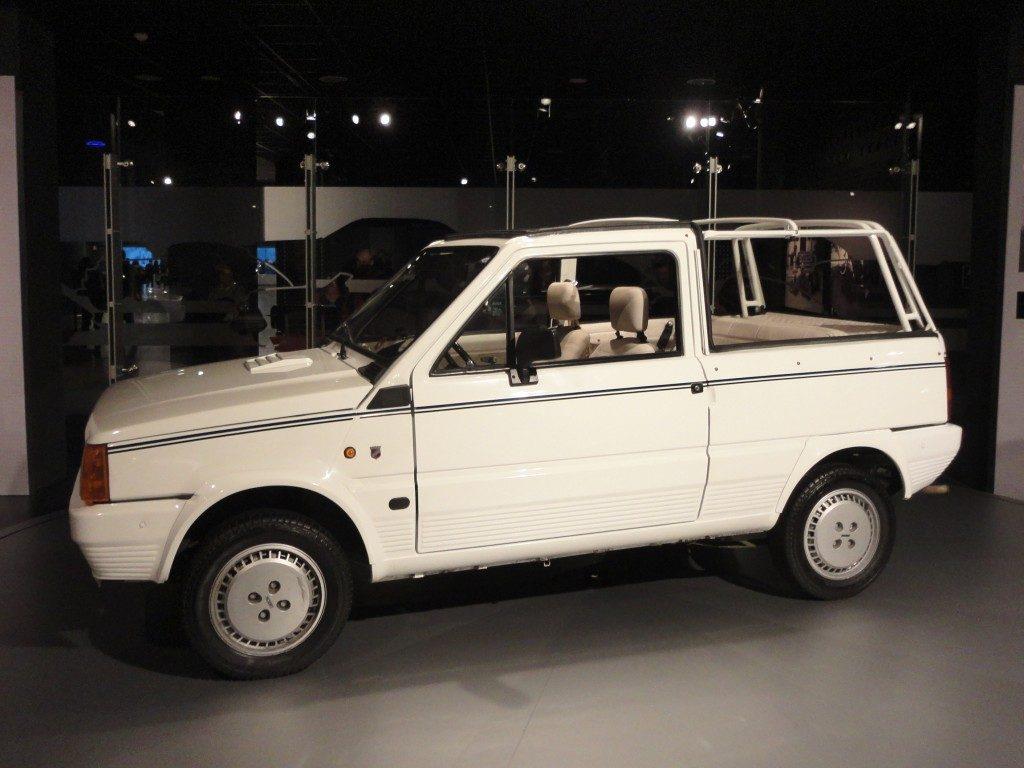
The Fiat Panda Cabrio Rock represented a continuation of this strategy, replacing the conventional rear roof structure with an open passenger compartment protected by a folding fabric hood, while retaining the essential proportions and practical character of Giugiaro’s original design. Unlike the radical Strip, the Rock was intended to function as an everyday automobile, offering its occupants the advantages of open-air driving without abandoning the straightforward maintenance, compact dimensions and familiar driving characteristics of the standard Panda.
The Rock’s history began earlier than the 1986 date frequently associated with the model. Its first generation can be traced to approximately 1982, while an official government price order published in Malta on 8 November 1983 provides particularly valuable contemporary evidence of its commercial existence. The document identifies two separate Moretti Panda Rock 30 vehicles, chassis 6199086 and 6198309, with maximum public prices of 3,485 and 3,653 Maltese lira respectively. Their inclusion demonstrates that the Rock was already being offered commercially by late 1983, several years before the introduction of the later FIRE-powered versions.
A surviving 1982 Panda Rock, identified by chassis ZFA141A0006153068, provides another link to the earliest phase of the programme. Taken together, these vehicles support a chronology extending from the first Rock series of approximately 1982–1986 to the revised versions offered during the second half of the decade, rather than treating all examples as products of a single 1986 introduction.
The later Rock range developed alongside Fiat’s changes to the Panda’s mechanical specifications. Contemporary Moretti promotional material identifies the Panda Rock 750 S FIRE and Panda Rock 4×4 FIRE, the former equipped with a 769 cc engine producing 34 CV DIN and the latter using a 999 cc unit rated at 50 CV DIN. Both were advertised with five-speed transmissions, although these specifications apply to their respective versions and should not be extended retrospectively to the earlier Rock 30.
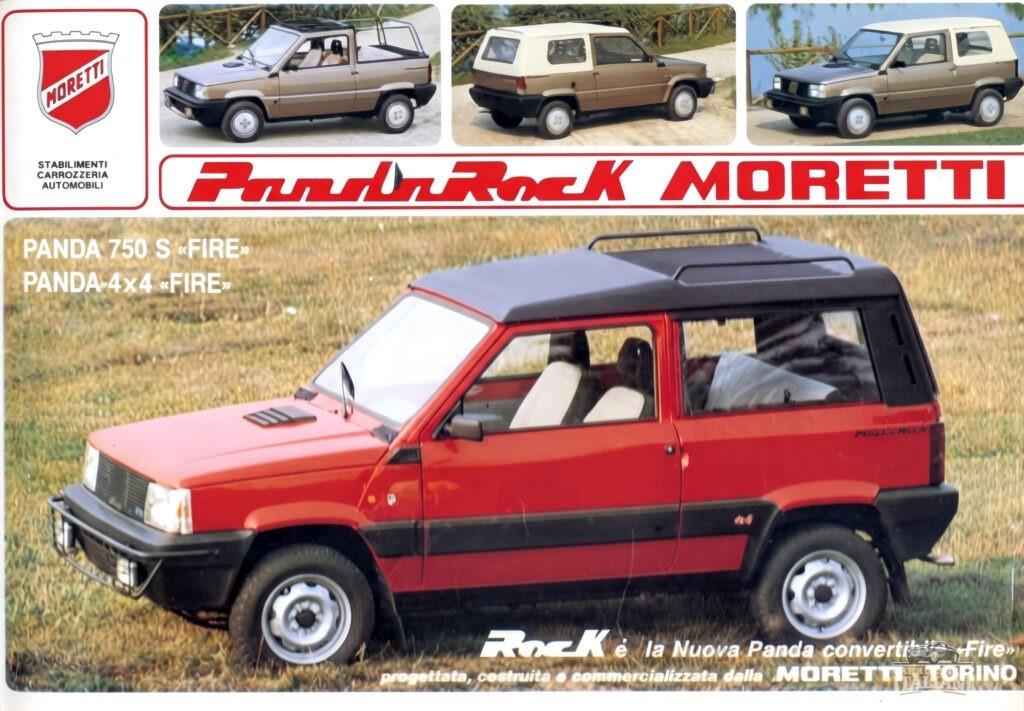
Moretti also offered different arrangements for weather protection, including the familiar folding hood and alternative removable coverings, reflecting the company’s intention to make the Rock practical enough for ordinary use. The conversion nevertheless involved more than changes to the exterior appearance, since removing a substantial part of a unitary body requires consideration of how structural loads are carried through the remaining shell. Even on a relatively small and light automobile, a successful convertible conversion depended on suitable reinforcement and careful body construction rather than simply cutting away the steel roof.
The Rock occupied an unusual position in Moretti’s final years. It was neither a conventional mass-production Fiat nor a unique exhibition prototype, but a specialist commercial model manufactured in comparatively small numbers for customers seeking something unavailable in the ordinary dealer catalogue. Its production continued into the period when the traditional independent Italian carrozzeria was becoming increasingly difficult to sustain, with Moretti relying on niche models such as the Rock and the Uno Folk to preserve a market for its work.
The same commercial logic also produced the Panda 4×4 Gold, although this represented a different kind of transformation. Instead of altering the body to create a convertible, Moretti developed a more elaborate version of the utility car through distinctive exterior finishes, wheels and improved interior appointments. The Gold name was already in use by 1983, when a Panda Gold 30 appeared in the same Maltese price order as the early Rock vehicles, while the later 4×4 Gold extended the idea to Fiat’s increasingly popular four-wheel-drive model. The two programmes consequently illustrated complementary aspects of Moretti’s business: the Rock changed the vehicle’s configuration and intended use, whereas the Gold sought to give an inexpensive production car a more exclusive identity.
Savio and Maggiora: Two Different Interpretations of the Open Panda
The versatility of the Panda continued to attract experimental work from coachbuilders whose activities extended beyond the production of conventional passenger cars. In 1987, Carrozzeria Savio developed the Fiat Freely, a prototype designed by Paolo Martin around the complete mechanical basis of the Panda 4×4 and intended to investigate a particularly ambitious approach to modular body construction.
Martin’s proposal was based on the use of interchangeable or equivalent body components, allowing different sections of the vehicle to be manufactured using common forms and thereby reducing the tooling and production costs normally associated with specialised bodywork. Elements such as the front and rear sections, doors, sills and wheel arches were conceived according to this principle, extending the idea of modularity beyond the removable equipment of the earlier Italdesign Strip.
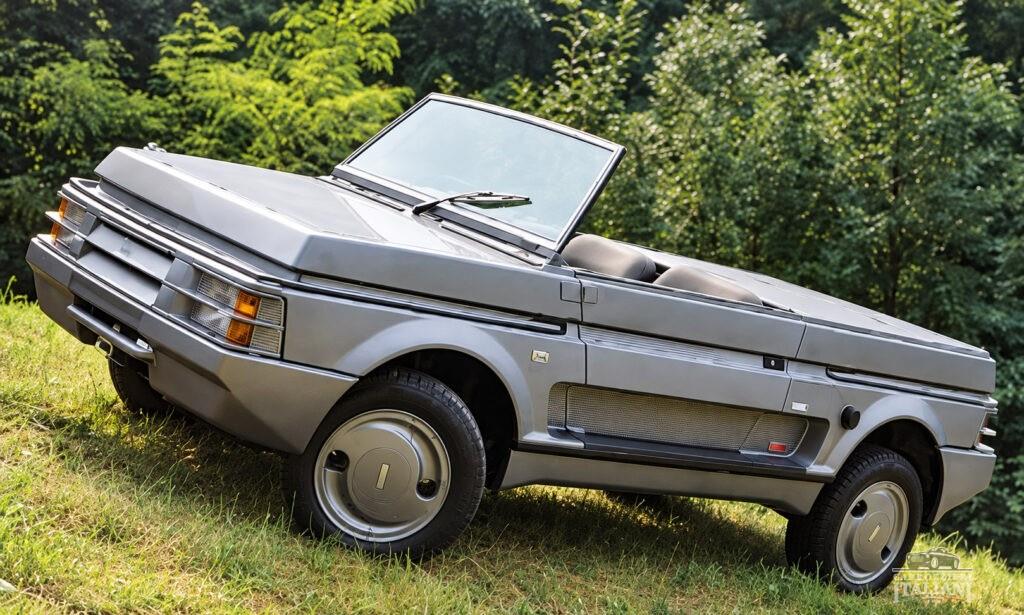
The Freely’s windscreen could be folded forward, while the steering wheel was designed to be repositioned so that the upper body could form an extended working surface. Such an arrangement made it possible to transport unusually long objects, operate in restricted spaces or adapt the vehicle for temporary outdoor accommodation. A specially designed symmetrical canvas covering provided shelter for camping, while a rigid hardtop offered an alternative enclosed configuration. The unusual architecture was therefore connected to a serious investigation into low-cost, multipurpose transport rather than being conceived solely as an exercise in unconventional styling.
Martin’s Freely and Giugiaro’s Strip shared an interest in the Panda’s ability to serve several functions, but their solutions were fundamentally different. The Strip explored adaptability through removable structures and rearrangeable equipment, whereas the Freely examined whether modularity could be incorporated into the manufacture of the body itself. Although the Savio prototype did not progress into series production, it remains an important example of Paolo Martin’s work outside the familiar fields of sporting cars and high-profile design studies.
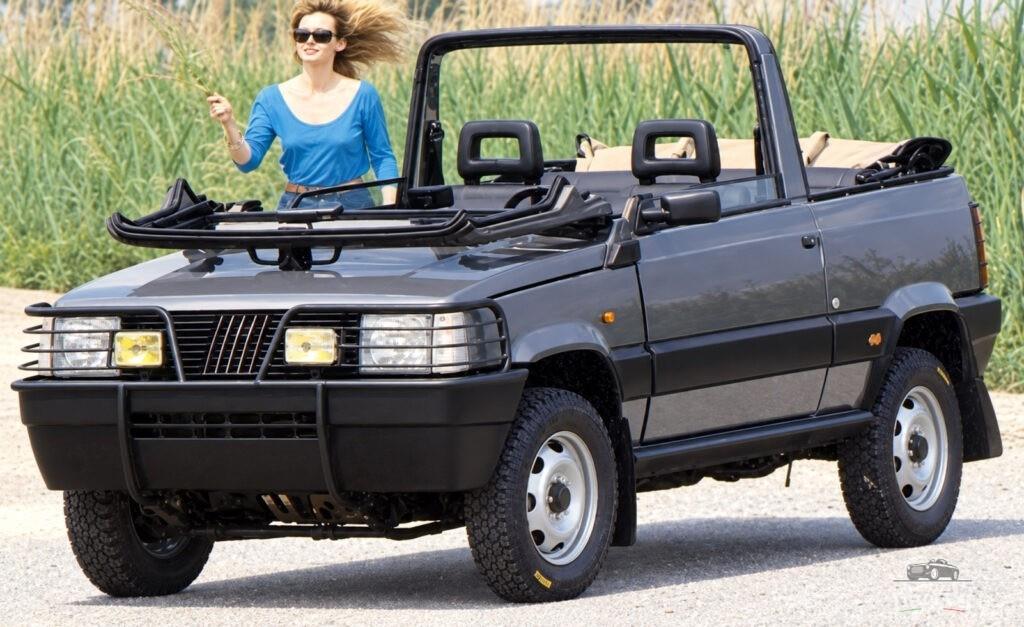
A different interpretation arrived in 1988 when Maggiora produced the Fiat Panda 4×4 Cabrio, combining the production Panda’s off-road mechanical capabilities with an open body intended for recreational driving. The prototype incorporated a substantial rollover bar, a reclining windscreen and distinctive protective equipment at the front, including a prominent bull bar with additional lighting. These features gave it a more overtly utilitarian appearance than the Moretti Rock, while the folding windscreen recalled a solution already explored by Italdesign at the beginning of the decade.
Maggiora’s project appears to have been developed as an experimental proposal for a possible small-series convertible, but it did not lead to an established production programme. Its importance lies partly in the industrial experience of the company responsible for its construction. Maggiora was capable of undertaking specialised prototype work while also participating in manufacturing projects for major automobile producers, an increasingly important combination of activities as the Italian coachbuilding industry changed. The Panda 4×4 Cabrio demonstrated how the skills involved in constructing and adapting automobile bodies could be applied to an inexpensive utility vehicle without requiring a complete departure from its original mechanical architecture.
Stola Panda Mirage–Destriero: The Return of the Italian Spiaggina
In 1991, Alfredo and Maria Paola Stola initiated a project to reinterpret the traditional Italian spiaggina using the first-generation Fiat Panda. Authorised by Roberto Stola, the programme was conceived as a demonstrator of the Turin company’s design-development and prototype-building capabilities, drawing inspiration from the open beach cars produced by Ghia during the 1950s and 1960s. The styling was entrusted to Aldo Garnero, whose design retained the Panda’s recognisable front section while replacing its conventional roof and doors with an open body featuring deeply cutaway sides and distinctive rear buttresses. Initially proposed as Maui and subsequently named Mirage, the car was constructed by Opac at Rivalta, with upholstery by Salt of the Gavina family, under Stola’s direction.
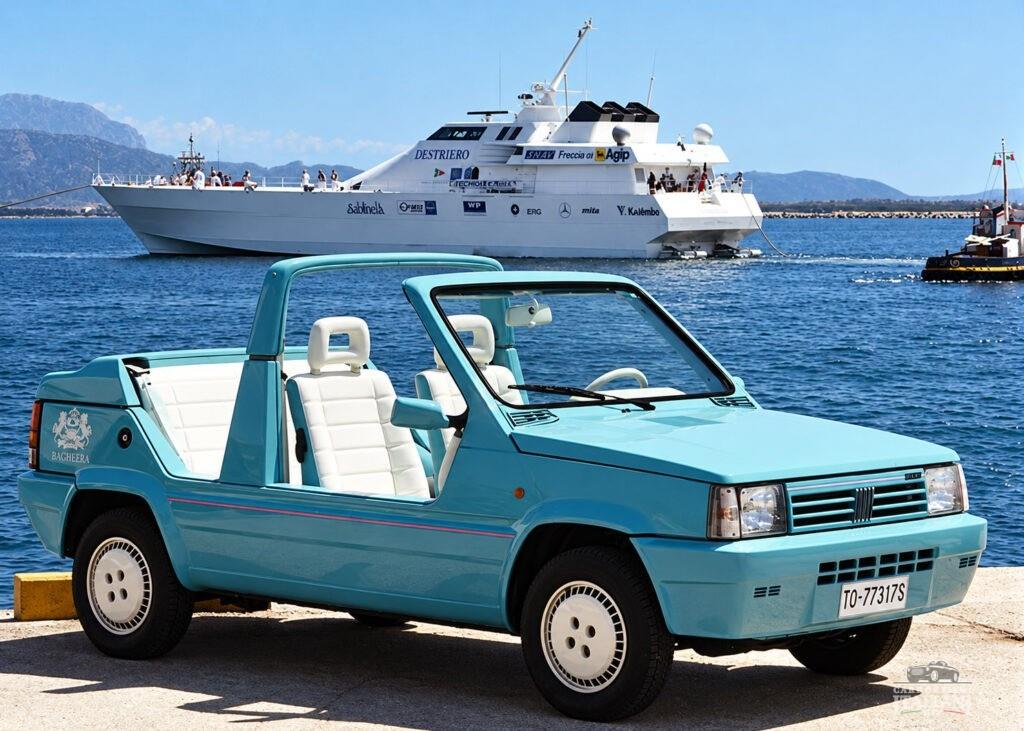
The turquoise prototype was completed and photographed at Portofino on 3 September 1991, carrying registration TO 64254 R and chassis number ZFA141A0004604624. Following Fiat’s involvement, the car was renamed Destriero at the suggestion of senior management, notably Paolo Cantarella, establishing a connection with the celebrated motorboat of the same name. Photographed at Porto Cervo in March 1992, it made its public debut on Fiat’s stand at the Turin Motor Show on 23 April 1992. The registration TO 77317 S, visible in certain contemporary photographs, had been temporarily borrowed from another Fiat-owned vehicle and did not identify a separate example.
The project’s reception led the Fiat Style Centre to commission a second Panda Destriero for Gianni Agnelli in 1992, finished in his characteristic blue with light-grey upholstery and a hood covering the front seats. Both cars were photographed together at Villarbasse that September, before the second was delivered to Fiat in October. The programme therefore comprised two documented examples, the original turquoise Mirage–Destriero and Agnelli’s personalised version. The first car subsequently underwent official homologation procedures in 1995–1996 and survived to receive ASI Targa Oro recognition in 2020. Conceived when Stola’s activities were increasingly concentrated on advanced engineering and confidential prototype development for major manufacturers, the Destriero demonstrated how traditional Italian coachbuilding could be carried forward through a collaboration between specialist designers, body manufacturers and craftsmen.
Panda Marrakech and the Return of the Open Panda
The introduction of the second-generation Panda in 2003 provided an opportunity to revisit the open-body theme using a substantially different vehicle. The new production model, developed with styling contributions from Bertone under the direction of Giuliano Biasio, replaced Giugiaro’s original three-door proportions with a taller five-door body that reflected the changing requirements of the European small-car market.

At the 2003 Geneva Motor Show, the Fiat Panda Marrakech offered an unconventional interpretation of the new architecture, developed by I.DE.A Institute as a recreational prototype recalling the dune buggies and lightweight leisure vehicles of the 1970s. Finished in bright yellow, the Marrakech dispensed with conventional doors in favour of tubular side structures and adopted a completely open passenger compartment, creating a vehicle whose appearance was deliberately distant from that of the enclosed production Panda.
The prototype demonstrated how the new Panda’s relatively tall proportions could be adapted to an open recreational body without attempting to reproduce the styling of the original model. Its design belonged to a different period of automobile development, when concept cars were increasingly used to investigate lifestyle-oriented derivatives and alternative interpretations of established vehicle platforms. Unlike the Moretti Rock, however, the Marrakech remained an experimental design exercise rather than progressing into a commercially available convertible.
Fiat Panda Jolly: From Turin to Capri
Three years later, Fiat revived the spiaggina tradition more directly with the Panda Jolly, unveiled in August 2006 as a unique vehicle intended to transport selected visitors around Capri during the summer season. Although its purpose recalled the Ghia-built Fiat 600 Multipla Jolly of the 1950s, the new car was conceived through a combination of contemporary automobile design and interior furnishings associated with high-end residential and nautical environments.
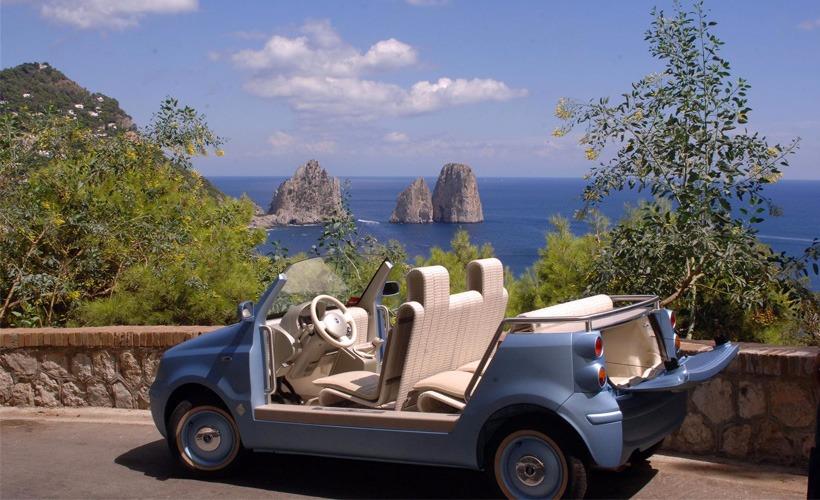
The Panda Jolly was designed by Centro Stile Fiat and physically constructed by Stola, which had meanwhile become part of the RGZ group. This division of responsibilities differed from the earlier Mirage–Destriero programme, in which Stola had directed the development of its own demonstrator with styling supplied by Aldo Garnero. For the Jolly, Fiat retained responsibility for the design while commissioning Stola to realise the vehicle, with Paola Lenti contributing the distinctive treatment of the passenger compartment.
The interior departed considerably from the wicker seating traditionally associated with Italian beach cars. Satin-finished steel structures were wrapped in Rope, a technical textile whose appearance and construction recalled the materials used in sailing equipment, while cotton cushions provided the upholstered surfaces. Sand-coloured ash, complete with contrasting inlays, covered the floor and several interior elements, creating a direct association with the timber decks and furnishings of contemporary yachts. A polished metal grab rail at the rear continued the nautical treatment, reinforcing the connection between the vehicle and its intended use on one of Italy’s best-known resort islands.
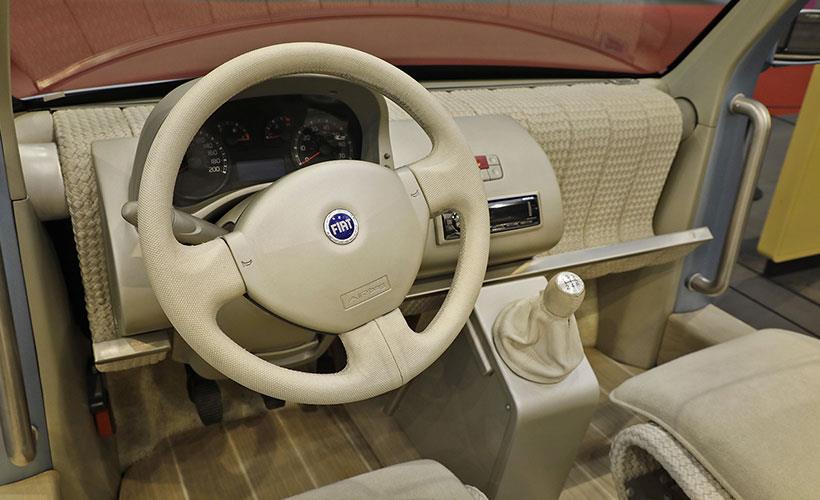
The exterior retained recognisable elements of the second-generation Panda, including the rounded lighting treatment associated with the Panda Cross, but replaced conventional body closures with an entirely open arrangement better suited to short journeys in a controlled environment. The familiar proportions were softened by the absence of the roof and doors, while the carefully coordinated materials gave the small Fiat a character distinct from the functional simplicity of both the ordinary Panda and the earlier Moretti conversions.
Mechanically, the Jolly retained a 1,242 cc four-cylinder engine producing 60 CV, with no attempt to transform the Panda into a high-performance automobile. Its exclusivity depended instead on the workmanship and material treatment of an individually constructed body, following the same tradition that had once allowed relatively inexpensive Fiat mechanical components to become the basis for specialised resort vehicles commissioned for wealthy private owners.
Bertone Barchetta: A Panda Beneath an Entirely Different Body
The final and perhaps most unexpected transformation of the Panda platform came in 2007, when Bertone celebrated its ninety-fifth anniversary with an open two-seat concept presented at the Geneva Motor Show. The Fiat Barchetta Bertone used mechanical foundations associated with the Panda 100HP but abandoned the donor vehicle’s proportions almost completely, replacing its tall hatchback body with a low aluminium roadster whose sculpted surfaces and transparent door sections belonged to a different design vocabulary.
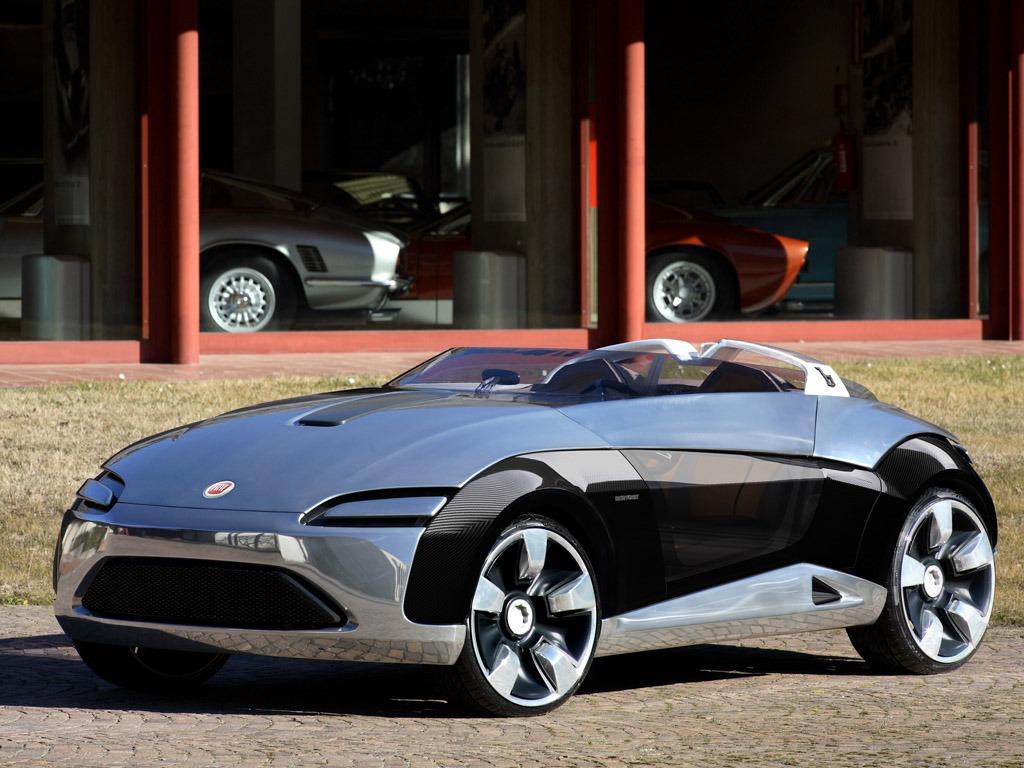
The project also drew upon Bertone’s own history, particularly the small Fiat 500 barchetta constructed for Nuccio Bertone in 1947, an automobile whose compact dimensions and sporting character had reflected the resourcefulness of Italian coachbuilding in the immediate postwar period. Sixty years later, the anniversary concept explored a similar relationship between modest mechanical origins and distinctive coachbuilt bodywork, although its construction techniques, materials and intended presentation were those of a modern design studio.
The body was divided into visually separate volumes connected by transparent door sections, while the aluminium construction and carefully finished leather interior emphasised the contrast between the relatively ordinary production platform and the specialised exterior created around it. The concept’s exhibition configuration included electric auxiliary equipment, while references to the Panda 100HP described the mechanical foundation on which the design had been developed rather than establishing a conventional series-production drivetrain for the displayed automobile.
Bertone presented the Barchetta at a difficult moment in its industrial history, when the traditional business of designing and manufacturing specialist automobile bodies was undergoing fundamental changes. The concept nevertheless maintained a connection with the company’s earliest postwar work, demonstrating how an inexpensive production automobile could serve as the starting point for a completely different body, just as the Fiat 500 had done for Nuccio Bertone six decades earlier.
By this stage, the relationship between the Panda and its coachbuilt derivatives had moved far beyond the relatively straightforward conversions developed by Moretti during the 1980s. Several Italian coachbuilders and design houses had explored open-bodied interpretations of Fiat’s utilitarian model, including the Panda Pick-Up by Coriasco, Panda Jungla by Savio, Panda Strip by Italdesign, Panda Penny by Fissore, Panda 4×4 African by Boneschi, and, much later, the Panda Top Less by GFG Style. These projects demonstrated the remarkable adaptability of the Panda’s compact architecture, ranging from practical recreational vehicles to experimental open-air designs. The original Moretti Rock remained visibly and mechanically close to the production Fiat, while Stola’s Destriero transformed the same utilitarian foundation into a carefully finished nautical tender. Bertone’s anniversary Barchetta went further, retaining the Panda primarily as a mechanical basis beneath a body that scarcely acknowledged its origins. Together, these interpretations reflected a longstanding Italian coachbuilding tradition in which the appearance, character and intended function of an automobile could be reconsidered independently of the mass-produced components upon which it was built.

ABOUT THE AUTHOR
Andreas Scheidl
Italian classic car enthusiast with German roots. Renowned as a respected figure in the classic car community, he serves as a jury member at various international concours d'elegance, including the Classic Gala Schwetzingen and Mantova. As a content creator, Andreas passionately shares his profound knowledge and appreciation for vintage automobiles. His heart beats for cars designed by Giovanni Michelotti, showcasing his discerning taste and dedication to preserving the timeless elegance of automotive history.
More stories by Andreas Scheidl ↗CONTINUE READING
Posts You Might Like
Gabriele d’Annunzio and the Cult of the Automobile
There was a time when the automobile had not yet become part of the landscape. It announced itself from afar through the beating of an engine, the smell of petrol and hot…
Read story
Fiat 1400: The Last Great Playground of the Carrozzieri
From Touring and Abarth to Farina, Ghia, Vignale, Boneschi, Bertone, Viotti and the smaller carrozzerie, the new Fiat quickly became one of the richest bases for Italian special bodies in the early…
Read story
How a Swiss Dealer Challenged Ferrari: The Story of Monteverdi
How Peter Monteverdi went from Swiss Ferrari dealer to creator of rare Frua and Fissore-bodied GTs, the Hai supercar and luxury off-roaders.
Read story
Virgilio Conrero: The Magician Who Whispered to Engines
Who was Virgilio Conrero? The self-taught Italian magician who whispered to engines and built one of motorsport’s greatest tuning legacies.
Read story
THE CONVERSATION
Comments 0
Share a memory, a period photograph or a documented detail about this story.