
THE VEHICLE AT A GLANCE
Model dossier
- Production period
- 1996
- Body style
- Berlina
- Type
- Mass
THE PEOPLE BEHIND THE CAR
Coachbuilding, design & conversions


PRICE & SALES RECORD
Vehicle value
- Original price
- Not documented
- Latest recorded sale
- Not documented
01 / THE STORY
History & context
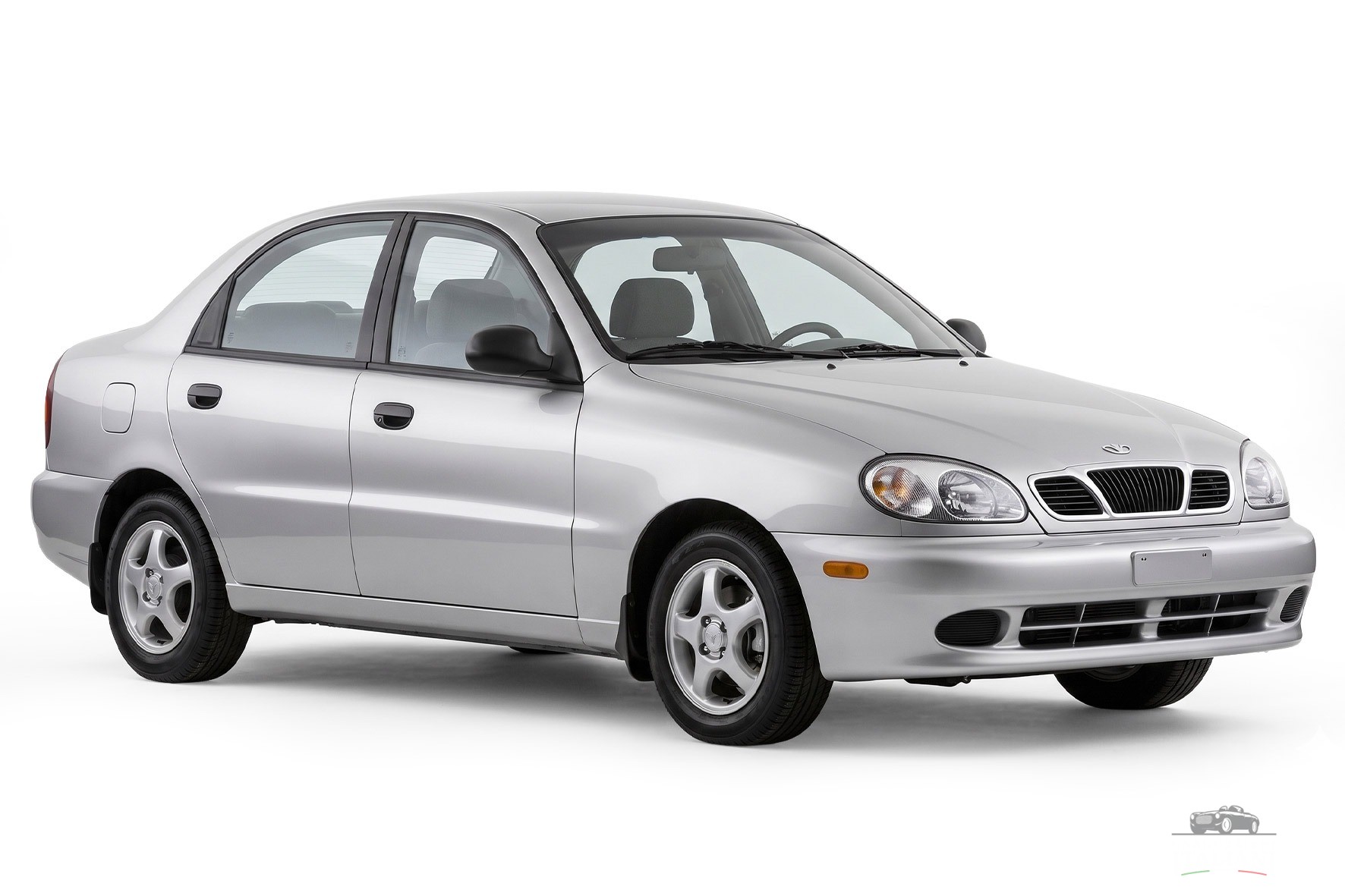
The Daewoo Lanos Notchback is a four-door compact sedan developed by Daewoo Motor Company of South Korea. It was introduced in 1997 as part of the broader Lanos range, which included hatchback and sedan variants intended to replace the Daewoo Nexia. The model was conceived during a period of rapid globalization within the automotive industry, reflecting Daewoo’s ambition to produce an internationally competitive vehicle through strategic collaborations with established design and engineering firms. Exterior design was executed by Italdesign under the direction of Giorgetto Giugiaro. The Notchback variant featured a conventional three-box sedan silhouette, offering a stylistic alternative to the Lanos hatchbacks. Its design prioritized restrained proportions and universal appeal, allowing for market adaptability across diverse regions. The Lanos Notchback was based on a modified General Motors T platform and employed a front-engine, front-wheel-drive layout. Engine offerings included a series of inline four-cylinder petrol units ranging from 1.3 to 1.6 litres in displacement. The most powerful configuration featured a 1.6-litre DOHC engine producing approximately 106 horsepower. Transmission options included a five-speed manual and a four-speed automatic. Suspension architecture comprised MacPherson struts at the front and a torsion beam axle at the rear, consistent with industry standards for compact sedans of the era. The vehicle’s dimensions included a length of 4,237 millimetres, a wheelbase of 2,520 millimetres, and a curb weight varying from 990 to 1,177 kilograms, depending on equipment and market specification. Interior appointments were modest, with an emphasis on cost-effectiveness and ease of manufacture, though basic safety and comfort features were included in most trims. Production of the Lanos Notchback occurred in multiple facilities globally through complete knock-down assembly, including in Poland, Ukraine, Egypt, and Vietnam. In these markets, the model was often rebadged and locally adapted, marketed under names such as FSO Lanos, ZAZ Lanos, and Chevrolet Lanos. The Daewoo Lanos Notchback served as a utilitarian vehicle aimed at emerging markets, where affordability, ease of maintenance, and simplicity were prioritized. Its extended production life and global proliferation underscore its function as a volume-oriented product in the transitional phase of post-1990s automotive manufacturing.
IN THE ARCHIVE
Related people
IN THE ARCHIVE
Coachbuilders & design studios
02 / TECHNICAL IDENTITY
Specifications & construction
Production & construction
- Production type
- Mass
Engine & performance
- Drive
- Front-wheel drive
- Specification notes
- Lanos Notchback production-body baseline: FWD, wheelbase 2520 mm, dimensions 4237 × 1678 × 1432 mm. Canonical 1996 reflects the design/programme phase; series sales specifications begin in 1997. Engine/gearbox/weight remain variant-level.
Dimensions & accommodation
- Wheelbase
- 2,520 mm
- Length
- 4,237 mm
- Width
- 1,678 mm
- Height
- 1,432 mm
Design & manufacture
- Designer · Candidate
- Giorgetto Giugiaro
- Design Studio · Documented
- Italdesign
- Manufacturer · Documented
- Daewoo
06 / EVENTS & AWARDS
Events & awards
No events or documented awards are currently recorded for this vehicle.
07 / THE VEHICLE IN DETAIL
Photo gallery
No publishable photographs are currently catalogued for this vehicle.
08 / FROM THE ARCHIVE
Archive
References held in the vehicle dossier. Their inclusion does not establish that every historical claim has been independently verified.
| Reference | Source type |
|---|---|
| Italdesign – Lanos Notchback www.italdesign.it | Design house official |
| Daewoo Lanos Notchback 1997–2000 range www.engineindetail.com | Specialist range technical reference |

THE CONVERSATION
Comments 0
Share a memory, a period photograph or a documented detail about this car.