
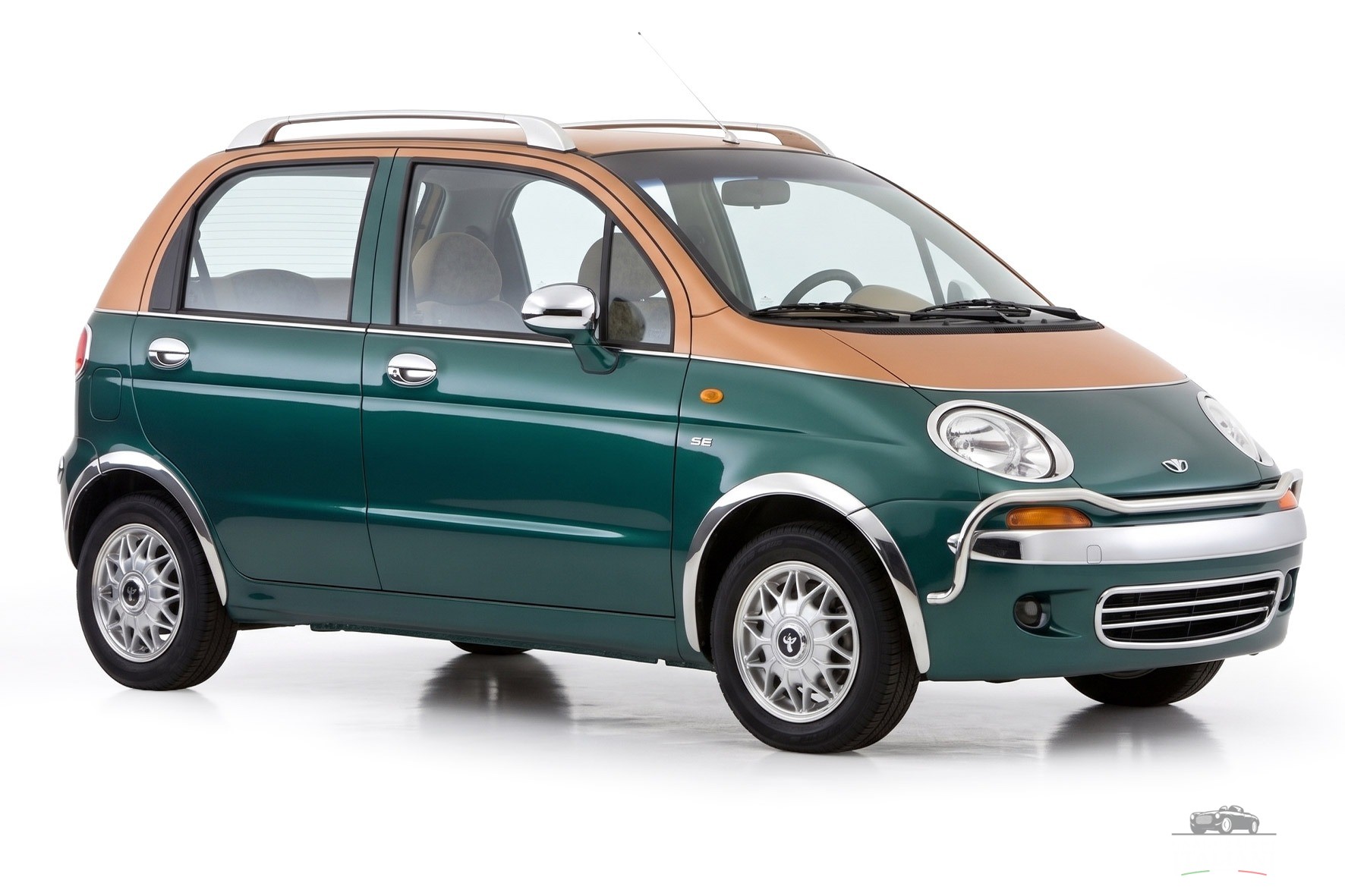
THE VEHICLE AT A GLANCE
Model dossier
- Production period
- 1997
- Body style
- Hatchback
- Engine
- Inline-3
- Type
- One-off
- Production
- 1
- Displacement
- 796 cc
- Power
- 56 CV
THE PEOPLE BEHIND THE CAR
Coachbuilding, design & conversions


PRICE & SALES RECORD
Vehicle value
- Original price
- Not documented
- Latest recorded sale
- Not documented
01 / THE STORY
History & context
The Daewoo d’Arts, later rebranded as the Daewoo Matiz, has its roots in the Fiat Cinquecento ID, a design concept by Italdesign introduced in 1992. Fiat’s decision to invite Italian coachbuilders to reinterpret the iconic Cinquecento theme led to the birth of the ID Cinquecento. The evolution continued in 1993 with the Lucciola prototype, emphasizing electric hybrid technology and eco-friendliness. While Fiat moved forward with the Seicento, Daewoo’s president, Kim Woo-choong, recognized the potential in the Lucciola. Under the skilled design direction of Fabrizio Giugiaro, Daewoo transformed the Lucciola into the “d’Arts,” maintaining key features while enhancing handling. The year 1997 marked the official transition from d’Arts to Daewoo Matiz. Part of the M Series, the Daewoo Matiz was Daewoo’s inaugural foray into the microcar market. Launched in 1997, it retained the essence of the 1992 concept but featured a more practical 5-door body. Surprisingly spacious for its compact size, the Matiz accommodated five passengers, establishing itself as a popular mini minivan in Europe. The Sport version, equipped with a 71-horsepower engine, aimed to compete in the sporty mini car segment. The Daewoo Matiz owed its success to a distinctive rounded design, complemented by signature oval headlights. The car’s internal flexibility and adaptability were key selling points, making it a standout choice in the competitive mini car market. The Matiz became a symbol of practicality, proving that a compact car could be both stylish and functional. Its legacy continued to shape Daewoo’s approach to microcar design, leaving a lasting impact on the automotive landscape.
IN THE ARCHIVE
Related people
IN THE ARCHIVE
Coachbuilders & design studios
02 / TECHNICAL IDENTITY
Specifications & construction
Production & construction
- Production
- 1
- Production type
- One-off
Engine & performance
- Engine configuration
- Inline-3
- Displacement
- 796 cc
- Power (CV)
- 56 CV
- Specification notes
- Primary Italdesign source confirms a 796 cc, 56 CV, three-cylinder engine for the 1997 d’Arts preseries outfit. Legacy 3495 × 1495 × 1485 mm dimensions remain unpromoted pending an independent/primary dimensional source.
Dimensions & accommodation
- Length
- 3,495 mm
- Width
- 1,495 mm
- Height
- 1,485 mm
Design & manufacture
- Designer · Candidate
- Fabrizio Giugiaro
- Design Studio · Documented
- Italdesign
- Manufacturer · Documented
- Daewoo
06 / EVENTS & AWARDS
Events & awards
No events or documented awards are currently recorded for this vehicle.
07 / THE VEHICLE IN DETAIL
Photo gallery
No publishable photographs are currently catalogued for this vehicle.
08 / FROM THE ARCHIVE
Archive
References held in the vehicle dossier. Their inclusion does not establish that every historical claim has been independently verified.
| Reference | Source type |
|---|---|
| Italdesign — d'Arts www.italdesign.it | Design house official |

THE CONVERSATION
Comments 0
Share a memory, a period photograph or a documented detail about this car.