
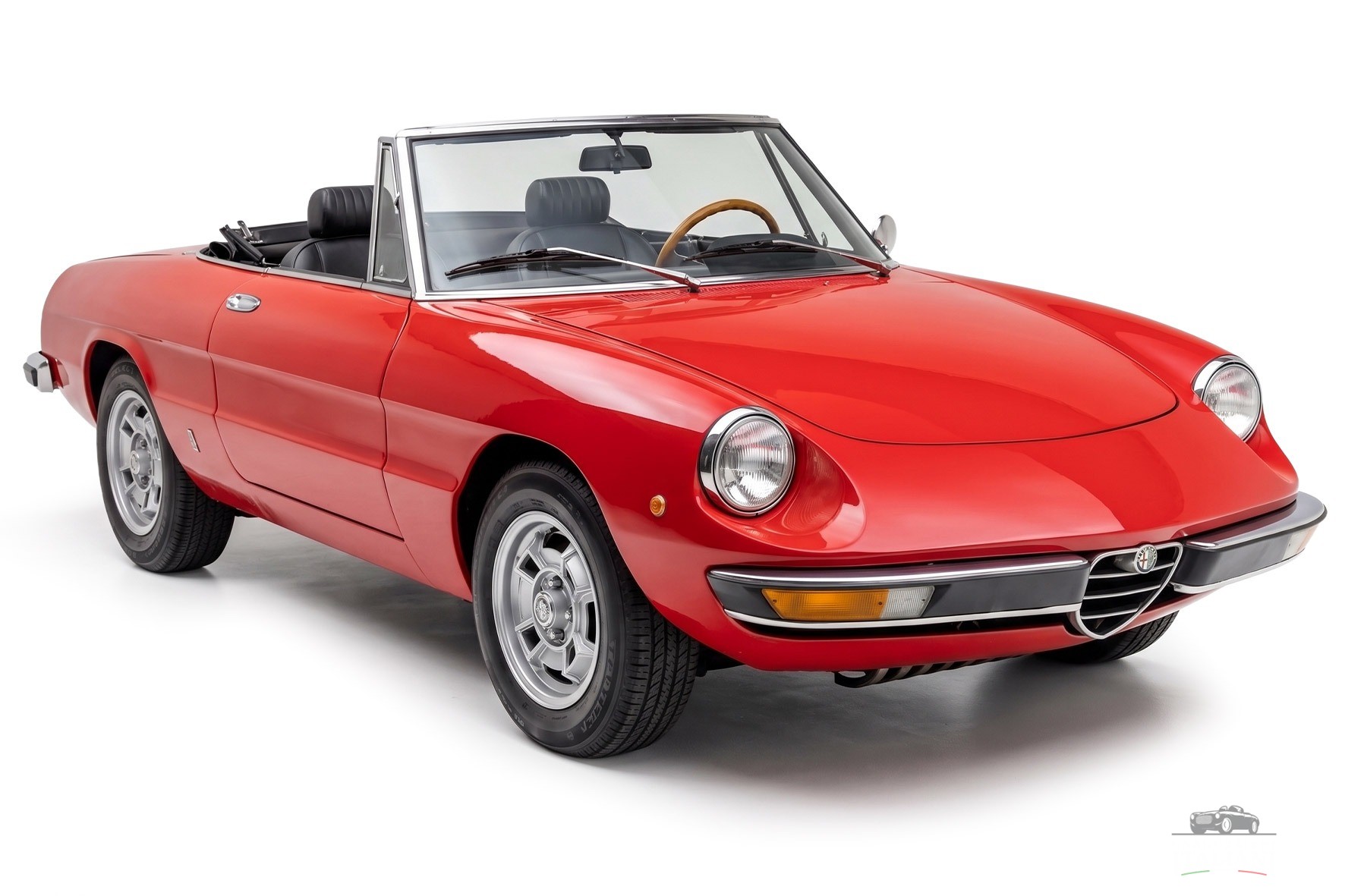
THE VEHICLE AT A GLANCE
Model dossier
- Production period
- 1969
- Body style
- Spider
- Engine
- Inline-4
- Type
- Limited
- Displacement
- 1,779 cc
- Power
- 113 CV
THE PEOPLE BEHIND THE CAR
Coachbuilding, design & conversions

PRICE & SALES RECORD
Vehicle value
- Original price
- Not documented
- Latest recorded sale
- Not documented
01 / THE STORY
History & context
The Alfa Romeo Duetto Spider 1969 marked a turning point in the evolution of the iconic Spider series, with the first significant change to its exterior design. The 1750 Spider Veloce, in particular, saw the original’s signature elongated, round tail revised into a more practical Kamm tail, enhancing luggage space. Along with this major change, numerous subtle updates were introduced both inside and out. The grille was slightly redesigned, new door handles were added, and the windscreen became more raked for improved aerodynamics. Other updates included top-hinged pedals and upgraded interior trim, giving the car a more refined feel. In 1971, the Spider Veloce received a larger, more powerful engine—a 1,962 cc, 132 hp (98 kW) unit. As a result, the model was renamed from the 1750 Spider Veloce to the 2000 Spider Veloce. The 1600 Spider re-entered production a year later, now dubbed the Spider 1600 Junior, which was visually identical to the earlier 1300 model. One of the more unique iterations of the Spider came in 1974 with the introduction of the Spider-Targa. This rare, factory-request model featured a solid rear window and lift-out roof panels, made from black GRP material, echoing the style of Porsche’s Targa models. Fewer than 2,000 Spider-Targas were ever produced, making them highly sought after by collectors. Both the 1300 and 2000 models were modified between 1974 and 1975 to incorporate two small rear seats, transforming them into “2+2” four-seater vehicles. The 1300 model was discontinued in 1977, and between 1974 and 1976, stainless-steel bumpers were replaced with black, rubber-clad units to meet stricter North American crash safety standards. Throughout its production, various models saw differing production numbers, including 4,557 units of the 1300 Junior, 4,848 of the 1600 Junior, 16,320 of the 2000 Spider Veloce, and 22,059 of the 2000 Spider Veloce Iniezione (U.S. version). Only 4,027 units of the 1750 Spider Veloce were made, making it a relatively rare variant.
IN THE ARCHIVE
Coachbuilders & design studios
02 / TECHNICAL IDENTITY
Specifications & construction
Production & construction
- Production type
- Limited
Engine & performance
- Engine configuration
- Inline-4
- Displacement
- 1,779 cc
- Power (hp)
- 111 hp
- Power (CV)
- 113 CV
- Power (kW)
- 83 kW
- Engine speed
- 5,500 rpm
- Torque
- 170 Nm
- Transmission
- 5-speed manual
- Drive
- Rear-wheel drive
- Specification notes
- Series 2 coda-tronca transition phase; 'Duetto' retained as informal umbrella nickname. Mid-1969 European baseline: inline-four 1779 cc, 113 PS DIN / 83 kW at 5500 rpm, 170 Nm, 5-speed manual, RWD, wheelbase 2250 mm, dimensions 4120 × 1630 × 1290 mm, curb weight 1040 kg.
Dimensions & accommodation
- Wheelbase
- 2,250 mm
- Length
- 4,120 mm
- Width
- 1,630 mm
- Height
- 1,290 mm
- Weight
- 1,040 kg
Design & manufacture
- Manufacturer · Documented
- Alfa Romeo
- Coachbuilder / Body Builder · Documented
- Pininfarina
06 / EVENTS & AWARDS
Events & awards
51° Salone Internazionale dell'Automobile – Torino General · legacy_preserved
- Date
- 1969
- Chassis
- General
Preserved CI 1.0 relation. Evidence field: _yoast_wpseo_primary_events. No award inferred.
07 / THE VEHICLE IN DETAIL
Photo gallery 1 photographs
08 / FROM THE ARCHIVE
Archive
References held in the vehicle dossier. Their inclusion does not establish that every historical claim has been independently verified.
| Reference | Source type |
|---|---|
| 1969 Alfa Romeo 1750 Spider Veloce — coda tronca phase www.automobile-catalog.com | Specialist period model reference |
THE CONVERSATION
Comments 0
Share a memory, a period photograph or a documented detail about this car.