
THE VEHICLE AT A GLANCE
Model dossier
- Production period
- 1955
- Body style
- Barchetta
- Type
- One-off
- Production
- 1
- Displacement
- 734 cc
- Power
- 55 CV
- Top speed
- 215 km/h
THE PEOPLE BEHIND THE CAR
Coachbuilding, design & conversions
PRICE & SALES RECORD
Vehicle value
- Original price
- Not documented
- Latest recorded sale
- Not documented
01 / THE STORY
History & context
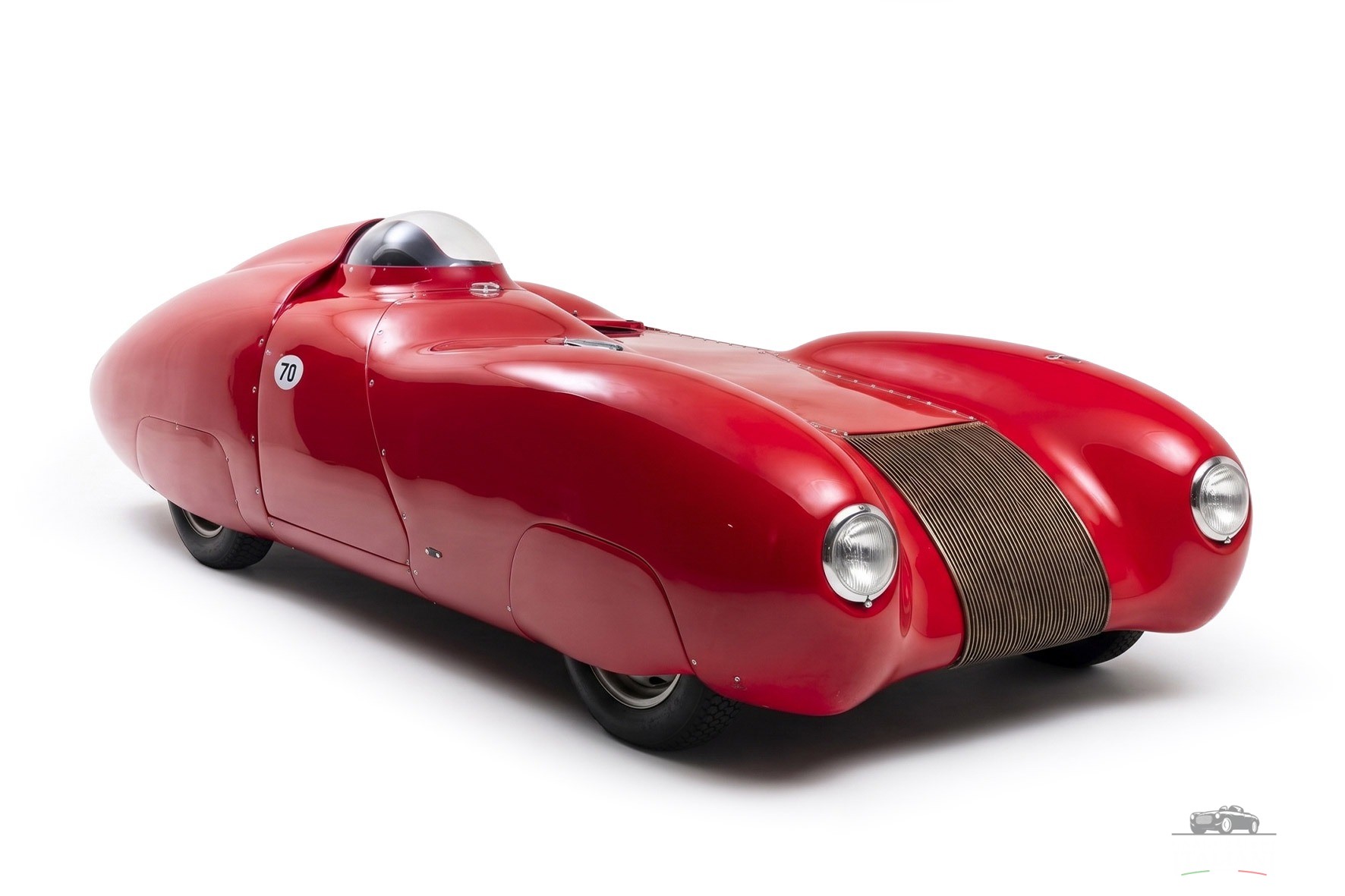
The Nardi Bisiluro, also known as the Nardi Le Mans, represents a fascinating yet ultimately short-lived experiment in automotive design and racing innovation during the 1950s. Conceived by Enrico Nardi’s Automobili Nardi in 1955, the Bisiluro was intended to push the boundaries of aerodynamics and performance at the prestigious Le Mans 24-hour race. The defining feature of the Nardi Bisiluro was its unique trimaran-like design, crafted by Carrozzeria Motto. The car was split into two distinct sections: the smaller, left-hand side housed the 735 cm³ Giannini engine, positioned horizontally. Meanwhile, the larger right-hand side accommodated the cockpit and fuel tank. This asymmetrical layout was aimed at optimizing aerodynamic efficiency and weight distribution, inspired by principles seen in marine trimarans. In practice, however, the Bisiluro faced significant challenges on the racetrack. Its unconventional design made it exceptionally unstable, particularly vulnerable to crosswinds. This instability was evident during the Le Mans race where, after just five laps, driver Mario Damonte encountered lapping traffic from much faster 3-liter cars. The turbulence created by these larger vehicles caused the Bisiluro to lift off the ground and ultimately overturn, leading to an accident. Despite the crash, the relatively slow speed of the Bisiluro meant the damage was minor, and fortunately, Damonte escaped unscathed. However, the incident underscored the fundamental flaws in the Bisiluro’s design, particularly its susceptibility to external forces and lack of stability at high speeds. Following this setback, Nardi chose not to pursue further development of the Bisiluro concept. The car’s brief foray into racing highlighted the ambitious yet precarious nature of its design. While innovative in theory, the practical challenges it faced on the track outweighed its potential benefits. As a result, the Nardi Bisiluro remains a curious footnote in automotive historya testament to bold experimentation and the quest for performance through unconventional means during a pioneering era of motorsport.
IN THE ARCHIVE
Coachbuilders & design studios
02 / TECHNICAL IDENTITY
Specifications & construction
Production & construction
- Production
- 1
- Production type
- One-off
- Chassis construction
- lightweight tubular chassis
Engine & performance
- Displacement
- 734 cc
- Power (CV)
- 55 CV
- Top speed
- 215 km/h
- Specification notes
- Museo Nazionale Scienza e Tecnologia documents the DaMolNar/Bisiluro as the 1955 Le Mans experimental car: body hand-built by Rocco Motto, lightweight tubular chassis engineered by Enrico Nardi, Carlo Mollino as design lead, Giannini G2 734 cc/55 CV engine and 215 km/h race top speed. Person relation for Mollino is not inserted here until a canonical person key is confirmed.
Design & manufacture
- Manufacturer · Documented
- Nardi
- Coachbuilder / Body Builder · Documented
- Motto
06 / EVENTS & AWARDS
Events & awards
No events or documented awards are currently recorded for this vehicle.
07 / THE VEHICLE IN DETAIL
Photo gallery 8 photographs
Show 2 more photographs Show fewer photographs
08 / FROM THE ARCHIVE
Archive
References held in the vehicle dossier. Their inclusion does not establish that every historical claim has been independently verified.
| Reference | Source type |
|---|---|
| Museo Nazionale Scienza e Tecnologia – Bisiluro DaMolNar collezioni-online.museoscienza.org | Museum primary |
| Museo Nazionale Scienza e Tecnologia – Fatte su misura press kit www.museoscienza.org | Museum primary |


THE CONVERSATION
Comments 0
Share a memory, a period photograph or a documented detail about this car.