
1970 Lamborghini Miura P-400 Jota, If Lambo Was a Race Car
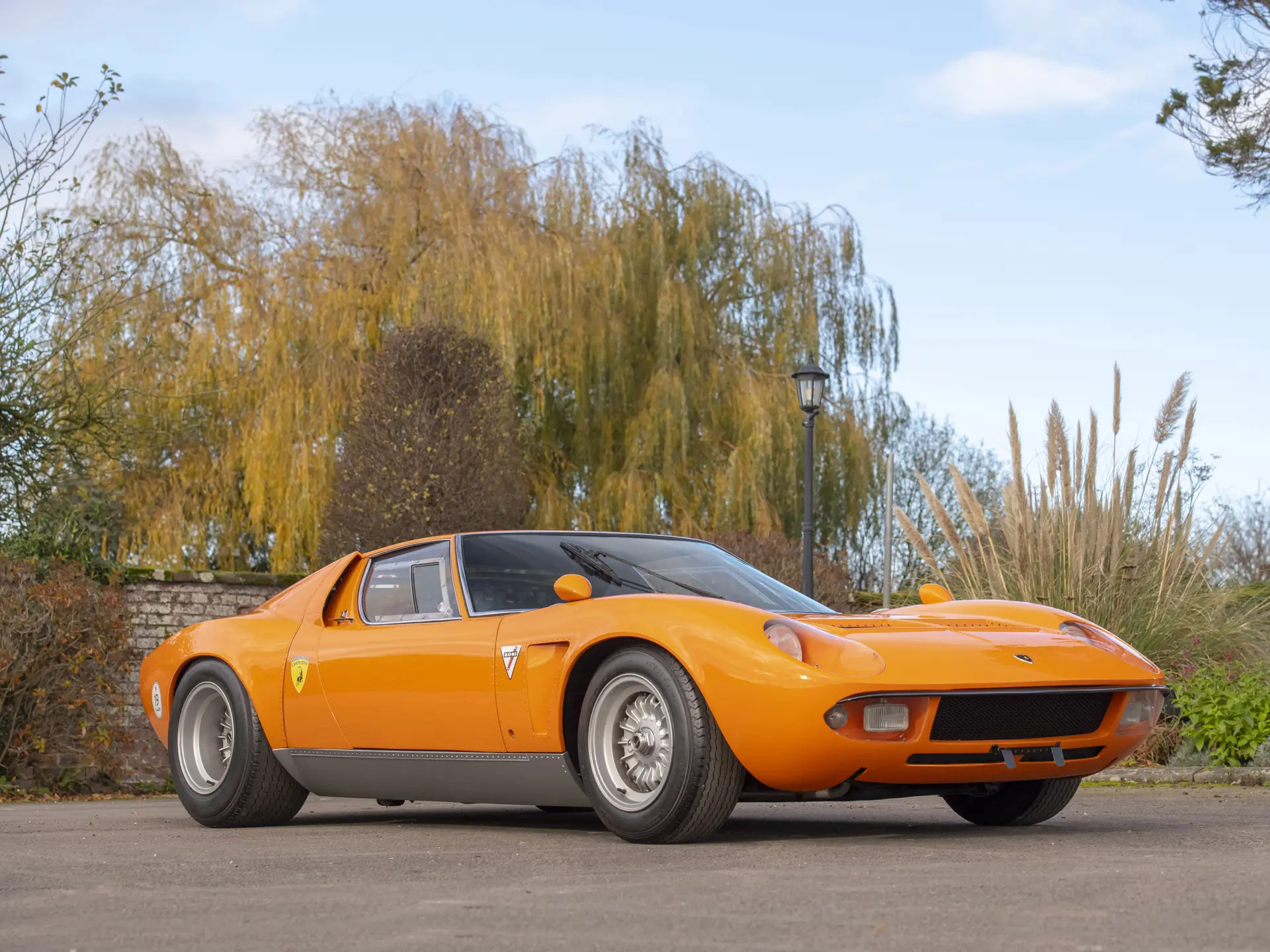
Born in secret and lost in flames, the Miura Jota is the greatest Lamborghini Sant’Agata never built. In a company sworn off racing, development driver Bob Wallace quietly set about creating the car he thought Lamborghini should make: lighter, angrier, and obsessively engineered for the stopwatch rather than the boulevard.
They called it Jota—a nod to Appendix J of the FIA rulebook—and it looked like a Miura that had spent a year in a wind tunnel and a gym. Thin-gauge alloy where there had been steel. Plexiglas where there had been glass. A V12 that howled past 8,000 rpm and an attitude to match. It never saw a starting grid, and it didn’t live long. But half a century later, the Jota’s shadow still falls across every hardcore Lamborghini that followed.
The No-Racing Policy and the Birth of a Rebellion
To understand the Jota, you have to understand the culture that created it — or rather, tried not to.
In the late 1960s, Ferruccio Lamborghini had no patience for racing. He saw motorsport as a waste of money and ego, a distraction from building refined, exotic road cars for wealthy clientele. Where Enzo Ferrari courted glory at Monza, Ferruccio preferred applause in Monte Carlo. His brand would conquer the boulevard, not the circuit.
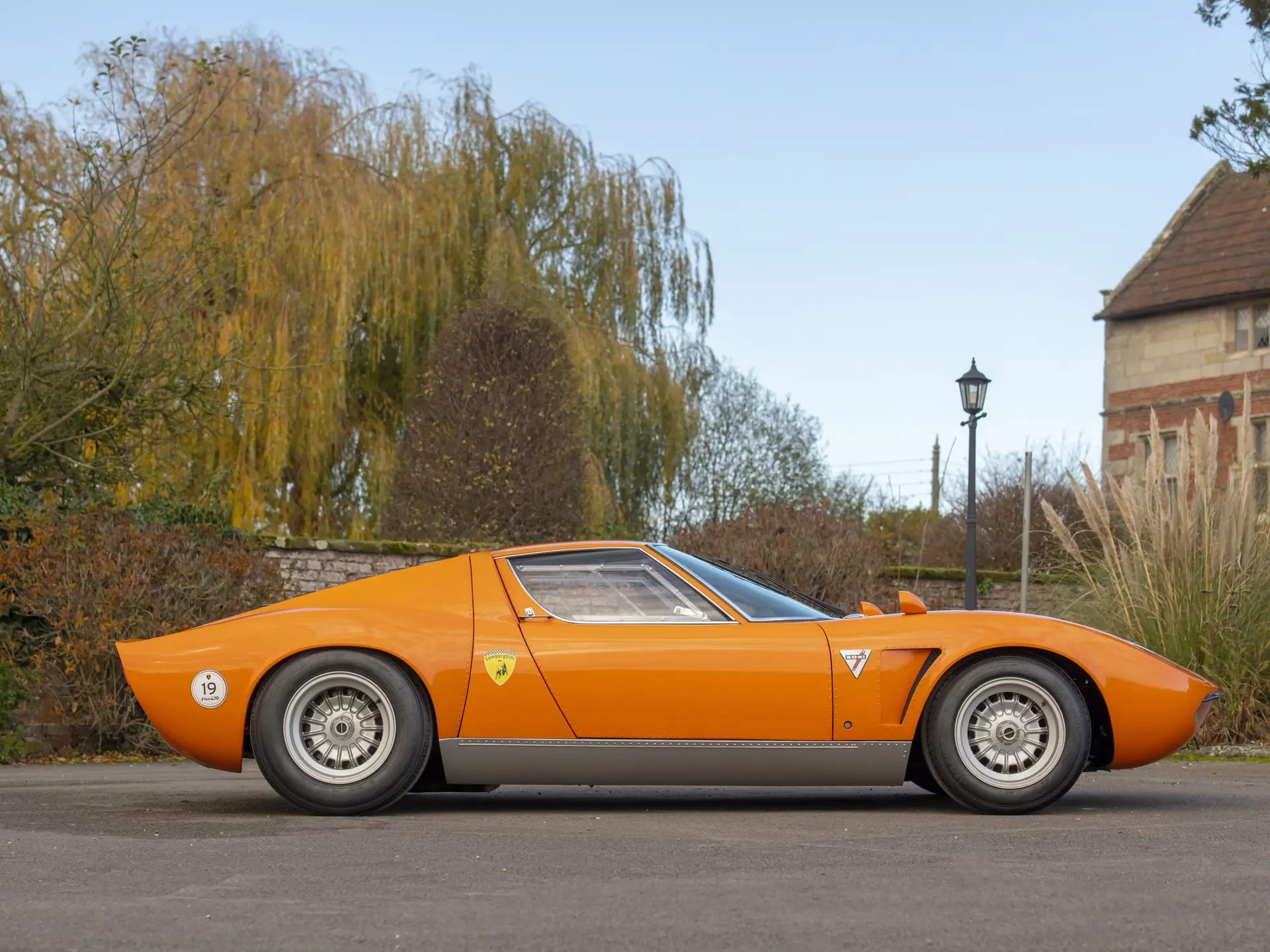
It was a philosophy that made commercial sense but quietly frustrated the engineers who had built the Miura. The car’s creators — Giampaolo Dallara, Paolo Stanzani, and test driver Bob Wallace — were racers at heart. The Miura, introduced in 1966, was the world’s first true mid-engined supercar, a masterpiece of form and balance that made the automotive world rethink what a road car could be. But under its beautiful skin, these men saw something more: a platform that could be a world-class racing machine.
Ferruccio’s refusal to go racing felt like a handbrake on that ambition. One by one, the restless talents drifted away — Giotto Bizzarrini, who had designed Lamborghini’s V12 engine, and then Dallara, both left in search of projects where they could test their ideas against the stopwatch. Only Wallace stayed behind, the ever-loyal test driver and problem solver. He was the man who turned prototypes into production cars, who made Ferruccio’s dreams driveable. Yet even he couldn’t ignore the itch. The Miura’s beauty was undeniable, but he knew how compromised it was dynamically. He could see, with a racer’s eye, what it might become if freed from its road-car shackles.
By 1970, opportunity finally arrived. Lamborghini’s technical director Paolo Stanzani, sympathetic to Wallace’s quiet obsession, gave him an unofficial blessing: build your ultimate Miura — just don’t let Ferruccio find out it’s cutting into company hours. The project would have to be a ghost operation, conducted in off-hours and with spare parts scavenged from around the factory.
🔗 Read more: Lamborghini Miura: The Bull That Launched the Supercar Era
And so, after the workers clocked off and the lights dimmed in Sant’Agata Bolognese, Bob Wallace went to work. He stripped a brand-new Miura chassis bare and began reinventing it with a racer’s touch. The plan was not to please accountants or customers but to prove a point: that Lamborghini could compete with Ferrari and Porsche on pure engineering merit, if only it chose to.
The prototype was nicknamed “Jota” — the Spanish pronunciation of the letter “J,” a cheeky reference to the FIA’s Appendix J racing regulations. It was part code name, part provocation. This was Wallace’s Miura — leaner, louder, lighter — the supercar Sant’Agata wasn’t supposed to build.
Journalists would later call it the “Miura Privata”, the private Miura, because that’s what it was: a one-man rebellion built with factory tools and after-hours sweat. Bob Wallace’s mission was simple but audacious — to take Lamborghini’s most beautiful creation and make it truly fast, truly focused, and, above all, worthy of the racetrack.
Design and Development of the Jota
Working with a fresh Miura P400 chassis (no. 5084) and a new 4.0-liter V12, Bob Wallace essentially started from scratch. His mission was simple yet audacious: make the Miura behave like a racing car. To do it, he needed to cut weight, stiffen the structure, sharpen the aerodynamics, and extract every ounce of power from Bizzarrini’s V12. The result would be the most extreme Lamborghini of its time — a Miura reimagined for the stopwatch rather than the salon.
A Lightweight Skeleton
The Miura’s original steel monocoque was beautiful, but heavy. Wallace attacked it with the mindset of an aircraft engineer. He cut out sections of the steel floor and replaced them with Avional, a high-strength aluminum alloy used in aviation. Wherever metal could be removed, he drilled holes — hundreds of them — until the frame resembled something out of a racing prototype. The structure was riveted together like an airplane fuselage, lighter yet stiffer than before.
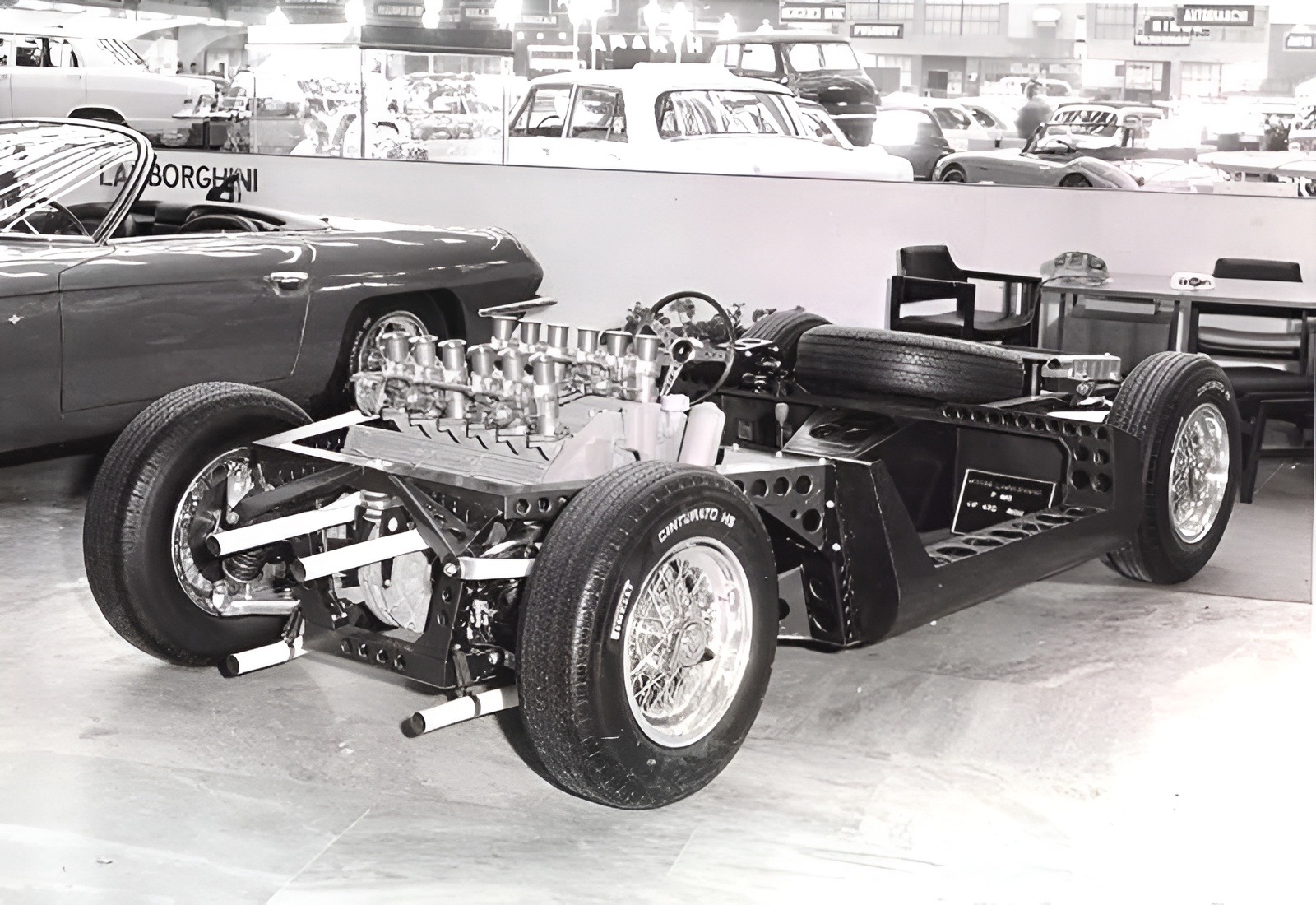
Virtually every outer panel was re-made in thin-gauge duralumin: the bonnet, doors, engine lid — even the delicate headlight surrounds. The glass was replaced with Plexiglas, including sliding side windows with simple pull-tabs in place of wind-up mechanisms. By the time Wallace was done, the Jota tipped the scales at around 880 kilograms (1,940 pounds) — some 250 kilos lighter than a Miura S. That alone transformed how it would drive.
Aerodynamics for the Unforgiving
At first glance, the Jota was still recognizably a Miura, but it looked harder, leaner, and unmistakably functional. Wallace’s modifications turned the voluptuous road car into a focused weapon.
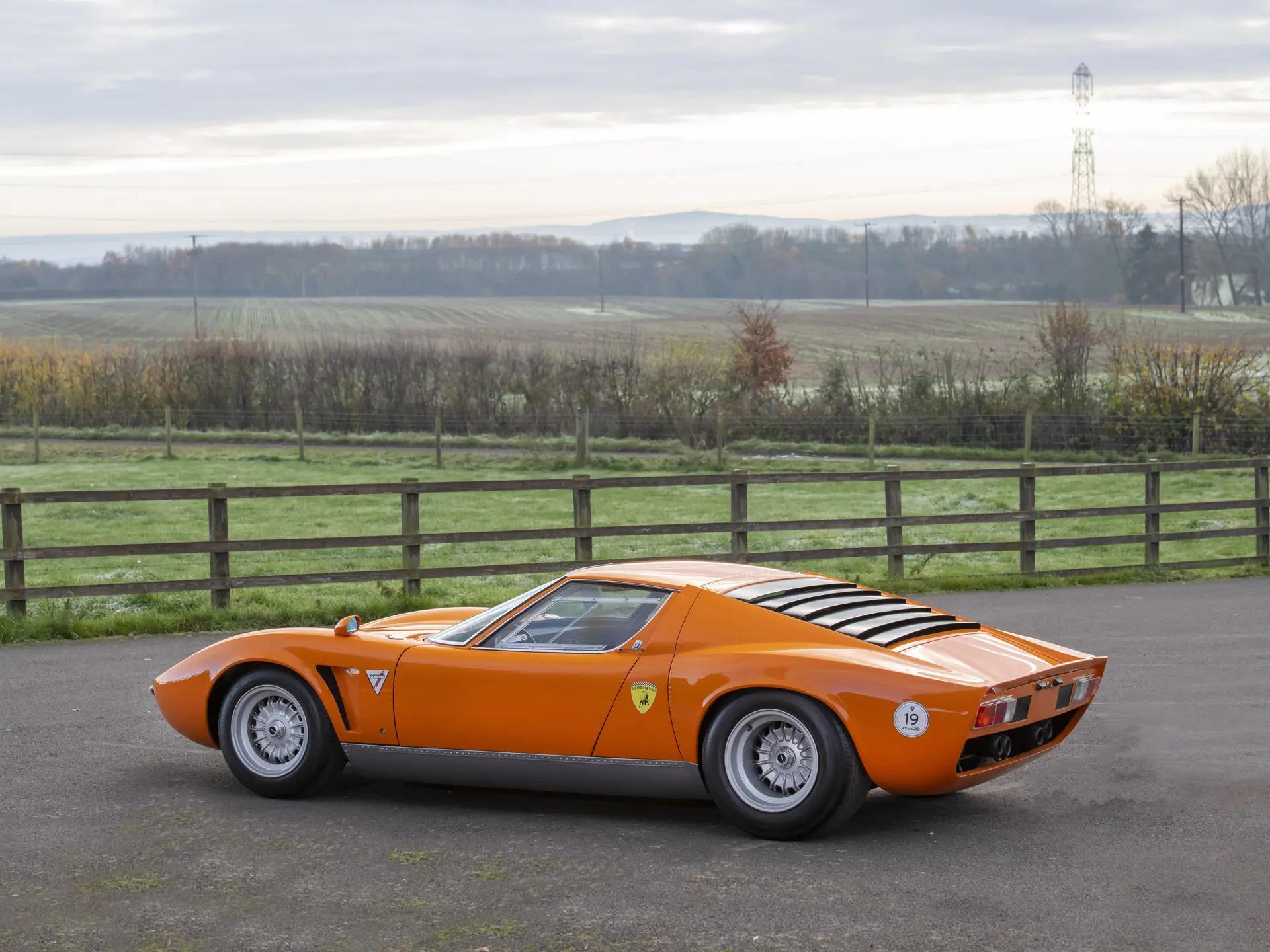
Up front, he added a deep chin spoiler to tame the Miura’s notorious front-end lift at speed. The pop-up headlights were deleted, replaced by fixed lamps faired in under clear Perspex covers. Large louvers behind the front wheels vented turbulent air from the wheel wells, while twin extractors on the bonnet bled off hot radiator air.
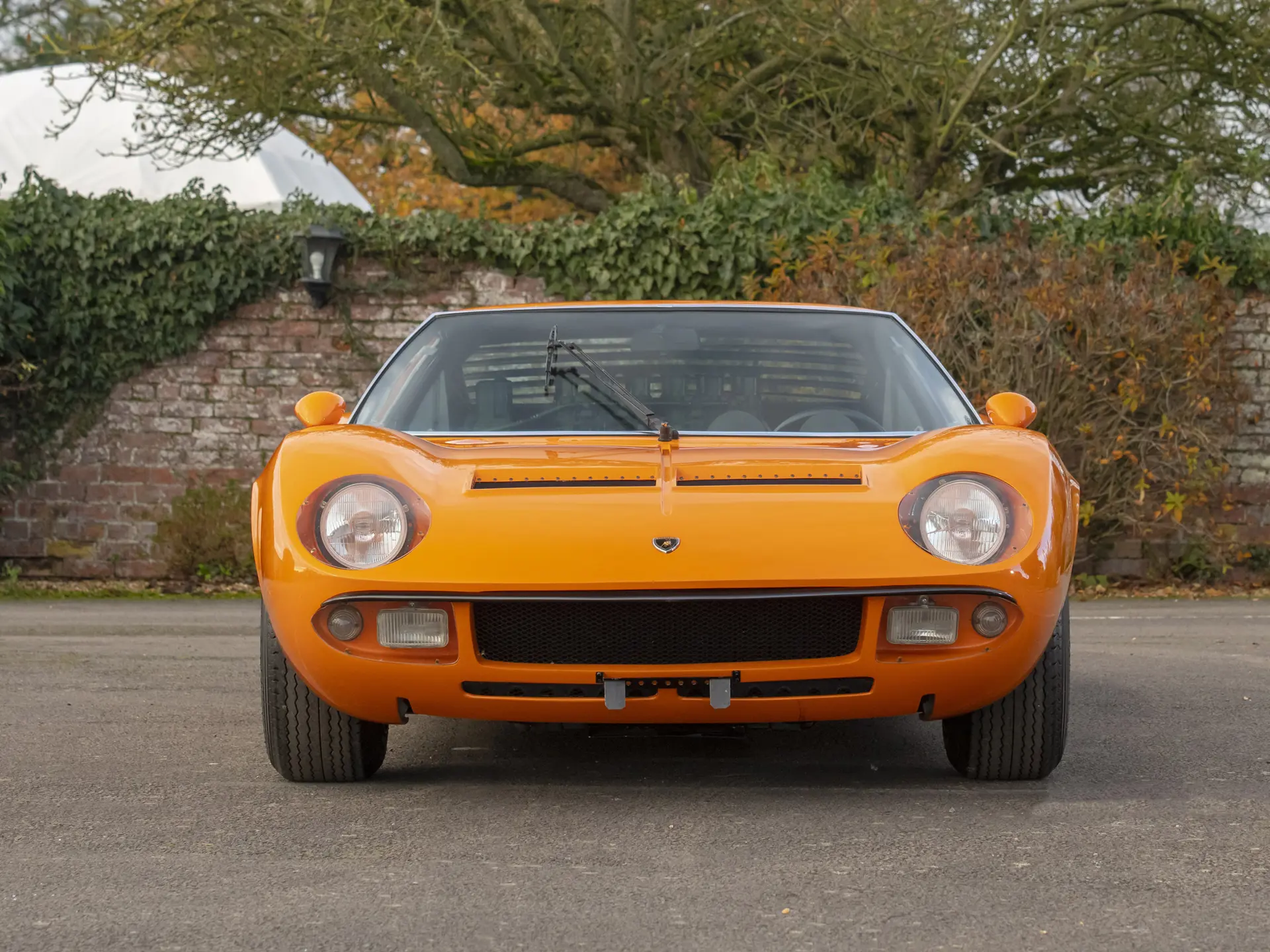
The roof sprouted twin scoops feeding cool air into the engine bay, and the tail gained a subtle lip spoiler for high-speed stability. The rear bodywork was drilled and vented like Swiss cheese, trading elegance for airflow. Chrome trim and ornamentation vanished; in their place came quick-release pins, raw rivets, and a single center-mounted wiper like a Le Mans prototype.
🔗 Read more: Italy’s Plexiglas Revolution in Postwar Car Design
When finished, Wallace painted the car a bold Rosso Corsa red, and — with typical mischief — added huge Lamborghini shield decals to each door, bright yellow bulls standing out against the crimson. It was impossible not to notice the resemblance to Ferrari’s prancing horse. Intentional or not, it was a provocative statement from Sant’Agata.
Suspension, Brakes, and Balance
To make the most of the lighter, stiffer chassis, Wallace re-engineered the Miura’s underpinnings from the ground up. The double-wishbone layout remained, but everything else was upgraded. Adjustable Koni racing dampers replaced the road-car units, and the suspension geometry was revised for sharper turn-in and more predictable grip at the limit. Stiffer anti-roll bars kept the car flat through corners.
He widened the track and fitted enormous Campagnolo magnesium wheels, 15 inches across with 9-inch fronts and massive 12-inch rears, shod initially with Dunlop slicks and later Pirellis during testing. The brakes were uprated to ventilated discs at all four corners — a major leap from the Miura’s standard solid rotors — giving the Jota endurance-race stopping power.
Wallace obsessed over weight distribution. The Miura’s single front fuel tank was replaced by dual 60-liter cells mounted low in the side sills, improving balance and lowering the center of gravity. Even the spare wheel was moved to the rear bulkhead to shift weight toward the driven wheels. Nothing escaped his fine-tuning.
Inside the Cockpit
If the exterior hinted at competition, the cabin confirmed it. Gone were the Miura’s carpets, sound insulation, and soft leather. The Jota’s cockpit was stripped bare — just aluminum, rivets, and the essentials. The original dashboard and center console were replaced by a custom lightweight panel holding only the necessary gauges and toggles, relocated from the Miura’s roof console.
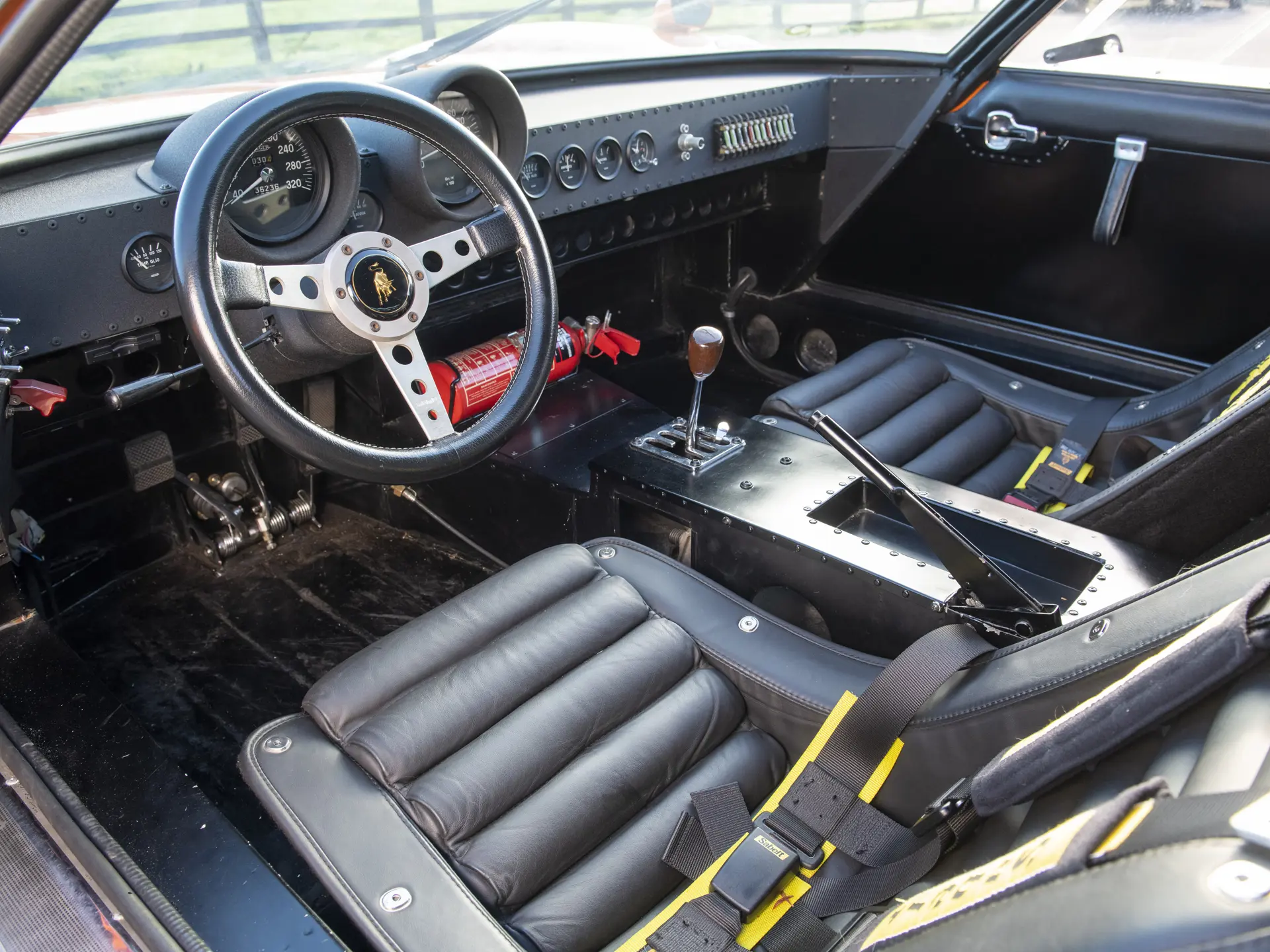
The passenger seat was optional at best; the driver’s seat was a minimal canvas sling, bolted directly to the chassis — pure race car thinking. The pedals hung from the bulkhead in top-hinged, competition style, a change that transformed the driving ergonomics. Everything that didn’t serve performance was discarded.
The Bizzarrini V12, Unleashed
At the Jota’s heart beat a reworked version of Giotto Bizzarrini’s 3.9-liter V12, and Wallace treated it with the reverence of a watchmaker and the ruthlessness of a racer. He tore it down, blueprinted every tolerance, and rebuilt it for violence.
Compression was raised to 11.5:1, the camshafts reprofiled for wilder lift and duration, and a set of Weber 46 IDL carburetors replaced the stock 40s. The engine inhaled through open trumpets and exhaled through four unmuffled megaphone pipes, their bark described by one witness as “metallic thunder.” A dry-sump system was added for cornering reliability and to drop the engine lower in the frame.
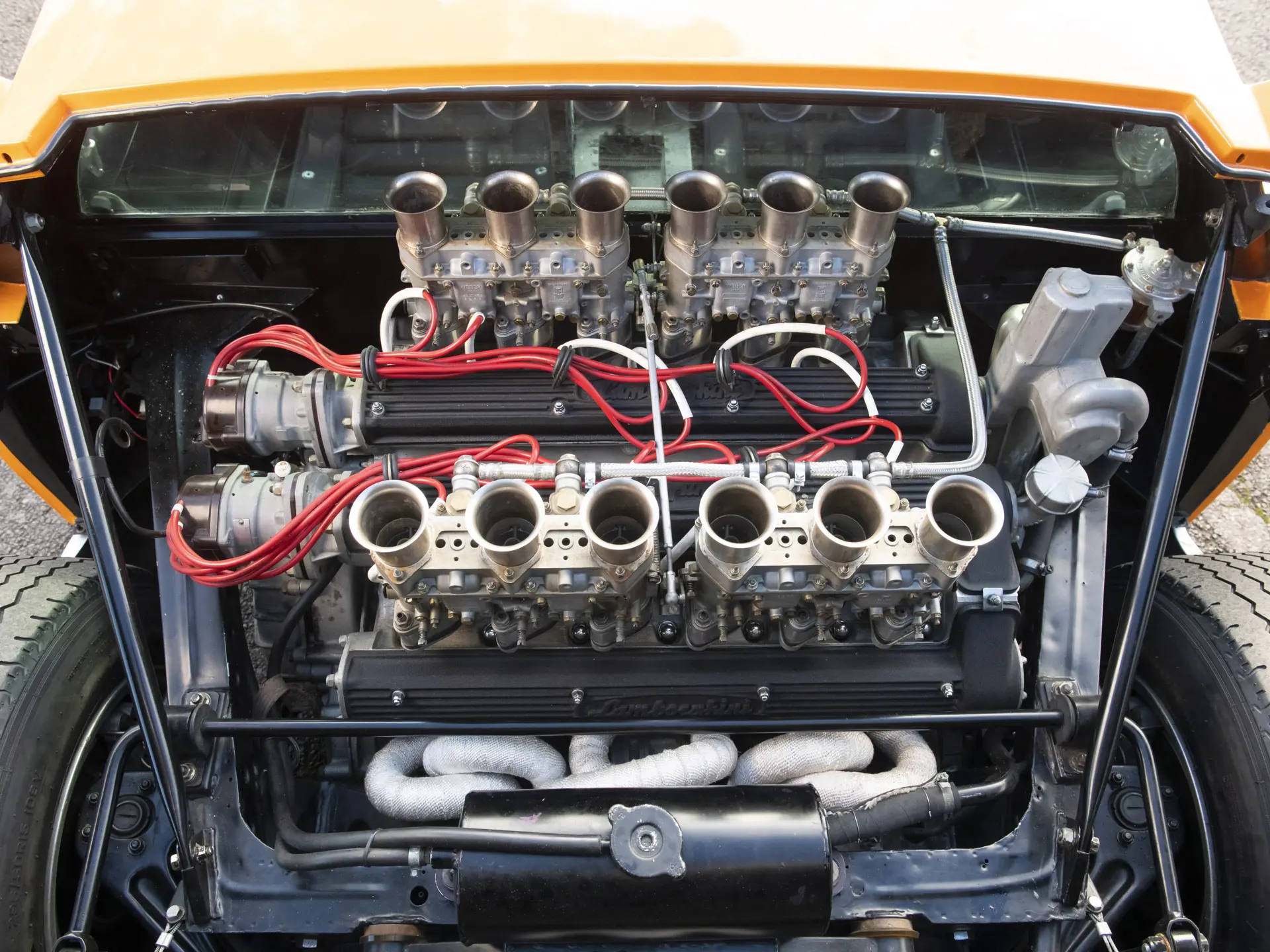
Power climbed to around 440 horsepower at 8,500 rpm, up from 350 in the standard P400 — an extraordinary figure for 1970. With roughly 110 horsepower per liter, the Jota’s V12 was one of the most potent naturally aspirated engines of its age. It didn’t just sound like a race car — it was one.
Performance and Testing
The numbers alone tell you how radical the Jota was. With 440 horsepower and just 880 kilograms to move, it hit 100 km/h in roughly 3.5 seconds — faster than most race cars of its day and decades ahead of anything wearing a license plate. Top speed? Estimated at over 190 mph (305 km/h), leaving the standard Miura’s 170 mph ceiling far behind. On paper and in person, it was a revelation. Bob Wallace liked to call it “a monster” — an uncaged bull that barely tolerated the leash of public roads.
But Wallace didn’t build the Jota for bragging rights or press photos. He built it to drive — and drive hard. Throughout 1970 and 1971, he used the car as a rolling laboratory, logging thousands of test kilometers. His workdays might have ended when the factory gates closed, but his nights often began behind the Jota’s wheel. Locals in Emilia-Romagna still talk about the red blur that tore through the countryside after midnight — Wallace testing, tuning, and pushing the car well past anything the company would officially sanction.
Lamborghini’s test track was limited, so Wallace often relied on Pirelli’s private circuit, thanks to the brand’s ongoing tire partnership. There, the Jota reached its true potential, serving as both a development mule and a test bench. Its feedback proved so valuable that Pirelli created a new H60-series tire specifically for high-speed Miuras, informed directly by data gathered from the Jota’s punishing runs. What began as an after-hours experiment had started to influence production engineering — and even tire technology.
By the time Wallace was done, the Jota had covered nearly 20,000 kilometers (12,000 miles) of relentless testing. It wasn’t just the fastest Lamborghini ever built; it was also the most instructive. Every kilometer refined Sant’Agata’s understanding of aerodynamics, balance, and high-speed behavior.
Of course, secrets like this don’t stay hidden for long. Rumors of a “hot-rod Miura” began circulating among European journalists, and in August 1971, Car magazine ran a full story by Doug Blain, dubbing it the “Miura Privata” and mispronouncing its Spanish codename as “Iota.” The press attention only amplified the car’s mystique. Enthusiasts whispered that Lamborghini might finally go racing. Even inside the factory, some dared to dream of Group 4 competition or a shot at Le Mans.
But Ferruccio Lamborghini would have none of it. The whispers about racing made him uneasy; his company, he insisted, would remain firmly on the road. The Jota, extraordinary though it was, had become a dangerous temptation — proof that Lamborghini could compete with Ferrari on its own turf. And Ferruccio wasn’t about to let that happen.
The Sale and Tragic Fate of the Jota
After more than a year of relentless testing, the Miura Jota had done its job. It was Bob Wallace’s laboratory on wheels — the car that proved what a Lamborghini could be if freed from corporate restraint. But for Ferruccio Lamborghini, it had also become a liability. The murmurs about racing were growing louder, and he wanted them silenced. The order came down quietly: sell the car.
In early 1972, the Jota found an eager buyer — Dr. Alfredo Belponer, an Italian privateer racer and owner of the Scuderia Brescia Corse team. A gentleman driver with means and taste, Belponer had heard the rumors: a Miura like no other, faster, lighter, sharper — the ultimate expression of Sant’Agata’s genius. He had to have it. The transaction was handled through InterAuto of Brescia, a local Lamborghini dealership, and on February 8, 1972, the Jota was officially delivered to the dealer, waiting to be handed over to its new owner.
It would never happen.
Shortly after its arrival in Brescia, fate intervened in the cruelest way. One of the dealership’s mechanics — accounts differ as to whether he was asked to perform a test drive or simply couldn’t resist temptation — decided to take the Jota out for a run. Some say a girlfriend rode beside him, perhaps unaware she was stepping into one of the most powerful road cars in Italy.
What followed was a tragedy written in gasoline and fire. On the newly opened Brescia ring road, the mechanic lost control at high speed. The Jota struck a barrier with catastrophic force, and its side-mounted fuel tanks — innovative but vulnerable — ruptured instantly. Within moments, the car erupted into flames. The thin alloy bodywork that had made it so light became its undoing, melting and collapsing in the inferno. The mechanic escaped, injured but alive. The Jota did not.
By the time the flames were extinguished, nothing remained but a scorched shell and the twisted remnants of its spaceframe. The world’s only Lamborghini racing prototype — the car that had never been allowed to race — was gone forever.
News of the fire spread quickly through Italy’s small automotive community. Enthusiasts were stunned. The Jota had existed for barely a year, its legend only just beginning to form, and now it was ash. Some in Sant’Agata went silent on the subject, others spoke of it with a kind of reverence, as though describing a fallen comrade.
The factory did recover the engine, which had survived the blaze with surprising integrity. Rumor has it that the V12 was later transplanted into another Miura, though records are hazy and no car has ever been conclusively identified as its host. What’s certain is that Ferruccio Lamborghini never authorized a rebuild. The Jota had served its purpose; in his eyes, its destruction neatly closed a chapter he’d never wanted to open in the first place.
Aftermath: SVJ Variants and the Jota’s Legacy
The Jota may have perished in fire, but its legend was only just beginning. Word of Bob Wallace’s one-off creation spread quickly through the small world of collectors and Miura owners. For those who could afford anything, the idea of a “super Miura” — lighter, faster, and sharper than the production cars — was intoxicating. Within months, Lamborghini began receiving quiet requests from a few favored clients who said, in essence, “I want mine to be like the Jota.”
Officially, there would be no resurrection. But unofficially, Lamborghini complied. Between 1972 and 1975, a handful of Miura SVJs were built — modified versions of the final Miura SV, each infused with the Jota’s spirit. These were not production cars but factory-sanctioned specials, built in ones and twos for VIP customers.
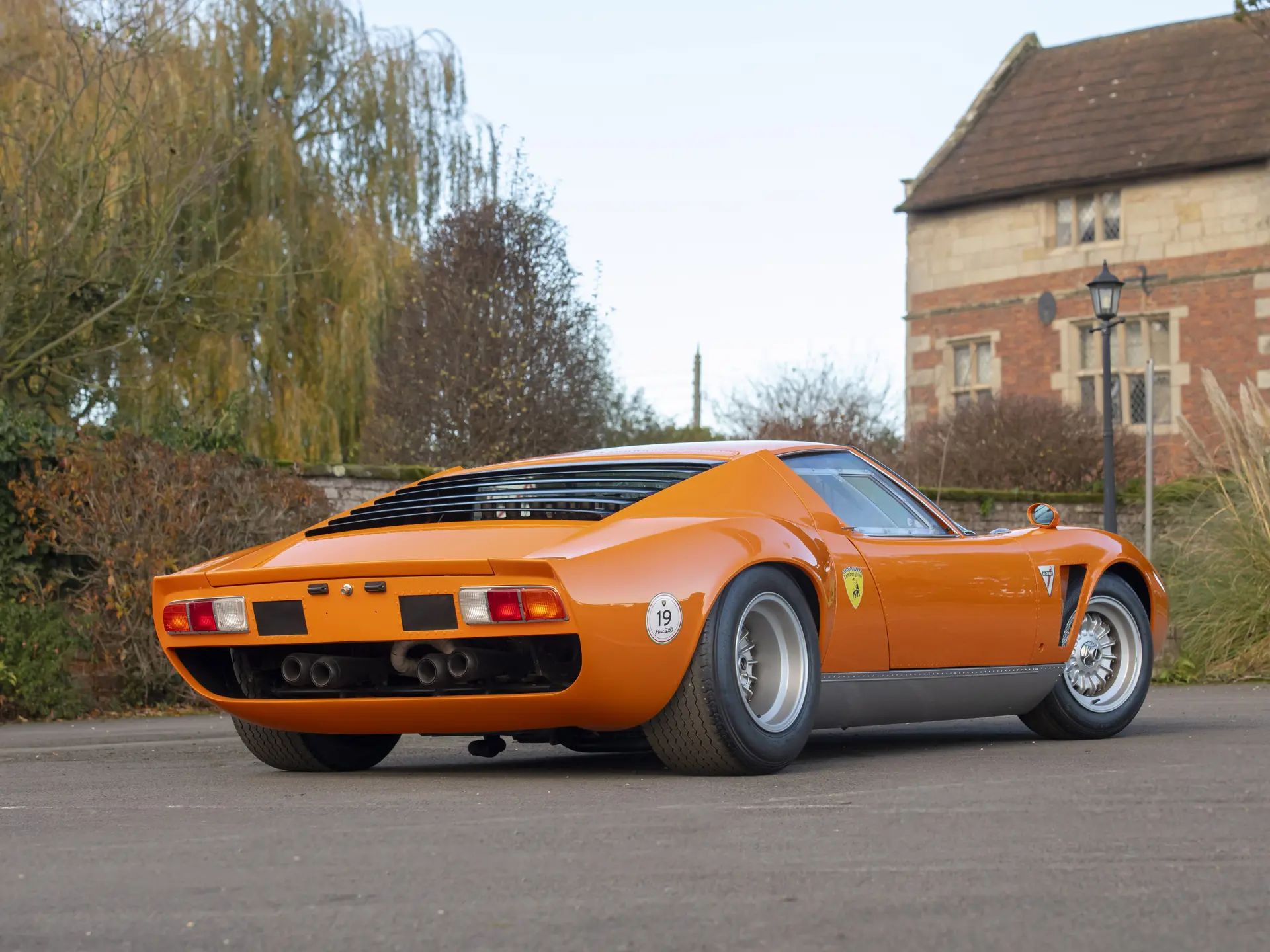
The SVJ formula was simple but seductive. Each car received Jota-inspired bodywork — extra cooling vents and intakes on the hood and fenders, flush-mounted headlamps, a racing-style quick-fill fuel cap, and a signature four-outlet exhaust. Some even gained dry-sump engines, like Wallace’s original, allowing sustained high-speed cornering. Power rose slightly beyond the standard SV’s 385 bhp thanks to hotter cams and carburetion tweaks, and suspension and brakes were uprated to match. Still, the SVJ was more grand tourer than test mule — civil enough for the Riviera, but capable of hinting at the madness of the Jota.
Each of these cars came with its own mythology. The first SVJ, chassis #4860, was built for German Lamborghini importer Hubert Hahne, a man who knew his way around a race car. Another, #4990, went to the flamboyant Haitian collector Alberto Silvera, who loved his so much that he reportedly ordered a second one. A third, #3781, was sold to a French enthusiast — and, in time, would play an unexpected role in the Jota legend’s next chapter. Lamborghini’s archives mention at least one more, #5090, possibly a fifth — each one a bespoke masterpiece, whispering the same message: the Jota lives on, if you can pay for it.
Then there was the Miura SVR, a car that pushed the tribute even further. In 1975, a Lamborghini dealer transformed that same chassis #3781 — once an SVJ — into a brutal, wide-bodied machine with bolt-on arches, racing seats, and a rear wing. It looked more Group 4 than grand tourer. The SVR’s journey was even stranger: it ended up in Japan, where it inspired a popular manga series and became a cult icon before being restored by Lamborghini’s Polo Storico division in 2018. The company that once banned racing had now lovingly rebuilt its most outrageous racing lookalike.
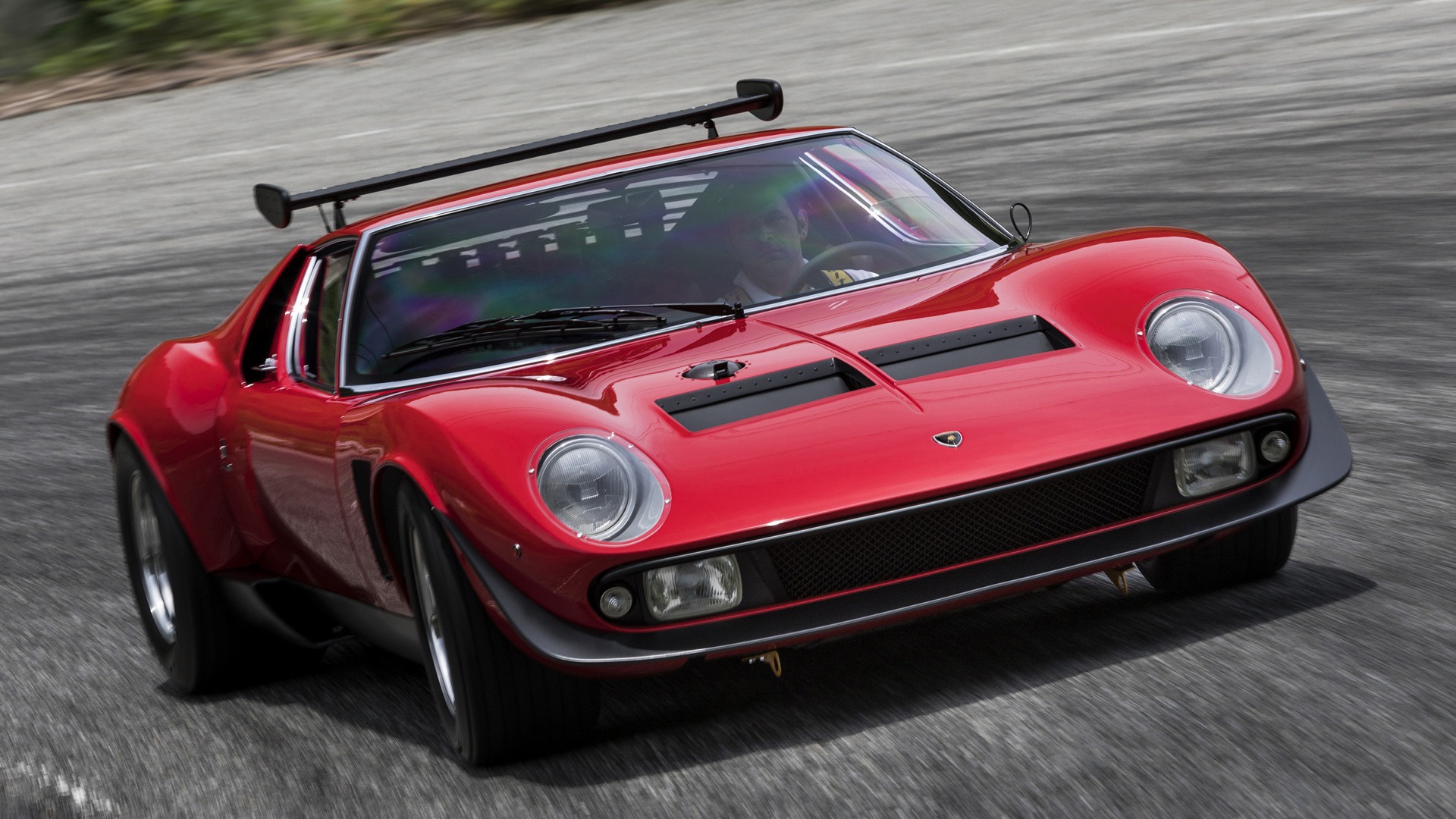
As the decades passed, the Jota’s shadow lengthened. Enthusiasts and restorers began creating their own Jota-inspired conversions, painstakingly reshaping original Miuras into tributes to the lost prototype. One Miura S, extensively modified in Japan in 2013 with SV mechanicals and custom bodywork, came up for sale in 2022 — proof that the appetite for the Jota dream had never faded.
Even Lamborghini couldn’t resist. The factory revived the name twice: first with the Diablo SE30 Jota of the 1990s — a track-focused upgrade kit that echoed Bob Wallace’s philosophy — and later with the Aventador SVJ, launched in 2018, a car whose very name (“Super Veloce Jota”) was a direct salute to the Miura’s mythical forebear.
Today, the letter “J” has become shorthand for the most uncompromising Lamborghinis — those built for speed above civility, for passion above profit. It all began with Bob Wallace’s midnight experiment in 1970. The original Miura Jota may have burned, but in doing so it lit a fire that still fuels Sant’Agata’s wildest creations.
Recreating the Legend
For decades, the Lamborghini Miura Jota existed only as a ghost. Its brief life and fiery death had left behind no surviving chassis, no tangible artifact — only photographs, magazine articles, and the fading memories of those who had heard its metallic howl. Over time, the car became less a machine than a myth: the ultimate Lamborghini that no longer was.
Then, in the early 2000s, one man decided that myth deserved flesh and metal once more. Piet Pulford, a respected British Lamborghini collector, set out on a quest that would take him fifteen years — to resurrect the Jota exactly as Bob Wallace had built it. This would not be a re-creation in spirit, but in substance.
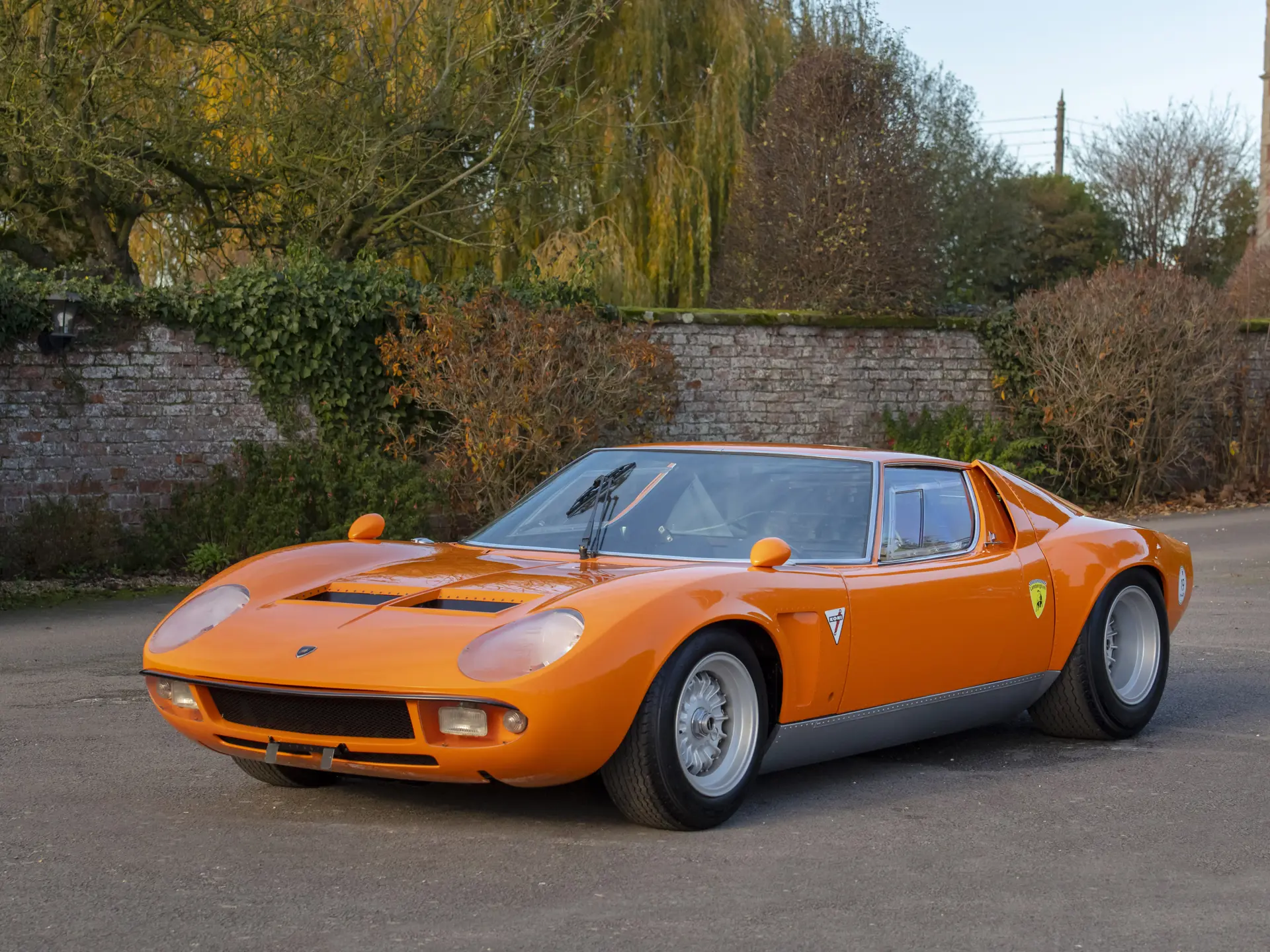
Pulford began with a genuine Miura P400 chassis — serial no. 3033 — a tired car in poor condition, ideal for transformation. He assembled a small team of specialists, including Chris Lawrence of Wymondham Engineering and Roger Constable of The Car Works, two craftsmen renowned for precision restoration. Together, they reconstructed the Jota piece by piece: the riveted alloy body, the Plexiglas windows, the twin roof scoops, the quick-release pins, and the myriad vents that gave the original its functional menace. Every curve was drawn from historical records, every detail cross-checked against photos and period notes.
And then came the greatest coup of all: Bob Wallace himself joined the project. From his workshop in Arizona, the man who had built the original Jota forty years earlier provided guidance, measurements, and memories. He even constructed a correct Jota-spec 4.0-liter V12, complete with dry-sump lubrication, race cams, and open trumpets — the same beating heart he had once tuned by hand in Sant’Agata. Under his mentorship, Pulford’s team recreated not just a car, but a moment in history.
When the new Jota was completed in 2006, it stunned even its creator. Wallace inspected the finished car, smiled, and told a reporter: “The workmanship is probably better than mine was on the original.” It was the highest possible compliment.
Painted in deep red, sitting low on its wide Campagnolos, the reborn Jota looked every inch the lost prototype. And when its V12 roared to life — uncorked through four megaphone pipes — it sounded like a memory made real. The noise was so ferocious that Pulford later fabricated removable silencer caps, just to drive it legally on British roads. For the first time in more than thirty years, the legend could be seen, heard, and felt again.
The Pulford Jota remains the most faithful and celebrated recreation to date, a car that blurs the line between restoration and resurrection. Yet it’s not alone. Lamborghini’s own Ferruccio Lamborghini Museum in Italy now displays a full-scale aluminum-bodied Jota reconstruction, built to the original blueprints as a static tribute. It stands like an industrial sculpture — a monument to Bob Wallace’s genius, to a car that lived fast, died young, and refused to be forgotten.
The Enduring Legend
The story of the Lamborghini Miura P400 Jota is both inspiring and tragic — a tale of ingenuity, rebellion, and loss. It began with Bob Wallace, a quiet craftsman with a racer’s heart, who was given rare freedom and built something the world had never seen. In a company forbidden to race, he created a car that could have rewritten history.
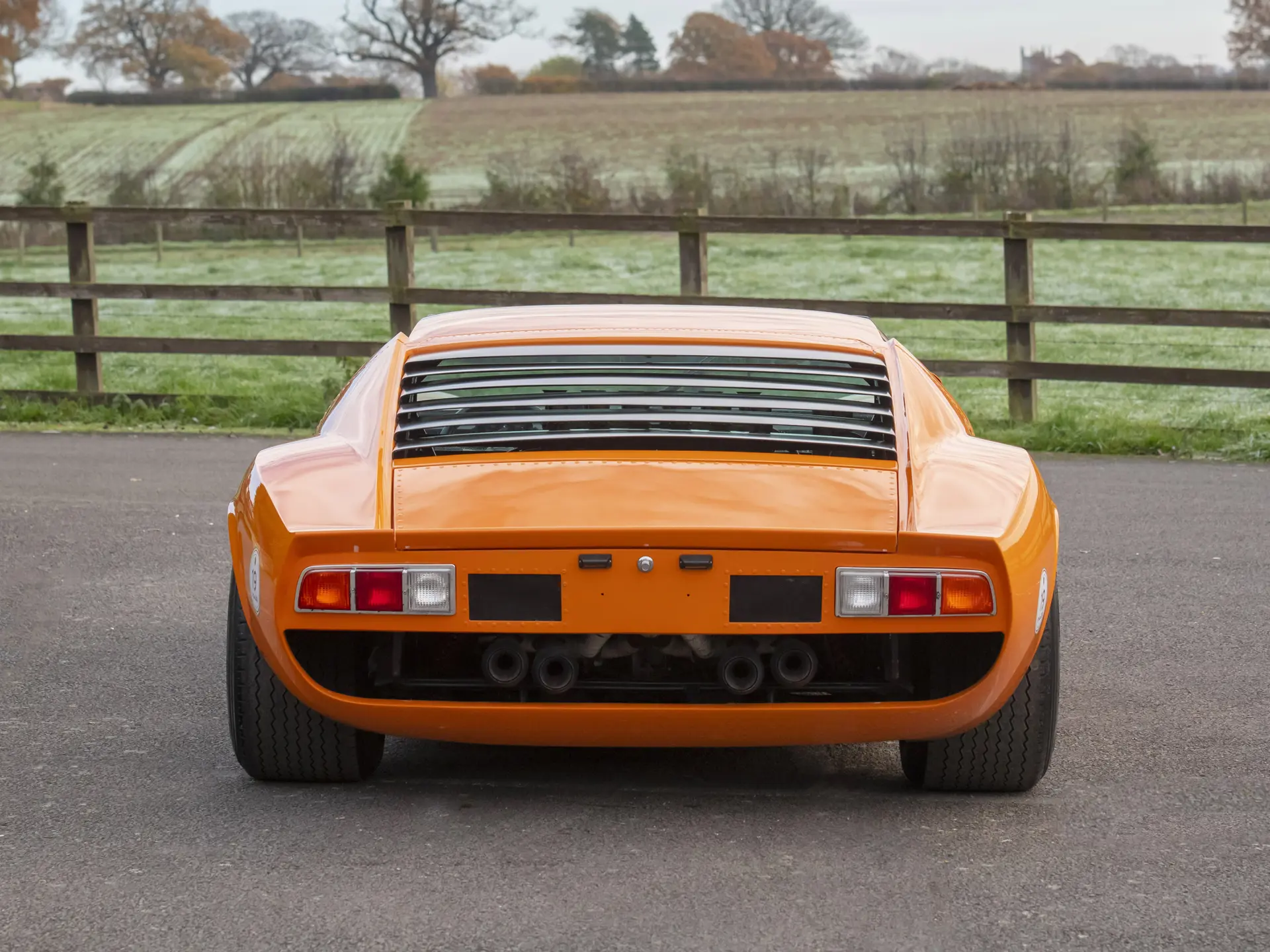
For a brief, incandescent moment, the Jota showed what Lamborghini’s engineers were truly capable of when the corporate leash was loosened. It was the Miura stripped to its essence — ultra-light, brutally fast, and astonishingly advanced. In another timeline, it might have been a Le Mans contender. In ours, it became something rarer: a myth.
Ferruccio Lamborghini never allowed his factory to enter motorsport, but the lessons of the Jota resonated long after its destruction. The experimental chassis work, the aerodynamic tweaks, the dry-sump lubrication — all left fingerprints on the cars that followed. You can trace its DNA in the Countach’s wedge, the Diablo’s menace, and the Aventador SVJ’s ferocity. The Jota transformed Lamborghini’s identity, shaping its reputation as the maker of wild, uncompromising machines — cars built not for convenience, but for glory.
More than fifty years later, the Jota remains one of motoring’s most captivating “what ifs.” Enthusiasts still speak its name with reverence; collectors treasure any car that carries its spirit — whether an SVJ, an SVR, or one of the painstaking recreations that keep its memory alive. The very letter “J” has become Lamborghini shorthand for the ultimate: the apex of speed, noise, and nerve.
Ultimately, the Miura Jota reminds us of an era when a single man, armed with skill and stubbornness, could change a company’s destiny — if only for a moment. It lived fast and died violently, but its legend never cooled. The Jota’s flame burned briefly, yet in its glow, Lamborghini found its soul.
CONTINUE READING
Posts You Might Like

A Central Driving Position, a Rear-Mounted V8. Was This Really a Lancia?
In 1948, visitors to the Turin Motor Show could see an unusual Lancia on the stand of Carrozzeria Ghia. It was a large two-door coupé with a two-litre V8 mounted behind the…
Read story
Fioravanti F100: The Ferrari He Was Allowed to Imagine
Enzo Ferrari’s centenary, Leonardo Fioravanti’s independent studio and a supercar that explored air brakes, steel wheels and a new way of driving—without ever wearing the Cavallino.
Read story
Michelotti Shellette: When the Fiat 850 Became a Yacht
The yacht designer, the Turin stylist and the tiny coachbuilt car that crossed between the quay, the royal holiday house and the auction room. Some automobiles were conceived for the open road,…
Read story
Maserati A6 1500: A New Road for the Trident
When the doors of the Geneva Motor Show opened in March 1947, Maserati was a name that required little introduction to anyone who followed motor racing. What it did not yet possess…
Read story
THE CONVERSATION
Comments 0
Share a memory, a period photograph or a documented detail about this story.