
Dressed to Race: The Marzotto Brothers and Their Rebel Ferraris
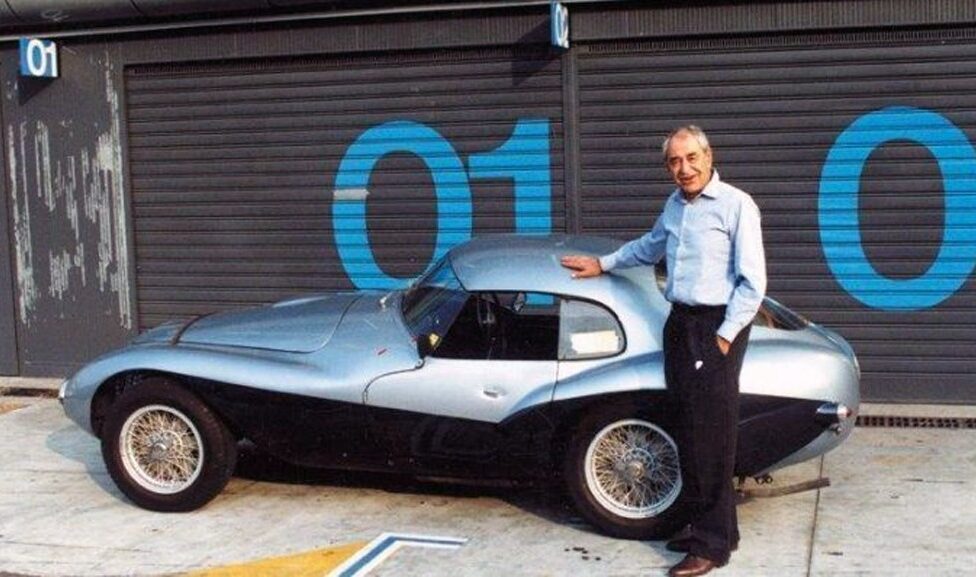
Giannino Marzotto was no ordinary racing driver – he was an Italian count, a textile heir, and a daredevil who famously raced in style. In 1950, at just 22 years old, Giannino showed up at the start of the Mille Miglia not in overalls, but in a tailored double-breasted brown suit with a tie, looking more ready for a business meeting than a grueling 1000-mile road race. By the end of that race, he had proven that a gentleman could be both elegant and lightning fast – he crossed the finish line in Brescia as the overall winner after 13+ hours of high-speed driving, still impeccably dressed and having beaten legends like Juan Manuel Fangio along the way. This “double-breasted victory” became racing folklore, and it announced Giannino as a new star in Italian motorsport.
Despite his aristocratic background (his father Count Gaetano Marzotto ran a prominent textile empire), Giannino’s true passion was racing cars. He and his three brothers – Paolo, Umberto, and Vittorio – were all gentleman drivers in Italy’s post-war racing boom. Fast cars and competition offered a thrill quite different from fabrics and factories. The Marzotto brothers had the means to buy the best cars of the day, which naturally meant Ferraris. In fact, Giannino became good friends with Enzo Ferrari himself. But being friends with “Il Commendatore” (as Enzo was nicknamed) didn’t mean Giannino was a meek customer. Far from it – as a wealthy young enthusiast with engineering curiosity, Giannino wasn’t afraid to question Ferrari’s choices or push for improvements.
One anecdote illustrates this boldness: after winning the 1950 Mille Miglia in a Ferrari 195 S, Giannino tested another Ferrari and felt it was underperforming. Suspecting that Ferrari’s team had deliberately “strangled” the engine to make it easier to handle for a young driver, Giannino marched straight to Enzo to complain. The audacity of a 22-year-old telling the great Enzo Ferrari that his car was too slow is almost comical, but it happened. A somewhat embarrassed Enzo promised to personally have the car prepared properly for the next race. This mix of confidence and youthful cheek would soon lead Giannino to an even bolder idea: build a better Ferrari himself (or at least, commission one).
Brothers in Arms (and Wheels): Scuderia Marzotto
By 1951, the four Marzotto brothers decided that instead of just entering races individually, they would form their own team. Scuderia Marzotto was born in Valdagno (the Marzotto hometown) as a family racing outfit with an almost limitless enthusiasm for speed. With ample funds at their disposal, the brothers acquired several Ferraris to campaign in events like the Mille Miglia, Giro di Sicilia, Targa Florio, and more. They weren’t content to simply buy off-the-shelf racecars from Maranello – they started tweaking and even radically modifying their Ferraris to gain an edge, often operating in uncharted territory for customer teams.
Giannino, especially, believed the standard Ferrari racing cars could be improved. After his Mille Miglia triumph and other wins (including the Coppa d’Oro delle Dolomiti in 1950), the young man had ideas on how to make the cars faster. He felt some designs were aerodynamically old-fashioned or heavier than necessary. Enzo Ferrari, proud of his creations, wasn’t exactly eager to let a 20-something amateur tell him how to build cars. So Giannino took a more daring route: he would commission special one-off bodies and modifications, effectively creating bespoke Ferrari-based racecars that could outdo even Ferrari’s own designs. It was a gutsy move – some might say impudent – but Giannino had the resources, the vision, and a bit of that youthful arrogance to give it a shot.
To accomplish this, Giannino and his brothers turned to an unlikely partner: Carrozzeria Fontana of Padua. Unlike the famous coachbuilders of the time (Touring, Vignale, Pinin Farina, etc.), Fontana was a relatively obscure outfit for high-end sports cars. In fact, Fontana’s heritage went back to making horse-drawn carriages in the 19th century, and by 1950 it wasn’t known for cutting-edge racing bodies. But Giannino wasn’t looking for mainstream – he wanted innovation and was willing to take risks. Fontana had two brothers (Paolo and Piero Fontana) running the show and an ace up its sleeve: a talented young designer/engineer named Franco Reggiani. Reggiani was in his mid-20s, much like Giannino, and had an aeronautical engineering background along with a flair for artistic design. (He would later become a renowned sculptor, which tells you about his eye for form.) Giannino realized that Reggiani and the Fontana brothers could think outside the box – exactly what he needed.
In late 1950, Giannino placed a very special order with Carrozzeria Fontana: two custom-built racing car bodies, to be fitted on Ferrari chassis the Marzotto team had purchased. The plan was to create one lightweight open-top spyder optimized for winding, hilly courses (like mountain races or the Giro di Sicilia) and one radical closed berlinetta (coupe) designed for high-speed events (like the Mille Miglia and other road races). The chassis chosen were a pair of Ferrari 212 Export frames – one numbered 0086E and the other 0084E. Essentially, the Marzotto brothers were handing Fontana two brand-new Ferraris and saying, “Go wild. Surprise us.” It was an unprecedented collaboration: a private customer teaming with an unsung coachbuilder to challenge Ferrari’s own engineering.
What emerged from this daring venture were two of the most unusual Ferraris ever seen. One would earn the nickname “Carretto Siciliano” (Italian for Sicilian Cart), and the other would forever be known as “L’Uovo” (Italian for The Egg). These cars were so outlandish in looks that they initially horrified Enzo Ferrari, yet they embodied the Marzottos’ blend of ingenuity and rebellion in the racing world. Let’s take a closer look at each of these marvels.
The “Sicilian Cart” Ferrari: Folk Art on Wheels
The first of the Fontana creations to hit the road was the Ferrari 212 Export Spyder chassis 0086E, which quickly became known as the Carretto Siciliano. If the name sounds whimsical, the car’s appearance certainly matched it. This open-top racer was completed in time for the April 1951 Giro di Sicilia (a strenuous 11-lap race around the island of Sicily). Rather than a sleek, polished racing machine in traditional red, the Marzotto brothers had 0086E fitted with a minimalistic, lightweight body that was then painted by hand in exuberant fashion. The inspiration came from Sicily’s traditional donkey carts – wooden carriages painted in bright colors and elaborate folk motifs. Imagine a Ferrari dressed up for Carnival: turquoise and yellow paint, intricate patterns, possibly depictions of knights and saints or Sicilian folklore scenes adorning its curves. It was part racecar, part rolling piece of art.
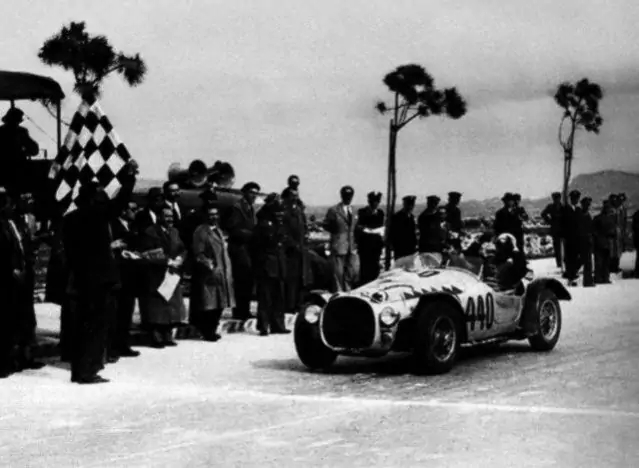
Underneath the eye-popping paint job, 0086E was all business: a 2.6-liter Colombo V12 engine lurked under the hood, and the Fontana body was feather-light, built for performance. The fenders were of the cycle type (separate, thin fender pieces over each wheel), which reduced weight and gave the car a somewhat spindly, old-timey appearance – almost like a pre-war racer but with flamboyant decoration. Many onlookers and competitors must have been baffled: was this a joke? Some garish promo vehicle? But any snickering stopped once the race began. In the 1951 Giro di Sicilia, Vittorio Marzotto (Giannino’s brother) took the wheel of the “Sicilian Cart” with Paolo Fontana (the coachbuilder himself) as co-driver. Not only did they compete, they won the race outright, beating a field of more conventionally clothed Ferraris and other sports cars. The bright yellow-and-turquoise Ferrari flying through the Sicilian countryside left competitors in its dust and spectators with their jaws dropped. It was as if a Sicilian folk parade wagon had suddenly developed a 150-horsepower fury and decided to humiliate the serious machines.
Winning a major race on its debut gave the Carretto Siciliano a kind of instant legend status. However, its wild attire was short-lived. The Marzottos were pragmatists at heart – winning was more important than showmanship in the long run (well, maybe slightly more important). After securing that Giro di Sicilia victory, they decided to retire the elaborately painted body. By mid-1951, chassis 0086E was stripped of its decorative form and rebodied in a more conventional style. They had Carrozzeria Vignale (a more established coachbuilder for Ferrari) craft a typical 212 Export spyder body for it, likely to keep Enzo Ferrari from fainting at the sight of the “cart” and to ensure the car could be taken seriously in subsequent races. The car’s mechanicals were also adjusted: notably, the original triple-carburetor setup was swapped at one point for a single-carburetor engine (possibly an engine from chassis 0084E) to improve reliability and drivability in endurance events. In other words, 0086E put on a plain suit after dancing in carnival costume – time to get back to business.
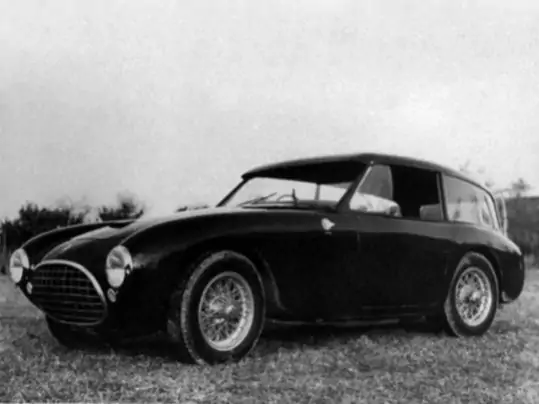
Yet, the shape-shifting adventures of the Sicilian Cart were far from over. Chassis 0086E would go through more transformations than a movie spy’s getaway car. Later in 1951, the Marzotto team had Fontana convert 0086E into an estate car (giardinetta) – essentially a station wagon Ferrari, complete with a tailgate! Yes, you read that correctly: the race-winning Ferrari was turned into a three-door wagon to carry spare parts and tools as a support vehicle for the team. If this sounds like the punchline to a joke, it actually made practical sense. The legendary Carrera Panamericana in Mexico was on the calendar, and the Marzottos figured a fast “service car” that could keep up with the racers was a clever idea. So, Fontana added a wagon-like rear to 0086E, reinstalled the more powerful triple-carb V12 engine, and the once-whimsical racer became a workhorse. One can imagine the pit crews at races doing double-takes as a Ferrari wagon rolled up to deliver tires or fuel – talk about one-of-a-kind sight!
Before 1952 rolled around, 0086E was transformed yet again. The station wagon experiment was temporary; next, Fontana rebodied the chassis as a sleek two-seat sports spyder with “fianchi stretti”, Italian for narrow, inswept flanks. This design removed any unnecessary width or bulk, making the car as slender as possible for cutting through the air. The front grille was widened and the body further lightened in June 1952 for optimal performance. In this guise, the car was a far cry from the gaudy Sicilian Cart design – it looked more like a serious competition Barchetta (little boat) ready to bite back at the winding roads. Guido Mancini, one of the team’s drivers, took 0086E (in its fourth body incarnation by now!) to compete in the 1952 Targa Florio race in Sicily. The car didn’t clinch a victory there, but the fact it was still racing competitively after so many makeovers is extraordinary.
After 1952, the Marzotto brothers finally let 0086E retire from frontline duty. In 1953 Giannino won the Mille Miglia again (this time in a Ferrari 340 MM), and the era of sports car racing was evolving with new models. What does one do with a twice-rebodied, thrice-modified Ferrari after its racing heyday? In the case of 0086E, it eventually found a new life overseas. In 1958, an American enthusiast named Jim Flynn purchased 0086E, bringing this chameleon-like Ferrari to the United States. Flynn raced it in SCCA (Sports Car Club of America) events – the flamboyant Marzotto machine became a regular competitor on American tracks, no doubt with some curious stories attached. By the 2000s, the car resurfaced in the hands of a collector (Peter Markowski) who undertook a meticulous restoration. In a delightful twist, during the restoration the long-lost Fontana spyder body from the 1952 Targa Florio was discovered and reunited with the car. Today, chassis 0086E is a priceless piece of Ferrari history – not because of a string of world championships, but because it symbolizes a wild era of creativity when privateers could experiment fearlessly on Ferrari’s dime (and survive to tell the tale!).
The Ferrari “Uovo”: Cracking the Code of Aerodynamics
The second custom car ordered by Giannino and built by Fontana/Reggiani was even more infamous. This was the radical coupé designed for high-speed racing – the car that would become known as “L’Uovo” (The Egg) due to its egg-like profile. Where the Sicilian Cart was whimsical, the Uovo was almost futuristic for its time. Giannino wanted aerodynamics above all: a car that could slip through the air with minimal drag, allowing higher top speeds on long straights. Franco Reggiani delivered a truly avant-garde design: the Uovo had a bulbous, streamlined front with a rounded nose and grille that looked like the blunt end of an egg, a teardrop cockpit, and a fastback tail. It was all curved surfaces and no sharp edges – form truly followed function (with a bit of artistic flair thrown in). Built on a Ferrari chassis (in fact, the Uovo’s underpinnings were a bit complicated – it started from a Ferrari 166 MM that had been wrecked, chassis #024MB, which was then repaired and fitted with a new 2.6L 212 Export V12 engine), the car was essentially a Ferrari 166/212 hybrid with a one-off body.
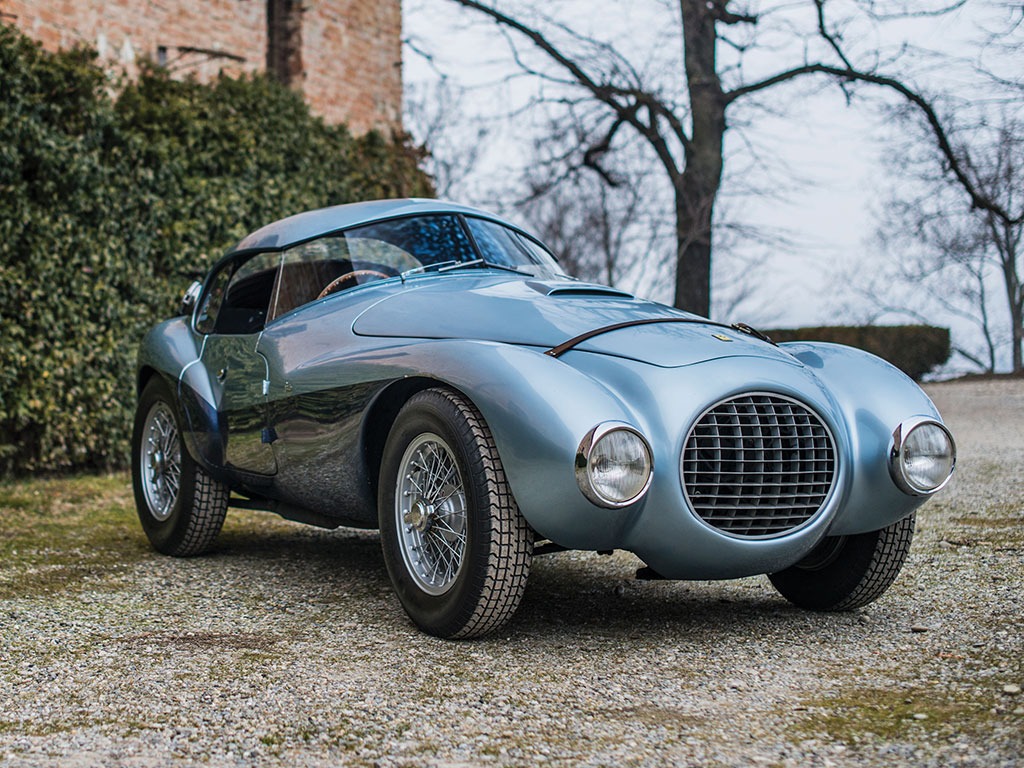
By early 1952, the Fontana Uovo was ready to take on the big challenge: the Mille Miglia, Italy’s toughest road race. Giannino Marzotto had every intention of defending his 1950 title and proving that his unorthodox creation could outclass Ferrari’s own factory cars. During the 1952 Mille Miglia, the silver, egg-shaped coupe must have looked like an alien spacecraft among the more traditional vehicles. But it was fast – Giannino actually took the lead in the race, vindicating his bold design choices. For much of the race, the Uovo was ahead of all comers, and one can imagine Enzo Ferrari’s shock (and perhaps a bit of pride, deep down) seeing his young friend’s oddball car leading the pack. Unfortunately, fate intervened in the form of a technical failure; Giannino was forced to retire the Uovo while still in a commanding position. It was a heartbreaking end to an audacious attempt – the Uovo had been on track to potentially win the Mille Miglia overall, which would have been the ultimate “I told you so” to Enzo.
Giannino didn’t get his Mille Miglia redemption with the Uovo, but the car did have other moments to shine. Later in 1952, Giannino entered the Uovo in the Giro di Toscana (Tour of Tuscany) and clinched victory, reportedly reaching a blistering 230 km/h on the straights – proof that the aerodynamic concept worked when the car held together. In 1953, the Uovo was entrusted to crew mates Guido Mancini and Domenico Ercolani for another go at the Mille Miglia, but that attempt ended before it began (they did not manage to qualify for the start, perhaps due to mechanical issues during qualifying or test runs). After that, the Uovo’s active racing life was brief. It eventually disappeared from Europe and resurfaced in the United States, much like its sister car. For decades the Uovo was something of a myth, occasionally seen at vintage events. It even spent time displayed in the Ferrari museum as an example of a unique experiment. In 2017, this one-of-a-kind Ferrari went up for auction, with a pre-sale estimate of around €4.5 million – a testament to its historical significance despite (or because of) its quirky looks.
Enzo’s Shock and the Marzotto Legacy
Enzo Ferrari was known for his strong opinions and an almost paternal attachment to the cars bearing his name. So, one can imagine his reaction the first time he laid eyes on the Fontana creations that the Marzotto brothers commissioned. When Enzo saw the completed Uovo in 1951, he reportedly turned pale and fell silent, as if he couldn’t believe someone had warped one of his beloved Ferraris into this egg-shaped oddity. Likewise, the garish Carretto Siciliano must have elicited at least a raised eyebrow or two from the Ferrari engineers – after all, it looked more suited to a street parade than a road race. But results speak louder than aesthetics. Giannino Marzotto later remarked in his characteristically frank style: “Those cars were perhaps ugly, but they were much lighter and faster than the usual Ferraris.” Indeed, the Marzotto specials were fast, and they achieved something important: they pushed boundaries. They proved that innovation can come from unlikely places – like a young count teaming up with a small coachbuilder – and that even Ferrari’s designs could be challenged and improved upon.
The Marzotto brothers eventually stepped back from racing as the 1950s went on. Giannino won the Mille Miglia again in 1953 (this time driving a more conventional Ferrari 340 MM, albeit still in a neatly pressed outfit), and also took 5th place at the 24 Hours of Le Mans in 1954. As the family focused on their business empire and other pursuits, the Scuderia Marzotto chapter closed. However, their legacy lives on in the lore of Italian motorsport. The story of the well-heeled brothers who ran their own team, won major races as amateurs, and dared to tell Enzo Ferrari “we can make your cars better” is a delicious slice of racing history. It’s filled with color – literally, in the case of that Sicilian-cart Ferrari – and it captures a free-spirited era when private racers could experiment wildly.
Today, both the Carretto Siciliano and Ferrari Uovo are remembered as remarkable curiosities. They are celebrated at concours events, written about in magazines, and gawked at in museums. Enthusiasts love to recount how a Ferrari became a station wagon, or how an “ugly” egg car nearly won the Mille Miglia. These tales invariably come with a smile, because they’re a bit funny (imagine Enzo’s face!), yet also admirable in their audacity. The Marzotto Ferraris show that racing isn’t just about competition – it’s also about creativity, courage, and a dash of humor. Giannino Marzotto and his brothers had all of that in spades. They approached racing with the flair of showmen but the determination of professionals, never shying away from a technical challenge or an unconventional idea.
In the end, the Marzotto story reminds us that some of the greatest chapters in automotive history were written by those who dared to be different. It’s not every day that millionaire counts and scrappy coachbuilders team up to thumb their noses (affectionately) at Ferrari’s factory conventions. But in the early 1950s, in Italy’s golden age of motorsport, that’s exactly what happened – and we’re still talking about it decades later, with a chuckle and a nod of respect. In the race of life (and cars), sometimes the ones who color outside the lines leave the most unforgettable impression.

ABOUT THE AUTHOR
Andreas Scheidl
Italian classic car enthusiast with German roots. Renowned as a respected figure in the classic car community, he serves as a jury member at various international concours d'elegance, including the Classic Gala Schwetzingen and Mantova. As a content creator, Andreas passionately shares his profound knowledge and appreciation for vintage automobiles. His heart beats for cars designed by Giovanni Michelotti, showcasing his discerning taste and dedication to preserving the timeless elegance of automotive history.
More stories by Andreas Scheidl ↗CONTINUE READING
Posts You Might Like
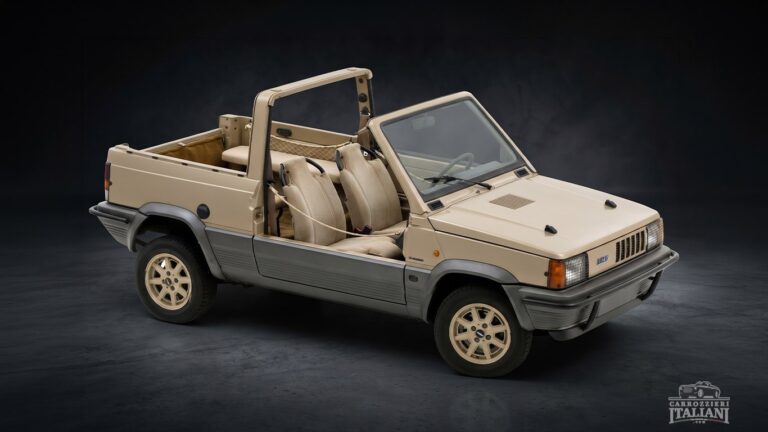
Fiat Panda Cabrio: The Italian Coachbuilders Who Opened Giugiaro’s Box
From Moretti’s Panda Rock to Italdesign’s experimental Strip, Maggiora’s four-wheel-drive convertible and Stola’s remarkable Destriero, the history of the open-top Panda reveals an unexpected chapter in Italian coachbuilding. When Giorgetto Giugiaro designed…
Read story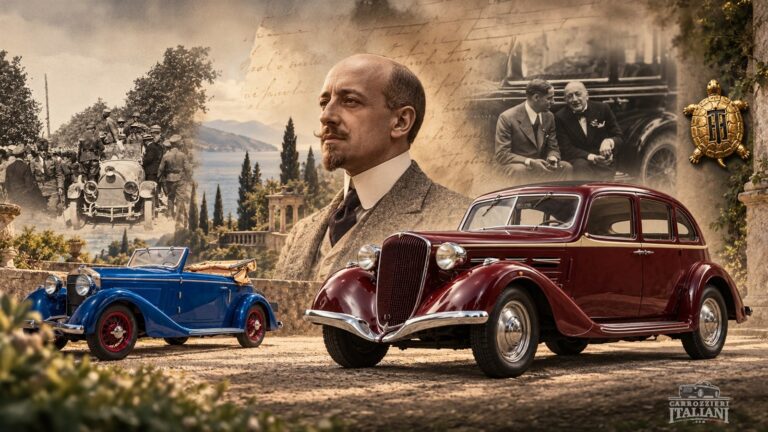
Gabriele d’Annunzio and the Cult of the Automobile
There was a time when the automobile had not yet become part of the landscape. It announced itself from afar through the beating of an engine, the smell of petrol and hot…
Read story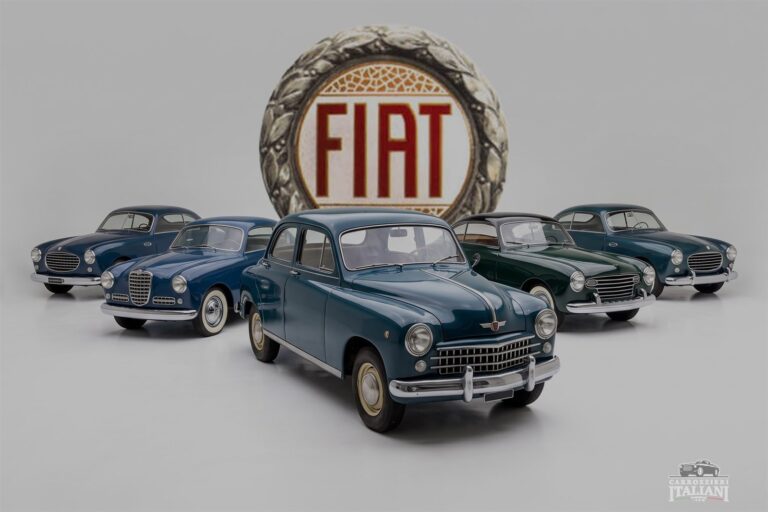
Fiat 1400: The Last Great Playground of the Carrozzieri
From Touring and Abarth to Farina, Ghia, Vignale, Boneschi, Bertone, Viotti and the smaller carrozzerie, the new Fiat quickly became one of the richest bases for Italian special bodies in the early…
Read story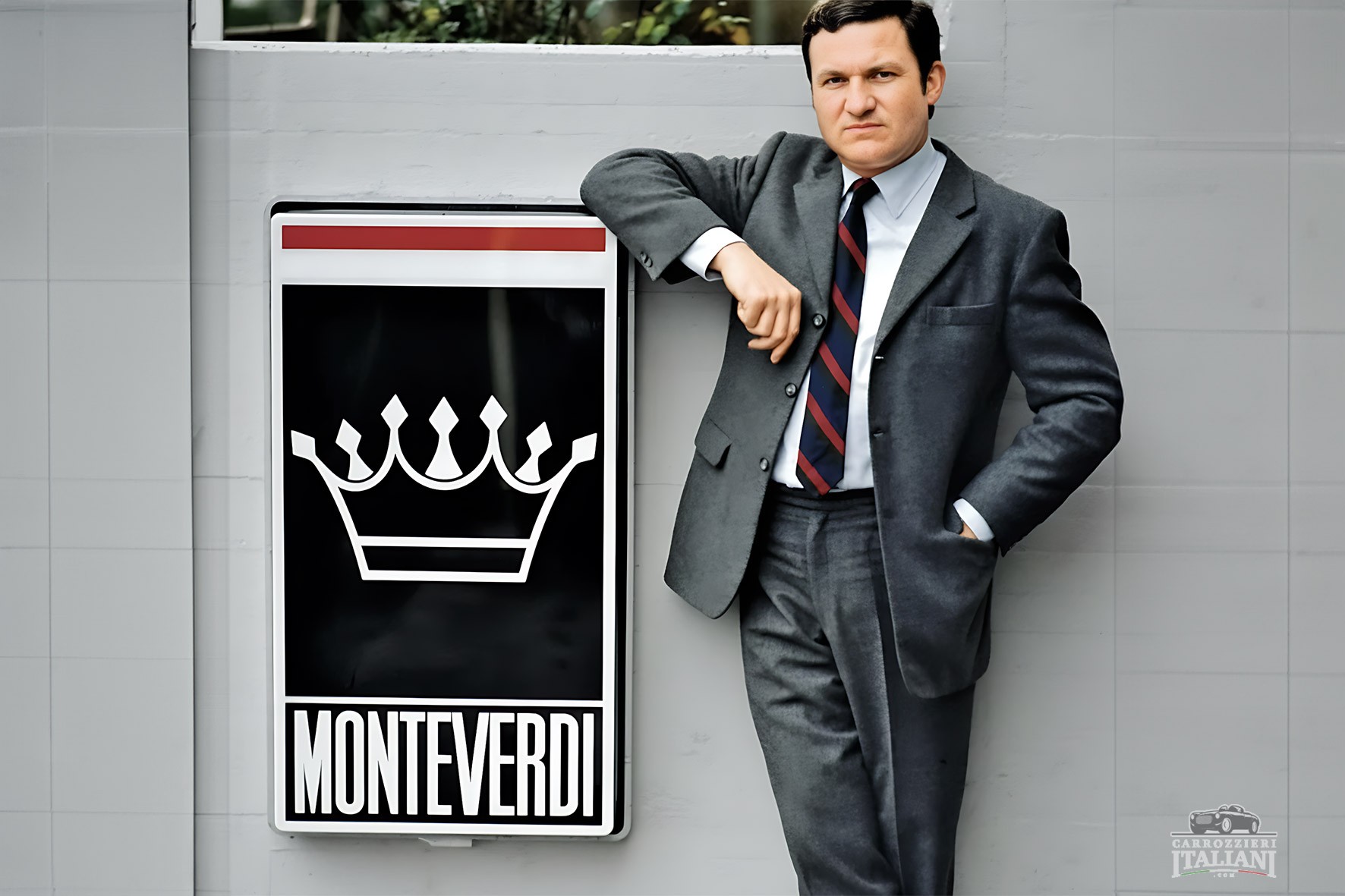
How a Swiss Dealer Challenged Ferrari: The Story of Monteverdi
How Peter Monteverdi went from Swiss Ferrari dealer to creator of rare Frua and Fissore-bodied GTs, the Hai supercar and luxury off-roaders.
Read story
THE CONVERSATION
Comments 0
Share a memory, a period photograph or a documented detail about this story.