
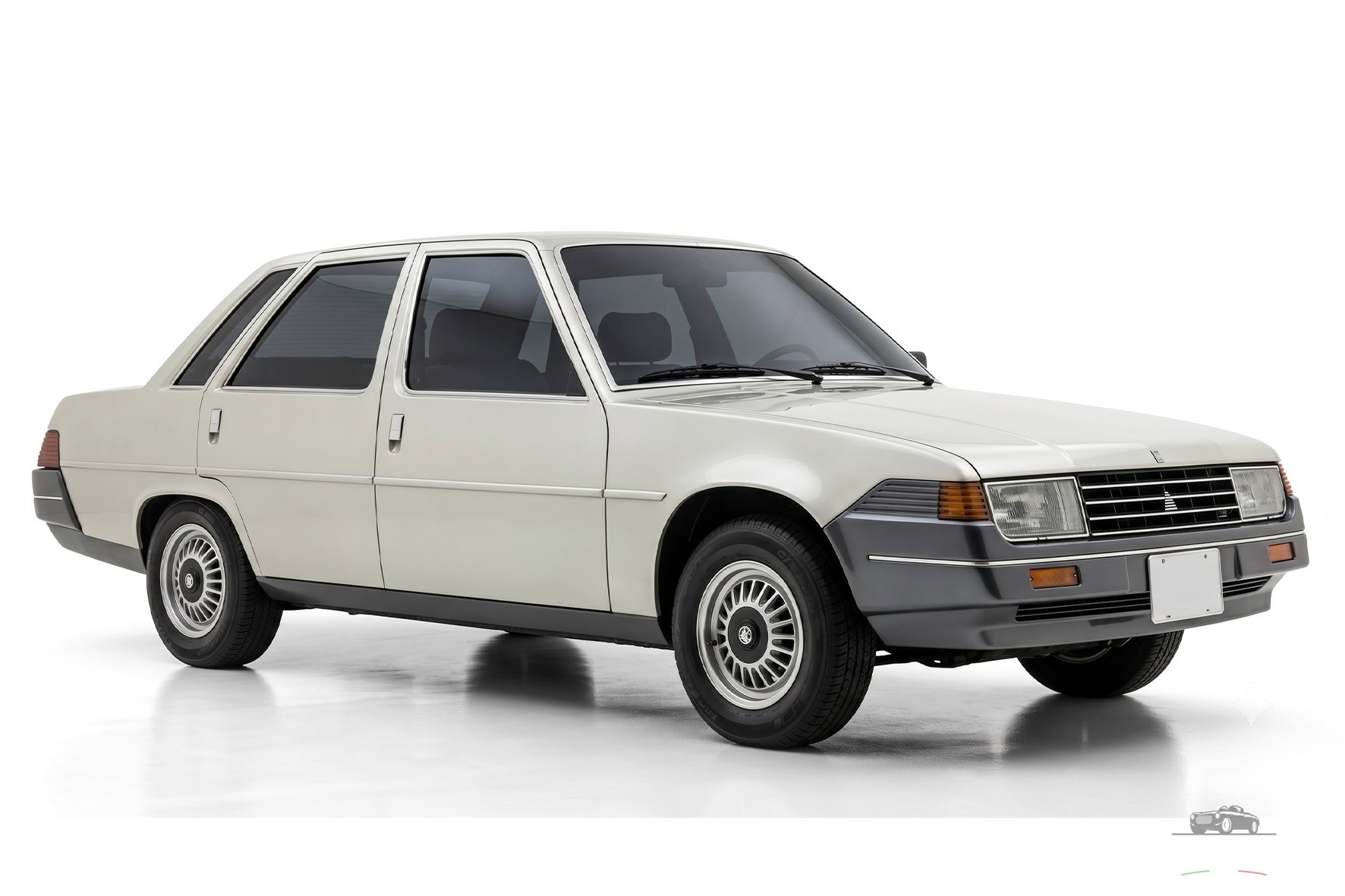
THE VEHICLE AT A GLANCE
Model dossier
- Production period
- 1979
- Body style
- Berlina
- Type
- Prototype
THE PEOPLE BEHIND THE CAR
Coachbuilding, design & conversions

PRICE & SALES RECORD
Vehicle value
- Original price
- Not documented
- Latest recorded sale
- Not documented
01 / THE STORY
History & context
The Mitsubishi Lancer Fissore Prototype was presented in 1979 as a styling study based on the platform of the second-generation Mitsubishi Lancer. The vehicle was commissioned by Mitsubishi Motors and executed by Carrozzeria Fissore of Savigliano, Italy, with design supervision attributed to Aldo Sessano. The prototype was developed to explore a revised aesthetic direction for Mitsubishi’s compact sedan, with an emphasis on integrating European design language into a Japanese mechanical platform. The underlying chassis was derived from Mitsubishi’s A170-series Lancer, retaining a front-engine, rear-wheel-drive configuration. Mechanical components remained consistent with production specifications, including a range of four-cylinder inline engines with displacements between 1.2 and 1.8 litres. At the time, Mitsubishi was also evaluating turbocharged variants, although it is not known whether the prototype was fitted with a forced induction unit. The bodywork was entirely restyled by Fissore and constructed using lightweight composite materials and steel panels. The exterior design featured linear proportions, integrated bumpers, flush-mounted glazing, and a low beltline. The front fascia incorporated rectangular headlamps and a restrained grille treatment. The overall appearance anticipated the angular styling conventions that would become prevalent in the early 1980s. The cabin was designed to seat four occupants, with instrumentation and controls following standard sedan practice. The prototype was publicly exhibited at the 1979 Geneva Motor Show. While the model was not intended for production in its prototype form, several of its styling cues were later adopted in the Mitsubishi Lancer EX, which entered series production shortly thereafter. The Fissore study provided a transitional design reference between Mitsubishi’s earlier utilitarian designs and the more internationally influenced products of the 1980s. The Mitsubishi Lancer Fissore Prototype represents a documented instance of cross-cultural design collaboration between a Japanese manufacturer and an Italian coachbuilder. It illustrates the efforts by Japanese automakers during the late 1970s to engage with European design practices in order to broaden market appeal and refine brand identity. The vehicle remained a one-off and does not appear to have been retained in Mitsubishi’s historical collection. Its current status is unknown.
IN THE ARCHIVE
Coachbuilders & design studios
02 / TECHNICAL IDENTITY
Specifications & construction
Production & construction
- Production type
- Prototype
- Production notes
- This legacy route maps to the same 1979 full-scale static Mitsubishi Lancer styling model documented by Paolo Fissore as built in Epowood by Fissore and designed by Aldo Sessano. Preserve as a non-additive legacy route; clear Units=1 so the duplicate URL does not imply a second physical prototype. NO_AUTO_INHERIT.
Engine & performance
- Specification notes
- AISA documents this 1979 Fissore Mitsubishi Lancer as a full-scale static Epowood styling model, not a running prototype. No drivetrain, chassis or series-production technical specification is applicable.
Design & manufacture
- Coachbuilder / Body Builder · Documented
- Carrozzeria Fissore
- Designer · Documented
- Aldo Sessano
- Manufacturer · Documented
- Mitsubishi
06 / EVENTS & AWARDS
Events & awards
No events or documented awards are currently recorded for this vehicle.
07 / THE VEHICLE IN DETAIL
Photo gallery 1 photographs
08 / FROM THE ARCHIVE
Archive
References held in the vehicle dossier. Their inclusion does not establish that every historical claim has been independently verified.
| Reference | Source type |
|---|---|
| AISA — Fissore and the 1979 Mitsubishi Lancer styling model www.aisastoryauto.it | Automotive history association |
THE CONVERSATION
Comments 0
Share a memory, a period photograph or a documented detail about this car.