
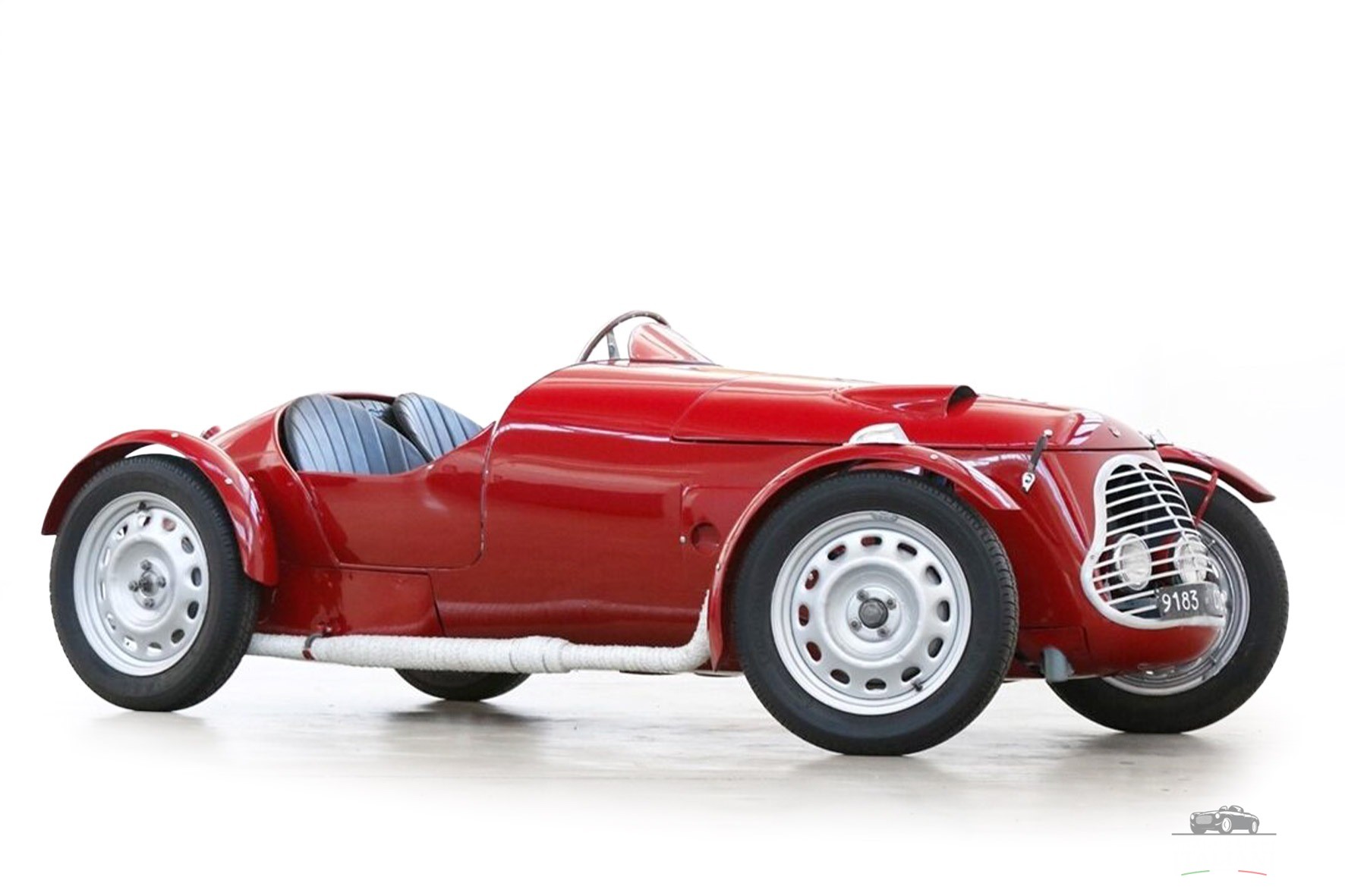
THE VEHICLE AT A GLANCE
Model dossier
- Production period
- 1949
- Body style
- Barchetta
- Engine
- Inline-4
- Type
- One-off
- Displacement
- 715 cc
- Power
- 45 hp
THE PEOPLE BEHIND THE CAR
Coachbuilding, design & conversions
No documented people or organizations are currently linked to this vehicle.
PRICE & SALES RECORD
Vehicle value
- Original price
- Not documented
- Latest recorded sale
- Not documented
01 / THE STORY
History & context
The Giannini Fiat 500 “A Pini” was a limited-production, competition-focused sports car constructed in the late 1930s and early 1940s. Based on the Fiat 500 A “Topolino” platform, the model combined mechanical components supplied by Fiat with performance enhancements by Giannini Automobili and bespoke coachwork attributed to the Pini brothers of Forlì. The vehicle was conceived for regional racing use and represented a transitional example of pre-war Italian small-displacement sports car construction. The chassis was derived from the Fiat 500 A, introduced in 1936. Modifications included a shortened wheelbase and revised suspension geometry. The vehicle employed a front-mounted, water-cooled, side-valve inline four-cylinder engine, which in its original form displaced 569 cubic centimetres. In the Giannini-prepared configuration, the engine received significant internal modifications, including a proprietary cylinder head and carburation upgrades. Displacement was increased to approximately 615750 cubic centimetres, and output ranged from 30 to 45 horsepower depending on specification. Power was transmitted to the rear wheels through a three-speed manual gearbox. Braking was via mechanically operated drum brakes on all four wheels. The bodywork was constructed by the Pini brothers, either independently or in cooperation with Carrozzeria Autodromo. It followed the “barchetta” format, with an open-top configuration, exposed cycle fenders, and minimal superfluous elements. The body was composed of lightweight materials, likely aluminium over a tubular or modified ladder-type chassis. A single, low-profile windscreen and fixed headrest fairings were included in certain examples, reflecting the car’s intended use in competitive driving. Production was extremely limited. Available evidence suggests that no more than three units were constructed, with some sources identifying only one surviving example. Chassis no. 039443 is the best documented and is associated with period racing activity in postwar Italy, including entries in events such as the Circuito di Modena and Trofeo Arcangeli. The car remained under private ownership and was restored to near-original condition in the early 2000s. The Giannini Fiat 500 “A Pini” represents a rare collaboration between a small tuning firm and independent coachbuilders in the pre-industrial Italian automotive landscape. Its rarity, period competition use, and early Giannini engine development place it among the more significant early derivatives of the Fiat 500 platform.
02 / TECHNICAL IDENTITY
Specifications & construction
Production & construction
- Production type
- One-off
- Production notes
- Finarte independently confirms chassis 039443 and engine G1-015. The Fiat 500 A donor chassis is from 1938, while Pelio and Pino Pini completed the unique competition barchetta in 1949. Carrozzeria Autodromo is only a possible attribution based on badges and is therefore not written as canonical coachbuilder/body builder.
Engine & performance
- Engine configuration
- Inline-4
- Displacement
- 715 cc
- Power (hp)
- 45 hp
- Specification notes
- Confidence detail moved from confidence: very_high_exact_chassis_engine_build_chronology_medium_bodybuilder_attribution
Individual vehicle
- Build date
- 1949
Design & manufacture
- Manufacturer · Documented
- Fiat
04 / INDIVIDUAL HISTORY
Chassis & provenance
Chassis 039443
- Chassis number
- 039443
- Engine number
- G1-015
- Year
- 1949
06 / EVENTS & AWARDS
Events & awards
No events or documented awards are currently recorded for this vehicle.
07 / THE VEHICLE IN DETAIL
Photo gallery 7 photographs
Show 1 more photographs Show fewer photographs
08 / FROM THE ARCHIVE
Archive
No publishable archival references are currently catalogued for this vehicle.
THE CONVERSATION
Comments 0
Share a memory, a period photograph or a documented detail about this car.