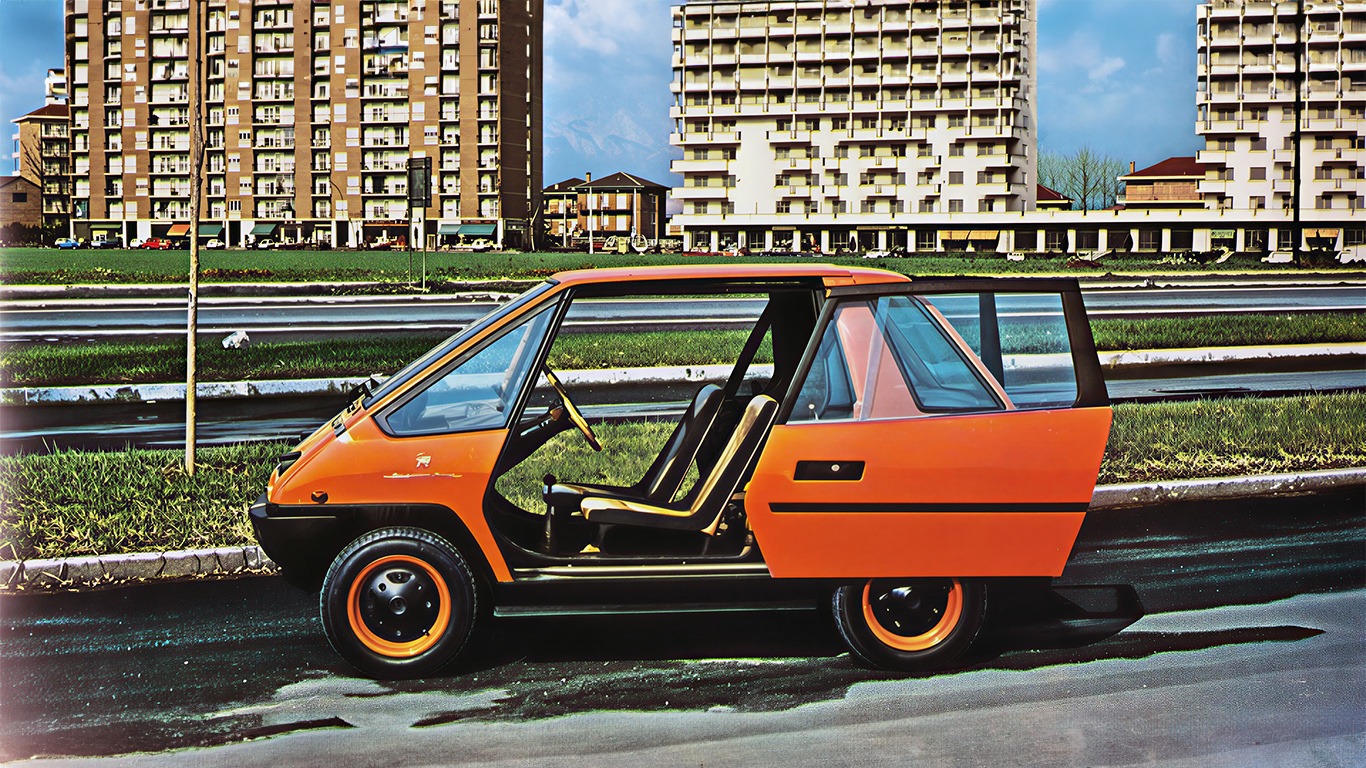
The De Tomaso Rowan was an electrically powered concept developed in 1967 by Giorgetto Giugiaro during his tenure at Carrozzeria Ghia. Conceived as a supermini-class urban vehicle, it employed a compact two-door body configured for five occupants, an unusual accommodation target for the period. The layout used left-hand drive, and the exterior proportions combined a short overall length with a relatively tall passenger cell to maximize interior volume. Surfaces were resolved through a combination of planar sections and controlled curvature, finished in white–silver paintwork. The cabin, trimmed in red leather, emphasized vertical space and clear sightlines. Giugiaro’s work on the Rowan occurred at an early stage in his career but already demonstrated his preference for clean geometries and rational packaging. The concept’s electric drivetrain, atypical for 1960s show cars, enabled a simplified front structure and contributed to the car’s compact footprint. Attention to ingress, seat arrangement, and interior openness aligned the Rowan with contemporary studies on high-density urban mobility. After Giugiaro founded Italdesign in 1968, the principles explored in the Rowan—compact electric architecture, strict volumetric control, and a focus on urban functionality—served as a point of departure for later micro-vehicle research. This trajectory produced the Suzuki Microutilitaria, which translated the Rowan’s experimental themes into a more systematic design program developed under Italdesign’s methodology.

THE CONVERSATION
Comments 0
Share a memory, a period photograph or a documented detail about this car.