
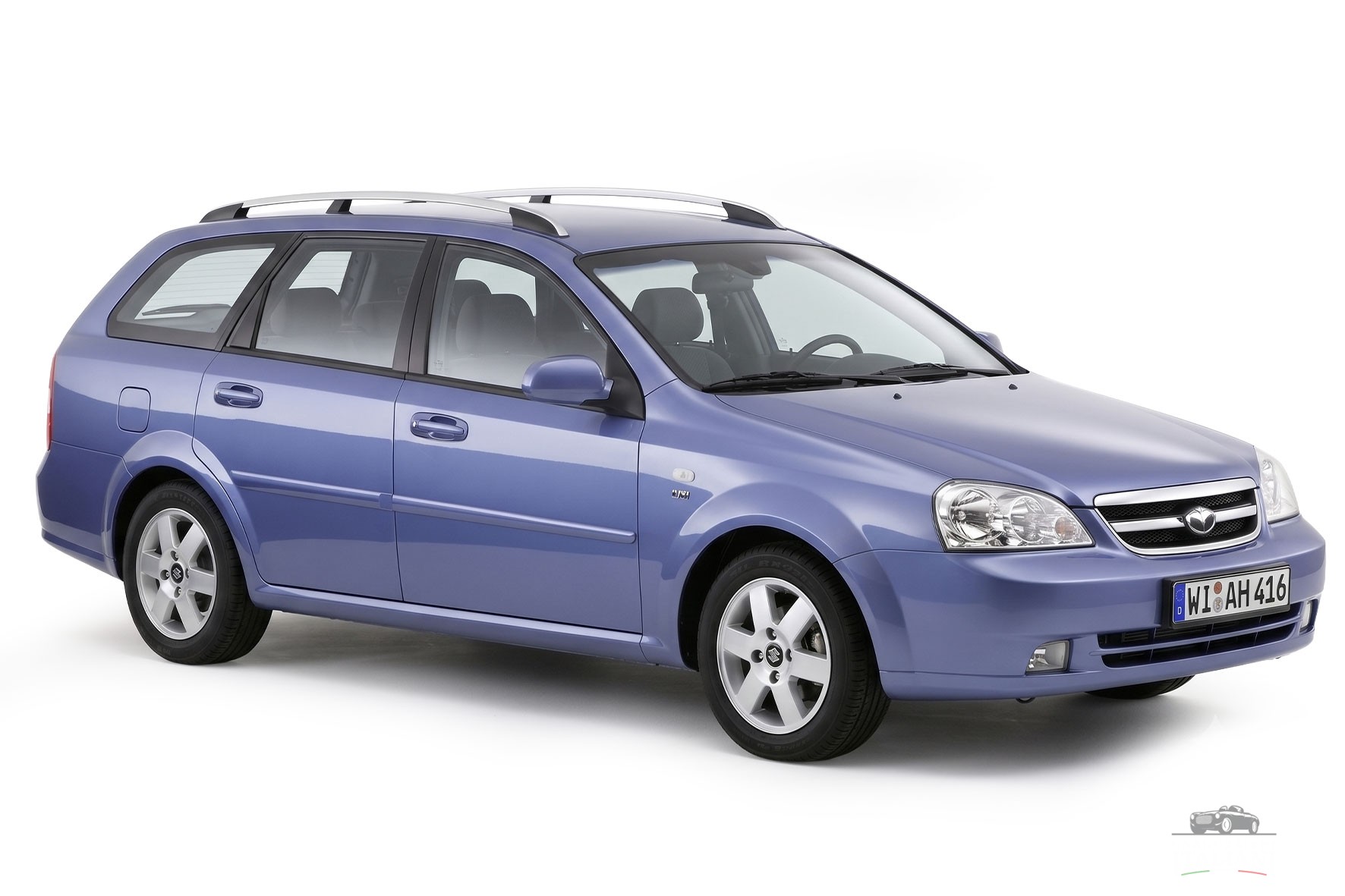
THE VEHICLE AT A GLANCE
Model dossier
- Production period
- 2004
- Body style
- Station Wagon
- Engine
- Inline-4
- Type
- Mass
THE PEOPLE BEHIND THE CAR
Coachbuilding, design & conversions
No documented people or organizations are currently linked to this vehicle.
PRICE & SALES RECORD
Vehicle value
- Original price
- Not documented
- Latest recorded sale
- Not documented
01 / THE STORY
History & context
The Daewoo Nubira Wagon of 2004 is the result of a collaboration between the South Korean automotive industry and Italian design, specifically Italdesign Giugiaro. Positioned within the second generation of the Nubira series (internal code J200), this station wagon variant was conceived to offer increased cargo capacity and versatility compared to the sedan upon which it is based. Its introduction marked a phase in which Daewoo, undergoing corporate restructuring and eventual integration into General Motors, sought to strengthen its global market presence. The design of the vehicle follows a rational and unembellished approach, consistent with the pragmatic style that characterized many Italdesign projects of the period. The extended roofline, upright rear pillars, and large tailgate contribute to a functional silhouette, while maintaining proportional balance. Smooth surfaces and restrained detailing reflect the intention to deliver an accessible vehicle with understated aesthetic coherence. Mechanically, the Nubira Wagon employed broadly conventional solutions for its time. Available petrol engines included four-cylinder units with displacements ranging from 1.6 to 1.8 liters, paired with either five-speed manual transmissions or four-speed automatics. The suspension layout—MacPherson struts at the front and a torsion beam at the rear—ensured predictable handling and a level of comfort suitable for everyday use, particularly in a family-oriented context. The interior was designed with simplicity and practicality in mind. It offered ample space within its class, emphasizing luggage capacity and flexible rear seating arrangements. The materials and finish quality met the expectations for a mid-size vehicle of its era, focusing on durability and ease of use rather than luxury. Production of the Daewoo Nubira Wagon continued until its gradual replacement by models sold under the Chevrolet brand, reflecting the broader shift in Daewoo’s identity following its acquisition. In various markets, the vehicle was marketed under alternative names such as Chevrolet Lacetti or Suzuki Forenza, depending on regional strategies. The involvement of Italdesign imparted a distinct stylistic identity to an otherwise utilitarian vehicle, granting it a degree of recognition beyond its mainstream origins.
02 / TECHNICAL IDENTITY
Specifications & construction
Production & construction
- Production type
- Mass
- Production from
- 2004
- Mechanical platform
- J200
- Production notes
- Corrected from erroneous J100/1997 normalization. The legacy content and contemporary GM Daewoo material identify this record as the 2004 J200 Nubira Station Wagon. Do not merge with legacy 52666, the 1997 J100 programme.
Engine & performance
- Engine configuration
- Inline-4
Dimensions & accommodation
- Length
- 4,562 mm
- Width
- 1,725 mm
- Height
- 1,459 mm
Design & manufacture
- Manufacturer · Documented
- Daewoo
06 / EVENTS & AWARDS
Events & awards
No events or documented awards are currently recorded for this vehicle.
07 / THE VEHICLE IN DETAIL
Photo gallery 1 photographs
08 / FROM THE ARCHIVE
Archive
References held in the vehicle dossier. Their inclusion does not establish that every historical claim has been independently verified.
| Reference | Source type |
|---|---|
| GM Daewoo news release – Nubira Station Wagon www.theautochannel.com | Manufacturer press release |
| AutoWeek – Nieuwe Daewoo Nubira Wagon www.autoweek.nl | Period press |
THE CONVERSATION
Comments 0
Share a memory, a period photograph or a documented detail about this car.