
THE VEHICLE AT A GLANCE
Model dossier
- Production period
- 1964
- Body style
- Fastback
- Engine
- Rear-mounted circa 1.1-litre engine
- Type
- One-off
- Production
- 1
- Displacement
- 1,100 cc
- Seats
- 2
THE PEOPLE BEHIND THE CAR
Coachbuilding, design & conversions

PRICE & SALES RECORD
Vehicle value
- Original price
- Not documented
- Latest recorded sale
- Not documented
01 / THE STORY
History & context
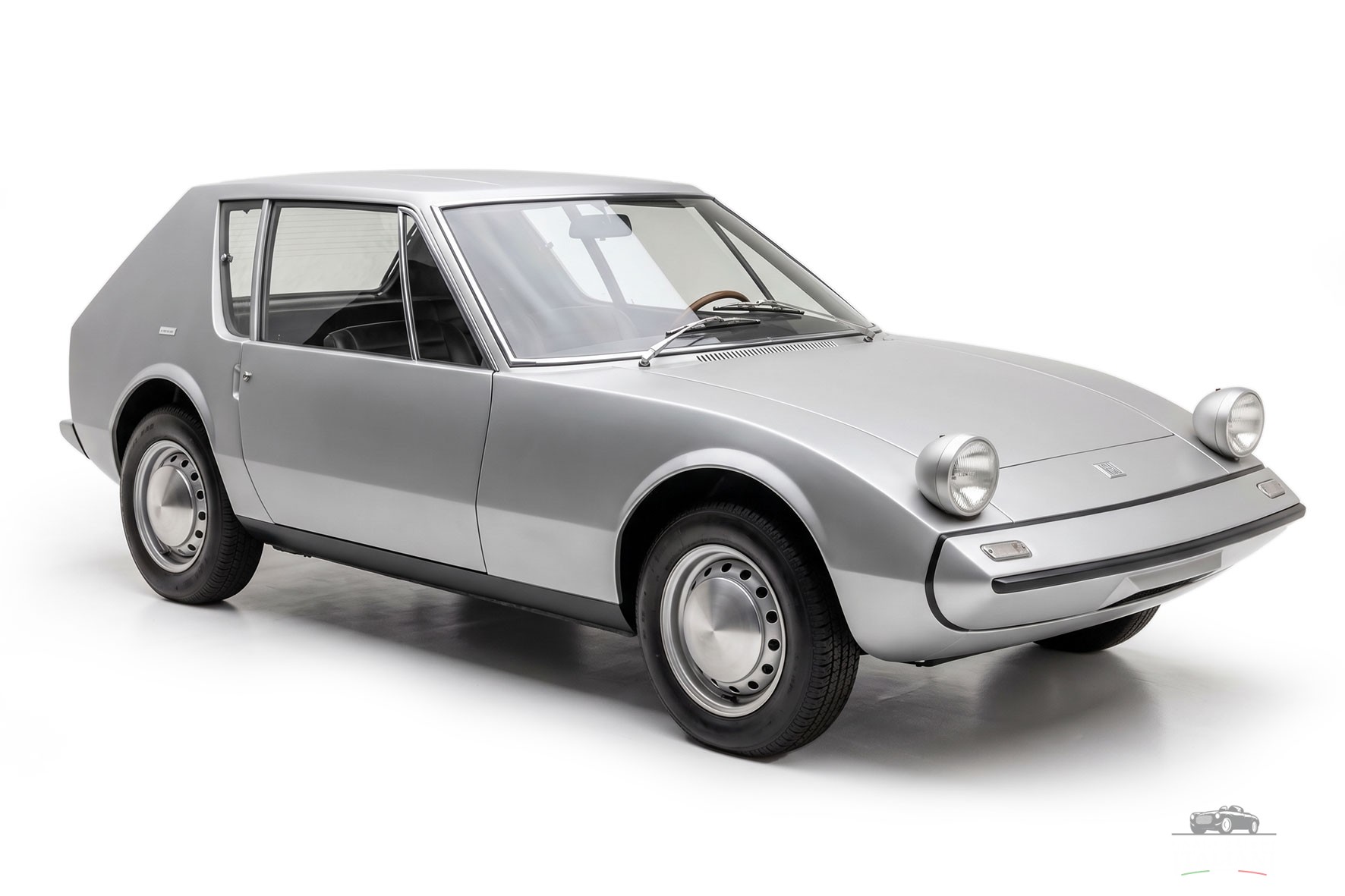
The Autonova GT was built by Sibona Basano on the platform of the standard NSU Prinz 1000 TT, with a rear-mounted 1085 cc engine producing 55 HP. The spare lines of the profile of the body converged at the front in an original appendage to the nose, which served the twofold function of a bumper and a fascia uniting the surfaces of the low, elongated engine hood. However, perhaps the most original feature of the Autonova GT was the aerodynamic design of the flanks, enhanced by a truncated integral rear end with a window that could be opened (unusual in a fastback body type). Also distinctive was the arrangement of the headlights. Its protruding outlines were dictated not only by functional constructional criteria but also by practical considerations, because they helped give the driver a sense of the car’s volumes. The interior was notable for the austere design of the bucket seats, the central tunnel housing the gearshift and other principal switches and levers, and the door panels equipped with tubular armrests of an original design. In this car Pio Manzù and Michael Conrad sought to rethink critically the stylistic currents of the day, which Manzù regarded as stuck with a sort of “formal catechism” and incapable of moving beyond their established schemes. Of the Autonova GT ‘s numerous functional and technical-constructional features, the most striking were its rigorous formal synthesis, the simple, “modern” design of its different parts, from the lines that unite or segment the different sections of the body down to individual details like handles and switches and the most minute seams and welds. Both the Autonova prototypes are still surprising for their originality and coherence, even after this lapse of time. Pio Manzù and Michael Conrad’s project can still be seen as an exemplary contribution to the evolution of the automobile and car design, not only because of the results they achieved but also in terms of method and the development of radically innovative contents.
IN THE ARCHIVE
Coachbuilders & design studios
02 / TECHNICAL IDENTITY
Specifications & construction
Production & construction
- Production
- 1
- Production type
- One-off
- Mechanical platform
- NSU 1000 chassis
Engine & performance
- Engine configuration
- Rear-mounted circa 1.1-litre engine
- Displacement
- 1,100 cc
- Specification notes
- The contemporary HfG Ulm publication describes Autonova GT as a two-seat design on an NSU 1000 chassis with a circa 1,100 cc rear engine. The displacement is explicitly approximate.
Dimensions & accommodation
- Seats
- 2
Design & manufacture
- Coachbuilder / Body Builder · Documented
- Sibona & Basano
- Designer · Candidate
- Pio Manzù
06 / EVENTS & AWARDS
Events & awards
Frankfurt General · legacy_preserved
- Date
- 1964
- Chassis
- General
Preserved CI 1.0 relation. Evidence field: _yoast_wpseo_primary_events. No award inferred.
07 / THE VEHICLE IN DETAIL
Photo gallery 8 photographs
Show 2 more photographs Show fewer photographs
08 / FROM THE ARCHIVE
Archive
References held in the vehicle dossier. Their inclusion does not establish that every historical claim has been independently verified.
| Reference | Source type |
|---|---|
| HfG Ulm journal 14/15/16 (1965) — Autonova GT digi.ub.uni-heidelberg.de | Period institutional publication |
| Carrozzieri Italiani — Autonova GT www.carrozzieri-italiani.com | Legacy editorial archive |
THE CONVERSATION
Comments 0
Share a memory, a period photograph or a documented detail about this car.