
Sibona & Basano: The Turin Workshop Behind Abarth, Exner and Autonova
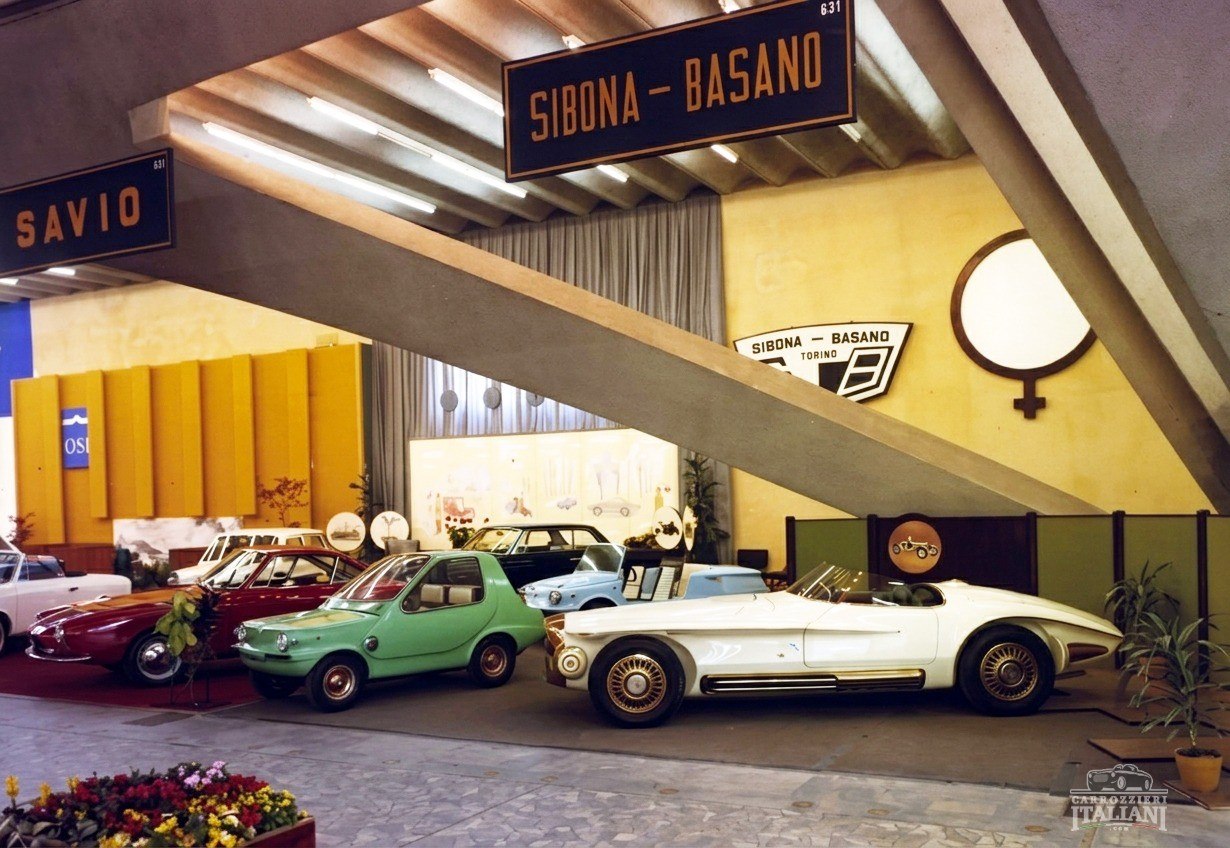
For a brief period in the 1960s, Sibona & Basano occupied a distinctive position in Turin’s coachbuilding industry, constructing competition bodies, prototypes and experimental cars for Abarth, American designers and some of Europe’s most progressive design projects. Its history is also a reminder that the company that built a body was not necessarily the company or designer that conceived it.
In the Turin of the early 1960s, the distinction between designer, coachbuilder and prototype maker was not always visible in the finished automobile. While some carrozzerie established their reputation through a recognisable design language, others worked more discreetly between the drawing board and the completed car, transforming sketches, models and engineering requirements into functioning prototypes or limited-production bodies. Sibona & Basano belonged largely to this second world. From its workshop in Via Eritrea came lightweight Abarth competition bodies, experimental fiberglass Fiats, American dream cars, Studebaker prototypes and the two Autonova concepts, a remarkably diverse output united less by appearance than by the technical ability required to build it.
This distinction is essential to understanding the company. A car constructed by Sibona & Basano was not automatically a Sibona & Basano design, and several of its best-known creations were conceived elsewhere. The workshop’s importance lay instead in its ability to interpret very different projects and realise them in aluminium, steel or fiberglass, often in extremely small numbers and sometimes as unique prototypes. In only a few years, Sibona & Basano worked at the point where traditional Turin craftsmanship was meeting new materials, international industrial design and a rapidly changing automotive industry.
From craftsmen to coachbuilders
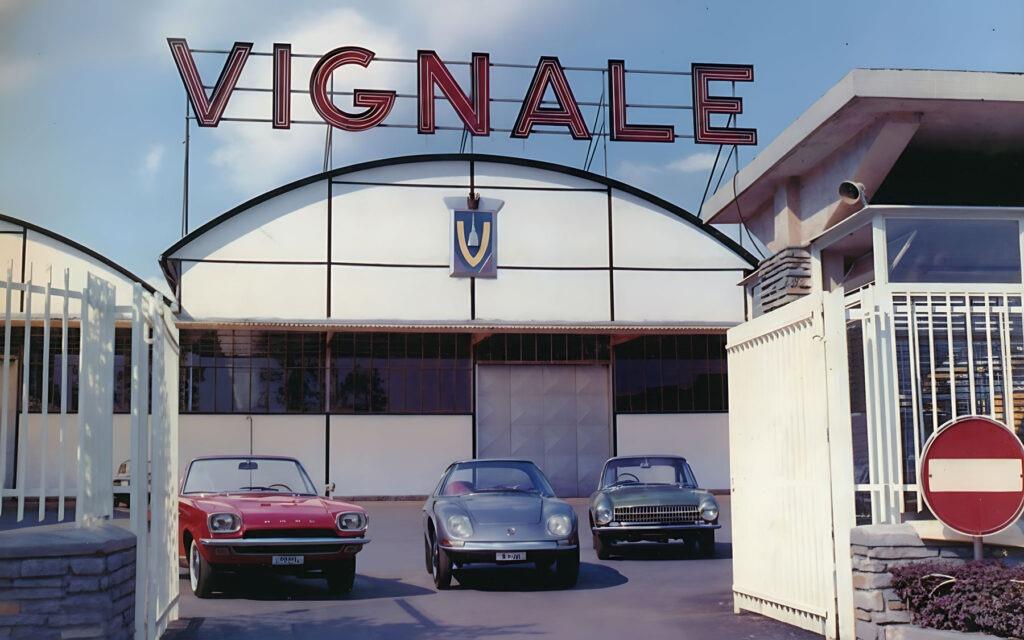
The origins of Sibona & Basano precede the formal establishment of the company. Pietro Sibona came from Turin’s metalworking and coachbuilding environment, while the craftsmen who would form the business had already accumulated experience within the network of designers, prototype makers and carrozzerie that surrounded the city’s automobile industry. Early work has been connected with projects for Pietro Frua and with the development of the Renault Floride, while subsequent activity brought the workshop into contact with the Simca 1000 programme and with other Turin companies including Ghia and Vignale.
The identity and precise roles of the Basano brothers are less straightforward than the subsequent history of the workshop might suggest. Surviving documentation and later records do not agree completely, with Walter, Elio and Emilio Basano appearing in different accounts of the company’s formation and operation. Rather than imposing a certainty that the available evidence does not support, it is more useful to retain this discrepancy as an unresolved part of the company’s history. What can be established more securely is the emergence of a formal Sibona & Basano operation in Turin in the early 1960s and its activity from Via Eritrea 21–23, where a relatively small workforce was capable of carrying out model making, panel beating, body construction, trimming and finishing.
This combination of skills explains much of what followed. Sibona & Basano was neither a mass-production body manufacturer nor simply a styling studio. Its scale allowed it to respond quickly to unusual commissions, construct a single prototype without conventional production tooling and move between different materials according to the requirements of each project. At a time when Turin still contained a dense network of specialised suppliers and craftsmen, such flexibility could connect an individual designer or engineering department with the physical automobile needed for testing, exhibition or limited production.
Abarth and the development of lightweight bodies
Abarth became one of the most important recurring threads in Sibona & Basano’s activity, although the relationship also demonstrates why construction and design attribution must be kept separate. Abarth’s small GT and competition cars developed continuously, passing through different technical phases and involving both outside coachbuilders and the company’s own engineering organisation. Zagato had been responsible for the earlier bodies associated with the 1000 Bialbero, while subsequent development increasingly reflected work carried out within Abarth itself, where technical director Mario Colucci played an important role.
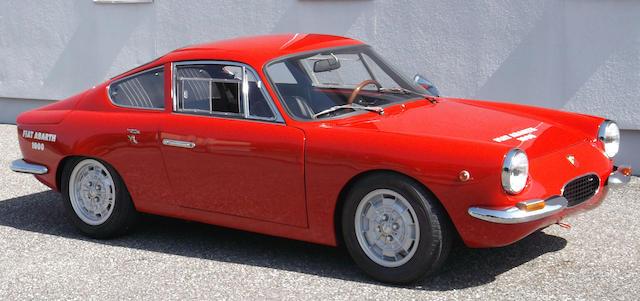
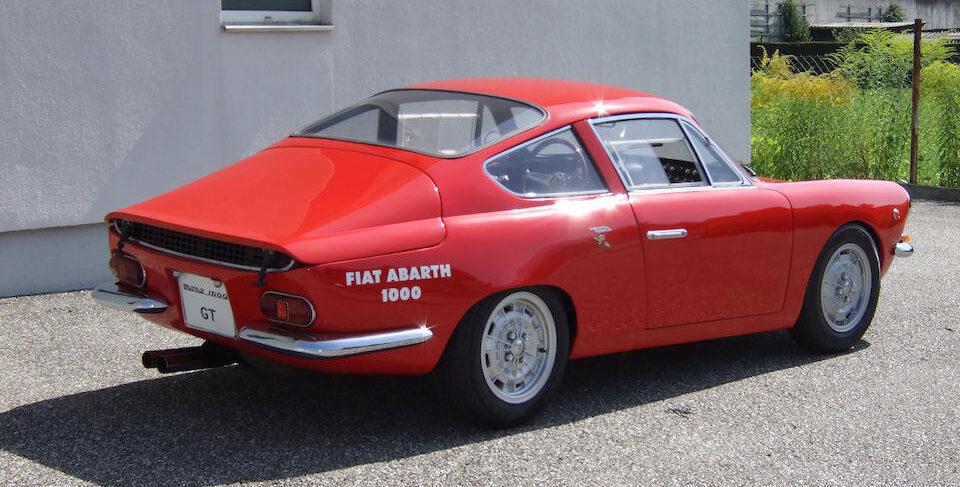
By 1963, Sibona & Basano was producing bodies for the Abarth 1000 Bialbero. The later form incorporated revisions to the front and rear together with enlarged wheel arches, allowing wider tyres while continuing the aerodynamic development of the competition coupé. The change of coachbuilder therefore did not transform Sibona & Basano into the author of the entire Bialbero design; rather, the workshop became part of an evolving programme in which Abarth’s technical requirements, previous body development and specialist construction all contributed to the final automobile.
The Monomille provides an equally useful example of the need to work from individual evidence rather than broad model attribution. Surviving cars can be documented with Sibona & Basano coachwork, including the 1963 Fiat-Abarth Monomille GT chassis 110-0381, but the production history remains sufficiently complex that a bodybuilder should not automatically be assigned to every chassis. Individual chassis records and contemporary documentation therefore provide a more reliable basis for attribution than generalisations applied to the model as a whole.
The Abarth relationship also brought Sibona & Basano increasingly into composite construction. Fiberglass offered obvious advantages for experimental and competition work, particularly where weight mattered and production numbers were too small to justify conventional tooling. The workshop constructed fiberglass bodies for specialised Abarth projects including the OT 1600 and OT 2000 Sport, while composite construction was also used in later competition work associated with the 1300 OT programme. Lightweight fiberglass components were produced for smaller Abarth models as well.
Taken together, these projects reveal more than a supplier relationship. Abarth required bodies that could be developed quickly, produced in very small numbers and modified as engineering requirements changed, while Sibona & Basano possessed precisely the mixture of traditional panel-beating skills and experimental construction methods needed for that work. Its contribution is therefore best understood not as a recognisable styling signature but as part of the development process that transformed Abarth engineering into physical competition cars.
Turin 1963 and the possibilities of fiberglass
The 1963 Turin Motor Show provided Sibona & Basano with an opportunity to appear more visibly under its own name. Among the cars associated with the company were two open Simca-based projects, the Cerbiatto, developed around the Simca 1000 platform, and the larger Mistral, which used Simca 1500 mechanical components. Both belonged to a well-established Italian tradition of creating specialised automobiles from series-production mechanical bases, but another exhibit demonstrated a more experimental direction.
The Fiat 500 Decathlon was remarkable less for its mechanical foundation than for the way its body was constructed. A photograph taken at the Turin show on 8 November 1963 identifies the car as a Fiat Nuova 500 with Sibona & Basano coachwork formed as a single piece of Gabraster polyester resin. The surviving image and its contemporary archival description provide unusually precise evidence for the project and place it firmly within the company’s experiments with composite construction.
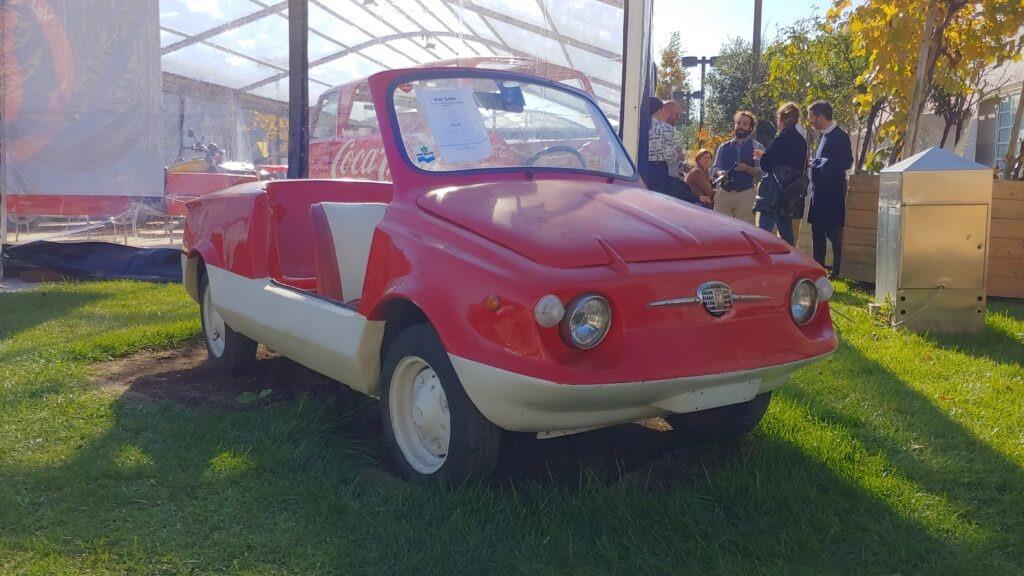
For a workshop operating between prototype manufacture and very limited production, fiberglass offered possibilities that went beyond simple weight reduction. Complex shapes could be reproduced without the extensive tooling required for conventional series manufacture, making the material particularly attractive for experimental bodies and specialised vehicles. Sibona & Basano’s interest was not confined to automobiles, and the workshop explored composite structures for other transport applications during the same period. These activities provide useful context for the Decathlon: it was not an isolated attempt to make a fashionable Fiat 500 derivative, but part of a broader investigation into what fiberglass could offer a small specialist manufacturer.
The subsequent survival of a later Decathlon complicates the frequently repeated description of the project as a single motor-show prototype. Fiat 500 F chassis 806595 retains Sibona & Basano fiberglass coachwork and Italian registration documentation, with its later history including use as a rental car on the island of Ponza. The precise number of Decathlons produced has not yet been established, but the surviving evidence demonstrates that the project continued beyond the car exhibited at Turin in 1963 and reached the Fiat 500 F period.
American ideas, Turin craftsmanship
Sibona & Basano’s ability to construct complete prototypes also brought commissions from the United States, where the economics of hand-built Italian coachwork could be combined with the work of American industrial designers. One of the important connections was Brooks Stevens, whose studio was developing proposals for Studebaker during a difficult period in the manufacturer’s history.
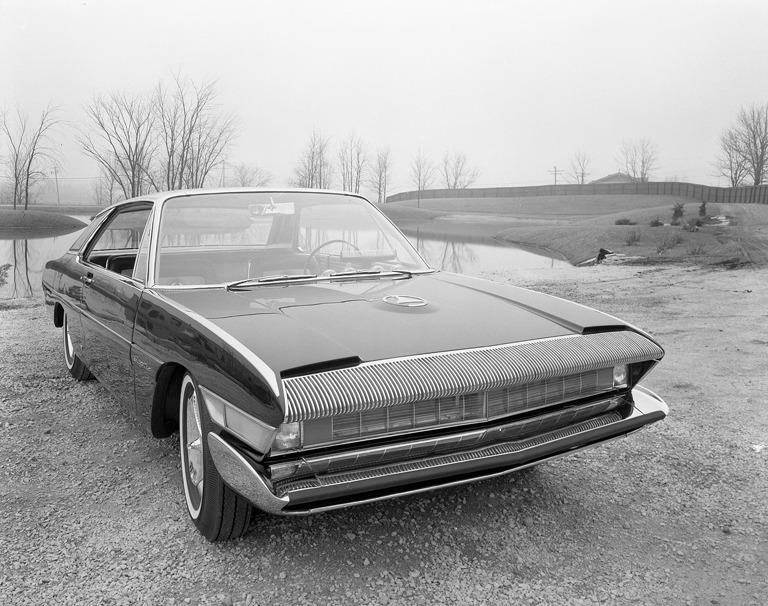
The Studebaker Sceptre emerged from this programme as a Brooks Stevens design realised as a full-size automobile by Sibona & Basano. Its construction in Turin illustrates the international prototype system that had developed around the Italian coachbuilding industry: drawings and design intentions could originate in the United States, while a compact specialist workshop in Turin supplied the modelling, metalworking and finishing necessary to produce an exhibition-quality automobile. The Sceptre was therefore neither an Italian design disguised as an American car nor a Sibona & Basano styling exercise; it was an American design whose physical execution depended upon Italian prototype-building skills.
That distinction became even clearer with the Mercer-Cobra, one of the most ambitious automobiles constructed in Via Eritrea. Its origins lay in Virgil Exner‘s proposals for modern interpretations of historic American marques, published in 1963. The Mercer project attracted the interest of the Copper Development Association, which commissioned a functioning automobile that could simultaneously revive the visual identity of the old marque and demonstrate the potential use of copper and copper alloys in automotive construction.
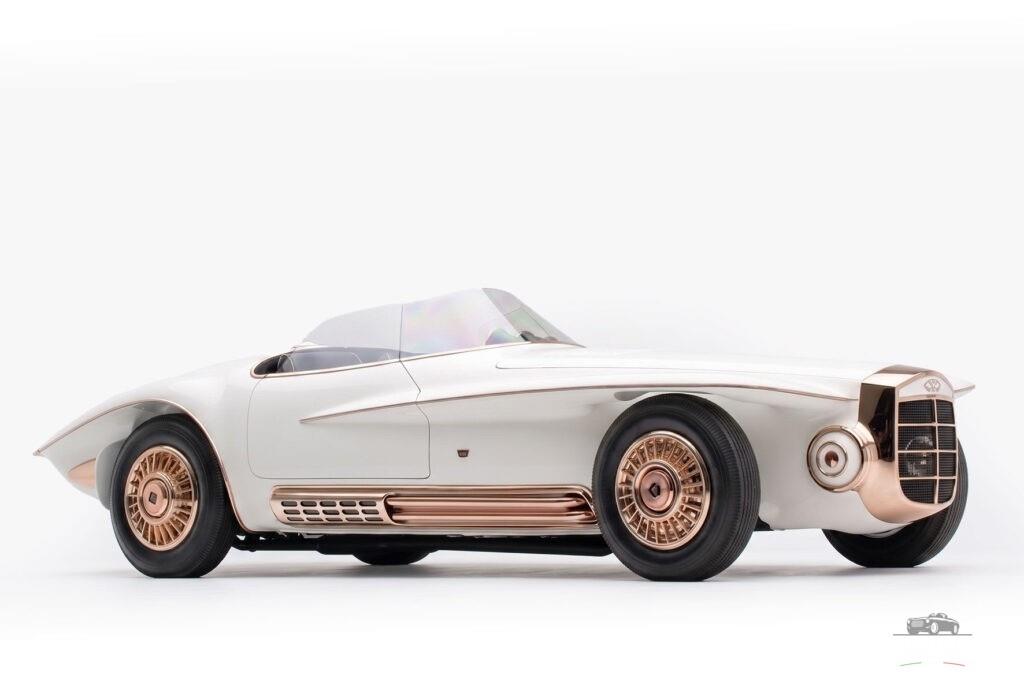
A Shelby Cobra provided the mechanical basis. Chassis CSX2451 was ordered through Shelby American in February 1964 and subsequently modified, including a substantial extension of its wheelbase to 108 inches, before Sibona & Basano constructed the new body. Virgil Exner and Virgil Exner Jr. were responsible for the design, while the Turin workshop translated their proposal into metal, producing a car whose proportions and detailing bore little visual relationship to the compact sports car beneath it.
The surviving financial documentation gives an unusually clear indication of the economics behind such work. The Cobra chassis cost approximately $2,800, increasing to just over $3,000 by the time it reached Turin, while Sibona & Basano’s completed coachwork was contracted at $10,400. The wider agreement for the project amounted to $35,000. These figures help explain why a small Italian carrozzeria could remain attractive to an international client: a unique, complex and fully finished show car could be realised without the infrastructure of a major manufacturer.
The completed Mercer-Cobra incorporated numerous copper materials, alloys and finishes as functional and decorative elements rather than merely applying copper as superficial trim. Once completed in late 1964, it became an international exhibition object and travelled extensively, leaving behind a particularly well-documented example of the kind of work Sibona & Basano could undertake when supplied with an ambitious design and an unconventional brief.
Small cars and new ideas
The Tsé-Tsé, presented at Turin in 1964, occupied almost the opposite end of the automotive spectrum. Conceived as an extremely compact two-seat urban vehicle, it employed a fiberglass body and an unusual forward-pivoting canopy incorporating the windscreen and part of the upper structure, allowing access without conventional side doors. The project was less concerned with creating another derivative of an existing production car than with exploring how little structure and space were actually required for personal urban transport.
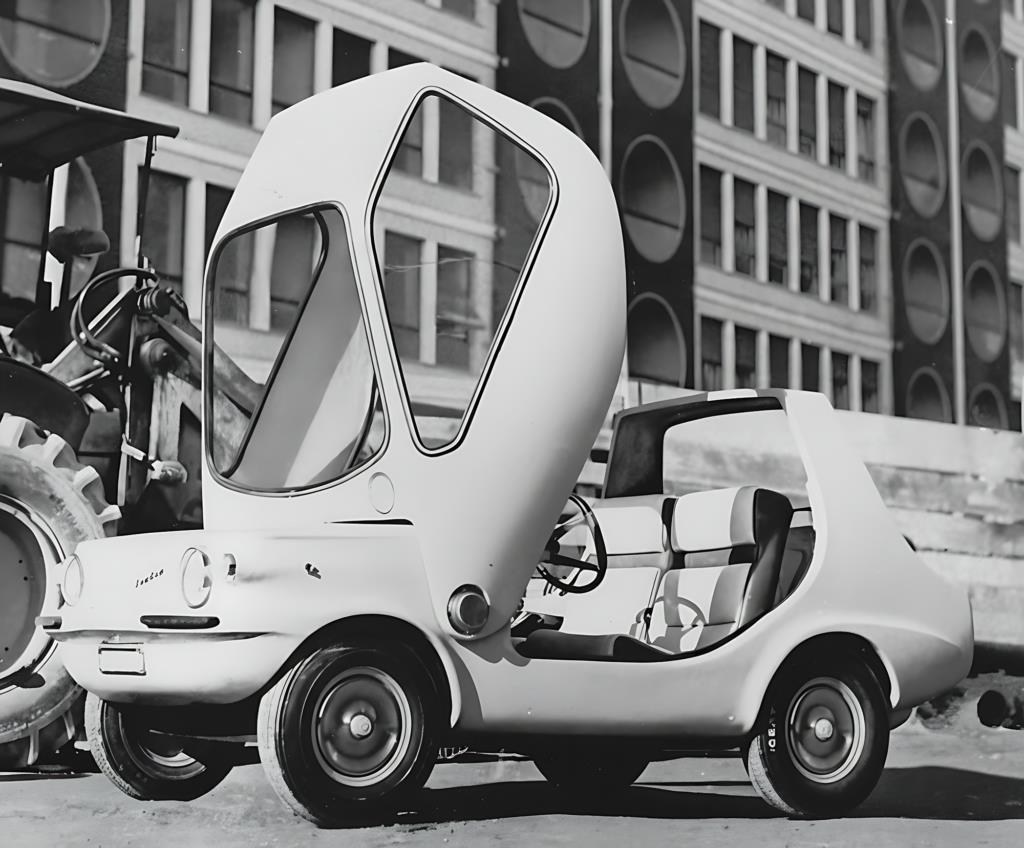
Not every aspect of the Tsé-Tsé can presently be reconstructed with equal certainty. Surviving descriptions differ over the intended engine capacity, and there is evidence that the car displayed at Turin may not have been mechanically complete. Those discrepancies make a definitive specification premature, but they do not diminish the significance of the body itself. Together with the Decathlon and Abarth work, the Tsé-Tsé shows Sibona & Basano exploring fiberglass not merely as a lightweight substitute for metal but as a material that permitted different approaches to structure, access and small-volume manufacture.
This willingness to build unconventional solutions made the workshop particularly suitable for another project that had little connection with conventional Turin coachbuilding. In 1965, Autonova brought together Pio Manzù, Michael Conrad and journalist Fritz B. Busch in an attempt to reconsider the automobile from the requirements of its users rather than from established body categories. Their work produced two very different prototypes, both of which required a specialist capable of translating experimental ideas into complete vehicles.
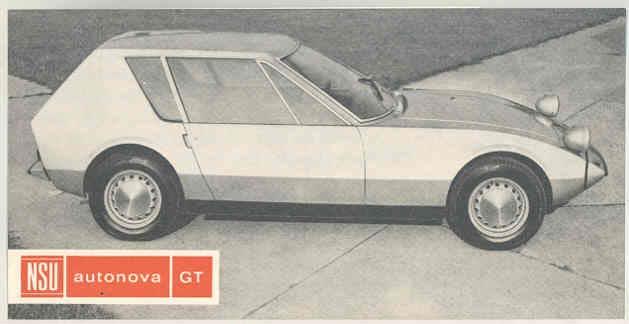
The Autonova GT approached the problem through a compact sporting automobile using NSU mechanical components, while the Autonova Fam concentrated on passenger accommodation, access, luggage and interior flexibility. The Fam’s tall, geometric architecture was particularly unusual in an era when the conventional three-box saloon remained dominant, and its emphasis on the relationship between exterior dimensions and usable interior volume anticipated questions that would become increasingly important in later European family cars.
Both prototypes were displayed at the Frankfurt IAA in 1965, but their presence in a history of Sibona & Basano requires the same distinction already encountered with Abarth, Studebaker and the Mercer-Cobra. Manzù, Conrad and Busch developed the Autonova concepts; Sibona & Basano provided the prototype-building capability that allowed those concepts to become full-size automobiles. Far from diminishing the Turin workshop’s contribution, the distinction defines it more accurately: the value of Sibona & Basano lay in its ability to understand another designer’s intentions and solve the practical problems involved in making them real.
Bizzarrini and the final period
Among the important programmes associated with the company’s final period was the open version of the Bizzarrini 5300 GT, developed in 1966. The Spyder programme involved Stile Italia, under Virgilio D’Iseglio, together with Sibona & Basano, and ultimately resulted in only a very small number of automobiles. The first was conceived as a fully open prototype, while subsequent development introduced a central structural roof element intended to address the loss of rigidity caused by removing the fixed roof.
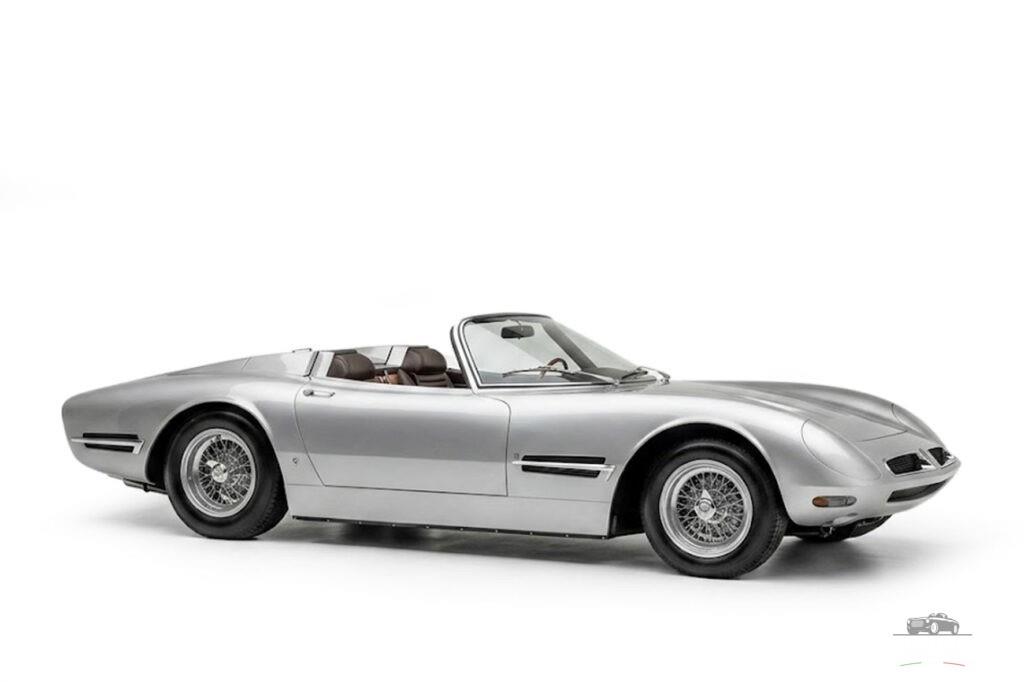
As with several earlier projects, reducing the Spyder to a single attribution would obscure the way it was actually created. Bizzarrini provided the engineering context and initiated the programme, Stile Italia was central to its development, and Sibona & Basano contributed its experience in prototype development and body construction. The project belongs to the company’s history precisely because it illustrates the collaborative structure within which specialist Italian coachbuilding still operated during the middle of the decade.
By the end of 1966, the Sibona & Basano partnership had effectively reached the end of its independent activity, and Pietro Sibona subsequently moved to OSI, where his experience was employed in prototype construction. The precise circumstances surrounding the closure are less securely documented than the projects themselves, and it would be misleading to reduce the company’s disappearance to a single cause. Changes in the availability of specialist commissions, the economics of hand-built prototypes and the wider transformation of the Italian coachbuilding industry all provide relevant context, but further documentary evidence would be required to establish their individual importance.
A different kind of carrozzeria
Sibona & Basano’s short independent existence coincided with a fundamental transformation of the Italian coachbuilding industry. The traditional model in which an independent carrozzeria could design and manufacture small series of special bodies was becoming progressively more difficult to sustain as manufacturers developed their own styling and production capabilities, volumes increased and the financial requirements of industrial body manufacture grew. At the same time, however, prototypes, experimental vehicles, competition bodies and highly specialised limited-production work continued to require precisely the skills that had developed within Turin’s traditional coachbuilding system.
Sibona & Basano occupied this transitional space particularly well. Its craftsmen could form an aluminium competition body for Abarth, construct a large fiberglass shell, execute an American designer’s show car or build a full-size experimental prototype for a new European design group. The resulting automobiles shared remarkably little in visual terms, but this absence of a recognisable house style was a consequence of the company’s role rather than evidence of an uncertain identity. Sibona & Basano was frequently employed to interpret a design rather than impose one.
Seen in this context, the variety of its surviving work becomes the most useful evidence of what the company represented. The Abarth competition cars demonstrate its ability in lightweight specialist construction; the Decathlon and Tsé-Tsé record its experiments with fiberglass; the Studebaker Sceptre and Mercer-Cobra show that its reputation extended to American designers and industrial clients; the Autonova prototypes place the workshop within one of the most forward-looking European design experiments of the period; and the Bizzarrini programme connects its final years with another highly specialised Italian manufacturer.
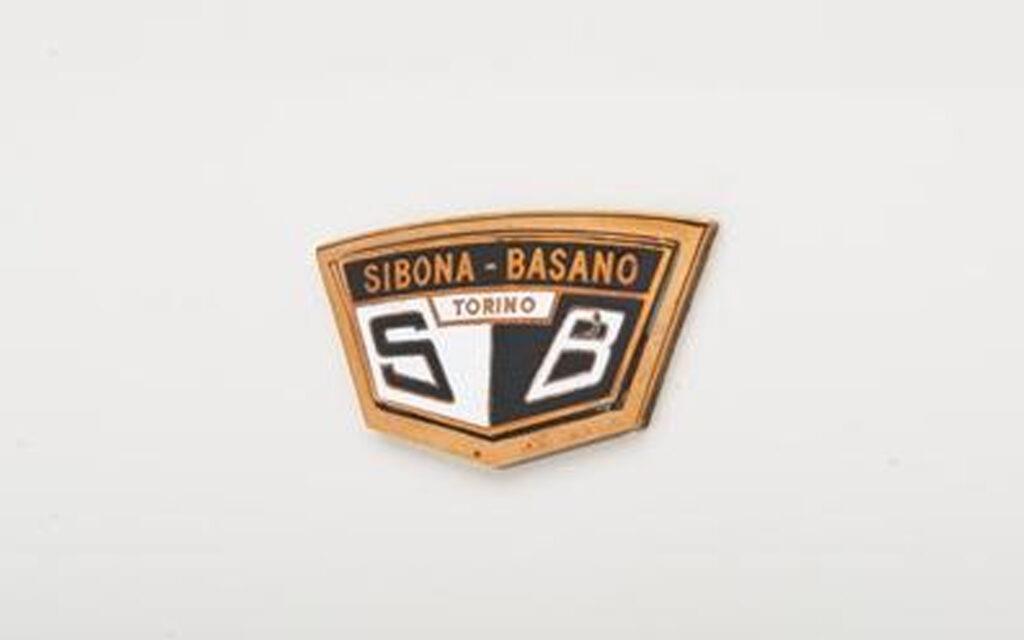
This also helps explain why Sibona & Basano has remained less visible than many of the designers and manufacturers with which it collaborated. Prototype builders often disappeared from the public identity of the finished automobile, particularly when the project was commissioned by a recognised manufacturer or carried the name of a celebrated designer. Reconstructing the company’s history therefore requires looking beyond the badge on the nose and asking a more precise question: not simply who designed the automobile, but who transformed the design into the object that survives.
For a brief period in the first half of the 1960s, many of those answers lead back to the same small workshop in Via Eritrea, Turin.

ABOUT THE AUTHOR
Andreas Scheidl
Italian classic car enthusiast with German roots. Renowned as a respected figure in the classic car community, he serves as a jury member at various international concours d'elegance, including the Classic Gala Schwetzingen and Mantova. As a content creator, Andreas passionately shares his profound knowledge and appreciation for vintage automobiles. His heart beats for cars designed by Giovanni Michelotti, showcasing his discerning taste and dedication to preserving the timeless elegance of automotive history.
More stories by Andreas Scheidl ↗CONTINUE READING
Posts You Might Like
The Story of Carrozzeria Vignale
The story of Carrozzeria Vignale represents one of the many somewhat forgotten success stories born against the backdrop of an Italy that was torn apart by the Second World War and which,…
Read story
Carrozzeria Savio: The History
From early Fiat specials to the Jungla, Delta S4 and Italdesign Aztec, the story of Carrozzeria Savio is far richer than many remember.
Read story
The History of Carrozzeria Boano
The untold story of Mario Boano and Carrozzeria Boano, from Ferrari 250 GTs to the Spiaggina, reshaping Italian automotive history.
Read story
Carrozzeria Coggiola: The Untold Story of Turin’s Hidden Coachbuilder
Discover the story of Carrozzeria Coggiola, the discreet Turin coachbuilder behind some of the most striking concept cars of the 20th century. From Saab and Volvo to Chrysler and Mercedes, its hidden…
Read story
THE CONVERSATION
Comments 0
Share a memory, a period photograph or a documented detail about this story.