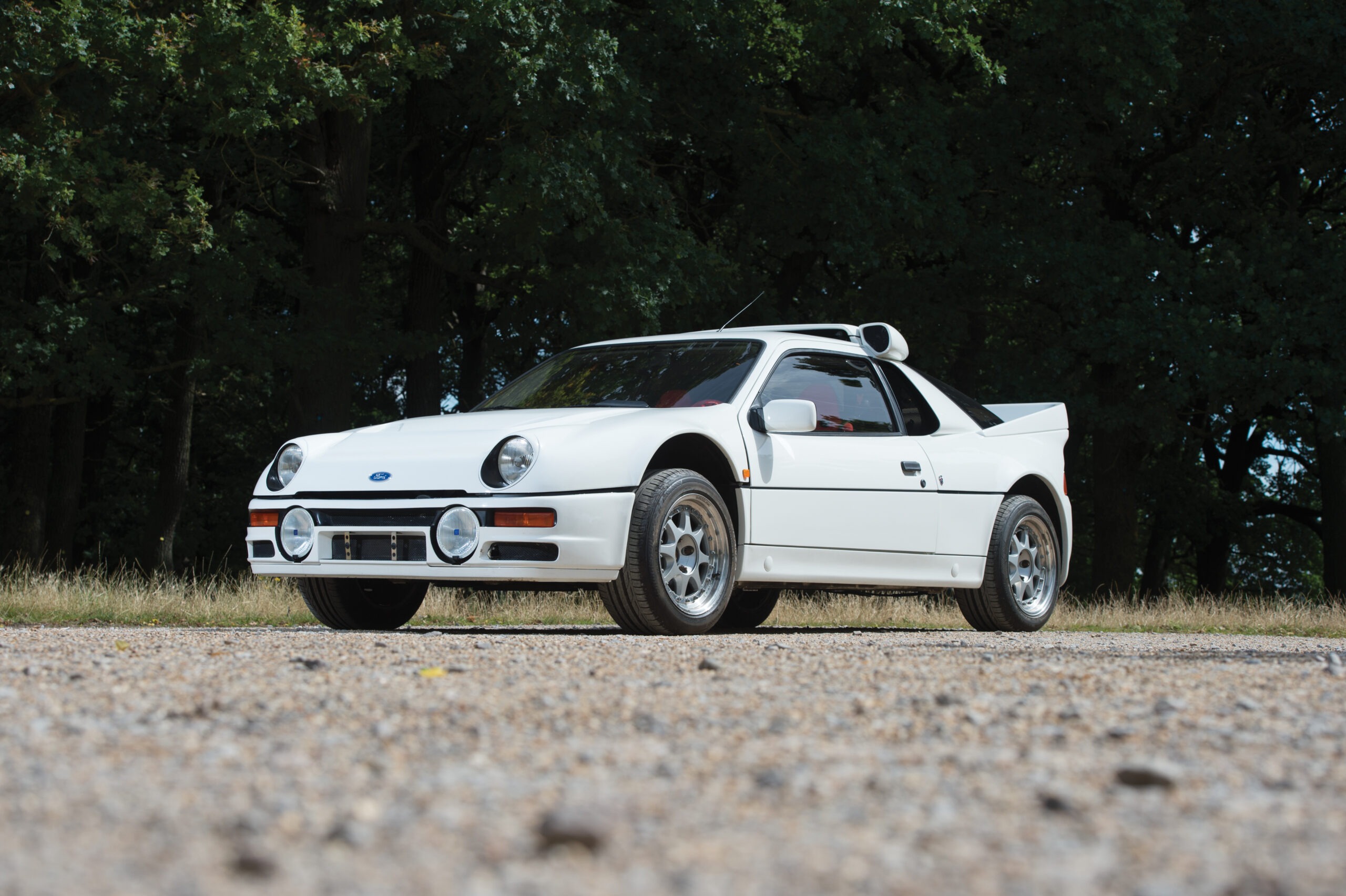
Ford RS200: A Wild Group B Rally Legend
Delve into the Ford RS200, a legendary mid-engine Group B rally car of the 1980s. Learn its wild history, cutting-edge design, specs, rally record, and cult legacy
Read story
THE PEOPLE BEHIND THE CAR
No documented people or organizations are currently linked to this vehicle.
PRICE & SALES RECORD
01 / THE STORY
The Ford RS200 was born out of Ford Motorsport’s desire to dominate the fierce world of Group B rally racing. After the debut of the new Ford Escort in 1981, the company began working on a rear-wheel-drive, turbocharged car, known as the Ford Escort RS 1700T, to compete in Group B rallies. However, development issues led to the cancellation of the project in 1983, forcing Ford to rethink their strategy. Unwilling to give up on their rally aspirations, Ford decided to create a new car; this time with all-wheel drive and a mid-engine layout, better suited to compete with rivals like Peugeot and Audi. The Ford RS200 was designed with a fiberglass and plastic body by Ghia and manufactured by Reliant. The car featured a complex powertrain, where power was first sent to the front wheels before being routed to the rear, creating a unique and challenging drivetrain system. The chassis was designed by Tony Southgate, a Formula One engineer, with assistance from John Wheeler. Its wishbone suspension with twin shock absorbers for each wheel gave the RS200 exceptional handling, benefiting from an ideal weight distribution. Despite its impressive engineering, the RS200’s aesthetics reflected the urgency of its production, with many parts sourced from other Ford models. For example, the windshield and taillights were shared with the Ford Sierra. Under the hood, the RS200 housed a Cosworth 1.8-liter turbocharged engine, producing 258 horsepower in the road version. Competition versions of the car, however, saw power outputs ranging from 350 to 460 horsepower. Road cars could be upgraded to exceed 300 horsepower, though the RS200 still suffered from turbo lag at low revs and a less-than-ideal power-to-weight ratio compared to its rivals. The car’s most notable result in competition came in the 1986 Rally Sweden, where Kalle Grundel secured a third-place finish in Group B. However, the Ford RS200’s legacy would be overshadowed by tragic accidents. In the 1986 Rally of Portugal, a crash involving Joaquim Santos’ RS200 resulted in the deaths of three spectators and injuries to thirty others. Later that year, in Germany, driver Marc Surer crashed the RS200 into a tree, leading to a horrific explosion that claimed the life of his co-driver, Michel Wyder. These incidents contributed to the FIA’s decision to abolish Group B at the end of the 1986 season. Despite the suspension of Group B, Ford continued to develop the RS200. For 1987, Ford planned an evolution of the car, the RS200 Evolution, which featured the new 2.1-liter Cosworth BDT-E engine. This engine was capable of producing up to 826 horsepower, allowing the car to accelerate from 0 to 100 km/h in just 2.2 seconds. Enhanced suspension and brakes made the RS200 even more competitive. However, with the cancellation of Group B, the RS200 E2 became a rallycross car, where it saw success. Norwegian driver Martin Schanche won the 1991 Rallycross Championship in a 652-hp RS200 E2. In 1998, the RS200 E2 was used by Swedish driver Stig Blomqvist in the Unlimited category of the Pikes Peak International Hillclimb, where an 850-hp version helped him achieve a fourth-place finish. A total of 200 road-going Ford RS200s were produced to meet Group B requirements, with an additional 20 built for competition. Of these, only 25 were upgraded to the E2 version. The Ford RS200 Evolution featured the 2.1-liter turbocharged engine boosted to 580 horsepower, making it capable of a 0-60 mph time of under 3.07 seconds. After its rally career ended, the RS200’s body plans were sold to Banham Conversions, which used them to create the Banham 200 kit car, based on the Austin Maestro. Although the Banham 200 resembled the RS200 in looks, its mechanicals and engine position were vastly different. The Ford RS200 remains a rally icon, remembered both for its groundbreaking engineering and the tragic events that shaped its legacy.
02 / TECHNICAL IDENTITY
04 / INDIVIDUAL HISTORY
06 / EVENTS & AWARDS
No events or documented awards are currently recorded for this vehicle.
07 / THE VEHICLE IN DETAIL
08 / FROM THE ARCHIVE
No publishable archival references are currently catalogued for this vehicle.
CONTINUE READING
Delve into the Ford RS200, a legendary mid-engine Group B rally car of the 1980s. Learn its wild history, cutting-edge design, specs, rally record, and cult legacy
Read story
THE CONVERSATION
Comments 0
Share a memory, a period photograph or a documented detail about this car.